
Car Battery 12 or 6 Volts

Most modern cars use 12-volt batteries, while older or specialized vehicles may require 6-volt systems. Understanding the difference ensures you pick the right battery for reliability, safety, and performance.
If you’ve ever popped the hood of your car and stared at that rectangular power box with confusion, you’re not alone. Car batteries might look simple, but choosing between a 12 or 6-volt battery isn’t just about flipping a coin—it’s about understanding your vehicle’s electrical needs, history, and performance requirements. Whether you’re restoring a vintage Ford or maintaining your daily driver, getting the voltage right is crucial.
Most people assume all cars use the same type of battery, but that’s far from true. The shift from 6-volt to 12-volt systems marked a major turning point in automotive history. Today, nearly every gasoline-powered car on the road relies on a 12-volt battery to start the engine, power the lights, run the radio, and support advanced electronics like GPS and backup cameras. But if you’re working with an antique vehicle or a specialty machine, you might still encounter 6-volt setups. Knowing the difference helps you avoid expensive mistakes and keeps your ride running reliably.
So, how do you know which one your car needs? It’s not just about age—though that’s a big clue. It’s also about design, electrical load, and compatibility. In this guide, we’ll break down everything you need to know about 12 and 6-volt car batteries, from how they work to how to choose the right one for your vehicle.
Key Takeaways
- Modern vehicles use 12-volt batteries: Since the 1950s, 12V systems have become the standard for cars, trucks, and SUVs due to their efficiency and power output.
- 6-volt batteries are for classic or vintage cars: Older models, especially those made before 1950, often rely on 6V systems and cannot safely run on 12V without electrical modifications.
- Voltage affects starter motor performance: A 12V battery delivers more cranking power, making it ideal for larger engines and cold-weather starts.
- Mixing voltages can damage electronics: Installing a 12V battery in a 6V system—or vice versa—can fry wiring, lights, and gauges.
- Check your owner’s manual first: Always verify your vehicle’s required voltage before purchasing a new battery to avoid costly mistakes.
- Dual-voltage systems exist for specialty uses: Some RVs, golf carts, or marine vehicles use 6V batteries wired in series to create a 12V system for better longevity.
- Battery maintenance matters regardless of voltage: Regular checks for corrosion, proper charging, and secure connections keep any battery running smoothly.
📑 Table of Contents
Understanding Car Battery Voltage: The Basics
At its core, voltage is the measure of electrical pressure that pushes current through your car’s wiring. Think of it like water pressure in a hose: higher voltage means more “push” to get electricity where it needs to go. Car batteries provide direct current (DC) power to start the engine and run accessories when the engine is off.
The two most common voltages in automotive applications are 6 volts and 12 volts. While both serve the same basic function—storing and delivering electrical energy—they differ significantly in design, output, and application.
A 6-volt battery typically contains three cells, each producing about 2 volts, for a total of 6 volts. These were standard in cars built before the mid-1950s. In contrast, a 12-volt battery has six cells, delivering twice the voltage. This increase allowed automakers to use smaller wires, brighter lights, and more powerful starter motors—key advancements as cars grew more complex.
But voltage isn’t the only factor. Amperage (measured in cold cranking amps or CCA) determines how much current the battery can deliver at low temperatures. A 12-volt battery usually offers higher CCA, making it better suited for modern engines that require a strong, quick burst of power to start.
Why Voltage Matters for Your Vehicle
Using the wrong voltage can cause serious problems. If you install a 12-volt battery in a car designed for 6 volts, the excess voltage can overload and destroy delicate components like the ignition coil, voltage regulator, or even the headlights. Conversely, putting a 6-volt battery in a 12-volt system will result in weak cranking, dim lights, and frequent stalling.
For example, imagine trying to start a modern sedan with a 6-volt battery. The starter motor simply won’t get enough power to turn over the engine, especially on a cold morning. On the flip side, a classic 1948 Chevrolet with a 6-volt system would suffer blown fuses and fried gauges if connected to a 12-volt battery.
That’s why it’s essential to match the battery voltage to your vehicle’s original electrical system. Even if you’ve upgraded some parts, the core wiring and components may still be designed for a specific voltage.
The History: From 6 Volts to 12 Volts
Visual guide about Car Battery 12 or 6 Volts
Image source: carawareness.com
To truly understand why we use 12-volt batteries today, it helps to look back at how cars evolved. In the early days of automobiles—think Model T Fords and 1920s roadsters—electrical systems were minimal. Cars had basic lighting, a simple ignition, and not much else. A 6-volt system was sufficient for these needs.
However, as cars became more advanced in the 1930s and 1940s, so did their electrical demands. Heaters, radios, and more powerful starters required more energy. Engineers realized that 6 volts wasn’t cutting it anymore—especially as engines grew larger and harder to crank.
The big shift happened in the 1950s. General Motors led the charge in 1952 by introducing 12-volt systems in some of its vehicles. By the mid-to-late 1950s, nearly all American automakers had made the switch. European and Japanese manufacturers followed suit shortly after.
Why the change? Higher voltage allows for lower current to deliver the same amount of power (since Power = Voltage × Current). Lower current means thinner wires, which are cheaper, lighter, and easier to route through the car. It also reduces energy loss due to resistance in the wiring.
Additionally, 12-volt systems support brighter headlights, more reliable starters, and the growing number of electronic accessories. Today, with features like touchscreens, advanced safety systems, and hybrid components, the need for a robust 12-volt system is greater than ever.
Are There Still 6-Volt Cars on the Road?
Yes—but they’re rare and usually fall into one of two categories: vintage collector cars or specialized equipment. Classic cars from the 1940s and earlier often retain their original 6-volt systems, especially if they’ve been restored authentically. Enthusiasts who want to preserve historical accuracy may choose to keep the 6-volt setup, even if it means using older-style bulbs and generators.
On the other hand, some owners of classic cars upgrade to 12-volt systems for practical reasons. Converting a 6-volt car to 12 volts involves replacing the generator with an alternator, updating the voltage regulator, and possibly rewiring certain components. This upgrade improves reliability, especially if you drive the car regularly or in varying weather conditions.
Specialty vehicles like golf carts, forklifts, and certain marine applications also use 6-volt batteries—but often in pairs. Two 6-volt batteries wired in series create a 12-volt system, which provides longer life and deeper discharge capability than a single 12-volt battery. This setup is common in applications where battery longevity and consistent power matter more than compact size.
How to Identify Your Car’s Battery Voltage

Visual guide about Car Battery 12 or 6 Volts
Image source: images-na.ssl-images-amazon.com
If you’re unsure whether your car needs a 6 or 12-volt battery, don’t guess—check! There are several reliable ways to determine the correct voltage for your vehicle.
Check the Owner’s Manual
The easiest and most accurate method is to consult your car’s owner’s manual. It will clearly state the recommended battery voltage, along with specifications like group size, cold cranking amps (CCA), and reserve capacity. If you don’t have the physical manual, most manufacturers provide digital copies online using your vehicle identification number (VIN).
Look at the Existing Battery
Open the hood and inspect the battery currently in your car. Most batteries have a label that includes the voltage. You’ll typically see “12V” or “6V” printed prominently on the casing. Some older batteries may only list the number of cells (e.g., “6 cells” = 12V, “3 cells” = 6V), but modern labels are usually straightforward.
Examine the Vehicle’s Age and Make
As a general rule, if your car was manufactured after 1960, it almost certainly uses a 12-volt system. Vehicles from the 1950s may vary—some early 1950s models still used 6 volts, while others had already switched. Pre-1950 cars are highly likely to be 6-volt, especially if they’re unrestored classics.
For example, a 1949 Ford Deluxe would originally have a 6-volt positive-ground system, while a 1965 Ford Mustang uses a 12-volt negative-ground system. Knowing your car’s production year can give you a strong clue.
Test with a Multimeter
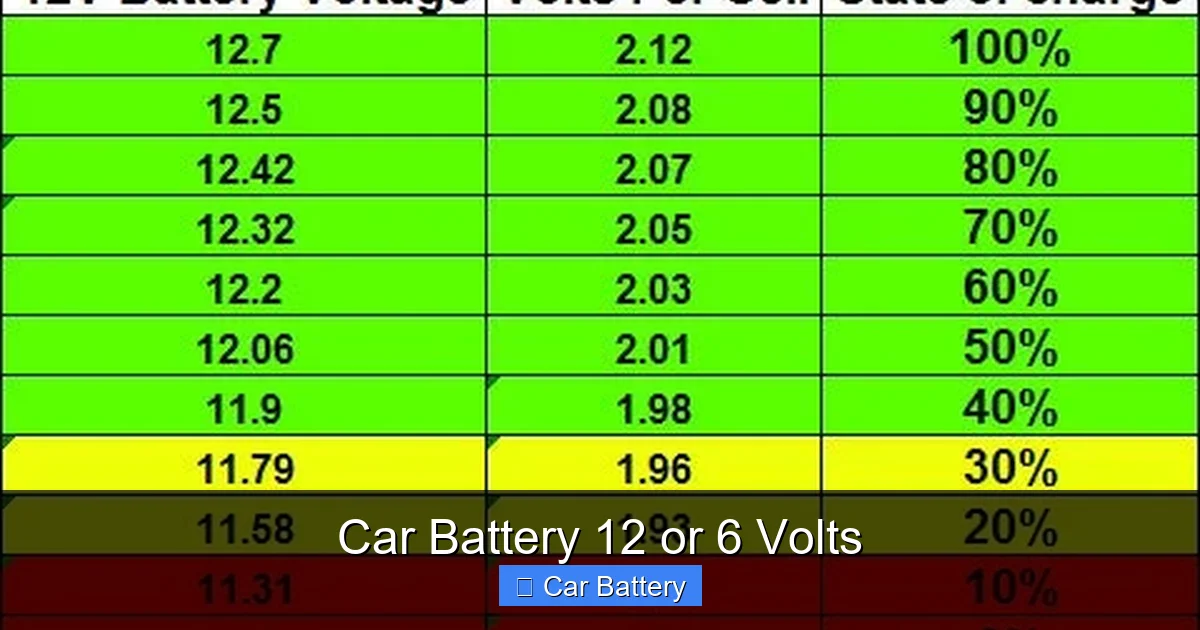
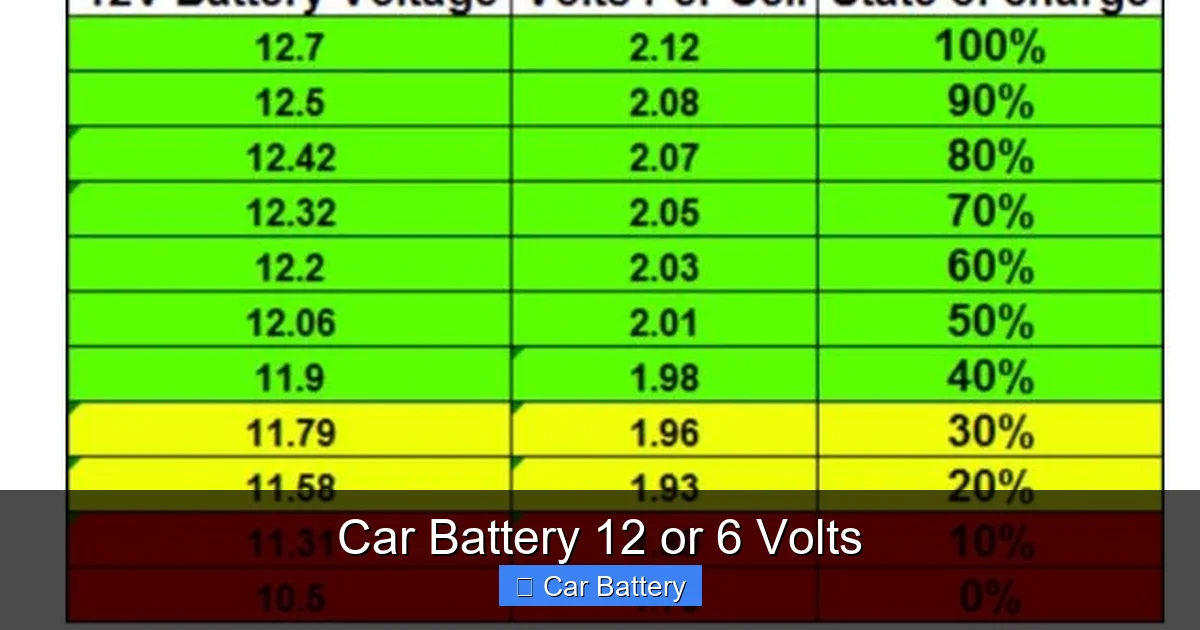
If you’re still uncertain, use a digital multimeter to measure the voltage. With the engine off, set the meter to DC voltage and touch the red probe to the positive terminal and the black probe to the negative terminal. A fully charged 12-volt battery should read between 12.6 and 12.8 volts. A 6-volt battery will show around 6.3 to 6.4 volts.
This method is especially useful if the battery label is worn or missing, or if you suspect the battery has been replaced with the wrong type in the past.
Pros and Cons of 12-Volt vs. 6-Volt Batteries
Visual guide about Car Battery 12 or 6 Volts
Image source: i.pinimg.com
Both 12-volt and 6-volt batteries have their place, but they’re suited to different needs. Let’s break down the advantages and disadvantages of each.
Advantages of 12-Volt Batteries
– **Higher power output:** Delivers more cranking amps, ideal for large engines and cold starts.
– **Supports modern electronics:** Powers everything from infotainment systems to advanced driver-assistance features.
– **Wider availability:** Easier to find at auto parts stores, online retailers, and service centers.
– **Better efficiency:** Lower current reduces energy loss and allows for lighter wiring.
– **Longer lifespan in modern vehicles:** Designed to handle the electrical demands of today’s cars.
Disadvantages of 12-Volt Batteries
– **Not compatible with older systems:** Can damage vintage cars not designed for higher voltage.
– **More complex charging requirements:** Requires proper charging systems (like alternators) to maintain health.
– **Higher risk of electrical shock:** While still low-risk, 12 volts can deliver more current than 6 volts if shorted.
Advantages of 6-Volt Batteries
– **Perfect for vintage vehicles:** Maintains authenticity and protects original electrical components.
– **Simpler design:** Fewer cells mean less complexity in some older systems.
– **Used in deep-cycle applications:** Often preferred in golf carts and RVs for their durability under repeated discharge.
Disadvantages of 6-Volt Batteries
– **Limited power:** Struggles to start larger or modern engines, especially in cold weather.
– **Harder to find:** Less common in mainstream automotive use, so replacement can be tricky.
– **Outdated for most applications:** Doesn’t support the electrical load of contemporary vehicles.
Can You Convert a 6-Volt System to 12 Volts?
Yes, it’s possible—and many classic car owners do it to improve performance and reliability. But it’s not a simple swap. Converting from 6 to 12 volts requires more than just installing a new battery.
What’s Involved in the Conversion?
To safely upgrade, you’ll typically need to:
– Replace the 6-volt generator with a 12-volt alternator (more efficient and better at charging).
– Install a 12-volt voltage regulator or use an internally regulated alternator.
– Update the ignition system, including the coil and distributor, to handle higher voltage.
– Replace bulbs, horns, and gauges with 12-volt equivalents—or use resistors to step down voltage for original parts.
– Reconfigure the wiring, especially if the car was originally positive-ground (many 6-volt systems were).
This process can be complex and may require professional help, especially if you’re not experienced with automotive electrical systems. However, the benefits—brighter lights, stronger starts, and compatibility with modern accessories—often make it worthwhile.
Should You Convert?
It depends on how you use the car. If it’s a showpiece that rarely leaves the garage, keeping the original 6-volt system preserves its value and authenticity. But if you drive it regularly, especially in traffic or bad weather, a 12-volt conversion can greatly improve usability and safety.
Many restoration shops offer conversion kits that simplify the process, including pre-wired harnesses and compatible components. Just remember: once converted, reverting back to 6 volts is difficult and costly.
Maintenance Tips for Any Battery Voltage
No matter whether your car uses 6 or 12 volts, proper maintenance extends battery life and prevents unexpected failures.
Regular Inspections
Check your battery every few months for signs of corrosion (white or green powder on terminals), loose connections, or swelling. Clean terminals with a baking soda and water solution and a wire brush to ensure good contact.
Keep It Charged
A battery that sits unused for long periods can lose charge and sulfation can build up, reducing capacity. Use a smart trickle charger or battery maintainer if the car won’t be driven for weeks.
Secure the Battery
Make sure the battery is tightly secured in its tray. Vibration can damage internal plates and shorten lifespan.
Monitor Performance
If your car is slow to start, lights dim when idling, or electronics act up, it could be a sign of a weak battery—regardless of voltage. Have it tested at an auto shop or with a portable load tester.
Replace When Needed
Most car batteries last 3–5 years. Don’t wait for a complete failure—replace it proactively to avoid being stranded.
Conclusion
Choosing between a 12 or 6-volt car battery isn’t just a technical detail—it’s about matching your vehicle’s design, age, and electrical needs. While 12-volt batteries dominate the modern automotive world thanks to their power, efficiency, and compatibility with advanced systems, 6-volt batteries still play a vital role in preserving classic cars and powering specialty equipment.
The key is to never assume. Always verify your car’s required voltage using the owner’s manual, battery label, or a multimeter. Installing the wrong battery can lead to damaged electronics, poor performance, or even safety hazards.
Whether you’re maintaining a daily driver or restoring a vintage gem, understanding the difference between 12 and 6 volts empowers you to make informed decisions. With the right battery and proper care, your car will start reliably, run smoothly, and keep you on the road for miles to come.
Frequently Asked Questions
Can I use a 12-volt battery in a 6-volt car?
No, you should not. A 12-volt battery can overload and damage the electrical components in a 6-volt system, including the ignition, lights, and gauges. Always use the voltage specified for your vehicle.
How do I know if my classic car has a 6-volt or 12-volt system?
Check the owner’s manual, inspect the battery label, or use a multimeter to measure voltage. Most cars made before 1950 use 6 volts, while those after 1960 use 12 volts.
Are 6-volt batteries still sold today?
Yes, but they’re less common. You can find them at specialty auto parts stores, online retailers, or stores that cater to vintage vehicles and golf carts.
Can I wire two 6-volt batteries to make 12 volts?
Yes, by connecting them in series (positive to negative), you can create a 12-volt system. This is common in RVs, golf carts, and solar power setups.
What happens if I install the wrong voltage battery?
Using the wrong voltage can cause electrical components to overheat, fail, or burn out. In extreme cases, it may lead to fire or complete system failure.
Is it worth converting a 6-volt car to 12 volts?
It depends on usage. If you drive the car regularly, the conversion improves reliability and performance. For show cars, keeping the original system may preserve value.