Can You Tow a Tesla Behind a Motorhome?

Contents
- 1 Key Takeaways
- 2 📑 Table of Contents
- 3 The Allure and the Reality of Towing a Tesla with Your RV
- 4 Why You Can’t Flat Tow a Tesla: The Engineering Explained
- 5 The Only Approved Method: Flatbed Trailer Towing
- 6 The Dangerous “Gray Area”: Tow Dollies (And Why to Avoid Them)
- 7 Practical Considerations: Weight, Hitches, and Your Motorhome
- 8 Legal, Insurance, and Warranty Implications
- 9 Smart Alternatives to Towing Your Tesla
- 10 Best Practices If You Must Tow: The Trailer Method Protocol
- 11 Conclusion: A Clear-Cut Rule for a High-Stakes Decision
- 12 Frequently Asked Questions
Tire Shine Spray

Carburetor Cleaner

Torque Wrench Set

Tire Pressure Monitoring System (TPMS)
You cannot flat tow (all four wheels on the ground) a Tesla behind a motorhome. Tesla’s design, specifically its always-connected drivetrain, makes this method impossible without causing severe, irreversible damage to the vehicle. The only safe and approved method to transport a Tesla with an RV is using a flatbed trailer or a tow dolly that lifts the drive wheels (if applicable), though the latter is still not recommended by Tesla. Understanding this critical restriction is essential to avoid a costly mistake that could void your warranty and lead to massive repair bills.
Key Takeaways
- Tesla explicitly forbids flat towing: All Tesla models have a design that does not allow for four-wheel-down towing. Doing so will cause catastrophic damage to the transmission and motor.
- The only safe method is a flatbed trailer: The universally accepted and Tesla-approved way to transport a Tesla behind an RV is on a full-size flatbed trailer with all four wheels off the ground.
- Tow dollies are a risky gray area: While some EV manufacturers allow front-wheel lift with a dolly, Tesla does not endorse this. Lifting only the front wheels still leaves the rear wheels (and motor) spinning, causing damage.
- Weight and hitch capacity are paramount: Your motorhome must be rated to tow the combined weight of the trailer and the Tesla. A Model 3 weighs ~4,000 lbs; a Model X can exceed 5,500 lbs.
- Legal and insurance implications exist: Improper towing that leads to an accident or damage may not be covered by insurance. Towing laws also vary by state regarding trailer brakes and lighting.
- Consider the “why” before you tow: Are you relocating or on a long road trip? Sometimes, renting a car at your destination or using Tesla’s Supercharger network is more practical and less risky than towing.
- Preparation is key for trailer towing: You must put your Tesla in “Transport Mode” (specific steps vary by model/year), secure it properly with wheel chocks and straps, and disconnect the 12V battery if recommended for long trips.
📑 Table of Contents
- The Allure and the Reality of Towing a Tesla with Your RV
- Why You Can’t Flat Tow a Tesla: The Engineering Explained
- The Only Approved Method: Flatbed Trailer Towing
- The Dangerous “Gray Area”: Tow Dollies (And Why to Avoid Them)
- Practical Considerations: Weight, Hitches, and Your Motorhome
- Legal, Insurance, and Warranty Implications
- Smart Alternatives to Towing Your Tesla
- Best Practices If You Must Tow: The Trailer Method Protocol
- Conclusion: A Clear-Cut Rule for a High-Stakes Decision
The Allure and the Reality of Towing a Tesla with Your RV
So, you’ve got the dream setup: a spacious motorhome for comfortable travel, and a sleek, silent Tesla for efficient, fun running around once you reach your destination. The idea of towing your electric car behind your home-on-wheels seems like the ultimate convenience. No need to rent a car, no airport shuttles—just unhitch and go. It’s a logical plan, until you run headfirst into one of the most important and non-negotiable rules in the electric vehicle world: you cannot flat tow a Tesla.
This isn’t a quirky preference or a minor suggestion from Tesla; it’s a fundamental engineering directive. Understanding why is crucial for any RV owner considering this move. It’s about protecting a $40,000 to $100,000+ investment. Ignoring this rule doesn’t just risk a repair bill—it risks a total loss of the drivetrain. Let’s break down everything you need to know, from the mechanical “why” to the safe “how.”
Why You Can’t Flat Tow a Tesla: The Engineering Explained
Always-On, Single-Speed Reduction Gears
To understand the prohibition, you need a very basic grasp of how a Tesla moves. Unlike a traditional gas car with a multi-gear transmission and a neutral position that disconnects the engine from the wheels, a Tesla uses a single-speed reduction gear. There’s no “neutral” in the traditional sense that physically decouples the motor from the wheels. When the car is “on” and in drive or reverse, the motor is directly connected to the wheels through this fixed gear set.
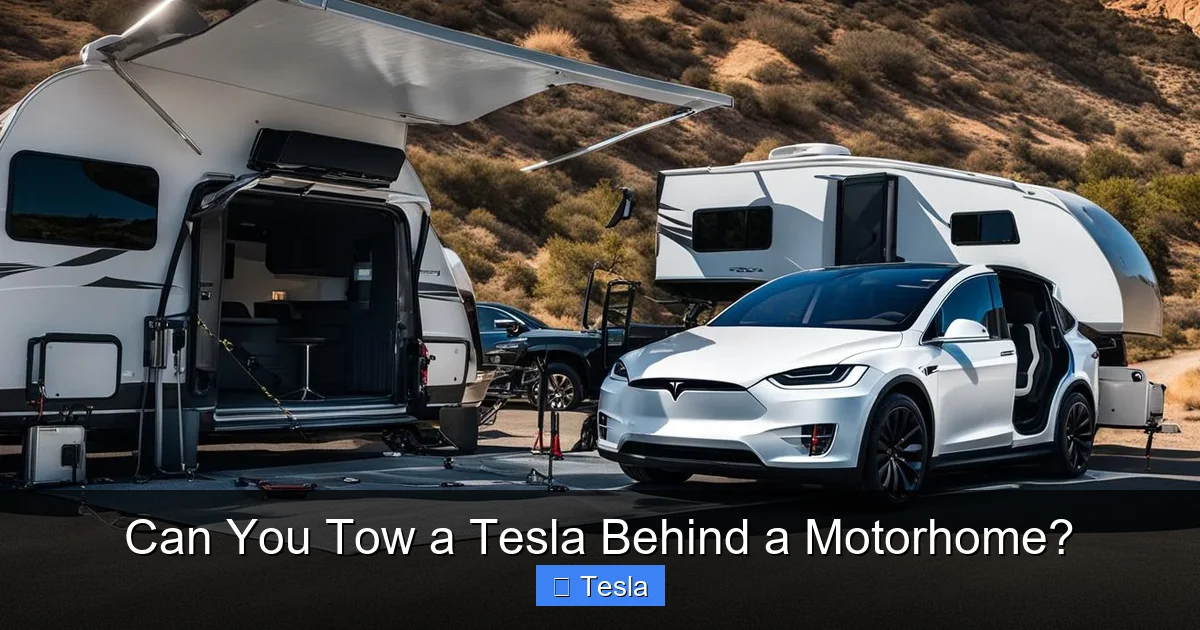
Visual guide about Can You Tow a Tesla Behind a Motorhome?
Image source: rvparenting.com
When you flat tow—with all four wheels on the ground and rolling—the wheels turn. If the Tesla is in its normal “Park” or “Neutral” (which is software-based, not mechanical), the motor is still connected. The spinning wheels force the motor to spin. But here’s the critical part: in a Tesla, the motor is always generating electricity when it spins. This forced rotation with no destination for that generated power creates immense resistance and heat. It’s like trying to push-start a car that’s already running at high speed. The result is catastrophic damage to the motor, gearbox, and power electronics. The lubrication system isn’t designed for this kind of forced, high-speed rotation without active cooling and control.
The Software “Neutral” Is Not for Towing
Tesla does offer a “Transport Mode” within its service menu. This mode disables certain systems and allows the vehicle to roll freely for very short distances (like being winched onto a flatbed). It is not a towing mode. Tesla’s own documentation is unequivocal: “Tesla vehicles are not designed to be towed with all four wheels on the ground. Doing so will cause damage to the vehicle and is not covered under the warranty.” This software state is temporary and for precise maneuvering, not for hours-long highway journeys behind an RV. The heat buildup and mechanical stress during extended towing would be extreme and guaranteed to cause failure.
The Only Approved Method: Flatbed Trailer Towing
Why a Flatbed is Non-Negotiable
The only method Tesla approves for towing is on a full-size flatbed trailer where all four wheels are off the ground. This completely isolates the drivetrain from any rotation. The car is simply sitting on a platform, secured by its tires or chassis. There is zero connection between the spinning trailer wheels and the Tesla’s motor. This method is used by all Tesla roadside assistance and transport companies for a reason: it’s safe and it works.

Visual guide about Can You Tow a Tesla Behind a Motorhome?
Image source: outdoordriving.com
For an RVer, this means your motorhome must be capable of towing a trailer that itself weighs 2,000-3,000+ pounds, plus the weight of your Tesla. A typical small car trailer (like a 5×8) might weigh 1,500 lbs empty. A larger, heavier-duty trailer for a Model X could weigh 2,500 lbs or more. You must calculate your Gross Combined Weight Rating (GCWR)—the total weight of your motorhome, everything in it, the trailer, and the Tesla. Exceeding this rating is dangerous and illegal. You can find your motorhome’s GCWR in the owner’s manual or on a placard in the driver’s door jamb. For understanding your motorhome’s limits, resources like articles on towing weight limits and CDL requirements are essential reading.
Setting Up for Trailer Towing: The Critical Steps
Once you have a suitable trailer and a motorhome with the correct hitch and electrical connections (7-pin plug for trailer lights and brakes), the process for the Tesla is specific:
- Activate Transport Mode: This is done through the vehicle’s touchscreen under Service > Towing. Follow the on-screen prompts precisely. This disables the parking brake and allows the vehicle to roll.
- Secure the Vehicle: Use heavy-duty wheel chocks in front of and behind the tires. Then, use soft-loop straps or wheel nets (never hard-chain directly to the wheels or suspension) to secure the car to the trailer’s D-rings. The straps should be tight enough to prevent any movement but not so tight as to damage the suspension or body panels.
- Consider 12V Battery Disconnection: For very long hauls (multiple days), some Tesla service advisors recommend disconnecting the 12V auxiliary battery to prevent it from draining and to avoid any potential electrical system quirks during transport. This requires accessing the front trunk (frunk) and is a step you should research for your specific model year.
- Range Anxiety for the Towing Trip: Remember, your motorhome is now towing significant extra weight. Your fuel economy (if diesel/gas) will plummet. Plan fuel stops accordingly. Your Tesla, of course, will be unplugged and its battery will slowly self-discharge over weeks. That’s normal.
The Dangerous “Gray Area”: Tow Dollies (And Why to Avoid Them)
You might see tow dollies—small trailers that lift the front wheels of a car off the ground while the rear wheels roll—used for front-wheel-drive vehicles. The logic is: if the drive wheels aren’t touching the ground, the drivetrain isn’t engaged. For a Tesla, this logic is fatally flawed for two reasons.

Visual guide about Can You Tow a Tesla Behind a Motorhome?
Image source: tremec-blog.com
First, Tesla is all-wheel drive (AWD) on most models (Model S, X, 3 Long Range, Y). Even if you lift the front wheels, the rear wheels—which are directly connected to a motor—are still on the ground and spinning. You are back to the same catastrophic damage scenario. Second, for the rare rear-wheel-drive Tesla (original Model S 60, some early Model 3 Standard Range), lifting the rear wheels would theoretically leave the front wheels (non-driven) on the ground. However, Tesla still does not approve this method. The potential for damage to other systems, the lack of a true mechanical neutral, and the risk of the dolly swaying or failing make it a gamble not worth taking. Your Tesla’s warranty will be void the moment you hook up a dolly. It’s simply not a recommended practice by any Tesla enthusiast community or service center.
Practical Considerations: Weight, Hitches, and Your Motorhome
Know Your Numbers: Tesla Weights and Motorhome Ratings
Before you even shop for a trailer, you must know the numbers. Here are approximate curb weights for popular Tesla models:
- Model 3: 3,900 – 4,100 lbs
- Model Y: 4,200 – 4,500 lbs
- Model S: 4,600 – 4,900 lbs
- Model X: 5,200 – 5,600+ lbs
Add to that the weight of your trailer. You’re likely looking at a total towed weight of 6,000 – 8,500+ lbs. Many Class C and some Class A motorhomes are rated to tow this much, but you must verify your specific vehicle’s ratings. That sticker in the door jamb is your bible. Also, consider the tongue weight—the downward force the trailer exerts on the hitch. A heavy Tesla on a trailer can create a tongue weight of 500-1,000 lbs. Your motorhome’s rear axle and hitch must be able to handle it. Overloading can cause sway, poor handling, and brake failure. For a deep dive into the capabilities of different tow vehicles, which can help you benchmark against your motorhome’s potential, you might explore resources on how much a GMC Yukon can tow to understand weight classes, though your motorhome’s specs are the ultimate authority.
Hitch and Brake Controller Requirements
Your motorhome needs a properly rated hitch—usually a Class III or Class IV receiver for these weights. More importantly, because the trailer+Tesla will almost certainly exceed 1,500-3,000 lbs (depending on state law), you will need a trailer brake controller installed in your cab. This device syncs your motorhome’s brakes with the trailer’s electric brakes, providing essential stopping power and stability. This is not optional; it’s a legal and safety requirement in most jurisdictions for trailers over a certain weight. The wiring harness for your motorhome must also support a 7-pin connector for brake lights, turn signals, and trailer brakes.
Legal, Insurance, and Warranty Implications
Voided Warranty: The Starkest Warning
Let’s be perfectly clear: if you flat tow a Tesla and it breaks, Tesla will not repair it under warranty. The damage from improper towing is considered “abuse” or “misuse.” You will be on the hook for the entire cost of replacing the drive unit(s), which can easily run $10,000-$20,000+ per motor. This is a financial risk that dwarfs the cost of a trailer and a proper hitch setup. The warranty on your vehicle is effectively nullified for the drivetrain the moment you connect a tow bar for four-wheel-down towing.
Insurance and Liability
Standard auto insurance policies may not cover damage incurred during an “illegal” or “prohibited” activity like flat towing a Tesla. If your improperly towed Tesla comes loose and causes an accident, your liability coverage could be challenged. Furthermore, if the damage to your own Tesla occurs due to prohibited towing, your comprehensive/collision coverage might deny the claim. Always talk to your insurance agent about the specifics of towing a vehicle behind your RV before you hit the road.
State Towing Laws
Laws vary by state regarding trailer length, brake requirements, and speed limits when towing. Some states have specific rules about towing a vehicle with its wheels on the ground (dolly towing). You are responsible for complying with all laws in every state you travel through. The American Association of Motor Vehicle Administrators (AAMVA) provides general guidelines, but state-specific research is a must. Ignorance is not an excuse for a traffic stop or, worse, an accident.
Smart Alternatives to Towing Your Tesla
Given the complexity, cost, and risk of towing a Tesla, it’s worth considering if there’s a better way.
- The “One-Way Rental” Strategy: Rent a Tesla (or any car) at your destination. Companies like Turo or traditional rental agencies sometimes have them. This eliminates all towing stress, cost, and risk. You fly or drive your motorhome to the location, pick up the rental, and return it at the end of your trip.
- Leverage the Supercharger Network: Tesla’s greatest strength is its charging infrastructure. If your motorhome trip is about exploring a region, consider simply driving your Tesla to your destination, using Superchargers along the way. Your motorhome stays at the campground. You have your car for local trips. This is often the most practical solution for trips under 300-400 miles from home.
- Ship It Separately: For long-distance, one-way moves (e.g., relocating from California to Florida), use an auto transporter service that specializes in classic or high-value cars. They will put it on an enclosed trailer. It’s a service cost, but it’s a professional, insured, and safe method.
- The “Two-Vehicle” Compromise: Some RVers own a small, lightweight, flat-towable vehicle (like an old Jeep Wrangler or certain manual-transmission cars) specifically for towing behind their RV, and keep the Tesla at home for local use. This is a significant compromise but solves the problem for those who must have a towed car.
Best Practices If You Must Tow: The Trailer Method Protocol
If, after weighing all risks and alternatives, you’ve decided that flatbed trailer towing is your path, follow this protocol meticulously.
- Verify Everything: Motorhome GCWR, hitch rating, trailer weight (empty and loaded), brake controller installation, and lighting connections. Do a shake test with the empty trailer hitched to ensure no sway.
- Pre-Trip Tesla Setup: With the Tesla on the trailer and secured, go through the Transport Mode activation procedure. Set the parking brake after securing the vehicle, not before. Disconnect the 12V battery if your model/year recommends it for long-term storage/towing. Cover the charging port to protect it from road debris.
- Drive with Extreme Caution: Your stopping distance will increase dramatically. Your acceleration will be sluggish. Your ability to pass or climb grades will be reduced. Drive in the right lane. Allow extra following distance. Be hyper-aware of crosswinds, which can affect a long motorhome-trailer combination.
- Regular Stops: Every 2-3 hours, stop and check everything. Check strap tension (they can loosen as the car settles). Check the trailer coupler and safety chains. Check tire pressures on both the trailer and the Tesla (if you haven’t disconnected the 12V, the monitor will work). Listen for any unusual noises.
- Unloading Protocol: When you arrive, park on level ground. Lower the trailer. Remove all straps and chocks. Put the Tesla in Park. Then, exit Transport Mode via the touchscreen. Do not try to drive it off the trailer while still in Transport Mode.
Conclusion: A Clear-Cut Rule for a High-Stakes Decision
The question “Can you tow a Tesla behind a motorhome?” has a simple, unwavering answer: not by flat towing. The engineering of an electric drivetrain with its always-connected motor and lack of a true mechanical neutral makes four-wheel-down towing an act of guaranteed destruction. There is no workaround, no secret setting, no aftermarket device that makes it safe. The risk of a $15,000+ repair bill and avoided warranty is far too high.
The only viable path is using a dedicated flatbed trailer, which adds significant cost, weight, and complexity to your RVing lifestyle. You must be a meticulous planner, a counter of weights, and a cautious driver. For many, the alternative solutions—renting a car at the destination or using the Supercharger network—are not just safer for the Tesla, but simpler and more cost-effective for the traveler. The freedom of the open road in a motorhome is priceless; protecting your investment in a Tesla means respecting its design limits. Do not tow it. Haul it.
Frequently Asked Questions
Can I put my Tesla in neutral and flat tow it?
No. Tesla’s “neutral” is a software state, not a mechanical disconnect. The motor remains connected to the wheels, and spinning it without proper load and lubrication while towing will cause severe damage. Transport Mode is for very short maneuvers only, not for towing.
Will flat towing a Tesla void the warranty?
Absolutely. Tesla’s warranty explicitly states that damage from improper towing, including flat towing, is not covered. You would be responsible for the entire cost of replacing the damaged drive unit(s), which can exceed $15,000.
What is the safest way to transport a Tesla behind my RV?
The only safe and Tesla-approved method is using a full-size flatbed trailer where all four wheels are off the ground. The car must be securely strapped down, and Transport Mode should be activated before moving it on the trailer.
Can I use a tow dolly (front-wheel lift) on a Tesla?
No. Tesla does not recommend or approve the use of tow dollies. Most Teslas are all-wheel drive, so lifting only the front wheels leaves the rear wheels (connected to a motor) on the ground, causing damage. Even for rear-wheel-drive models, this method is not endorsed and carries significant risk.
How much weight can my motorhome tow to pull a Tesla on a trailer?
You must check your motorhome’s specific Gross Combined Weight Rating (GCWR). You need to add the weight of your motorhome (loaded with fuel, water, possessions), the weight of the trailer (empty), and the weight of your Tesla. A Model 3 on a small trailer might total 6,000 lbs, while a Model X on a large trailer could exceed 8,500 lbs. Many Class Cs are rated for this, but you must verify your exact model’s capacity.
Is it legal to flat tow a Tesla?
While there may not be a specific law saying “you cannot flat tow a Tesla,” doing so would violate Tesla’s operating instructions. In an accident or traffic stop, this could be construed as negligent or operating an unsafe vehicle. Furthermore, your insurance may deny a claim for damage resulting from an act explicitly prohibited by the manufacturer. It is a legally and financially risky practice.