
Alabama Window Tint Law Guide

Alabama’s window tint law allows 35% VLT on front side windows and 35% on rear sides for sedans, but SUVs/vans have different rules. Windshields may only have non-reflective tint above the AS-1 line. Medical exemptions are available, and violations carry fines. Always get a compliance certificate from your installer. For BMW owners, understanding these rules is crucial to avoid tickets and keep your vehicle’s premium look legal.
Key Takeaways
- Front Side Windows: Must allow more than 35% of light in (VLT over 35%) for all passenger vehicles, including BMWs.
- Rear Side & Back Windows: For sedans, must also be over 35% VLT. For SUVs/vans (like BMW X5), rear windows can be darker.
- Windshield Rules: Only non-reflective tint is permitted on the top 6 inches (above the AS-1 line). No full windshield tint.
- Reflectivity Limits: Tint cannot be more than 20% reflective on front windows and 20% on rear windows for most vehicles.
- Medical Exemptions: Available with proper documentation from a physician, allowing darker tint for specific medical conditions.
- Enforcement: Police use tint meters. First-time fines typically range from $75-$150, plus potential court costs and removal orders.
- Certificate Required: Installers must provide a certificate of compliance. Keep it in your vehicle to prove legality if stopped.
📑 Table of Contents
- Understanding Alabama’s Window Tint Law: A Friendly Guide for BMW Owners
- The Core Legal Limits: VLT, Reflectivity, and Windshield Rules
- Medical Exemptions: When Darker Tint is Legally Allowed
- Enforcement, Penalties, and What Happens If You Get Stopped
- Installation Requirements and the Certificate of Compliance
- Special Considerations for BMW Owners
- How to Stay Compliant: Your Action Plan
- Conclusion: Tint Smart, Drive Legal
Understanding Alabama’s Window Tint Law: A Friendly Guide for BMW Owners
Hey there, fellow car enthusiast! So you’ve got a sleek BMW—maybe a sporty 3 Series or a luxurious X5—and you’re thinking about tinting those windows. Smart move! Tint adds privacy, reduces glare, and gives your ride that sharp, finished look. But before you book that appointment, let’s have a real talk about Alabama’s window tint law. It’s not just about style; it’s about staying on the right side of the law. Getting it wrong can mean a ticket, a fine, and a hassle you don’t need. Think of this guide as your friendly go-to resource. We’ll break down the legal limits, the exceptions, and the must-do steps, all with an eye on keeping your BMW looking great and driving legally on Alabama roads.
The Core Legal Limits: VLT, Reflectivity, and Windshield Rules
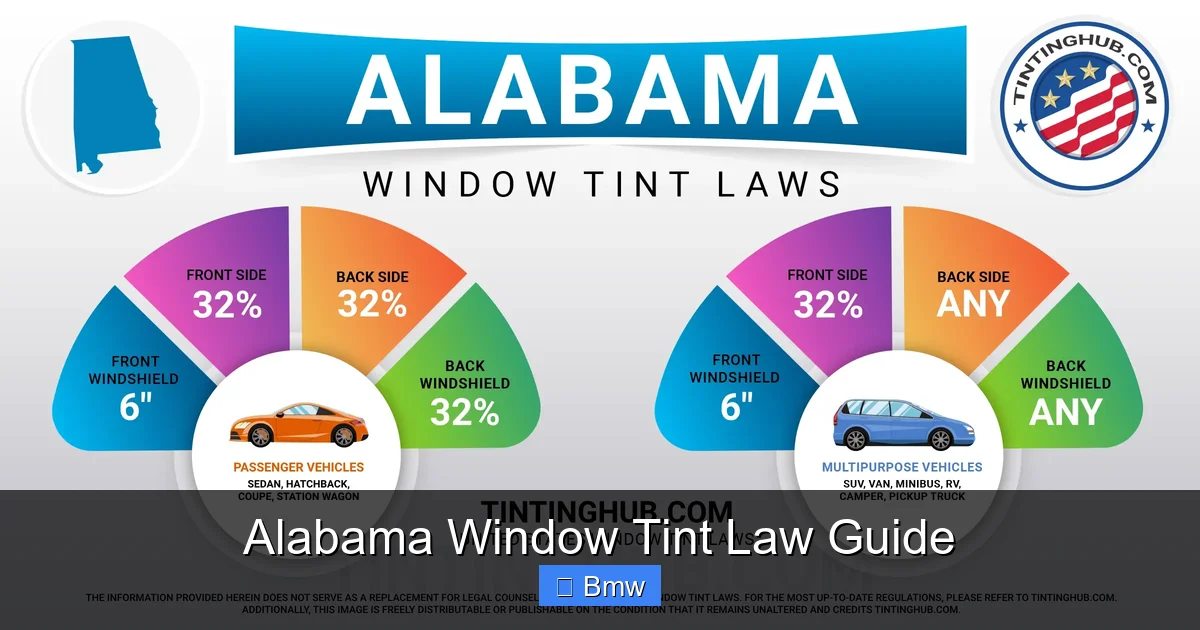
Alabama’s tint law is all about Visible Light Transmission, or VLT. That’s the percentage of light that passes through your window glass and tint film combined. A lower number means darker tint. For example, 35% VLT lets in 35% of outside light—it’s lighter than 20% VLT, which is much darker. The law sets different VLT limits for different windows on your vehicle.
Visual guide about Alabama Window Tint Law Guide
Image source: tintinghub.com
Front Side Windows: The 35% Rule for Everyone
This is the big one. For both the driver-side and passenger-side front windows, Alabama law is clear: the VLT must be more than 35%. In simple terms, your tint must let in over 35% of the light. That means the glass and film together can’t be darker than a 35% shade. This applies to all passenger vehicles, whether you’re driving a two-door BMW 4 Series Gran Coupe or a family-hauling BMW X7. Police officers can and will use a handheld tint meter to check this if they suspect a violation. It doesn’t matter if the factory glass already has a slight tint; you have to measure the combined darkness of the original glass plus any aftermarket film you add.
Rear Side and Back Windows: The SUV/Sedan Split
Here’s where vehicle type matters a lot. For sedans—think BMW 5 Series Sedan or i4 Gran Coupe—the rear side windows and the rear back window must also allow more than 35% of light in. So, you can’t go super dark in the back if you drive a sedan. But, and this is a big but, for SUVs, vans, and multipurpose vehicles (like your BMW X5, X6, or X7), the rear side and back windows can be tinted to any darkness level. You could legally have 5% “limo” tint on the rear of your X5 in Alabama. This distinction is critical. Always check your vehicle’s classification. If your BMW is registered as a “station wagon” or “sport utility” with the DMV, you likely fall under the more lenient rear-window rules.
Windshield: Only the Top 6 Inches
Let’s get this out of the way first: you cannot tint your entire windshield in Alabama. It’s illegal. Period. The only exception is a non-reflective strip of tint along the very top. This strip can extend down no more than 6 inches from the top of the windshield, and it must be above the AS-1 line (the manufacturer’s marking, usually near the sun visor). This top tint is meant to block sun glare but must not be reflective. For a BMW with a large windshield, this means your front visibility remains completely clear, which is a safety feature the state insists on. Any tint below that AS-1 line is a primary violation and can get you pulled over immediately.
Reflectivity: The Shiny Tint Trap
It’s not just about darkness. Alabama also limits how reflective your tint can be. For front side windows, the tinted film cannot reflect more than 20% of the light. For rear side and back windows, the limit is also 20% reflectivity. Why does this matter? Some metallic or mirrored tints are super reflective. They might look cool, but they can create a blinding glare for drivers behind you and are often used to circumvent VLT laws (a reflective film can appear darker from the outside while passing more light inside). When shopping for tint for your BMW, ask specifically for non-reflective or low-reflectivity film if you want to stay safely within the law.
Medical Exemptions: When Darker Tint is Legally Allowed
Life happens, and sometimes health conditions require extra protection from the sun. Alabama recognizes this and offers a medical exemption process. If you have a qualifying condition—like lupus, melanoma, photosensitivity from medication, or severe migraines triggered by light—you can apply for a waiver that allows darker window tint on all windows, including the front sides.

Visual guide about Alabama Window Tint Law Guide
Image source: windowtintlaws.us
How to Get a Medical Exemption in Alabama
This isn’t an automatic thing. You need to follow a specific process. First, you must obtain a signed statement from a licensed physician (MD or DO) or an optometrist. This statement must detail your medical condition, explain why darker tint is medically necessary, and recommend the specific VLT percentage needed. You then submit this statement, along with a completed application form (usually from your local county sheriff’s office or the Alabama Law Enforcement Agency), to the issuing authority. They review it and, if approved, issue you a special certificate or decal to display in your vehicle. This exemption is tied to you, not your car, so you can move it between vehicles. For a BMW owner with a sun-sensitive condition, this exemption is a lifeline, letting you install a much darker, more protective film legally.
Important Caveats for the Exemption
The exemption does not waive the windshield rule. You still cannot tint below the AS-1 line. Also, the exemption is for the named individual only. If you lend your BMW to a family member who doesn’t have the exemption, they must obey the standard tint laws. Always carry your exemption certificate in the vehicle when driving with darker tint. Police are trained to ask for it during a stop. Finally, the exemption is granted for a specific period, often one year, after which you must renew with updated medical documentation.
Enforcement, Penalties, and What Happens If You Get Stopped
Okay, let’s be real about the consequences. Alabama takes its tint law seriously. It’s a primary offense, meaning an officer can pull you over solely for suspected illegal tint. No other traffic violation needed.

Visual guide about Alabama Window Tint Law Guide
Image source: nuvisionautoglass.com
The Tint Stop: What to Expect
If an officer suspects your windows are too dark, they will use a calibrated tint meter. This device clips onto the window and gives a digital VLT reading. They’ll test the front side windows first, as those have the strictest limits. If you fail that test, they’ll likely check the others. If your BMW has factory-tinted glass (common on some BMW models as “Privacy Glass”), they measure the combination. If the combined VLT is under 35% on the front, it’s a violation, even if your aftermarket film is legal on its own. Always ask to see the meter reading. Reputable installers will do a pre-installation check with a meter to ensure their film will be legal on your specific glass.
Fines, Fees, and Court Costs
A first-time window tint violation in Alabama is typically a non-moving violation. The base fine is often around $75, but this can vary by county and city. However, that’s not the whole story. You’ll likely face additional court costs and fees, which can push the total to $150-$200 or more. The court may also issue a “fix-it” ticket, giving you a deadline (often 30 days) to remove the illegal tint or replace it with legal film and provide proof of correction (a new certificate from the installer). If you fail to correct it, the fine increases, and you could face additional penalties. For a BMW owner, the cost of a ticket plus the hassle of removing and replacing tint is way more than doing it right the first time. You can find more detailed cost breakdowns in our article on how much a window tint ticket costs.
Removal Orders and Inspection
In some cases, especially for repeat offenders or extremely dark tint, the judge may order the immediate removal of the tint at a certified facility. You’ll have to prove it was removed. This can be a real pain and might damage your window defroster lines or factory tint if done improperly. It’s far better to avoid this situation entirely by choosing the correct film percentage from the start.
Installation Requirements and the Certificate of Compliance
Here’s a step you cannot skip. Alabama law requires that any business installing window tint must provide the vehicle owner with a certificate of compliance. This is your legal protection.
What is the Certificate of Compliance?
This is a formal document, usually on the installer’s letterhead, that states the make, model, and VIN of your vehicle, and lists the VLT percentage of the film installed on each window. It should also state that the tint meets Alabama’s legal limits for that specific vehicle type. A reputable installer will perform a VLT test on your specific BMW windows (with the film applied) using a professional meter and include those actual readings on the certificate. Don’t accept a generic “35% film” certificate. Ask for the measured results on your car’s glass.
Why You Must Keep This Certificate
This piece of paper is your best friend if you get pulled over. You can present it to the officer as prima facie evidence that your tint is legal. While they can still check with their own meter, the certificate shows you acted in good faith and used a professional installer. It shifts the burden slightly. Keep it in your glove compartment. If you sell your BMW, you should provide this certificate to the new owner as part of the vehicle’s documentation.
Choosing the Right Installer for Your BMW
Not all tint shops are created equal, especially for a premium brand like BMW. Look for installers who are members of professional organizations like the International Window Film Association (IWFA) and who specifically mention experience with luxury or European vehicles. BMWs often have complex rear windows with embedded antennas, heating elements, and sensors (for rain, lane assist, etc.). A poor-quality installation or the wrong type of film (like a cheap metallic film) can interfere with these systems. Ceramic tint is usually the best choice for BMWs—it offers excellent heat and UV rejection, doesn’t interfere with electronics, and doesn’t fade or turn purple over time. Always ask to see examples of their work on similar vehicles.
Special Considerations for BMW Owners
tinting a BMW isn’t just about following the law; it’s about preserving the vehicle’s integrity, value, and performance.
Factory “Privacy Glass” vs. Aftermarket Tint
Many newer BMW models come from the factory with what’s called “Privacy Glass” or “Solar Glass.” This is a permanently dyed glass, not a film. It’s usually around 20% VLT on the rear windows and sometimes the rear side windows, but the front sides are typically clear. The critical point: factory glass counts towards the total VLT. If your BMW’s factory rear glass is 20% VLT and you add a 20% film, the combined VLT will be far darker than 20% (the math isn’t simple addition, but the result is much darker). You must factor the factory glass darkness into your film choice. A professional installer will measure your factory glass’s VLT first and then select a film that, when combined, meets the legal limit for your vehicle type. For a BMW sedan with factory rear privacy glass, you might need a very light film (like 70% or 80%) on the rear if you want to add any film at all, or you might choose to leave the factory glass as-is and only tint the front sides to 35%.
Electronics, Sensors, and Ceramic Film
Your BMW is a technology hub. The rear window likely has a defroster grid. The windshield and rear glass house antennas for GPS, SiriusXM, keyless entry, and advanced driver-assistance systems (ADAS) like lane departure warnings. Metallic or dyed window films can block or weaken these radio signals, leading to poor GPS reception, flaky key fobs, or malfunctioning safety systems. Ceramic window film is non-metallic and non-conductive, so it’s virtually transparent to these signals. For any BMW, especially newer models with extensive sensor suites, ceramic film is the safest, highest-performance choice. It also offers superior heat rejection without the electronic interference.
Maintaining Your BMW’s Aesthetic and Resale Value
A clean, legal tint job done with high-quality film and precision installation enhances your BMW’s appearance. It protects the interior from UV cracking and fading. But a bubbling, peeling, or purpleing cheap tint looks terrible and devalues your car. When you eventually sell your BMW, having documentation of a legal, professional tint job (with the certificate) can be a selling point. Conversely, a buyer discovering illegal tint might demand its removal or a price reduction. Always choose quality over the lowest quote. Your BMW deserves it.
How to Stay Compliant: Your Action Plan
So, what are the next steps? Here’s a simple checklist to get your BMW tinted legally in Alabama.
- Step 1: Know Your Vehicle Classification. Is your BMW a sedan or an SUV/van? This determines the rear window rules. Check your registration or ask your installer.
- Step 2: Measure Your Factory Glass. Before buying film, have a pro measure the VLT of your existing windows. This is non-negotiable.
- Step 3: Choose the Correct Film Percentage. Based on your vehicle type and factory glass, select a film that will result in a combined VLT over 35% for front sides (and rear sides/back for sedans). For an SUV BMW, rear darkness is flexible.
- Step 4: Select Ceramic Film. Protect your BMW’s electronics. Insist on ceramic film from a reputable brand like 3M, LLumar, or SunTek.
- Step 5: Hire a Certified, Experienced Installer. Get multiple quotes. Ask about their experience with BMWs. Ask to see their certificate of compliance template before you commit.
- Step 6: Get Your Certificate. On installation day, ensure you receive a detailed certificate listing your BMW’s VIN and the actual VLT readings for each window. File it away.
- Step 7: Keep Documentation. Store the certificate with your other important car docs. If you have a medical exemption, keep that with it.
Following this plan means you get the benefits of tint— comfort, privacy, style—without the stress of a ticket. It’s a smart investment in your driving experience. If you’re curious about the actual cost of a professional tint job for a BMW, which can vary based on film quality and vehicle size, we have a detailed breakdown in our article on how much auto window tint costs.
Conclusion: Tint Smart, Drive Legal
Alabama’s window tint law is pretty straightforward once you break it down: 35% VLT minimum for front sides (and rear for sedans), no full windshield tint, reflectivity under 20%, and a certificate from your installer. For BMW owners, the extra steps of accounting for factory privacy glass and choosing signal-friendly ceramic film are what separate a good tint job from a great, worry-free one. Remember, the goal is to enjoy your car’s enhanced comfort and look while respecting the rules of the road. A little research and a quality installer go a long way. So tint with confidence, keep that certificate handy, and enjoy the ride in your beautiful, compliant BMW.
Frequently Asked Questions
Can I have different tint percentages on different windows of my BMW?
Yes, as long as each individual window meets the legal limit for its position. For a BMW sedan, both front sides must be over 35% VLT, and both rear sides and the back window must also be over 35% VLT. You could legally have 40% on the fronts and 50% on the rears, for example. For an SUV BMW, you could have 35% on the fronts and any darkness on the rears.
Does the law for SUVs and vans apply to my BMW X5 if I use it to carry tools?
It depends on how the vehicle is registered and its primary design. The law defines an SUV/van based on the manufacturer’s classification. Your BMW X5 is almost certainly classified as an “SUV” or “sport utility vehicle” by BMW and on your registration, so it follows the SUV rules regardless of how you personally use it. The rear window darkness allowance is based on the vehicle type, not its cargo capacity on a given day.
How long does a medical exemption last, and can it be transferred?
A medical exemption in Alabama is typically valid for one year from the date of issuance. You must reapply with updated medical documentation to renew it. The exemption is tied to you, the driver, not your specific vehicle. So, if you get a new BMW or drive a different car, you can use the same exemption certificate as long as it’s current and you are the driver.
What’s the total cost if I get a tint ticket in Alabama?
The base fine is usually $75-$100, but you’ll also pay mandatory court costs and fees, which often add another $75-$100. The total out-of-pocket cost is commonly in the $150-$250 range. If you get a “fix-it” ticket and fail to correct the tint, additional penalties apply. Always factor in the potential cost of removal and re-tinting if you choose illegal film.
My BMW came with dark factory rear windows. Is that legal?
Yes. Factory-installed privacy glass is legal because it was installed by the manufacturer to meet federal safety standards. The problem arises when you add aftermarket film on top of it. You must measure the combined VLT of the factory glass plus any new film. Adding a dark film to already-dark factory glass will almost certainly make the combined VLT illegal for a sedan.
How can I verify my new tint is legal before driving off?
First, ensure your installer uses a professional, calibrated tint meter on your specific BMW windows after installation. They should give you a certificate listing the actual VLT readings. You can also buy an inexpensive handheld tint meter (around $20-$50 online) to double-check yourself. The reading should show over 35% light transmission on your front side windows. For peace of mind, a quick call to your local county sheriff’s office (non-emergency line) to ask about their specific enforcement practices can also be helpful.