
Why Does My Bmw Shake When I Stop?

If your BMW shakes violently when coming to a stop, it’s rarely a minor annoyance—it’s a critical warning sign from your car’s engine, brakes, or drivetrain. The most common culprit is failing engine or transmission mounts, but warped brake rotors, ignition misfires, or fuel delivery problems can also cause dangerous vibrations. Never ignore this symptom; driving with a severe shake can lead to catastrophic component failure and unsafe driving conditions. A professional diagnosis is essential to pinpoint the exact cause and prevent costly repairs.
You’re cruising down the road, everything feels perfect. You approach a stoplight, gently press the brake pedal, and as your BMW comes to a halt, the entire car starts to shudder, shake, and vibrate violently. It feels less like a car and more like a washing machine on a spin cycle. Your heart sinks. “Why does my BMW shake when I stop?” is one of the most common—and worrying—questions we hear from BMW owners. That smooth, composed ride you expect from the Ultimate Driving Machine has been replaced by an unsettling tremor. This isn’t just a comfort issue; it’s a loud and clear cry for help from your vehicle’s critical systems. Ignoring it is not an option. In this complete guide, we’ll dive deep into the mechanical symphony that can go wrong, exploring every possible reason your BMW shakes at a standstill, from the simple to the severely complex.
First, let’s set the stage. The vibration you feel is almost always a result of something that is supposed to be securely held in place—an engine, a transmission, a brake rotor—suddenly being allowed to move or oscillate in an uncontrolled way. When your car is moving, the momentum and constant motion can mask minor issues. But when you stop, the engine idles at a specific RPM, the brakes clamp down with immense force, and the drivetrain unloads. This is the moment of truth. A small gap in a rubber mount, a microscopic warp in a metal rotor, or a mis-fired cylinder becomes a massive, violent shake. Understanding where that shake originates is the first step to fixing it. We’ll break it down by system, starting with the most frequent offender.
Key Takeaways
- Engine/Transmission Mounts Are Prime Suspects: Worn or broken rubber mounts are the #1 cause of stop-time shaking in BMWs, allowing the engine/transmission to shift and vibrate excessively.
- Brake System Faults Create Pulsation: Warped rotors, stuck calipers, or severely worn pads cause the brake assembly to shake, often felt in the pedal and steering wheel.
- Ignition & Fuel Issues Cause Misfires: Faulty spark plugs, coils, or fuel injectors can make the engine run roughly at idle, translating to a shake when you stop.
- Transmission Problems Are Serious: Low fluid, a failing torque converter, or internal wear (especially in automatics) can cause shuddering during the final stop.
- Wheel/Tire Alignment Affects Stability: Severe misalignment or bent wheels can cause a shimmy as weight transfers to the front tires during braking.
- Never Ignore the Shake: This symptom indicates a component is failing or failed. Continuing to drive risks damaging other parts and creates a major safety hazard.
- Diagnosis Requires a Professional: The causes range from simple to complex. A trained mechanic with BMW-specific knowledge will use road tests and scans to find the root cause.
📑 Table of Contents
- The Usual Suspect #1: Failing Engine & Transmission Mounts
- The Brake System: Warped Rotors & Stuck Components
- Ignition & Fuel System Misfires: The Rough Idle Connection
- Transmission & Drivetrain Issues
- Wheel, Tire, and Alignment Factors
- The Diagnostic Process: What a Mechanic Will Do
- Cost, DIY, and When to Worry
- Conclusion: Listen to Your BMW
The Usual Suspect #1: Failing Engine & Transmission Mounts
When it comes to a BMW shaking specifically when coming to a stop, the statistical probability points directly at the engine and transmission mounts. These are the heavy-duty rubber (or sometimes hydraulic) blocks that secure your car’s powerplant and gearbox to the chassis. Their job is to absorb engine vibration and prevent the massive weight of the engine/transmission assembly from shifting around under acceleration, braking, and cornering. Over time, the rubber hardens, cracks, and separates from its metal inserts. Once a mount fails, the engine is free to twist and lurch.
How to Recognize a Bad Mount
The classic symptom is a heavy, clunking or banging sensation, often accompanied by a violent shake, when you accelerate from a stop or when you brake to a stop. You might also notice the engine tilting excessively when you pop the hood and have someone rev the engine. In severe cases, you can see physical damage—the rubber is torn, the metal is exposed, or the mount has collapsed. BMWs, particularly inline-6 and V8 models, have significant engine mass, so a failed front mount is brutally obvious. The shake isn’t just a vibration; it’s a physical lurch as the engine torques against the remaining good mounts. Replacing engine mounts is a labor-intensive job on many BMWs, often requiring support of the engine and removal of other components, which contributes to the repair cost.
Why Do BMW Mounts Fail?
Age and heat are the primary enemies. The engine bay is an extremely hot environment, and the constant heating and cooling cycle degrades rubber. Performance driving, aggressive shifting, and even poor driving habits like riding the clutch in a manual can accelerate wear. For high-mileage BMWs, this is a classic wear-and-tear item. If your car has over 100,000 miles and has never had its mounts inspected, this should be your top suspect.
The Brake System: Warped Rotors & Stuck Components
If the shake is most intensely felt through the brake pedal, steering wheel, or the entire front end of the car, your attention must turn to the braking system. The principle here is simple: a brake rotor is a large, flat disc that the brake pads squeeze against to create friction and slow the car. For this to work smoothly, the rotor must be perfectly flat and spin true. If it becomes warped (distorted from heat), has excessive run-out, or has a thickness variation, the pads will alternately grip and slip as the rotor spins, creating a pulsating feedback that feels like a shake.
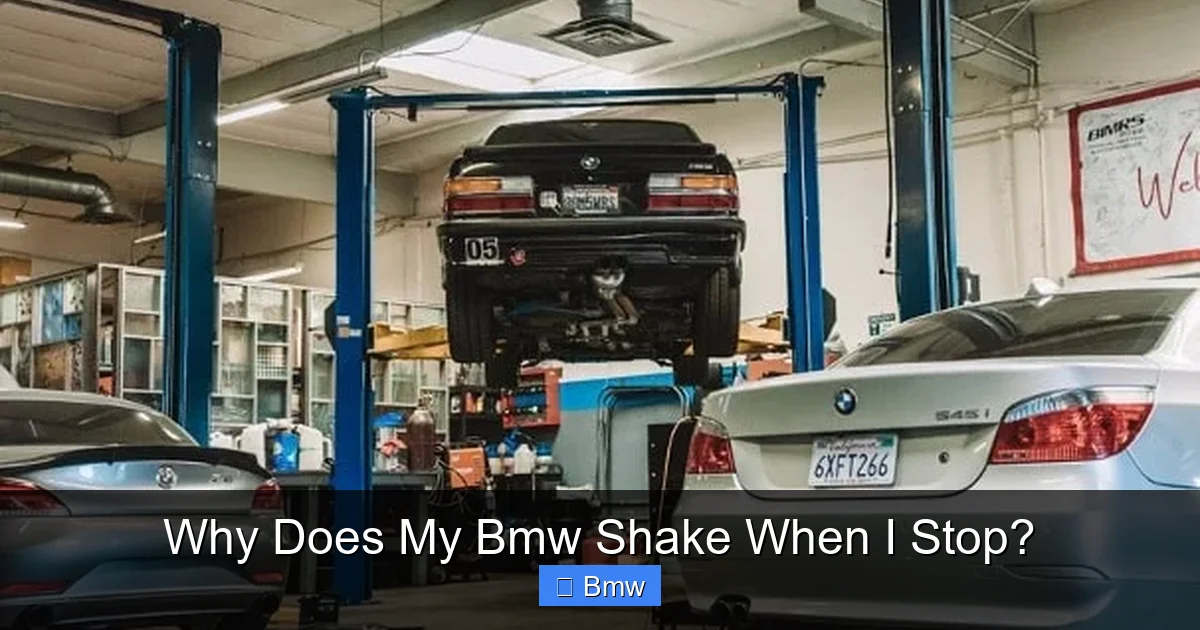
Visual guide about Why Does My Bmw Shake When I Stop?
Image source: oceansidemotorsports.com
Warped Brake Rotors
Warping is often caused by excessive heat. This can happen from riding the brakes on mountain roads, towing heavy loads, or simply from the natural process of heating and cooling. The metal rotor expands and contracts, and over time, this can cause it to become slightly concave or develop high and low spots. When you brake, the pads contact these high spots, creating a strong vibration that is directly proportional to your braking force. You’ll feel it in the pedal and steering wheel. A visual inspection might show a blue discoloration (heat tinting) on the rotor surface, and a mechanic can measure rotor thickness variation with a micrometer.
Stuck Calipers or Slider Pins
Another brake-related cause is a caliper that cannot move freely on its mounting slides (slider pins). The caliper must center itself over the rotor. If the pins are corroded and stuck, the caliper will drag on one side of the rotor constantly. This not only causes uneven pad wear and a pulling sensation but also creates a severe shake when braking because only one pad is doing the work unevenly. You might also smell a burning odor from the overheating brake component. A simple caliper slide service—cleaning, lubricating, and replacing the pins and boots—can often solve this.
Ignition & Fuel System Misfires: The Rough Idle Connection
An engine needs three things to run smoothly: fuel, air, and spark. If any cylinder fails to ignite this mixture at the precise moment—a misfire—the engine’s balance is disrupted. At driving RPMs, you might just feel a slight hiccup. But at a stop, with the engine idling at a low RPM (often around 600-800 RPM for a BMW), that same misfire becomes a pronounced shake that travels through the entire chassis. The idle quality degrades, and the car may feel like it’s about to stall.
Common Misfire Culprits in BMWs
For modern BMWs (especially the popular N54, N55, B48, and S55 engines), the usual suspects are:
- Ignition Coils: These small components sit on top of each spark plug and generate the high voltage needed for the spark. They are a known wear item. A failing coil will cause a specific cylinder to misfire, often triggering a check engine light with a code like P0301 (Cylinder 1 Misfire Detected).
- Spark Plugs: Worn, fouled, or incorrectly gapped plugs can fail to ignite the mixture. BMW recommends specific service intervals for plugs, often around 60,000-80,000 miles for modern models, but they can fail earlier.
- Fuel Injectors: A clogged or leaking injector can cause a lean or rich condition in a cylinder, leading to a misfire. High-pressure direct injectors (used in many BMWs) can be expensive to replace.
- High-Pressure Fuel Pump (HPFP): Particularly on N54 and early N55 engines, a failing HPFP cannot maintain adequate fuel pressure, causing random misfires under load and at idle.
Diagnosis here is straightforward with a professional scan tool that reads live misfire data per cylinder. The mechanic can then swap components (like moving a coil from cylinder 1 to cylinder 2) to see if the misfire moves, pinpointing the bad part.
Transmission & Drivetrain Issues
While less common than mounts or brakes, transmission-related problems can absolutely cause a stop-time shake, and they are often more serious and expensive. This is especially true for automatic transmissions.
Visual guide about Why Does My Bmw Shake When I Stop?
Image source: oceansidemotorsports.com
Torque Converter Problems
The torque converter is the clutch equivalent in an automatic transmission. It uses fluid coupling to transfer engine power to the transmission. Inside, a lockup clutch can engage at low speeds to improve efficiency. If this clutch is shuddering, glazed, or failing, you will feel a pronounced vibration or shake when the vehicle is at a near-stop or low speed with the transmission in gear (like at a traffic light in Drive). It may feel like a continuous rumble rather than a sharp shake. This is a classic sign of a failing torque converter, which typically requires a transmission rebuild or replacement.
Low or Degraded Transmission Fluid
Transmission fluid provides hydraulic pressure, lubrication, and cooling. If the fluid level is low, or if the fluid is old, burnt, and contaminated, the internal clutches and bands may slip or engage harshly. This can manifest as a shudder during gear changes and at a stop. Checking the fluid level and condition (color, smell) is a critical first step in diagnosing any transmission issue.
Engine/Transmission Mounts (Again)
We mentioned these first for a reason. They are so common they bear repeating in this section. The transmission mount, specifically the rear mount, is a frequent failure point. A broken transmission mount allows the tailshaft of the transmission to flop around, causing a distinct clunk and shake when coming to a stop or when shifting into Reverse/Drive.
Wheel, Tire, and Alignment Factors
While not the most common cause of a *severe* stop-time shake, wheel and tire issues can contribute or be the sole problem in some cases.
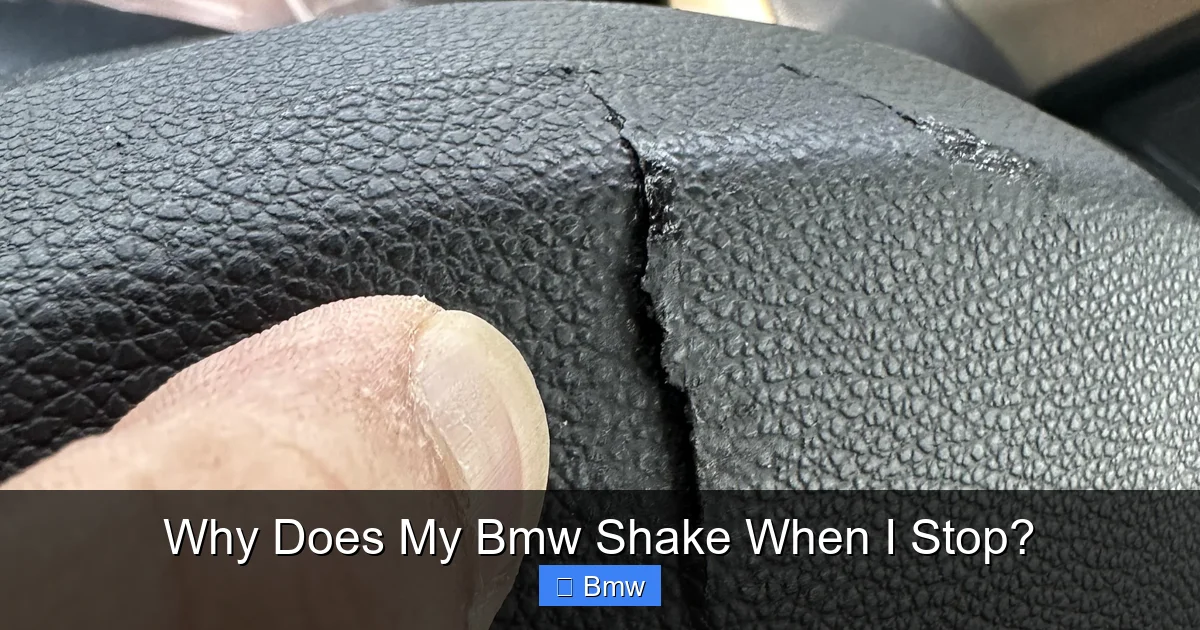
Visual guide about Why Does My Bmw Shake When I Stop?
Image source: i.redd.it
Bent Wheels or Out-of-Balance Tires
A severely bent wheel or a tire that has lost a significant amount of wheel weight will cause a high-speed shimmy in the steering wheel. This vibration usually increases with speed and decreases when you slow down. It’s less likely to be exclusive to the moment you stop, but as the car’s speed bleeds off, you might feel the vibration frequency change and become more apparent right before the car is fully stopped. A tire/wheel balance and a visual/physical inspection of the wheels for bends are good diagnostic steps.
Severe Alignment Issues
Extreme toe or camber misalignment won’t typically cause a shake at a stop on its own. However, if the misalignment is so severe that it causes the tires to scrub and fight against each other as the car slows, it can create a subtle pull or vibration. This is rare and usually accompanied by very uneven and rapid tire wear.
The Diagnostic Process: What a Mechanic Will Do
You’ve read the possibilities. Now, how does a professional figure out which one it is? A systematic approach is key.
1. The Road Test & Symptom Replication
The most important tool is the mechanic’s own butt in the driver’s seat. They will drive the car, specifically trying to replicate the shake. They’ll note: Is it in the steering wheel, seat, or pedal? Does it happen only when braking? Only when the engine is cold/hot? Only in Drive or also in Neutral? This first-hand experience narrows the field dramatically. A shake in the steering wheel points to the front end/wheels/brakes. A shake in the seat points to the rear. A shake felt through the pedal is almost certainly brake-related.
2. Visual & Physical Inspection
With the car safely lifted, the mechanic will perform a methodical inspection. They will:
- Check all engine and transmission mounts for cracks, tears, and fluid leaks (hydraulic mounts).
- Inspect brake rotors for scoring, rust grooves, and blue discoloration. They will measure rotor thickness and run-out.
- Check calipers for free movement and proper slide pin condition.
- Inspect wheels and tires for bends, bulges, and proper balance.
- Check transmission fluid level and condition.
- Look for any obvious leaks (oil, coolant, transmission fluid) that could point to other problems.
3. Electronic Diagnostics
A scan tool is connected to the car’s OBD-II port. The mechanic will look for any stored or pending trouble codes. Codes for misfires (P0300-P030X) are a huge red flag for the ignition/fuel system. They will also look at live data, such as fuel trim values, oxygen sensor activity, and, on some models, transmission solenoid performance.
4. The “Isolate” Test
To definitively rule out the engine/transmission as the source of the shake, a mechanic might perform a “stall test” or simply put the car in Neutral at a stoplight (if safe to do so). If the shake **disappears** when the transmission is in Neutral and the engine is still running, the problem is almost certainly **engine/transmission mounts or an engine misfire**. If the shake **persists** in Neutral, the problem is likely **wheel/brake-related** (since the wheels are still connected and can lock up the rotors). If the shake **only happens when the brake is applied**, it points squarely to the **brake system**.
Important Related Reading: While your BMW’s shake is unique, the principle of a car shaking at a stop is universal. Many drivers of other brands, like Dodge Rams, experience similar symptoms. Understanding the common causes across platforms, such as those detailed in our article on why a Dodge Ram stalls when stopping, can provide valuable context. Often, the root causes—failing mounts, ignition issues, or idle control problems—are remarkably similar, even if the specific component designs differ. This reinforces the importance of a methodical diagnostic approach over guessing.
Cost, DIY, and When to Worry
Now for the practical questions. How much will this cost? Can I fix it myself? And most importantly, is it safe to keep driving?
Estimated Repair Costs
The cost varies wildly by cause:
- Engine/Transmission Mounts: $800 – $2,500+ for parts and labor. Labor is the big factor. Some BMWs require removing the front subframe or supporting the engine from the top.
- Brake Rotors & Pads: $400 – $1,200+ per axle. Pads are relatively inexpensive; high-quality rotors and the labor to resurface or replace them drive the cost. If calipers are stuck, add $100-$300 per caliper for rebuilding/replacement.
- Ignition Coils & Spark Plugs: $300 – $800+ for a full set. Coils are $50-$150 each, plugs $20-$40 each. Labor is usually straightforward on most BMWs.
- Fuel Injectors/HPFP: $1,000 – $3,000+. This is a major repair, especially if multiple injectors are faulty.
- Torque Converter: $2,000 – $4,000+. This is a transmission-level repair.
Can I Diagnose This Myself?
Some basic checks are within the realm of a competent DIYer:
- Visually inspect engine mounts (look from underneath or with a flashlight from the top).
- Check brake rotor condition (look for grooves, rust, blue tint).
- Use a code reader to check for misfire codes.
- Check transmission fluid (if your model has a dipstick—many BMWs are “sealed” and require a professional).
However, definitively diagnosing a bad mount (it often requires physical prying to see the gap), measuring rotor run-out, or performing the isolation test safely requires experience and tools. For something as critical as a stop-time shake, professional diagnosis is strongly recommended to avoid wasting money on the wrong part.
Is It Safe to Drive?
This is the most critical question. The answer depends on the severity.
- Severe, violent shaking: DO NOT DRIVE. A completely broken mount could allow the engine or transmission to shift enough to damage the radiator, hoses, or wiring. A severely warped rotor or stuck caliper can cause brake fade or a pull into traffic. A major misfire can overheat and damage the catalytic converter. Towing is the only safe option.
- Moderate shaking, only when braking: You can likely drive cautiously to a trusted brake shop, but be prepared for reduced braking efficiency. Avoid heavy braking.
- Rough idle shake that smooths out when driving: Misfires can damage the engine and catalytic converter over time. Get it checked soon, but you can usually drive it if it’s not stalling.
When in doubt, err on the side of caution. The shake is your car’s way of saying something is catastrophically wrong or about to be.
Conclusion: Listen to Your BMW
Your BMW shaking when you stop is not a mystery with a single answer. It’s a symptom with a menu of potential causes, ranging from a $100 coil to a $4,000 transmission rebuild. The key is understanding that the shake is a communication tool. A violent, chassis-shaking lurch is screaming “MOUNTS!” A pulsating pedal is shouting “BRAKES!” An uneven, RPM-related shudder is whispering “MISSFIRE!”
The diagnostic process is a logical elimination game. Start with the most common (mounts, brakes), use the isolation test, and let the codes and physical inspection guide you. Remember, your BMW’s reputation for performance and reliability is built on meticulous maintenance. Ignoring a fundamental symptom like this is the fastest way to undermine that reputation and create a dangerous situation. Invest in a proper diagnosis from a BMW specialist. It might cost a few hundred dollars for their time, but it will save you from guessing, buying wrong parts, and potentially causing thousands in collateral damage. Your smooth, confident stop is worth it.
Frequently Asked Questions
Can low transmission fluid cause my BMW to shake when stopping?
Yes, low or degraded automatic transmission fluid can cause the transmission to shudder, especially as it tries to lock up the torque converter at a stop. This is a serious issue that requires immediate fluid level check and potential fluid/filter change or further diagnosis.
Why does my BMW only shake when I come to a stop in Drive, but not in Neutral?
This is a classic diagnostic clue. If the shake disappears in Neutral, it means the problem is related to the load on the drivetrain. This points strongly to engine/transmission mounts (which are under stress when the transmission is in gear) or an engine misfire that is load-sensitive. It helps rule out wheels/tires and brake rotors, which would still shake in Neutral.
Is a shaking BMW at a stop always an expensive repair?
Not always. The most common cause, worn ignition coils or spark plugs, is relatively inexpensive ($300-$800). However, the most common *mechanical* cause, engine/transmission mounts, is labor-intensive and costly ($1,500+). The cost is entirely dependent on the root cause, which is why professional diagnosis is crucial before assuming the worst.
Could a dirty fuel system or bad gas cause this shaking?
Absolutely. Contaminated fuel or clogged fuel injectors can cause one or more cylinders to run poorly, creating a rough idle that manifests as a shake when stopped. This is often accompanied by a check engine light with misfire codes. A fuel system cleaning or injector service may resolve it.
My BMW shakes when I stop, but there’s no check engine light. What gives?
The absence of a check engine light is actually helpful information. It helps rule out major electronic sensor failures and severe misfires (which usually trigger a light). This narrows the field toward purely mechanical issues: engine/transmission mounts, brake rotor warpage, or a stuck caliper. These problems often don’t set diagnostic trouble codes.
Should I try to fix engine mounts myself on my BMW?
While possible for advanced DIYers with the right equipment (engine support bar, transmission jack), we strongly advise against it for most people. The process is complex, requires precise procedure to avoid damaging the engine or surrounding components, and carries significant risk if the engine is not properly supported. The labor cost is high for a reason—it’s skilled, intensive work. For safety and correctness, professional installation is recommended.
