
Are Bmw Diesels Reliable?

Modern BMW diesel engines are generally reliable when properly maintained, but they come with specific challenges like complex emissions systems (DPF/EGR) that require attentive ownership. While offering exceptional torque and fuel economy, potential repair costs for turbochargers, fuel injectors, and emissions components can be high, especially on older or neglected models. Your experience will heavily depend on the specific model year, engine variant, and, most critically, the vehicle’s service history.
So, you’re eyeing a BMW diesel. Maybe it’s a sleek 3 Series Touring with a throaty growl that promises 40+ MPG on the highway, or a capable X5 xDrive35d that feels like it could tow a small house. The appeal is undeniable: legendary BMW driving dynamics married to diesel torque and efficiency. But then the doubt creeps in, fed by horror stories from forums and friends. “Are BMW diesels reliable?” It’s the million-dollar question for any prospective buyer, and the answer isn’t a simple yes or no. It’s a nuanced “it depends,” and understanding that nuance is the key to either finding a fantastic, long-lasting daily driver or a very expensive garage ornament.
Let’s cut through the noise. At their core, BMW’s diesel engines are engineering marvels. They’re built with strong blocks, sophisticated turbocharging, and designed for longevity. The real story of BMW diesel reliability isn’t about the engine’s fundamental strength; it’s about the complex, sensitive, and expensive systems built around it to meet stringent emissions standards. Think of the engine itself as a marathon champion, but it’s wearing a very sophisticated, high-maintenance respirator (the DPF/EGR system). If you take care of the respirator, the champion runs for decades. Ignore it, and the whole system fails.
Key Takeaways
- Modern Core is Solid: The fundamental turbocharged diesel engine blocks (like the M57, N47, B47) are robust and built for high mileage, often surpassing 300,000 miles with good care.
- Emissions Systems are the Weak Link: The Diesel Particulate Filter (DPF) and Exhaust Gas Recirculation (EGR) systems are the most common failure points, leading to costly repairs and drivability issues if not maintained correctly.
- Maintenance is Non-Negotiable: Strict adherence to service intervals, using correct oil (LL-04 or LL-17 FE+), and timely fuel filter changes are critical to prevent catastrophic failures.
- Model Year Matters Greatly: Pre-2010 models (M47, M57) are simpler and often more durable but lack modern emissions tech. Post-2016 models (B47) have refined emissions but more complex electronics.
- High Repair Costs are Real: While not inherently unreliable, repairs like a failed turbo, high-pressure fuel pump, or DPF replacement can easily cost $3,000-$8,000+, pricing the car out of its value if not budgeted for.
- Driving Style is Key: These engines need consistent highway driving to properly regenerate the DPF. Primarily short-trip, city driving is a recipe for clogged filters and trouble.
- Used Purchase Requires Diligence: A full service history, proof of DPF health, and a pre-purchase inspection by a BMW diesel specialist are absolutely essential before buying any used BMW diesel.
📑 Table of Contents
The Evolution of BMW Diesel Engineering
To understand reliability, we must look at the timeline. BMW’s diesel journey in the US and globally has distinct generations, each with its own reliability profile.
The Legendary M57 Era (Pre-2009)
This is the golden age for many diesel enthusiasts. The M57 engine, found in the 2005-2009 335d, 525d, 530d, and X5 3.0d, is a cast-iron-block, twin-turbo workhorse. It’s mechanically controlled, relatively simple by modern standards, and famously robust. These engines routinely see 400,000+ miles. Their main weakness? The single-shell turbochargers can fail, but it’s a known, repairable issue. The emissions systems were less complex, so DPF drama was minimal. Finding a well-maintained example of these is like finding a trusted old friend.
The Transitional N47/N57 (2009-2015)
This generation brought aluminum blocks and more complex variable geometry turbochargers. The N47 (4-cylinder) and N57 (6-cylinder) are still fundamentally strong, but introduced more intricate emissions systems. The dual-mass flywheel and timing chain systems on some variants became known failure points if neglected. This era is the sweet spot for many: modern enough to have good features, but not yet burdened by the ultra-complex systems of the post-2016 cars. A well-serviced 2012 328d or 2014 X5 xDrive35d from this period can be an excellent value.
The Ultra-Efficient B47/B57 (2016-Present)
Enter the modern age. The B47 (4-cylinder) and B57 (6-cylinder) engines are incredibly efficient and powerful. They feature a new, more efficient DPF system integrated closer to the turbo (close-coupled), and AdBlue (urea) injection for NOx reduction. The engineering is top-tier, but the complexity is at its peak. These engines are highly reliable *when everything works*, but the AdBlue system (with its pumps, nozzles, and sensors) and the tightly integrated DPF add multiple new potential failure points. Software glitches can also cause false warnings. These cars demand meticulous care.
The Achilles’ Heel: Emissions Systems Explained
You cannot discuss BMW diesel reliability without dedicating a section to the trio of systems that cause 90% of the major headaches: the DPF, EGR, and AdBlue systems.
Visual guide about Are Bmw Diesels Reliable?
Image source: mufasadiesels.com
Diesel Particulate Filter (DPF)
The DPF is a ceramic filter that traps soot particles from the exhaust. To prevent it from clogging, it must regularly “regenerate” by burning off the soot at very high temperatures. This requires sustained highway driving (usually 20+ minutes at 50+ mph). If the car is only driven for short trips, the DPF never fully regenerates, leading to a clogged filter. Symptoms include poor performance, excessive smoke, and eventually, a “DPF blocked” warning that can lead to a limp mode. A clogged DPF can sometimes be cleaned, but often it requires replacement at a staggering cost. A clogged DPF will also cause the EGR valve to fail prematurely due to increased back pressure.
Exhaust Gas Recirculation (EGR) & Cooler
The EGR valve recirculates a portion of exhaust gases back into the engine to lower combustion temperatures and reduce NOx emissions. The EGR cooler then cools these gases. Both are subject to extreme heat and soot. They can become clogged with carbon or, worse, fail and leak coolant into the engine—a catastrophic failure that hydrolocks the engine. A failing EGR will cause rough idle, poor fuel economy, and check engine lights. This is a very common repair on higher-mileage BMW diesels.
AdBlue / SCR System (On B47/B57 Engines)
Selective Catalytic Reduction (SCR) uses a urea-based fluid (AdBlue) injected into the exhaust to break down NOx into nitrogen and water. The system includes a tank, pump, nozzle, and NOx sensors. Failures are common. The AdBlue pump can fail, the nozzle can clog, or sensors can give false readings. When it fails, you’ll get warnings, and eventually, the car will not start after a certain number of miles (a legal requirement to prevent driving with disabled emissions). AdBlue fluid itself is cheap, but the components are not.
Maintenance: The Non-Negotiable Covenant
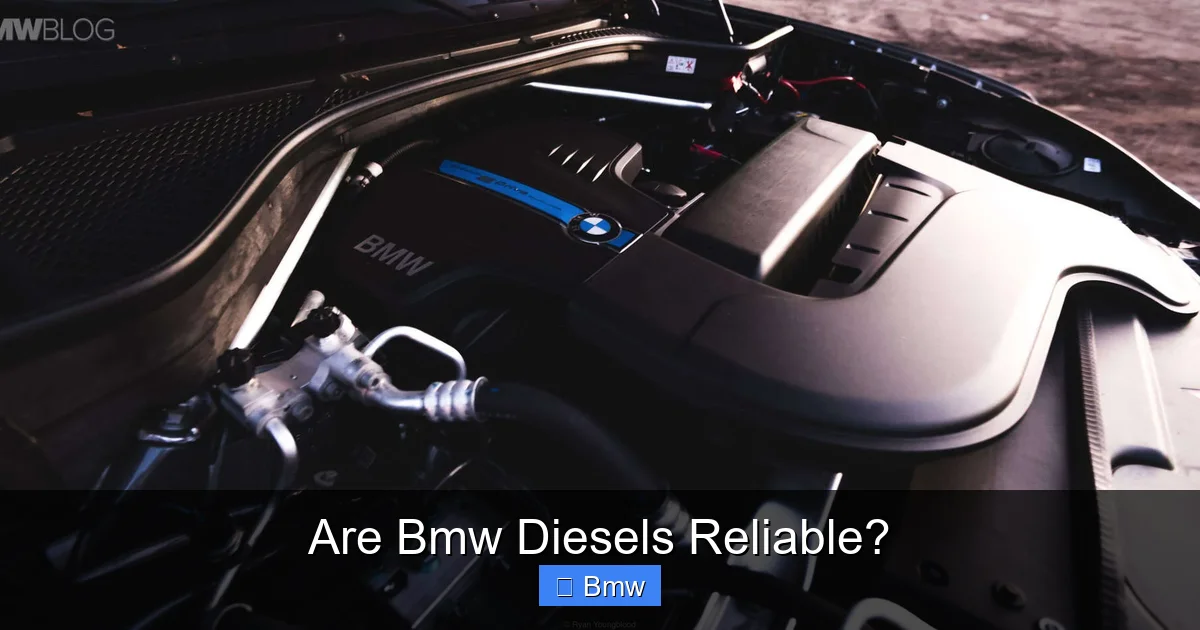
Reliability for a BMW diesel is a direct function of maintenance. Skipping or delaying services is not an option. Here is the sacred checklist:
Visual guide about Are Bmw Diesels Reliable?
Image source: cdn.bmwblog.com
- Oil Changes: Use ONLY BMW-approved LL-04 or LL-17 FE+ specification oil. Diesel engines produce more soot, and the wrong oil will lead to turbo bearing failure and sludging. Change every 7,500-10,000 miles without exception.
- Fuel Filters: The high-pressure fuel system is sensitive. Fuel filters must be changed every 30,000-40,000 miles. A clogged fuel filter strains the lift pump and can lead to expensive HPFP (High-Pressure Fuel Pump) failure.
- Air Filters: A dirty air filter chokes the turbo and engine, increasing soot production and harming the DPF. Check and replace as needed.
- Inspect/Service EGR & DPF: At high mileage (120k+), have the EGR valve and cooler inspected for carbon buildup. Monitor DPF status via a proper scan tool (like the ones discussed in our guide to the best scan tools for BMW and Mercedes). A forced DPF regeneration should be performed if regeneration cycles are incomplete.
- Glow Plugs: These heat the combustion chamber for cold starts. On 4-cylinder diesels (N47/B47), they are known to fail. While not immediately catastrophic, replace them in sets when one fails to avoid future headaches.
- Cooling System: The thermostat, water pump, and expansion tank are wear items on all modern BMWs. A cooling system failure leads to engine overheating and destruction. Proactively replace these components around 80,000-100,000 miles.
Model-by-Model Reliability Breakdown
3 Series & 5 Series (F30/F10, G20/G30)
The 328d/330d and 528d/530d are the quintessential BMW diesel sedans. The 6-cylinder models (N57/B57) are generally more robust and balanced than the 4-cylinder (N47/B47), which can have more vibration and glow plug issues. The F30 generation (2012-2019) is a sweet spot for reliability if maintained. The newer G20/G30 B47 engines are fantastic but watch the AdBlue system. The Touring (wagon) versions share the same drivetrain and are equally reliable if serviced.

Visual guide about Are Bmw Diesels Reliable?
Image source: cdn.bmwblog.com
X3 & X5 (E83/F15, G01)
SUVs add weight, which strains driveline components slightly more, but the diesel engines are the same as their sedan counterparts. The X5 xDrive35d (N57) is a beloved, torquey workhorse. The main concern is the transfer case and xDrive system on high-mileage examples, not the engine itself. For the newer G01 X3 xDrive30d with the B47, the same AdBlue vigilance applies. The额外 weight makes DPF regeneration even more critical; if the car is used for short school runs, problems will arise.
7 Series & X7
These use the same B57 6-cylinder diesel. The complexity is the same, but the repair bills are higher due to more complex bodywork and additional systems. The principle remains: impeccable maintenance history is paramount. The potential for expensive ancillary failures (air suspension, etc.) is also higher in these large luxury cars.
The Cost of Ownership: Budgeting for the Inevitable
Let’s talk numbers. A “reliable” BMW diesel doesn’t mean “cheap to fix.” It means it won’t leave you stranded if you’ve budgeted correctly. Here are realistic cost brackets for common repairs (parts + labor):
- EGR Cooler/Valve Replacement: $1,200 – $2,500
- DPF Cleaning (chemical): $500 – $1,000 | DPF Replacement: $3,000 – $6,000+
- Turbocharger Replacement: $2,500 – $4,500
- High-Pressure Fuel Pump (HPFP): $1,500 – $2,800
- AdBlue Pump/Nozzle: $800 – $1,800
- Glow Plugs (set of 4): $400 – $700
- Fuel Filter Change: $150 – $250
This is why a pre-purchase inspection is worth every penny. An independent BMW specialist can perform a diagnostic scan, check DPF soot levels, and inspect for pending issues. Paying $200-$300 for an inspection can save you from a $5,000 mistake. When comparing to a gasoline BMW or a competitor like a Bentley Bentayga or Maserati Levante, remember that German diesel engineering prioritizes efficiency and torque, trading some ultimate simplicity for those goals.
Final Verdict: Who is a BMW Diesel For?
A BMW diesel is an exceptional choice for the right driver:
- The Highway Commuter: If your drive involves 30+ minutes of steady highway speeding daily, the DPF will regenerate happily. You’ll reap massive fuel economy benefits.
- The Enthusiast with a Budget: You want the driving feel of a BMW but with lower running costs than a V8 gasoline model. The diesel’s torque curve is intoxicating.
- The Discerning Used Car Buyer: You are willing to pay a slight premium for a model with a complete, verifiable service history from a reputable specialist. You understand that a “bargain” BMW diesel with no records is a ticking time bomb.
A BMW diesel is a terrible choice for:
- The City-Only Driver: Stop-and-go traffic is the enemy of the DPF. You will face constant regeneration problems and a lifetime of emissions-related headaches.
- The “No Maintenance” Car Owner: If the idea of a $500 fuel filter change every year sounds excessive, look at a gasoline model or a different brand entirely.
- The Budget-Conscious with No Repair Fund: You must have a dedicated emergency fund for potential repairs. Buying a BMW diesel on a shoestring budget is financially reckless.
Frequently Asked Questions
Are BMW diesel engines more reliable than their gasoline counterparts?
In terms of core engine longevity (block, crankshaft, pistons), yes, the diesel engines are built more robustly and can often last longer. However, the gasoline engines have far fewer expensive emissions-related components (no DPF, EGR, AdBlue). So, while the diesel *engine* may be more durable, the overall *vehicle system* is more complex and prone to costly failures, making the real-world ownership experience less reliably cheap than a well-maintained gasoline BMW.
What is the biggest mistake people make when buying a used BMW diesel?
Failing to verify the DPF’s health and the complete service history. A car with a clogged DPF is a money pit. Always get a pre-purchase inspection from a BMW diesel specialist who can read the DPF soot levels and regeneration data. Also, avoid cars with spotty or no records; the previous owner’s neglect is now your problem.
How often do I need to drive my BMW diesel on the highway to keep it healthy?
Aim for at least one 20-30 minute highway drive per week at sustained speeds above 50 mph. This allows the DPF to reach the high exhaust temperatures needed for active regeneration. If you cannot do this regularly, you are at high risk for DPF clogging and should strongly consider a gasoline engine instead.
Is it worth repairing a failed DPF or EGR system on an older BMW diesel?
It depends entirely on the car’s value and your emotional attachment. On a car worth $8,000, a $4,500 DPF replacement may not make financial sense. On a cherished, well-optioned model worth $15,000+, it often does. For the EGR cooler, if it’s leaking coolant, repair is mandatory to avoid engine destruction. Always get a quote and weigh the car’s post-repair value.
Do I need to use special additives or fuel for my BMW diesel?
Use top-tier Tier 1 diesel fuel from reputable stations (like Shell, Chevron, BP). It has better detergent and lubricity properties. Occasional use of a diesel fuel additive (like Stanadyne or Red Line) can help keep injectors clean, but it’s not a substitute for regular fuel filter changes. Never use gasoline additives in diesel. For AdBlue, only use genuine or certified urea solution; cheap, counterfeit AdBlue can destroy the SCR system.
How does BMW diesel reliability compare to other German brands like Audi or Mercedes?
They are remarkably similar. BMW, Audi (VW group), and Mercedes all use similar diesel engine families (e.g., BMW’s B47 shares technology with VW’s EA288). The emissions systems (DPF, EGR, SCR) are industry-standard solutions to the same regulations. Therefore, the reliability profile—strong core engines paired with fragile, expensive emissions systems—is nearly identical across all German diesel manufacturers from this era. A well-maintained Audi A4 TDI or Mercedes E220 Bluetec will have a comparable reliability story to a BMW 328d.