
Why Is My Bmw Not Starting?

A BMW refusing to start can stem from simple issues like a dead battery or key fob problem to more complex failures in the starter, fuel system, or security module. While some checks are DIY-friendly, many modern BMWs require professional diagnostics due to sophisticated electronics. Understanding the symptoms—silence, clicking, or cranking without fire—is the first step to finding the solution.
You slide into the driver’s seat of your BMW, insert the key or press the start button, and… nothing. Or maybe you hear a frantic clicking, or the engine turns over but never catches. That sinking feeling is universal. Your prized Ultimate Driving Machine has let you down. Before panic sets in, take a breath. A BMW not starting is a symptom, not a death sentence. The cause could be a simple $10 battery in your key fob or a more complex electrical gremlin. This guide will walk you through the most common reasons, how to diagnose them like a pro, and when it’s time to wave the white flag and call for help. We’ll speak in plain English, no mechanical engineering degree required.
Key Takeaways
- The battery is the #1 suspect: Even if lights work, the battery may lack cranking amps. Test voltage and load, not just charge.
- Listen for the sound: A single click often means starter/solenoid; rapid clicking suggests weak battery; silence points to electrical/security.
- Key fobs are critical: A dead key battery or failed transmitter can immobilize the car. Spare key testing is essential.
- Fuel and spark must both be present: No fuel pump sound or worn spark plugs can prevent ignition despite a turning engine.
- BMW security systems are finicky: A faulty CAS or BDC module can lock the engine from starting, often requiring dealer-level coding.
- Don’t ignore warning lights: Check engine, battery, or key lights on the dash are direct clues to the failing system.
- When in doubt, call a pro: Modern BMWs rely on complex CAN bus networks; misdiagnosis can lead to costly, unnecessary part replacements.
📑 Table of Contents
The Usual Suspects: A Systematic Approach
Diagnosing a no-start is about pattern recognition. Your senses are your best tools: what do you hear? What do you see on the dashboard? Does the engine crank at all? We break it down into three core symptoms: No Crank (silence), Crank-but-No-Start (turns over but won’t fire), and Intermittent Starting (works sometimes). Each points to a different system. Let’s start with the most common and easiest fix.
Symptom 1: The Silence (No Crank, No Sound)
You turn the key or press the button. Nothing happens. No sound from the engine bay, no dash lights dimming. This is an electrical issue before the starter motor even gets involved. The starter’s job is to spin the engine; if it’s not getting the command or the power to do so, you get silence.
- Dead or Severely Weak 12V Battery: This is the #1 cause across all vehicles. BMWs are packed with electronics that draw small amounts of power even when “off” (the “sleep current”). A battery older than 4-5 years can sulfate and lose its ability to provide the high cranking amps (CCA) needed. A battery can read 12.6V (charged) at rest but still fail under load. Action: Try jumping the car. If it starts, the battery is the culprit. Have it load-tested at an auto parts store (most do this for free). If the battery is original or over 4 years old, replace it. Ensure the terminals are clean and tight.
- Faulty Key Fob/Key Battery: This is a classic BMW issue, especially with comfort access/keyless start. The key fob sends a coded signal to the car’s security module (CAS/BDC). If the key’s internal coin cell battery is dead (a common occurrence), it can’t transmit. Action: Replace the key fob battery (usually a CR2032). Use the physical emergency key blade (hidden inside the fob) to unlock the door and see if the car starts with the fob inserted in the slot or held against the start button (consult your manual for the exact procedure). If the spare key works, you’ve found the problem. For more on key issues, see our guide on why car key fobs fail.
- Blown Main Fuse or Faulty Starter Relay: A major fuse (often 100A+) in the engine bay fuse box can blow, cutting power to the starter circuit. Similarly, the starter relay itself can fail. Action: Check your owner’s manual for fuse locations. Visually inspect the main fuses and the starter relay (often labeled “Starter” or “S”). Swap the starter relay with an identical one from another circuit (like the horn relay) to test.
Symptom 2: The Clicking or Rapid Clicking
This is a distinct sound: a single loud CLICK from the engine bay, or a rapid-fire click-click-click that sounds like a machine gun. This is the starter solenoid engaging but not turning the motor. It’s a power issue at the starter.
- Weak Battery (Again): A battery that can’t supply the 300+ amps needed will cause the solenoid to click but the starter motor to not engage. The rapid clicking is the solenoid trying and failing repeatedly as voltage drops. Action: Jump start. If it starts, the battery is failing. If it doesn’t start even with a jump, the battery may be so dead it can’t take a charge, or there’s a major connection problem.
- Corroded or Loose Battery Terminals/Cables: BMWs, especially E9x and F-series, can have battery terminals that loosen or corrode over time. This creates high resistance, starving the starter of power even if the battery is good. Action: Open the hood. Check the positive (+) and negative (-) terminals. They should be tight with no green/white crusty corrosion. Clean with a battery terminal brush and baking soda solution, then tighten securely.
- Failed Starter Motor or Solenoid: If the battery and connections are pristine, the starter itself is worn out. The solenoid may click, but the internal brushes or armature are shot. Action: This is a bench-test or replacement job. A mechanic can tap the starter (a temporary fix) while another cranks to see if it engages, confirming the failure.
Symptom 3: The Crank-but-No-Start (Engine Turns Over, Won’t Fire)
The engine spins at normal cranking speed, but it never catches. This means the starter and electrical system are working. The problem lies in the three things an engine needs to run: Fuel, Spark, and Compression. In a modern BMW, it’s almost always a fuel or spark issue, as compression is a mechanical failure (rare).
- No Fuel:
- Fuel Pump Failure: You should hear a 2-3 second hum from the rear of the car (under the back seat or in the tank) when you turn the key to “ON” (before cranking). No sound means the pump isn’t priming. Action: Listen carefully. Check the fuel pump fuse and relay (in the trunk fuse box on many models). Tap the fuel tank (bottom center) while cranking; sometimes a dying pump will start. Ultimately, the pump may need replacement.
- Clogged Fuel Filter: A severely clogged filter can starve the engine. Action: This is a maintenance item. If the car has high miles and hasn’t had a filter change, it’s a possibility.
- Out of Fuel: Yes, it happens. BMW gas gauges can be optimistic. Action: Add a gallon of fresh fuel and try again.
- No Spark:
- Worn Spark Plugs/Ignition Coils: BMWs use individual ignition coils (coil-on-plug). A failed coil or a plug gap that’s too wide will prevent combustion. Action: This often triggers a check engine light with misfire codes (P0300-P0304). If you have a code reader, check for these. Replacing coils and plugs is a common DIY job on many BMWs.
- Crankshaft Position Sensor Failure: This sensor tells the ECU the engine’s speed and position. Without its signal, the ECU won’t fire the spark plugs or injectors. It’s a very common failure point on BMWs (M54, N52, N55 engines, etc.). The engine will crank but never start. Action: This often sets a code (P0335). It’s a relatively inexpensive part located behind the harmonic balancer, but access can be tricky.
BMW-Specific Security and Immobilizer Issues
This is where BMWs get notoriously finicky. The car’s security system (Immobilizer) is designed to prevent theft by only allowing a coded key to start the engine. If the communication between the key, the Comfort Access System (CAS), and the Engine Control Unit (ECU) breaks down, the car will crank but not start, or do nothing at all. There are often no obvious symptoms.
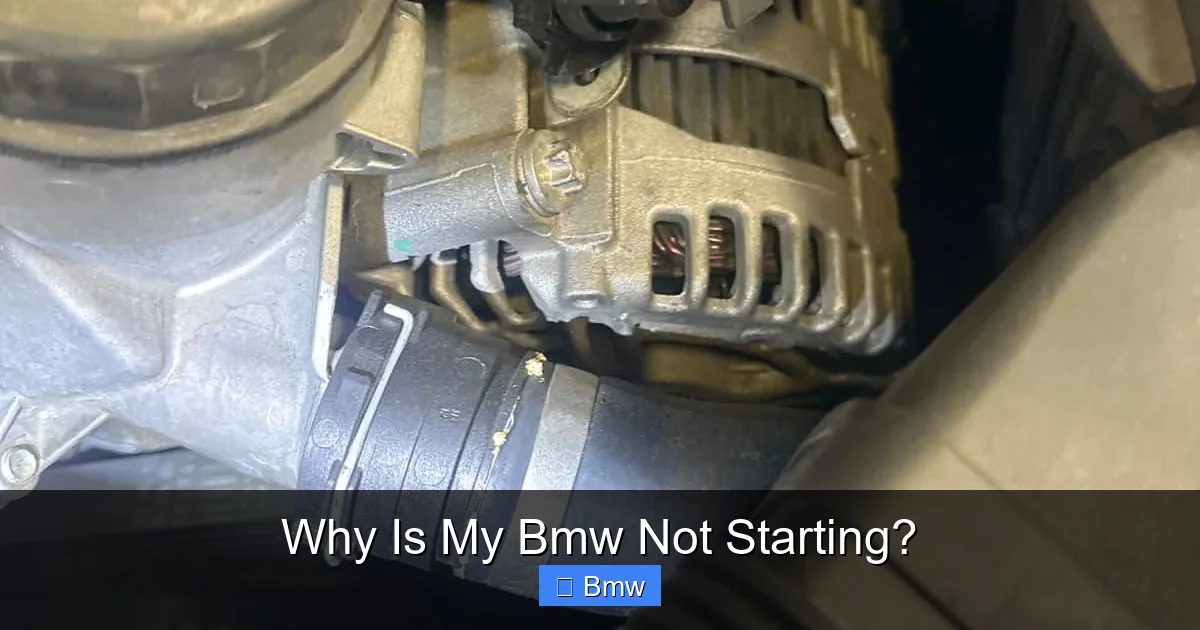
Visual guide about Why Is My Bmw Not Starting?
Image source: oceansidemotorsports.com
The Infamous “Red Key Light” or “Key Symbol” on the Dash
If you see a red key icon or a key symbol illuminated on the instrument cluster when trying to start, it means the car’s security system does not recognize your key’s transponder code. This can happen for several reasons:
- Key fob battery is dead. (See above).
- The key was not properly programmed to the car. This can happen after a key is replaced incorrectly or the car’s electronics were disturbed.
- Failure of the CAS or BDC module. These are the “brain” modules that read the key. They can fail due to water damage, voltage spikes, or age.
- A glitch in the system. Sometimes, resetting the system can work.
Action: First, try the spare key. If the spare works, the primary key needs reprogramming or repair. If neither works, the issue is with the car’s CAS/BDC module or its wiring. This almost always requires a dealer or specialist with the proprietary BMW diagnostic software (ISTA) to reprogram or replace the module. For general key problems, our article on key fob warning lights explains similar concepts across brands.
Intermittent Starting: The Most Frustrating Symptom
The car starts fine one day, then is completely dead the next. Or it might start after 10 tries. This points to a failing component that works until it heats up or cools down.
- Failing Starter Motor: Internal windings can short when hot, causing a no-crank. After cooling, it might work again.
- Cracked or Shorted Wiring: BMW engine bay wiring harnesses can get brittle. A wire that’s broken internally but touches when cold/contracted can cause intermittent failure.
- Failing Fuel Pump: As pumps age, they may seize when hot. After cooling, they might prime again.
- Glitching Security Module: A CAS module with a cold solder joint can work intermittently.
Action: Intermittent issues are the hardest to diagnose. You need to catch it in the “failed” state and perform tests immediately. This is a prime scenario for a professional with a live data stream to monitor sensors and modules while the problem occurs.
Less Common, But Not Impossible: Fuel and Exhaust
While we’ve covered the big ones, two other systems can cause a crank-but-no-start.
Visual guide about Why Is My Bmw Not Starting?
Image source: oceansidemotorsports.com
Mass Air Flow (MAF) Sensor or Intake Air Leaks
The MAF sensor measures incoming air. If it fails or is dirty, it can send wildly incorrect data to the ECU, causing it to inject far too much or too little fuel. A large vacuum leak (cracked hose, disconnected intake) has the same effect—the ECU can’t calculate the correct fuel mixture. Action: Check for obvious disconnected hoses. A severely dirty MAF can sometimes be cleaned with dedicated MAF cleaner spray (do not touch the sensor element). If cleaning doesn’t help, the MAF may need replacement. A smoke test is the best way to find intake leaks.
Clogged Catalytic Converter
This is rare but possible. If the catalytic converter melts internally, it can create a physical blockage in the exhaust, preventing the engine from breathing. The engine will crank vigorously but sound “blocked” and won’t start. Action: This is a last-resort diagnosis after fuel, spark, and air are confirmed good. It requires professional verification, often by checking exhaust backpressure. Replacing a cat is expensive.
When the Obvious Checks Aren’t Enough: The Need for Diagnostics
You’ve jumped the car, cleaned the terminals, replaced the key battery, and checked fuses. The engine still won’t start. Now it’s time for diagnostics. This is not about guessing; it’s about reading the car’s own computer reports.
Visual guide about Why Is My Bmw Not Starting?
Image source: vhride.com
- Read the Check Engine Light Codes: Even if the light isn’t on, stored or pending codes can be retrieved with a code scanner (not just a basic OBD2 reader, but one that accesses BMW-specific systems). Codes like P0335 (crankshaft sensor), P0505 (idle control), or P0171 (lean fuel trim) are giant clues.
- Check for Security System Communication: Using advanced software (like ISID/ISTA), a technician can see if the key is being recognized by the CAS module, if the CAS is talking to the ECU, and if the immobilizer is active. This is critical for the “crank-no-start with key light” scenario.
- Test Fuel Pressure: A mechanical fuel pressure gauge screwed into the test port (Schraeder valve) on the fuel rail tells you instantly if the pump is delivering the ~50-60 PSI BMWs typically need.
- Check for Spark: Removing a plug, grounding it, and cranking the engine should show a strong blue spark. No spark points to coils, sensors, or ECU issues.
For complex electrical issues that might be related to other systems, sometimes the problem is interconnected. For instance, a failing alternator that sent a voltage spike could damage multiple control modules. In such cases, consulting resources on related electrical failures, like those discussed in our article on Subaru electrical problems, can provide insight into how modern car electronics can be fragile, though the specific modules differ.
Conclusion: A Methodical Path to Resolution
A BMW not starting is a puzzle. Start simple: battery, key, terminals. Listen carefully. The sound you hear is your first clue. If those are good, move to fuel pump sound and spark. If you have a crank-but-no-start with a key light on, the security system is your prime suspect. Remember that BMW’s engineering brilliance comes with complexity. While many issues are fixable with basic tools and patience, the line between a simple fix and a costly module replacement is thin. Never replace parts blindly based on a hunch. A proper diagnosis saves money. If the basic checks don’t solve it, invest in a professional scan with BMW-specific software. It will tell you exactly what the car’s computer is complaining about. And hey, if you’re ever in a situation where the repair cost exceeds the car’s value, you can always explore options to sell a non-running car. But with a systematic approach, you’ll likely be back enjoying the twisty roads sooner than you think. Your BMW is waiting.
Frequently Asked Questions
My BMW cranks but doesn’t start, and there’s a red key light on the dash. What is it?
This is almost certainly an immobilizer/security issue. The car’s system doesn’t recognize your key’s code. First, replace the key fob’s internal battery. If that doesn’t work, try your spare key. If the spare works, the primary key needs reprogramming. If neither works, the CAS or BDC module may have failed and needs professional diagnosis and coding.
I hear a rapid clicking sound when I try to start my BMW. Is it the starter?
Rapid clicking usually means the starter solenoid is trying to engage but isn’t getting enough power. The most common cause is a weak or failing battery that can’t supply the high cranking amps. First, try jump-starting the car. If it starts, have the battery load-tested and likely replaced. Also, check and clean the battery terminals for corrosion.
My BMW’s engine turns over but won’t fire. What should I check first?
>First, confirm you have fuel and spark. Listen for the fuel pump priming (a 2-second hum from the rear when you turn the key to “ON”). If silent, check the fuel pump fuse and relay. For spark, if you’re comfortable, remove a spark plug, ground it to the engine, and have someone crank the car to look for a strong blue spark. No spark points to ignition coils or the crankshaft position sensor, a very common failure on BMWs.
Could a bad alternator cause a no-start condition?
Yes, but indirectly. A failed alternator won’t prevent a car from starting if the battery is charged. However, a failing alternator that’s not charging the battery will eventually drain the battery, leading to a no-start. Additionally, a faulty alternator can send voltage spikes that damage sensitive electronic modules (like the DME/ECU or CAS), which can then cause a no-start even with a good battery.
My BMW won’t start, but the dashboard lights and radio work fine. Is it still the battery?
Absolutely. The battery has two jobs: provide low-power for accessories (lights, radio) and high-power for cranking. A battery can have enough voltage to power lights (12.6V+) but be so weak that it can’t deliver the 300+ cranking amps needed to turn the engine. The lights will even dim severely when you try to start. This is why a load test, not just a voltage check, is crucial.
Is there a way to reset BMW’s security system myself?
Sometimes. Try this: with the key out of the ignition, lock and unlock the driver’s door using the key blade (not the fob button). Then insert the key, turn it to “ON” (dashboard lights on) and leave it for 10-15 minutes without cranking. Then try starting. This can sometimes reset a glitch. For persistent issues, however, you need a dealer or specialist with the BMW diagnostic system to reset or reprogram the immobilizer.