

What Year Did Toyota Highlander Get 3rd Row Seating?

The Toyota Highlander first introduced optional third-row seating in 2004 for the 2004-2007 first-generation models. It became a more common, often standard, feature starting with the second generation in 2008 and was nearly ubiquitous by the third generation launched in 2014. Today, every new Highlander offers a third row, making it a staple 3-row SUV for families.
If you’re in the market for a family-friendly SUV that can carry more than five people, the Toyota Highlander is almost certainly on your radar. Its reputation for reliability, comfort, and practicality is legendary. But the burning question for many shoppers is: what year did the Toyota Highlander get 3rd row seating? The answer isn’t as simple as a single model year, as it evolved over the vehicle’s history. Let’s take a detailed journey through the Highlander’s generations to pinpoint exactly when that crucial third row became available, how it changed, and what it means for you as a buyer today.
For decades, the midsize SUV segment was dominated by 5-passenger vehicles. Families needing more space often had to step up to a large, truck-based SUV or a minivan. Toyota recognized this need and, in the early 2000s, began developing a unibody SUV that blended car-like comfort with minivan-like capacity. The result was the Toyota Highlander (known as the Kluger in Japan and Australia), launched for the 2001 model year. Initially, it was a 5-passenger-only vehicle. The strategic addition of a third row would transform its market positioning forever.
Key Takeaways
- First Introduction: Third-row seating debuted as an optional feature in the 2004 model year, marking the Highlander’s entry into the 3-row SUV segment.
- Generational Shift: The 2008 second-generation model made third-row seating more widely available, and by the 2014 third generation, it became a standard or near-universal option across most trims.
- Capacity Evolution: Early models with a third row seated 7 or 8 passengers. Since 2014, the Highlander has primarily been configured as a 7- or 8-seater, with the 8-seat layout (bench second row) maximizing capacity.
- Trim Dependency: In certain model years (notably some 2004-2007 and 2008-2013 trims), the third row was not available on the base or lower trims, requiring buyers to select a higher trim level.
- Size Matters: The third row in pre-2014 Highlanders is best suited for children or small adults. The 2014+ models offer slightly more space but remain best for occasional adult use.
- Buying Tip: When shopping for a used Highlander with third-row seating, always verify the specific vehicle’s seating configuration through the VIN or window sticker, as package availability varied.
- Competitive Context: The Highlander’s adoption of a third row placed it directly against rivals like the Ford Explorer and Honda Pilot, solidifying its position in the family SUV market.
📑 Table of Contents
- The First Generation (2001-2007): The Third Row Arrives
- The Second Generation (2008-2013): Making It Standard Practice
- The Third Generation (2014-Present): The 3-Row Benchmark
- Practical Implications: What “Third Row” Really Means
- The Used Highlander Buyer’s Guide to Third-Row Seating
- Common Misconceptions and Final Thoughts
The First Generation (2001-2007): The Third Row Arrives
The first-generation Highlander (model years 2001-2003) was a clean-sheet design, sharing its platform with the Toyota Camry. It was praised for its smooth ride, quiet cabin, and excellent fuel economy for its size. However, it was strictly a two-row SUV, seating five passengers comfortably. The pressure from competitors like the Ford Explorer and Honda Pilot, both of which offered third-row options, was mounting.
2004: A Pivotal Model Year
Toyota answered the call for the 2004 model year. For the first time, a third-row seat was offered as an optional package. This was a significant upgrade, officially making the Highlander a 7-passenger or 8-passenger vehicle. The availability was not universal across all trims and configurations.
- Available on: V6-powered models. The base 4-cylinder engine did not get the third-row option.
- Trim Levels: Primarily the mid-level Limited and top-tier Sport trims. The base model typically did not include this option.
- Configuration: The third row was a single, folding seat that stowed into the floor. With it in place, cargo space behind the third row was minimal, typical for vehicles of this era.
- Seating Capacity: Models with the second-row captain’s chairs (a common option) seated 7. Models with the second-row bench seat seated 8.
This 2004-2007 first-generation Highlander with the third row is a fantastic used buy today for budget-conscious families. You must, however, meticulously check the vehicle’s original window sticker (a “Monroney label”) or decode the VIN to confirm it was factory-equipped with the third-row package. It was not a common feature on the most basic, entry-level examples from this period.
The Second Generation (2008-2013): Making It Standard Practice
The complete redesign for the 2008 model year brought a larger, more modern Highlander. This generation grew in almost every dimension, offering more passenger and cargo room. Toyota’s strategy for the third row also evolved. It was now available on a much wider range of models and became a central focus of the lineup.

Visual guide about What Year Did Toyota Highlander Get 3rd Row Seating?
Image source: imageio.forbes.com
Wider Availability and Improved Design
For 2008-2013, the third-row seat was again an option, but its availability expanded significantly:
- Engine: Now standard on all V6 models. (A 4-cylinder was still available briefly but was discontinued after 2010).
- Trims: Available on most trim levels, from the base LE up through the top-tier Platinum. It was no longer relegated to only the highest trims.
- Design: The folding mechanism was refined, and the seat cushion was slightly thicker, offering marginally better comfort. Cargo space with the third row folded remained tight but usable for grocery bags or small suitcases.
The 2010 model year saw a minor refresh. The biggest news for seating came in 2011 when Toyota introduced a new 8-passenger seating option as standard on most trims. This utilized a second-row bench seat instead of captain’s chairs, maximizing passenger count. This change acknowledged the primary family-buyer demographic that valued sheer capacity over individual second-row luxury.
During this generation, the Highlander solidified its identity as a premier 3-row family crossover. Its main rivals, like the Nissan Pathfinder (which also offered 3 rows in this era) and the Nissan Murano (which did not), provided clear points of comparison for shoppers.
The Third Generation (2014-Present): The 3-Row Benchmark
The 2014 redesign was a watershed moment. The Highlander grew again, adopted a more rugged, SUV-like exterior, and moved fully into the 3-row mainstream. From this generation onward, the third row became the expectation, not the exception.
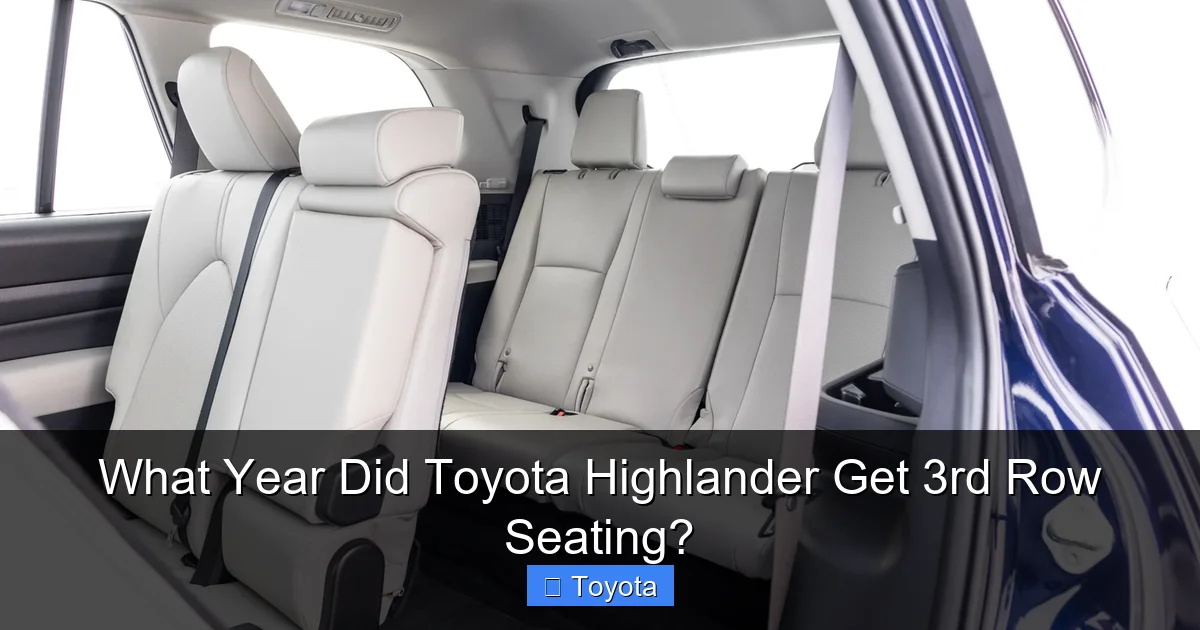
Visual guide about What Year Did Toyota Highlander Get 3rd Row Seating?
Image source: motortrend.com
2014-2020: Near-Universal Standard
Starting in 2014, every single Toyota Highlander, regardless of trim or engine (the V6 was now the only engine), came standard with a third-row seat. The choice was no longer *if* you got a third row, but *how many* seats you had (7 or 8) and what features it had.
- Standard Feature: Third-row seating became a core part of the Highlander’s value proposition.
- 7 vs. 8 Seats: The LE trim came with the 8-seat bench-second-row layout as standard. The XLE and higher trims offered the 7-seat layout with captain’s chairs as standard, with the 8-seat option available.
- Improved Usability: The third-row seat itself was more contoured. The folding mechanism was smoother, and the headrests were redesigned. While still best for children, the space for adults’ legs and heads improved noticeably over the previous generation.
The Current Fourth Generation (2020+)
The complete redesign for the 2020 model year (2021 in some markets) continued this tradition. The current Highlander is larger, more powerful (with a standard 3.5L V6 or optional hybrid powertrain), and more tech-laden than ever. The third row remains a standard feature on all models.
A notable change for the current generation is the slight reduction in maximum passenger capacity. The hybrid model, due to its battery pack location, is only available as a 7-seater (with second-row captain’s chairs). The gas-only V6 models are available as either 7- or 8-seaters. The third-row space is comparable to the previous generation—adequate for kids on long trips and manageable for smaller adults on shorter journeys.
Practical Implications: What “Third Row” Really Means
Knowing the year a third row became available is one thing; understanding its real-world utility is another. Across all generations, the Highlander’s third row has been a “child-sized” or “occasional adult” space. Here’s the practical breakdown.

Visual guide about What Year Did Toyota Highlander Get 3rd Row Seating?
Image source: i.ytimg.com
Space and Comfort Through the Years
The first and second generations (2004-2013) have very small third rows. Legroom is tight, and headroom can be compromised for taller passengers. The seat cushion is often thin and close to the floor, making it feel like a “kneeling” position rather than a proper chair. These are best reserved for children under 10 or very short adults for trips of under an hour.
The third and fourth generations (2014-present) offer a meaningful improvement. The floor is flatter, the seat cushion is thicker, and there’s more legroom. Teenagers and average-sized adults can fit for road trips of a few hours, though anyone over 5’10” will still find it cramped. The entry into the third row is also easier, with a wider opening and a slightly lower step-up.
Cargo Trade-Offs
The fundamental trade-off in any 3-row SUV is cargo space behind the third row. In the Highlander:
- 2004-2013: With the third row up, you have enough space for a few grocery bags or a couple of small suitcases. For serious family trips, you’ll likely need a roof rack. Speaking of which, check out our guide on the best roof rack for a Toyota Highlander to maximize your cargo capacity.
- 2014-Present: The space is slightly larger but still minimal. The current model offers about 16 cubic feet behind the third row—enough for a stroller and some bags. Folding the third row (which does so in a 60/40 split) creates a vast, flat load floor.
The Used Highlander Buyer’s Guide to Third-Row Seating
If you’re shopping the used market, the year you choose dictates not only the availability but also the value and practicality of that third row. Here’s a generation-by-generation buying guide.
First Generation (2004-2007): The Budget Entry
These are the most affordable used Highlanders with a third row. You’re looking at a vehicle that is now 17-20 years old. Reliability is generally good if well-maintained, but expect wear and tear. The 3.3L V6 is a proven engine. The key is verification. Use a VIN decoder or find the original window sticker. Also, inspect the third-row mechanism thoroughly—it should fold and latch smoothly. Be prepared for limited cargo space and a very small third row.
Second Generation (2008-2013): The Sweet Spot for Value
This generation represents the best balance of age, price, and third-row usability for many buyers. They are newer (11-16 years old), more reliable, and the third row, while still small, is a bit more functional. The 2010-2013 models, in particular, are excellent values. The 3.5L V6 (from 2011 onward) is a robust engine. Pay special attention to models from 2010-2011, as some early 3.5L engines had issues with excessive oil consumption—a topic covered in our article on what year Toyota Avalon should you avoid, which shares some powertrain lineage. A pre-purchase inspection is non-negotiable.
Third & Fourth Generations (2014-Present): The Modern Standard
These models offer the best third-row space, the most modern features (like rear-seat entertainment screens in some trims), and the highest safety ratings. Reliability is excellent. The choice between a 2014-2019 (third gen) and a 2020+ (fourth gen) often comes down to budget and preference for the newer styling and hybrid option. For the newest models, you might also want to read about the snow button in a Toyota Highlander to understand its all-weather capabilities if you live in a snowy climate.
Common Misconceptions and Final Thoughts
Let’s clear up a few frequent points of confusion about the Highlander’s third row.
Misconception 1: “All Highlanders Have Always Had a Third Row”
Absolutely false. The first three years (2001-2003) were strictly 5-passenger. Even after 2004, for several years, it was an expensive option on select trims. Assuming a random used Highlander has a third row is a surefire way to buy the wrong vehicle.
Misconception 2: “The Third Row is Spacious Enough for Adults on Long Trips”
This is largely a myth. While the current generation is better, the Highlander’s third row is designed for children or as emergency seating for adults. For regular, comfortable adult transport, a larger SUV like the Toyota Sequoia or a minivan would be a better choice. The Highlander prioritizes manageable exterior dimensions over maximum third-row space.
The Bottom Line
So, what year did the Toyota Highlander get 3rd row seating? The definitive answer is 2004, when it was first introduced as an option. However, its journey from a costly option on a few V6 models to the standard, expected feature it is today is the more important story. When choosing a Highlander, let your need for that third row—and your understanding of its real size—guide you to the correct model year and trim level. For families needing reliable, efficient, and reasonably spacious 3-row transportation, the post-2008 Highlander is a champion, with the 2014+ models truly perfecting the formula.
Frequently Asked Questions
Did the first model year Highlander (2001) have a third-row seat?
No. The 2001, 2002, and 2003 model year Highlanders were exclusively 5-passenger vehicles with two rows of seats. The third row was not introduced until the 2004 model year.
Can I get a third row on a 4-cylinder Toyota Highlander?
In the first generation (2004-2007), the third-row option was only available on V6 models. In the second generation (2008-2010), a 4-cylinder was briefly offered but the third row was not paired with it. From 2011 onward, the 4-cylinder was discontinued, so all third-row Highlanders have been V6 or hybrid V6.
Is the third-row seat removable?
No, in all generations, the third-row seat is a permanent, fixed installation that folds flat into the floor. It is not designed to be removed by the owner. Its design prioritizes flexibility between passenger and cargo space, not complete removal for maximum cargo volume.
How many people can the third row actually fit?
It varies by generation. The 2004-2013 models are best for children or small adults (under 5’8″). The 2014+ models offer more legroom and can accommodate average-sized adults for shorter trips, but anyone over 5’10” will find it very cramped. Legroom is the primary limiting factor, not headroom.
Does having a third row affect towing capacity?
Yes, but minimally. The maximum towing capacity for a Highlander is rated with the vehicle empty (only driver). Adding passengers and cargo, especially in the third row, reduces your available payload and can affect tongue weight. Always calculate your actual loaded weight against your specific model year’s payload and towing ratings. The difference between a 5-passenger and 8-passenger Highlander in terms of max tow rating is usually only a few hundred pounds.
What is the easiest year Highlander third row to access?
The third and fourth-generation Highlanders (2014-present) have the easiest access. The sliding second-row seats (on 7-seat models) provide a wider, lower opening. The folding mechanism of the third row is also smoother and requires less physical effort compared to the earlier, more cumbersome systems in the 2004-2013 models.
