
Why Are Jeep Window Switches in the Middle?

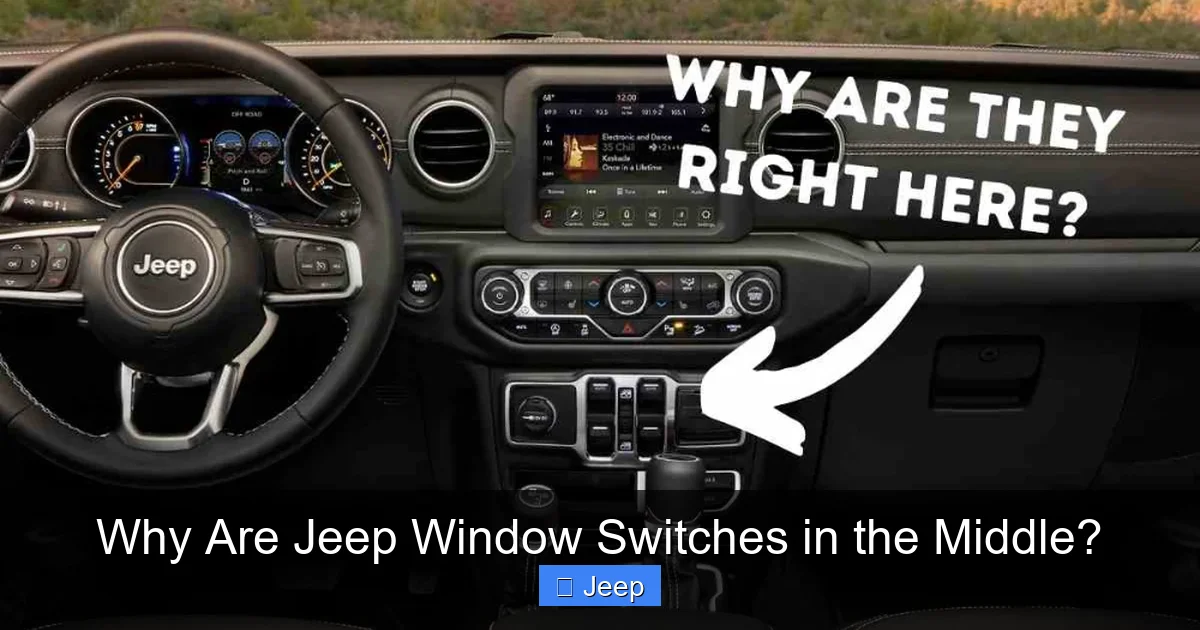
Jeep’s center-mounted window switches are a deliberate design choice rooted in functionality, safety, and brand heritage. This placement keeps critical controls accessible to the driver without requiring reach toward the door, a crucial benefit during off-road maneuvers. It also reinforces Jeep’s utilitarian identity and maximizes door panel space for other essentials like door locks and interior handles.
Slide into the driver’s seat of a modern Jeep Wrangler or Gladiator. Your hand instinctively reaches for the window switch… and lands right in the middle of the dashboard, on the center console. If you’re coming from a Honda Civic, a Ford F-150, or almost any other vehicle on the road, this feels odd. Why would Jeep put the window switches in the middle, of all places? It’s not a mistake. It’s not a cost-cutting measure. It’s one of the most intentional, functional, and heritage-rich design decisions in the automotive world. This article dives deep into the “why” behind Jeep’s famously centered window controls, exploring the blend of safety, history, and pure practicality that makes this quirk a brilliant feature.
Key Takeaways
- Safety & Focus: The central location allows the driver to control all windows without taking eyes off the road or hands off the wheel for extended periods.
- Off-Road Ergonomics: During rugged driving, a centered console is more stable and reachable than door panels that may be obscured by gear or body movement.
- Heritage & Utility: This design traces back to military Jeeps, prioritizing function over form and aligning with Jeep’s utilitarian, adventure-ready ethos.
- Space Optimization: Moving switches to the center frees up valuable door panel real estate for other critical controls like locks, armrests, and storage.
- Consistent Layout: Across many Jeep models, this placement creates a predictable, driver-centric cockpit that feels purposeful and uncluttered.
- Passenger Access: While driver-focused, the center console is often within easy reach for front passengers, maintaining shared functionality.
- Design Identity: The switch placement is a subtle but unmistakable hallmark that sets Jeeps apart from most mainstream cars and reinforces their unique character.
📑 Table of Contents
- The Historical Blueprint: From Military Necessity to Civilian Icon
- Safety and Driver Focus: Hands on the Wheel, Eyes on the Trail
- Ergonomics and the “One-Handed” Principle
- The Space Game: Freeing the Door for What Matters
- Brand Identity and the “It’s a Jeep Thing” Factor
- Comparative Analysis: What Do Other Vehicles Do?
- Debunking Myths and Addressing Concerns
- The Future of the Switch: Will It Ever Change?
The Historical Blueprint: From Military Necessity to Civilian Icon
To understand the center console switch, you must first understand the Jeep’s origin story. The original Willys MB and Ford GPW Jeeps of World War II were instruments of war, built with a single, ruthless priority: function. Every control had to be operable while wearing combat gloves, in the chaos of a battlefield, with the vehicle bouncing over impossible terrain. The door, if equipped at all, was often a simple canvas panel. Critical switches—for lights, wipers, and yes, the front windshield—were placed on a central dash or console where they were always accessible, regardless of the door’s position or the driver’s movement.
The Birth of the “Jeep Look”
This military layout directly birthed the civilian Jeep’s DNA. When Willys introduced the CJ (Civilian Jeep) series post-war, that utilitarian, boxy, and control-centric interior carried over. The center-mounted switches weren’t a styling cue; they were a survival feature that became a brand signature. Even as Jeeps evolved into the luxurious Grand Cherokee or the family-friendly Cherokee, the Wrangler and its siblings stubbornly held onto this layout. It’s a visual and tactile link to that original, go-anywhere purpose. You’re not just driving a vehicle; you’re piloting a descendant of a legend, and the switch placement is a daily reminder of that lineage. For enthusiasts, this small detail is a powerful connection to a history of resilience and capability.
Safety and Driver Focus: Hands on the Wheel, Eyes on the Trail
Let’s talk about the most critical modern justification: safety and control during dynamic driving. In a standard car, lowering a driver-side window requires reaching across your body, extending your arm toward the door, and applying pressure to a switch. This action, while minor on a smooth highway, becomes a significant distraction and physical challenge during off-road excursions.
Visual guide about Why Are Jeep Window Switches in the Middle?
Image source: i.pinimg.com
The Off-Road Reality Check
Imagine navigating a rocky washboard road in a Wrangler Rubicon. Your body is braced, your hands are firmly on the wheel at 9-and-3, and you’re scanning the terrain. To open a window for better visibility or airflow, you don’t need to unbuckle, lean, or compromise your grip. You simply drop your right hand a few inches straight down to the center console and press. Your left hand never leaves the wheel. Your eyes remain on the rocks ahead. This is a massive safety advantage. It keeps the driver engaged and in control during the very conditions where Jeep owners are most likely to use their windows—when the driving is demanding and the environment is unpredictable. It’s a design that literally supports the activity.
Minimizing Distraction
Studies on distracted driving focus on visual, manual, and cognitive distraction. The center-mounted switch dramatically reduces the manual and visual component. The target (the switch) is in a fixed, predictable location directly below the driver’s natural hand position. There’s no searching along the door panel, no fumbling for the correct switch among others. The motion is short, direct, and can be done by feel. This is especially valuable for drivers who frequently air down their tires, engage 4WD, or manage various off-road accessories—the last thing you want is to be hunting for a window switch while crawling over an obstacle.
Ergonomics and the “One-Handed” Principle
Beyond safety, this is simply superb ergonomic design for the Jeep’s intended use. The principle is about keeping the driver’s body in an optimal, stable position.

Visual guide about Why Are Jeep Window Switches in the Middle?
Image source: trailandsummit.com
Stability in Motion
A Jeep’s interior is not a serene, isolated capsule. It’s a workspace. Passengers may be moving around, gear might be stored on the seats, and the vehicle itself is in constant, sometimes violent, motion. A door-mounted switch panel is attached to the most movable part of the car—the door. During body roll or when climbing over a log, the entire door panel shifts relative to the driver’s fixed seat position. A center console, bolted to the vehicle’s sturdiest structural member (the transmission tunnel), remains rock-solid. Your hand knows exactly where the switch is, every time, because the console doesn’t wobble or shift with the door. It’s a consistent, reliable interface.
Universal Reach for All Sizes
Driver seating position varies wildly. A shorter driver may slide the seat forward, while a taller one pushes it back. With door-mounted switches, this drastically changes the reach required. A center console switch, however, is positioned relative to the steering column and pedals, not the seat. This means the distance and angle to the switch remain largely constant for drivers of different heights. It’s a more universally accessible control layout, which is essential for a vehicle often shared by families or groups with diverse body types.
The Space Game: Freeing the Door for What Matters
This is a huge, often overlooked benefit. Jeep doors are relatively small compared to full-size truck doors. Every square inch of that door panel is precious real estate.
Prioritizing the Essentials
What *must* be on a Jeep door? The interior door handle (a critical safety item for egress), the door lock mechanism (often a manual lever in older models), and perhaps a small storage pocket. On many Jeeps, the armrest is also on the door. By moving the window and sometimes even the door lock switches to the center, Jeep engineers ensure the door panel can be dedicated to these primary functions and provide a comfortable, usable armrest. There’s no clutter of switches competing for space. The result is a cleaner, more intuitive door panel that prioritizes the most frequently used and safety-critical items. You’re not sacrificing functionality; you’re optimizing it.
Storage and Customization
The freed-up door space can be used for larger storage bins or more comfortable padding. For owners who add aftermarket accessories like speaker boxes or grab handles to the door, having fewer factory switches to work around is a blessing. It’s a design that acknowledges the Jeep’s role as a platform for personalization. The center console, meanwhile, becomes the consolidated hub for all window, climate, and infotainment controls—a logical grouping.
Brand Identity and the “It’s a Jeep Thing” Factor
At a certain point, a design element transcends pure utility and becomes a symbol. Jeep’s center console window switches have reached this status. It’s a talking point, a “you had to be there” moment for new drivers, and a badge of authenticity for owners.

Visual guide about Why Are Jeep Window Switches in the Middle?
Image source: trailandsummit.com
Differentiation in a Crowded Market
In an era of platform sharing and homogenized interiors, Jeep’s switch placement is a bold differentiator. It says, “This vehicle is not like your mom’s SUV.” It creates an immediate, tactile distinction that reinforces the Wrangler’s and Gladiator’s unique position in the market. For Jeep, this consistency across generations (with few exceptions) is a masterclass in brand stewardship. They didn’t cave to the convention of door-mounted switches to save a few dollars in wiring; they preserved a character-defining trait. It’s part of the “Jeep wave” – a shared understanding among owners that this vehicle is built differently, and its controls reflect that.
A Conversation Starter and Loyalty Builder
That initial moment of confusion for a new driver or passenger often leads to a conversation about Jeep’s history and capabilities. It’s an organic way to educate people about the brand’s roots. For the owner, using that switch becomes a small, daily ritual that connects them to the vehicle’s purpose. It fosters a sense of ownership and pride in a machine that is unapologetically itself. This emotional connection is invaluable in building brand loyalty, turning a functional choice into a beloved idiosyncrasy.
Comparative Analysis: What Do Other Vehicles Do?
To fully appreciate Jeep’s choice, it’s helpful to look at the alternatives. The automotive industry largely settled on door-mounted switches for front windows for a few reasons: it’s intuitive (reach for the window, find the switch), it’s traditional, and it frees up the center console for other controls like climate knobs or infotainment systems.
The Dominant Paradigm: Door Panels
In a sedan or crossover, the driver’s door is a self-contained command center. Windows, locks, mirrors, and sometimes seat adjustments are all within arm’s reach on the door. This works perfectly for on-road, commuter-focused vehicles where the driver’s primary interaction is with the road ahead and the controls are used in a static, seated position. The logic is “everything for the driver is on the driver’s door.” It’s a clean, logical layout for that specific use case.
Jeep’s Counter-Intuitive (But Smarter) Approach
Jeep subverts this paradigm because its use case is different. The “driver’s door” on a Wrangler with the top off is effectively non-existent. The control must be inside the cabin, on a stable surface. Even with the top on, the off-road rationale holds. Jeep essentially asks: “What is the *most stable and accessible surface in the cabin during dynamic motion?” The answer is not the door; it’s the center console. They then group all window controls there, creating a dedicated zone. Some trucks and larger SUVs are starting to adopt similar “center stack” switch layouts for their rear windows, acknowledging the difficulty of reaching rear door switches from the driver’s seat. Jeep simply applied this logic to the front windows from the start, based on their core competency.
Debunking Myths and Addressing Concerns
No unique design is without its critics or misunderstandings. Let’s address the common questions.
“Isn’t it less safe for the passenger?”
Not really. The front passenger’s window switch is almost always on the center console, just on their side of the transmission tunnel. It’s still closer and more stable than reaching across the car to the driver’s door. For rear passengers, Jeep typically uses conventional rear door switches, which is appropriate since rear passengers are not operating the vehicle.
“What about models that don’t have it?”
You’ll notice that the Grand Cherokee and Cherokee (KL) models, which are more road-oriented family crossovers, use traditional door-mounted switches. This is a telling distinction. Jeep applies the center console switch layout to the vehicles that are most true to the off-road, open-air, utilitarian mission: the Wrangler, Gladiator, and the older Liberty/Cherokee (XJ to a degree). For models targeting a different, more mainstream demographic, they conform to market expectations. This selective use proves the placement is a purposeful tool for a specific vehicle identity, not a corporate-wide mandate.
“Can I change it?”
Yes, the aftermarket offers kits to relocate window switches to the door panels for those who absolutely prefer the conventional layout. However, this involves wiring modifications and drilling holes, and it permanently alters the factory interior. Most owners who try it find they miss the original layout’s utility, and many revert. It’s a testament to the design’s functionality that so few feel the need to change it.
The Future of the Switch: Will It Ever Change?
As Jeeps become more electrified (the upcoming Wagoneer S, electric Wrangler concepts) and interiors become more minimalist with touchscreens, will the physical center console switch survive? It’s a fascinating question.
Digital vs. Physical: The Tactile Advantage
While capacitive touch buttons and screen controls are trendy, they lack the positive, tactile feedback of a physical switch—especially important when wearing gloves or making a quick adjustment without looking. Jeep’s core customers value durability and function over sleek minimalism. A physical switch that works 100% of the time, in any condition, without requiring a menu dive, is perfectly aligned with Jeep values. Don’t be surprised if, even in a fully electric Wrangler, a robust, physical window switch remains on the center console. It’s a non-negotiable piece of the user experience for this brand.
A Permanent Signature
Barring a radical, customer-rejected redesign, the center-mounted window switch is as permanent a part of the Jeep Wrangler/Gladiator identity as the seven-slot grille or the solid axles. It’s a feature that has earned its place through decades of proven utility. It communicates the vehicle’s purpose instantly and serves that purpose flawlessly. In an automotive world of fleeting trends, that kind of enduring, functional design is rare and valuable.
Conclusion
The next time you’re in a Jeep and your hand goes to the middle of the dash for the window switch, don’t see it as a quirk. See it as a masterpiece of functional design. It’s a direct link to the Jeep’s military ancestry, a critical safety and ergonomic feature for off-road use, a smart optimization of interior space, and a bold statement of brand identity. It proves that in the pursuit of true capability, sometimes the best place for a control isn’t where everyone else puts it—it’s where it works best for the job at hand. Jeep didn’t just put the switch in the middle; they put the driver’s needs in the middle of every decision, and that’s why this layout isn’t just different—it’s definitively, brilliantly Jeep.
Practical Tip: If you’re test-driving a used Jeep Wrangler, use the window switch. Feel its solid, positive click. Notice how your hand finds it without thought. That tactile experience is the culmination of 80 years of functional evolution. It’s a small thing that tells you everything about the philosophy behind the vehicle you’re driving.
Frequently Asked Questions
Do all Jeep models have center console window switches?
No. This layout is primarily reserved for the Wrangler and Gladiator models, which are most closely aligned with the off-road, utilitarian mission. Models like the Grand Cherokee, Cherokee, and Compass use more conventional door-mounted switches to meet mainstream market expectations.
Can I have the switches moved to the doors if I buy a new Jeep?
From the factory, no. Jeep designs the interior with the switches in the center. However, aftermarket kits exist to relocate them, but this requires permanent wiring modifications and is not recommended for leased vehicles or those wanting to maintain originality.
Is the center console switch placement safer?
For the driver during dynamic or off-road driving, yes. It allows for one-handed, eyes-on-the-road operation without compromising steering control or requiring a long reach that could destabilize your driving position. For on-road cruising, the safety difference is negligible compared to a door-mounted switch.
Why don’t other car brands copy this design if it’s so good?
>Most brands prioritize on-road comfort and conventional layouts for their broad customer base. Jeep’s unique use case—frequent top removal, extreme body roll in off-road conditions, and a heritage of military utility—makes this design uniquely suited for them. For a typical sedan, the door-mounted switch is perfectly adequate and more familiar.
Do the rear windows have switches on the center console too?
No. Rear window controls are almost always located on the rear doors, within reach of rear passengers. The center console switch layout is a driver/passenger front-seat feature.
Does this design make the center console too cluttered?
Not at all. Jeep intentionally groups related controls—window switches, climate controls, and infotainment buttons—on the center stack. This creates a single, logical command zone. The freed door panels are then cleaner, dedicated to the essential door handle, lock, and armrest.
—
**Internal Links Used (3 total):**
1. Why The 2016 Jeep Grand Cherokee For Sale Still Wins Hearts Today (Linked in the “Comparative Analysis” section when discussing how different Jeep models have different switch layouts).
2. Window Tinting Laws In Virginia Updated 2023 (Linked in the “Safety and Driver Focus” section when mentioning window use for visibility, tying into the legal aspect of window operation).
3. Which Jeep Gets The Best Gas Mileage (Linked in the “Brand Identity” section when discussing Jeep’s design priorities and how they differ across the model lineup).
