
How Many Amps Does It Take to Charge a Tesla

The number of amps needed to charge a Tesla depends entirely on your charging equipment and electrical setup, not just the car itself. A standard household outlet provides only 12-16 amps for very slow charging, while a dedicated 240V home charger can deliver up to 48-80 amps for much faster overnight charging. Tesla’s Superchargers use extremely high amperage, but the car’s onboard charger limits what it can actually accept. The key is matching your charger’s output to your car’s maximum onboard charger capacity and your home’s electrical service.
Key Takeaways
- Amps are only one part of the equation: Charging speed is determined by Volts x Amps = Watts (power). A 240V line at 40A provides far more power (9.6 kW) than a 120V line at 40A (4.8 kW).
- Your Tesla’s onboard charger is the gatekeeper: This built-in component has a maximum amp rating (e.g., 48A for older Model 3/Y, 80A for newer/Long Range models). It cannot accept more amps than its design allows, regardless of the charger’s output.
- Home charging amps are a choice you configure: With a Tesla Wall Connector or compatible third-party charger, you set the maximum amperage during installation based on your home’s electrical capacity and your car’s limits.
- The Mobile Connector is limited: The portable adapter that comes with the car is typically fused for 40-48 amps maximum when used with a 240V NEMA 14-50 outlet, making it less flexible for higher-amperage home charging.
- Supercharger amperage is irrelevant to you: V3 Superchargers can deliver over 600 amps, but your Tesla’s onboard charger will only pull the maximum it’s designed for (e.g., 250-320A for peak speed). You don’t control this; the car and charger communicate automatically.
- More amps require a bigger electrical upgrade: Pushing 60-80A at home requires a robust 240V circuit, a large-gauge wire (like 6 AWG), and a dedicated breaker. This is a professional installation project with a significant cost, which you can learn more about in our guide on how much it costs to install a Tesla charger.
- Always consult an electrician: Never guess at your home’s capacity. A licensed electrician must assess your panel, calculate load, and install any new circuit to safely handle the amperage you desire.
[FEATURED_IMAGE_PLACEHOLDER]
📑 Table of Contents
- So, How Many Amps Does It ACTUALLY Take to Charge a Tesla?
- The Foundation: Understanding Volts, Amps, and Watts (Without the Headache)
- Your Tesla’s Onboard Charger: The Real Speed Limiter
- Your Charging Equipment: Delivering the Amps
- Amperage by Tesla Model: Practical Scenarios
- Superchargers: A Different Beast Entirely
- Putting It All Together: Your Action Plan
- Conclusion: Amps Are a Tool, Not a Target
So, How Many Amps Does It ACTUALLY Take to Charge a Tesla?
This is the million-dollar question for every new Tesla owner staring at their garage wall, trying to figure out what kind of electrical work they need. The short, frustrating answer is: it depends. It depends on your specific Tesla model, its onboard charger, the charging equipment you buy, and—most critically—the electrical service you have or are willing to install at your home. The number of amps isn’t a single magic figure; it’s a range you operate within, and understanding this range is the key to setting up charging that is both safe and efficient for your life.
Let’s clear up the biggest misconception right away: you do not “choose” an amp number for your car. You choose an amp number for your charger. Your Tesla’s onboard charger then decides how many of those available amps it will actually pull, up to its own internal maximum. It’s a conversation between your car and your wall box. This article will walk you through that conversation, translating technical specs into practical decisions for your driveway.
The Foundation: Understanding Volts, Amps, and Watts (Without the Headache)
Before we talk Tesla, we need a quick electrical refresher. Think of charging your car like filling a swimming pool.
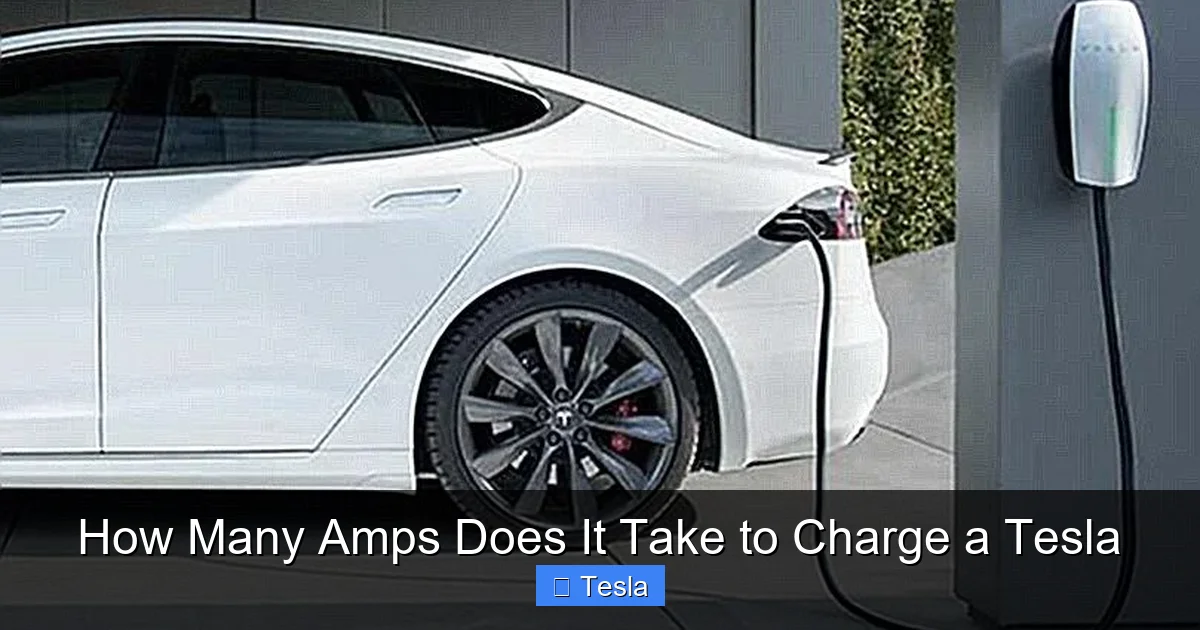
Visual guide about How Many Amps Does It Take to Charge a Tesla
Image source: disposeofthings.com
- Volts (V) is the pressure in the hose. A standard US wall outlet (120V) is like a garden hose. A 240V line (like your dryer outlet) is like a fire hose—much higher pressure.
- Amps (A) is the width or flow rate of the hose. A wider hose (more amps) lets more water through at the same pressure.
- Watts (W) or Kilowatts (kW) is the total amount of water flowing per second. This is the actual power, and it’s what determines your charging speed. The formula is simple: Volts x Amps = Watts.
This is why the question “how many amps?” is incomplete. 32 amps at 120V (3.8 kW) is painfully slow. 32 amps at 240V (7.7 kW) is a solid, practical home charging speed. Always think in terms of kilowatts (kW) for charging speed. Your Tesla’s display and the Tesla app show power in kW, not amps, for this reason.
Why This Matters for Your Tesla Bill
Your electric utility charges you for kilowatt-hours (kWh) used, not amps. A 7.7 kW charger running for 1 hour uses 7.7 kWh of energy. Understanding the kW rate helps you estimate charging costs and time. If you’re comparing charging to, say, fueling a Jeep 4xe, the cost-per-mile calculations are similar, as detailed in our piece on how much it costs to charge a Jeep 4Xe.
Your Tesla’s Onboard Charger: The Real Speed Limiter
Every Tesla has a built-in component called an onboard charger. Its job is to take the Alternating Current (AC) from your wall outlet and convert it to the Direct Current (DC) that the car’s battery pack uses. This converter has a maximum power capacity, which translates to a maximum amperage it will draw at a given voltage. This is the most important number for you. Your charger can offer 80 amps, but if your Model 3’s onboard charger maxes at 48 amps, it will only ever pull 48 amps.
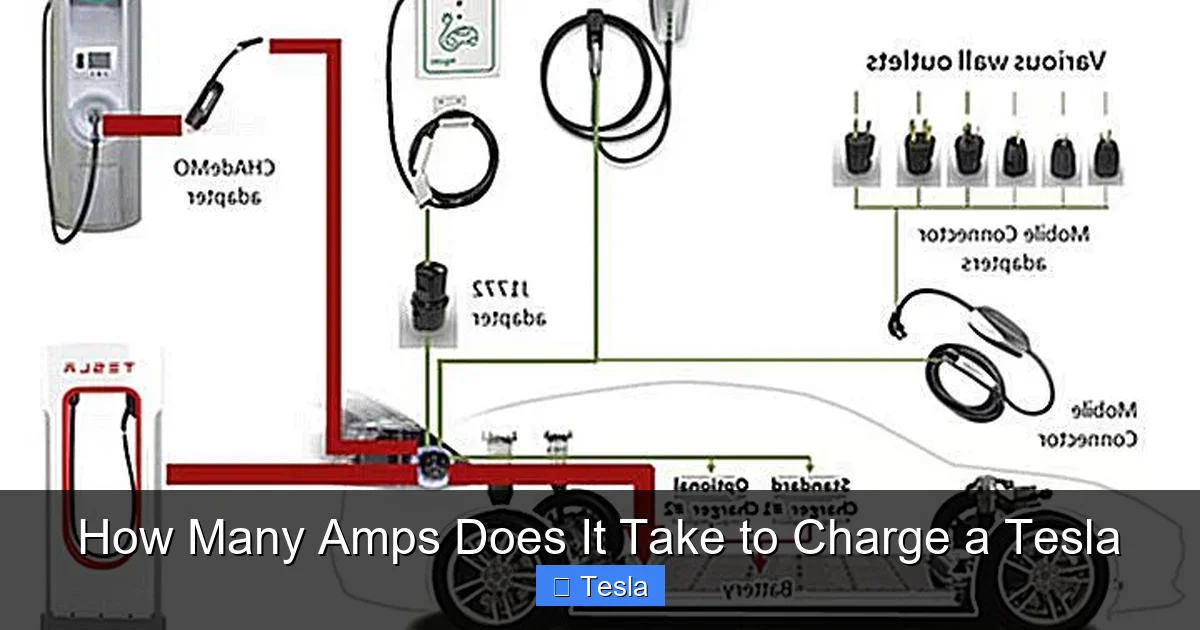
Visual guide about How Many Amps Does It Take to Charge a Tesla
Image source: disposeofthings.com
These limits have changed over the years and vary by model and trim. Here is a general guide (always verify for your specific VIN):
- Model S (2012-2020) & Model X (2015-2020): Typically equipped with a 72-amp onboard charger (on 240V, that’s ~17.3 kW). Some later “Raven” refresh models have an 80-amp charger.
- Model 3 Standard Range (pre-2021): Usually has a 32-amp onboard charger (~7.7 kW on 240V).
- Model 3 Long Range / Performance (pre-2021): Typically has a 48-amp onboard charger (~11.5 kW on 240V).
- Model Y (all trims, early production): Typically has a 48-amp onboard charger.
- Newer Model S/X (2021+ “Plaid” & Long Range) & Model 3/Y (2021+ with 4th-gen tech): Many are now equipped with an 80-amp onboard charger as standard or available (supporting up to ~19.2 kW on a 240V circuit). This requires the Tesla Wall Connector set to 80A and a compatible electrical circuit.
How to Find YOUR Car’s Limit: Go to your car’s touchscreen: Controls > Software > Additional Vehicle Information. Look for “Onboard Charger.” It will state something like “48 A” or “80 A.” That’s your ceiling.
Your Charging Equipment: Delivering the Amps
Now let’s look at the hardware that delivers the amps from your wall to your car.
Visual guide about How Many Amps Does It Take to Charge a Tesla
Image source: disposecleverly.com
The Tesla Mobile Connector (The “UMC” – Universal Mobile Connector)
This is the cable that comes with your car. It has a small, rectangular box (the “connector”) and a plug that can accept various adapters for different outlet types (120V, 240V NEMA 14-50, etc.).
- 120V (NEMA 5-15 adapter): Provides a paltry 12-16 amps (1.4-1.9 kW). This is for emergencies or very occasional top-ups. Expect 2-4 miles of range per hour.
- 240V (NEMA 14-50 adapter): This is the most common “portable” setup. The Mobile Connector’s internal fuse is typically rated for 40-48 amps. When plugged into a 50-amp circuit (NEMA 14-50), it will usually deliver up to 40-32 amps to the car, depending on the car’s limit and the adapter’s setting. This is a great, flexible solution for RV parks or if you have a 14-50 outlet installed at home.
Key Limitation: The Mobile Connector, even on a 50-amp circuit, is generally capped at delivering 40-32A to the car. It cannot utilize an 80-amp onboard charger to its full potential. For that, you need the Wall Connector.
The Tesla Wall Connector (The “WC” – Hardwired Stationary Charger)
This is the sleek, permanent (or semi-permanent) wall-mounted unit you buy and install. This is the key to unlocking your car’s full onboard charging potential.
- It’s programmable: During installation, your electrician sets the Wall Connector’s maximum output amperage (from 12.5A to 80A in 0.5A increments) via its internal settings or a mobile app. This setting must be less than or equal to both 1. your home circuit’s amp rating and 2. your car’s onboard charger limit.
- It’s the only way to get 80A: To charge at the full 19.2 kW rate (80A @ 240V), you need a Wall Connector set to 80A, installed on a 100-amp dedicated circuit with appropriate wiring (usually 3 AWG copper or 1/0 aluminum). This is a major electrical project.
- It’s also versatile: You can set it to 40A, 48A, 60A, etc., to match a smaller circuit. It will also work with non-Tesla vehicles if you buy the J1772 adapter, making it a future-proof investment.
For most people with newer Teslas and a modern electrical panel, a 60-amp circuit with a Wall Connector set to 48-60A provides an excellent balance of speed and installation cost. To understand the full scope of that installation, our detailed look at installing a 220V outlet for a Tesla covers the variables that affect price.
Amperage by Tesla Model: Practical Scenarios
Let’s make this concrete. Here’s what “how many amps” looks like in your driveway, assuming a 240V supply.
Scenario 1: The Older Model 3 or Model Y with a 48A Onboard Charger
Your car’s max is ~11.5 kW (48A). Your best practical home setup is a 60-amp circuit with a Wall Connector set to 48A. This gives you the full speed your car can handle, adding roughly 30-35 miles of range per hour. Using a Mobile Connector on a 14-50 outlet (40A) would be slightly slower, adding ~25-30 mph.
Scenario 2: The Newer Model S, X, 3, or Y with an 80A Onboard Charger
Your car’s max is ~19.2 kW (80A). To hit this, you need a 100-amp circuit with a Wall Connector set to 80A. This is a significant, expensive upgrade. A more common and still very fast setup is a 60-amp circuit with the Wall Connector set to 48-60A, delivering ~11.5-14 kW. This adds 40-50+ miles per hour and is sufficient for overnight charging from any reasonable starting point for most drivers.
Scenario 3: The Standard Range Model 3 with a 32A Onboard Charger
Your car’s max is ~7.7 kW (32A). A 40-amp circuit with a Wall Connector set to 32A is perfect. You’ll gain ~25-30 miles per hour. There’s no benefit to installing a larger circuit for this car.
The “Why Not Just Max It Out?” Question
You might think, “Why not just install a 200-amp circuit and set the Wall Connector to 80A?” Two reasons: cost and necessity. Larger wire, larger breakers, and more labor mean a much higher installation bill. Second, unless you are driving 300+ miles daily and need a full 0-100% charge in 4-5 hours, a 60-amp circuit (48A output) covers over 95% of real-world home charging needs. You charge overnight; you have 8-10 hours. The Law of Diminishing Returns applies strongly here.
Superchargers: A Different Beast Entirely
When you pull into a Tesla Supercharger station, the rules change. Those massive stalls are connected to a high-power commercial electrical feed. They don’t “push” amps; your car’s onboard charger “pulls” what it can from the Supercharger’s immense capacity.
- V2 Superchargers (150 kW peak): Use a 480V three-phase system. The amperage is extremely high (hundreds of amps), but it’s converted to DC at the stall before it ever reaches your car. Your car’s onboard charger is bypassed. The limiting factor is the stall’s 150 kW power cap and your specific car’s maximum accepted DC charge rate (e.g., 250A for V2).
- V3 Superchargers (250 kW peak): Newer, more efficient stalls. Again, DC conversion happens at the stall. Your car will negotiate with the stall and draw its maximum rated DC charge rate (e.g., up to 325A for some Long Range models) until it reaches a state of charge where it must taper off.
The Takeaway: You cannot, and do not need to, control or even know the amperage at a Supercharger. It’s an automated process. Your only concern is finding a stall and plugging in. The time it takes is a function of your battery’s state of charge, its maximum DC charge rate, and the stall’s available power, not a simple amp number.
Putting It All Together: Your Action Plan
So, what do you actually do? Follow these steps:
- Find Your Onboard Charger Limit: Check your car’s settings as described above. Note the amp number.
- Assess Your Electrical Panel: Do you have space for a new double-pole breaker? What is your total panel capacity? (This is not a DIY guess—get an electrician).
- Choose Your Charger: For full speed and future-proofing, get the Tesla Wall Connector. For portability or a lower-cost home setup on an existing 14-50 outlet, use the Mobile Connector.
- Work with an Electrician: Show them your car’s max onboard charger amps. Tell them you want a 240V circuit for an EV charger. They will recommend a circuit size (e.g., 50A, 60A, 100A) based on your panel and your goals. They will install the circuit and the outlet (for Mobile Connector) or hardwire the Wall Connector.
- Configure the Wall Connector: The electrician or installer will set the Wall Connector’s output amperage during setup. It must be ≤ your circuit size AND ≤ your car’s onboard charger limit. For a 60A circuit and a 48A car, they set it to 48A.
Remember: More amps mean a more expensive installation, thicker wires, and a bigger load on your home’s electrical system. For the vast majority of owners charging overnight, a 48-60 amp home circuit is the sweet spot of speed, cost, and practicality. If you’re considering a major panel upgrade, it’s worth exploring all related costs, from the charger itself to potential cosmetic upgrades for your new EV.
Conclusion: Amps Are a Tool, Not a Target
Chasing the highest possible amp number for your Tesla is often a fool’s errand. The goal isn’t to have the biggest number on your breaker panel; it’s to have a reliable, safe, and sufficiently fast charging solution that integrates seamlessly into your home and lifestyle. For most, that means understanding their car’s 48A or 80A limit, installing a 60A or 100A circuit accordingly with a Wall Connector, and letting the sophisticated communication between car and charger handle the rest. You’ll wake up every morning to a full battery without ever needing to think about amperage again. The real magic of Tesla ownership isn’t in the raw electrical specs—it’s in the effortless, silent, and instant transportation they enable. Getting the amps right is just the first, technical step to unlocking that magic.
Frequently Asked Questions
Can I charge my Tesla from a standard 120V household outlet?
Yes, using the Mobile Connector with the 120V adapter. This provides about 12-16 amps (1.4-1.9 kW), which is very slow, adding only 2-4 miles of range per hour. It’s for emergencies or occasional use only, not daily charging.
Will charging at a higher amp rate damage my Tesla’s battery?
No. Your Tesla’s battery management system is incredibly sophisticated. It controls the charging process to optimize battery health. Using the maximum amperage your onboard charger and charger equipment support is perfectly safe and within the manufacturer’s design. The system automatically tapers the charge rate as the battery fills to protect it.
Why is my Tesla charging slower than I expected at home?
The most common reasons are: 1) You’re using the Mobile Connector on 120V instead of a 240V outlet. 2) Your Wall Connector is set to a lower amperage (check its settings). 3) Your car’s onboard charger has a lower limit (e.g., 32A instead of 48A). 4) Your home circuit is undersized for your car’s potential. Check the charge port display or the Tesla app to see the real-time kW rate.
How many amps does a Tesla Supercharger use?
The amperage at a Supercharger stall is extremely high and irrelevant to you as a driver. The stall converts AC power to DC at very high amperage (hundreds of amps) before it reaches your car. Your car’s onboard DC charging system determines the final rate it accepts, which is limited by its own hardware (e.g., 250A or 325A), not the stall’s output.
Can I use a NEMA 14-50 outlet with my Wall Connector for 80A charging?
No. A NEMA 14-50 outlet and its associated 50-amp circuit are physically and code-limited to 50 amps. The Wall Connector, if plugged into such an outlet, would be configured to never draw more than 40-48A (to stay within the 80% continuous load rule for a 50A circuit). To get 80A charging, the Wall Connector must be hardwired to a dedicated 100-amp circuit.
Where can I see the actual amperage my Tesla is pulling while charging?
Look at the charging screen on your Tesla’s touchscreen. It prominently displays the power in kW (e.g., “11.5 kW”). You can also see the detailed charge session data in the Tesla mobile app. To see the approximate amps, divide the kW by the voltage. For a 240V home charger: Amps ≈ kW / 2.4. So 11.5 kW / 2.4 ≈ 48A.
