
What Does 94h Mean on a Tire

The “94H” on a tire combines a load index of 94 (1,477 lbs per tire) and a speed rating of H (up to 130 mph). This code ensures your tires can safely handle your vehicle’s weight and speed demands under normal driving conditions.
Have you ever glanced at the side of your car tire and noticed a string of numbers and letters like “225/50R17 94H”? If you’re like most drivers, you probably didn’t think much of it—until something went wrong. Maybe you were shopping for new tires and saw “94H” listed on a few options, and suddenly you’re wondering: What does that even mean? Is it important? Could it affect how your car drives, handles, or stays safe on the road?
The truth is, that little “94H” code is packed with vital information about your tire’s capabilities. It tells you exactly how much weight the tire can carry and how fast it can safely go. Ignoring it could lead to poor performance, faster wear, or even dangerous situations—especially at high speeds or under heavy loads. Whether you’re driving a compact sedan, a family SUV, or a sporty coupe, understanding what 94H means on a tire helps you make smarter, safer choices when it comes to maintenance and replacement.
In this guide, we’ll break down the meaning of 94H in simple terms, explain how it affects your driving experience, and show you why it’s not just a random label—it’s a critical part of your vehicle’s safety system. By the end, you’ll know exactly what to look for when buying tires and how to keep your car running smoothly and safely.
Key Takeaways
- 94 is the load index: It indicates the maximum weight each tire can support—1,477 pounds at maximum inflation pressure.
- H is the speed rating: It means the tire is certified to safely sustain speeds up to 130 miles per hour.
- Proper matching is essential: Always replace tires with the same or higher load and speed ratings as recommended by your vehicle manufacturer.
- Affects safety and performance: Using incorrect ratings can compromise handling, braking, and fuel efficiency.
- Check your owner’s manual: The recommended tire specs are listed there or on the driver’s side door jamb sticker.
- Season and driving style matter: High-speed ratings like H are common on sedans and coupes, while heavier vehicles may need higher load indexes.
- Never mix ratings without expert advice: Mixing different load or speed ratings can create uneven wear and safety risks.
📑 Table of Contents
- Understanding Tire Markings: The Basics
- What Does the “94” in 94H Mean? The Load Index Explained
- What Does the “H” in 94H Mean? The Speed Rating Decoded
- Why 94H Matters for Your Vehicle’s Safety and Performance
- How to Find the Right Tire Specifications for Your Car
- Common Mistakes to Avoid When Choosing Tires
- Conclusion: Making Smart Tire Choices for a Safer Drive
Understanding Tire Markings: The Basics
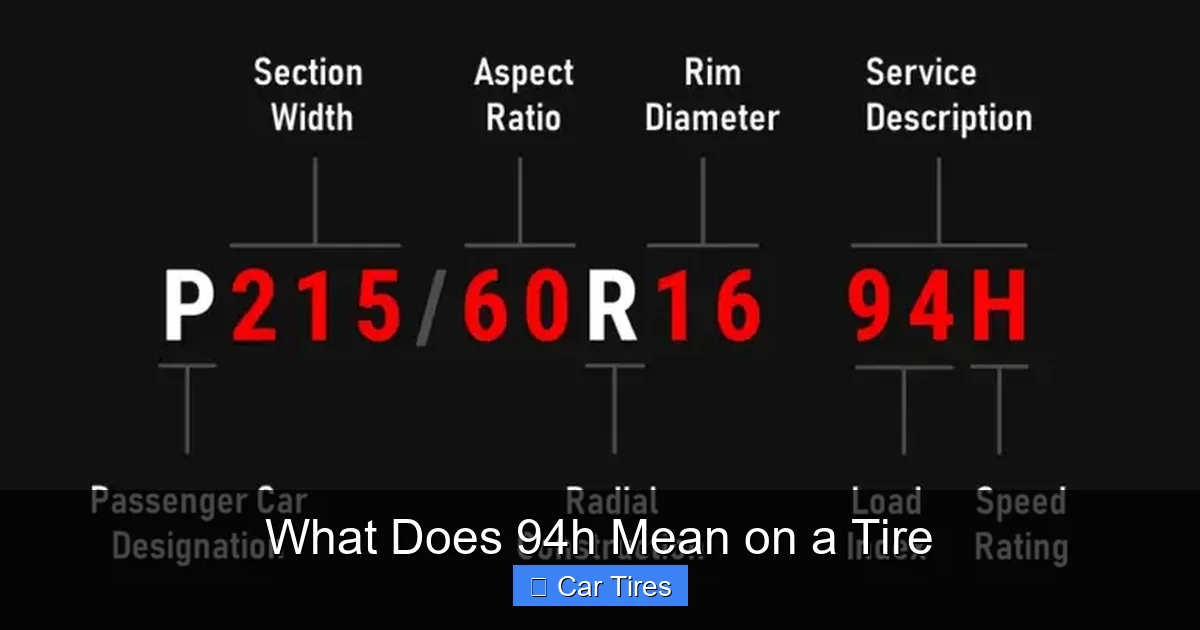
Before we dive into the specifics of “94H,” it helps to understand the full context of tire sidewall markings. These codes are like a tire’s birth certificate—they tell you everything from its size and construction to its performance limits. The full sequence usually looks something like this: 225/50R17 94H. Let’s decode it piece by piece.
The first number, “225,” refers to the tire’s width in millimeters from sidewall to sidewall. The second number, “50,” is the aspect ratio—the height of the sidewall as a percentage of the width. So a 50 aspect ratio means the sidewall is 50% as tall as the tire is wide. The “R” stands for radial construction, which is the most common type today, and “17” is the diameter of the wheel (in inches) that the tire is designed to fit.
Now, the part we’re focusing on—“94H”—comes at the end. This is known as the service description, and it includes two key pieces of information: the load index (94) and the speed rating (H). These aren’t just suggestions; they’re performance limits set by international standards to ensure safety and consistency across tire brands and models.
Understanding these markings helps you choose the right tires for your vehicle. For example, if your car came with 94H tires, replacing them with a lower load index or speed rating could put you at risk. On the other hand, going higher is usually safe—but not always necessary. The goal is to match or exceed the manufacturer’s recommendations without overpaying for features you don’t need.
What Does the “94” in 94H Mean? The Load Index Explained
Visual guide about What Does 94h Mean on a Tire
Image source: alltirechains.com
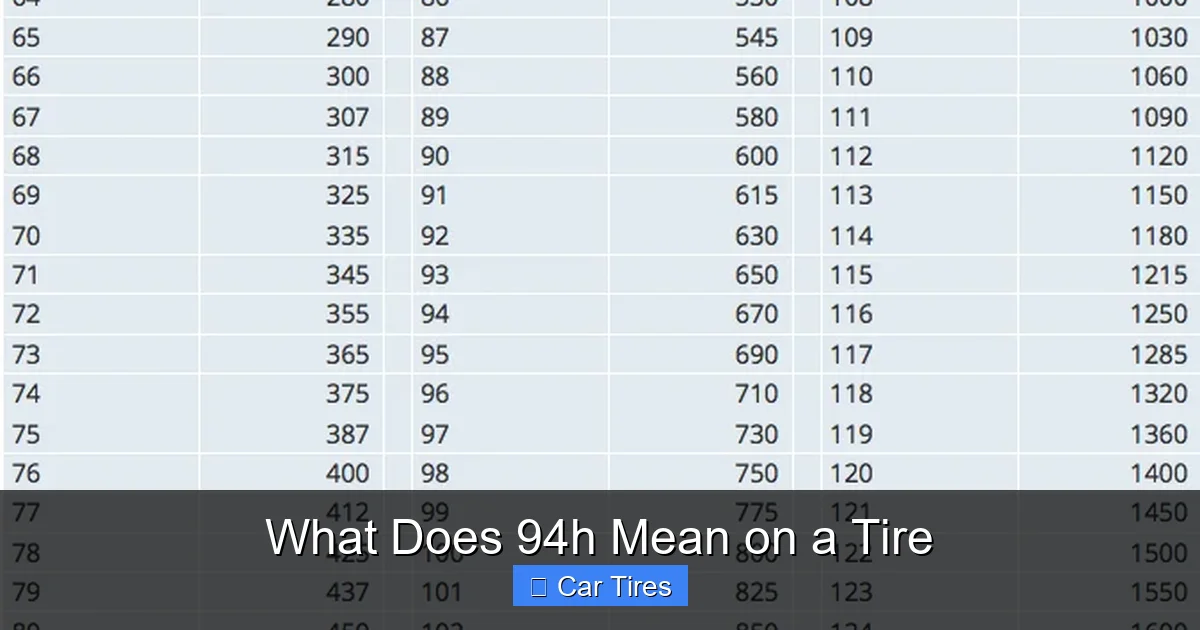
The “94” in 94H is called the load index. It’s a numerical code that tells you the maximum weight each tire can safely carry when properly inflated. But here’s the catch: the number doesn’t directly represent pounds or kilograms. Instead, it corresponds to a standardized chart created by the Tire and Rim Association (TRA) and used globally.
So what does 94 actually translate to in real-world terms? According to the load index chart, a load index of 94 means each tire can support up to 1,477 pounds (670 kilograms) at maximum air pressure. That’s per tire—so on a four-wheel vehicle, the total load capacity would be 5,908 pounds. This includes the weight of the car itself, passengers, cargo, and even fuel.
Why is this important? Because overloading your tires—even by a small amount—can cause excessive heat buildup, tread separation, or even blowouts. It also puts extra strain on your suspension and braking systems. For example, if you regularly carry heavy tools, luggage, or multiple passengers, you need tires that can handle that extra weight without failing.
Most passenger cars, sedans, and light SUVs use load indexes between 80 and 100. A 94 is fairly common for midsize sedans and crossovers. If you drive a larger SUV or truck, you might see higher numbers like 105 or 110. Always check your vehicle’s owner’s manual or the tire information placard (usually on the driver’s door jamb) to find the recommended load index.
One common mistake drivers make is assuming that all tires with the same size can carry the same weight. That’s not true. Two tires that are both 225/50R17 might have different load indexes—say, 91 and 94—meaning one can carry more weight than the other. Always match or exceed the original load index when replacing tires.
What Does the “H” in 94H Mean? The Speed Rating Decoded
Visual guide about What Does 94h Mean on a Tire
Image source: alltirechains.com
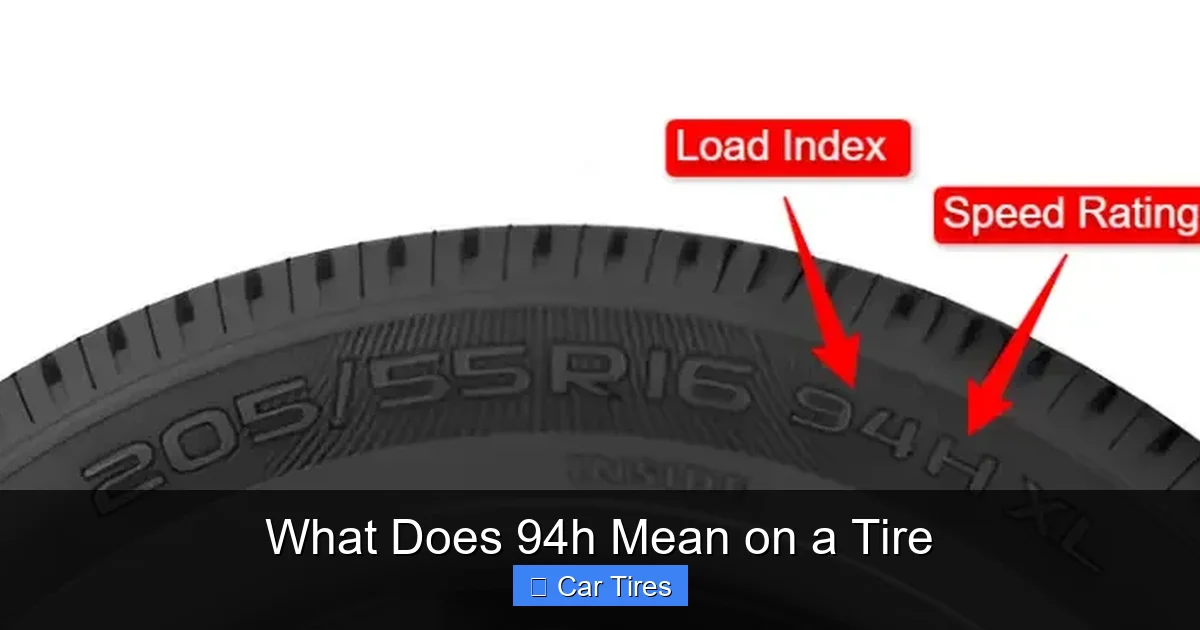
Now let’s talk about the “H” in 94H. This is the speed rating—a letter code that indicates the maximum speed a tire can safely maintain under optimal conditions. Unlike the load index, which is a number, the speed rating uses letters from A to Z, with each representing a specific speed range.
The “H” rating means the tire is certified to handle sustained speeds of up to 130 miles per hour (210 kilometers per hour). This doesn’t mean you should drive that fast—most speed limits are far lower—but it ensures the tire can withstand the heat and stress generated at high speeds without failing.
Speed ratings are determined through rigorous testing. Tires are mounted on a test wheel and run at increasing speeds until they reach their rated limit. They must maintain structural integrity and performance throughout the test. If a tire passes, it earns its letter rating.
Here’s a quick reference for common speed ratings:
– S: Up to 112 mph
– T: Up to 118 mph
– H: Up to 130 mph
– V: Up to 149 mph
– W: Up to 168 mph
– Y: Up to 186 mph
So why does this matter for everyday driving? Even if you never hit 130 mph, the speed rating affects how the tire handles at normal highway speeds. A higher-rated tire like H is built with stronger materials, better heat resistance, and improved tread compounds. This translates to better grip, shorter braking distances, and more stable cornering—especially in wet or hot conditions.
For example, if your car came with H-rated tires, replacing them with T-rated ones (118 mph max) might save you a few dollars, but you’re sacrificing performance and safety. The tire may overheat or wear out faster at highway speeds, increasing the risk of failure.
Most family sedans, coupes, and crossovers use H-rated tires because they offer a great balance of performance, durability, and cost. Sports cars and high-performance vehicles often use V, W, or Y ratings. Always follow your manufacturer’s recommendation—don’t go lower than the original speed rating.
Why 94H Matters for Your Vehicle’s Safety and Performance
Visual guide about What Does 94h Mean on a Tire
Image source: images1.blackcircles.com.s3.amazonaws.com
Now that you know what 94H means—1,477 lbs load capacity and 130 mph speed limit—you might be wondering: So what? Why does it matter in real life? The answer is simple: it directly affects your safety, handling, comfort, and fuel efficiency.
Let’s start with safety. Tires are the only part of your car that touches the road. If they can’t handle the weight or speed, everything else—brakes, suspension, steering—becomes less effective. For instance, if you overload your car with luggage and passengers, tires with a lower load index than 94 could overheat and fail, especially on long trips or in hot weather. Similarly, driving at high speeds on tires rated below H could cause tread separation or blowouts.
Performance is another big factor. A tire with the correct load and speed ratings will respond better to steering inputs, grip the road more securely in corners, and stop shorter in emergencies. This is especially important in rainy or snowy conditions, where traction is already reduced. A properly rated tire maintains its shape and contact patch under stress, giving you more control.
Fuel efficiency also plays a role. Tires that are underinflated or overloaded create more rolling resistance, which means your engine has to work harder. This burns more fuel and increases emissions. By using tires with the right load index and maintaining proper inflation, you can improve your gas mileage and reduce wear.
Comfort is another benefit. Tires designed for your vehicle’s weight and speed needs absorb road shocks better, reducing vibrations and noise inside the cabin. This makes for a smoother, quieter ride—especially on rough roads or long highway drives.
Finally, insurance and warranty considerations come into play. If an accident occurs and it’s discovered that your tires didn’t meet the manufacturer’s specifications, your insurance claim could be denied. Similarly, using incorrect tires might void parts of your vehicle’s warranty. It’s always better to be safe and stick to the recommended specs.
How to Find the Right Tire Specifications for Your Car
So how do you know if 94H is the right choice for your vehicle? The easiest and most reliable way is to check your owner’s manual or the tire information placard. This sticker is usually located on the driver’s side door jamb, inside the fuel door, or in the glove compartment. It lists the recommended tire size, load index, and speed rating for your specific make, model, and trim.
For example, a 2020 Honda Accord might recommend 235/45R18 94V, while a Toyota RAV4 could use 225/65R17 102H. Notice that even similar vehicles can have different specs based on engine size, weight, and intended use. Always follow these guidelines when replacing tires.
If you can’t find the placard or manual, you can also look at the current tires on your car. The sidewall will show the exact size and service description. Just make sure all four tires match—or are replaced as a complete set—to avoid uneven wear and handling issues.
When shopping for new tires, use online tire finders from retailers like Tire Rack, Discount Tire, or SimpleTire. Enter your vehicle’s year, make, and model, and they’ll show you compatible options with the correct load and speed ratings. You can also filter by performance needs, such as all-season, winter, or high-performance tires.
One tip: don’t assume that “bigger is better.” While it’s safe to go with a higher load index or speed rating (e.g., 98V instead of 94H), it might not be necessary. Higher-rated tires can be stiffer, noisier, and more expensive. Stick to the manufacturer’s recommendation unless you have a specific need—like towing, racing, or carrying heavy loads regularly.
Also, avoid mixing different ratings on the same axle. For example, don’t put a 94H tire on the front and a 91T on the rear. This can cause handling problems, especially in wet or slippery conditions. If you must mix, put the higher-rated tires on the rear axle for better stability.
Common Mistakes to Avoid When Choosing Tires
Even with all this information, many drivers still make mistakes when selecting tires. Here are some of the most common—and how to avoid them.
One big error is ignoring the speed rating. Some people think, “I never drive over 70 mph, so why do I need an H rating?” But speed ratings aren’t just about top speed—they reflect the tire’s overall construction and durability. A lower-rated tire may not handle heat or stress as well, even at legal speeds.
Another mistake is choosing tires based solely on price. Cheap tires might save you money upfront, but they often wear out faster, perform poorly, and may not meet safety standards. Investing in quality tires with the right 94H (or equivalent) rating pays off in the long run through better fuel economy, longer life, and improved safety.
Overloading the vehicle is another risk. Just because your tires say 94 doesn’t mean you can load them to exactly 1,477 lbs and expect perfect performance. Always leave a safety margin. If you regularly carry heavy loads, consider upgrading to a higher load index or using reinforced (XL) tires.
Ignoring tire maintenance is also a problem. Even the best tires won’t perform well if they’re underinflated, unbalanced, or misaligned. Check your tire pressure monthly, rotate them every 5,000 to 7,000 miles, and have them inspected during oil changes.
Finally, don’t forget about seasonal needs. A 94H all-season tire is great for most climates, but if you live in an area with heavy snow or extreme heat, you might need winter or performance tires with different compounds and tread patterns. Always match the tire to your driving environment.
Conclusion: Making Smart Tire Choices for a Safer Drive
Understanding what 94H means on a tire isn’t just about decoding a label—it’s about taking control of your vehicle’s safety and performance. That simple code tells you how much weight your tires can handle and how fast they can safely go. It’s a direct link to your car’s handling, braking, comfort, and fuel efficiency.
By choosing tires with the correct load index and speed rating, you’re not just following the rules—you’re protecting yourself, your passengers, and others on the road. Whether you’re commuting to work, taking a family road trip, or just running errands, the right tires make all the difference.
So the next time you see “94H” on a tire, don’t ignore it. Use it as a guide to make informed decisions. Check your owner’s manual, compare options, and invest in quality tires that match your vehicle’s needs. And remember: when it comes to tires, safety always comes first.
Your car deserves the best. And so do you.
Frequently Asked Questions
What happens if I use a tire with a lower load index than 94?
Using a tire with a lower load index than recommended can lead to overloading, which increases the risk of tire failure, blowouts, and poor handling. Always match or exceed the original load index for safety.
Can I drive faster than 130 mph on H-rated tires?
No. H-rated tires are tested and certified for speeds up to 130 mph. Exceeding this limit can cause overheating, tread separation, or catastrophic failure, even if the road allows higher speeds.
Is it safe to use tires with a higher speed rating than H?
Yes, it’s generally safe and often beneficial. Tires with higher speed ratings (like V or W) are built with stronger materials and offer better performance, though they may be more expensive and slightly stiffer.
Do all four tires need to have the same 94H rating?
Yes, for optimal safety and performance, all four tires should have the same load index and speed rating. Mixing different ratings can cause uneven wear and handling issues.
Where can I find the recommended tire specs for my car?
Check your vehicle’s owner’s manual or the tire information placard on the driver’s side door jamb. This will list the correct size, load index, and speed rating.
Can I replace 94H tires with 94V tires?
Yes, you can safely upgrade from H to V, as V-rated tires (up to 149 mph) exceed the performance of H-rated ones. Just ensure the load index remains the same or higher.