
How to Waterproof a Car Cover: A Step-by-Step Guide
Quick Answer
To waterproof a car cover, first check whether its manufacturer permits additional water-repellent treatment. Clean the cover using its care instructions, let it dry completely, and apply a compatible fabric waterproofing or reproofing product as directed. Allow the treatment to cure before use, while preserving enough breathability to release trapped moisture.
Steps to restore water resistance
- Check the material: Identify whether the cover is polyester, canvas, cotton blend, or a factory-coated multilayer fabric.
- Inspect the condition: Look for worn coatings, damaged seams, holes, and deteriorated fabric.
- Clean thoroughly: Remove dust and grime without harsh detergents or unapproved cleaning methods.
- Choose compatible treatment: Use only a product approved for your cover’s material and intended outdoor use.
- Apply evenly: Follow the product label for coverage, application conditions, and any required second coat.
- Dry and test: Allow full curing, then check water beading and inspect the inside for moisture penetration.
Important precautions
- Don’t apply generic household sealants, waxes, or silicone sprays without checking compatibility.
- Keep the cover breathable where possible, and never store it damp.
Rain protection matters when your car spends hours outside, but a cover that absorbs water can be frustrating to deal with. I’ll walk through how to restore a car cover’s water resistance, choose a suitable treatment, and avoid mistakes that could damage the fabric or vehicle paint.
The key is understanding that waterproofing and breathability aren’t the same thing. A cover that blocks every drop of water may also trap condensation underneath, so the right approach depends on your material and parking conditions.
In This Guide
- What does waterproofing a car cover involve?
- What should you check before waterproofing?
- How do you waterproof a car cover step by step?
- Which waterproofing treatment should you use?
- How do you test and maintain water resistance?
- What mistakes should you avoid, and when should you replace the cover?
- Frequently asked questions
What does waterproofing a car cover involve?
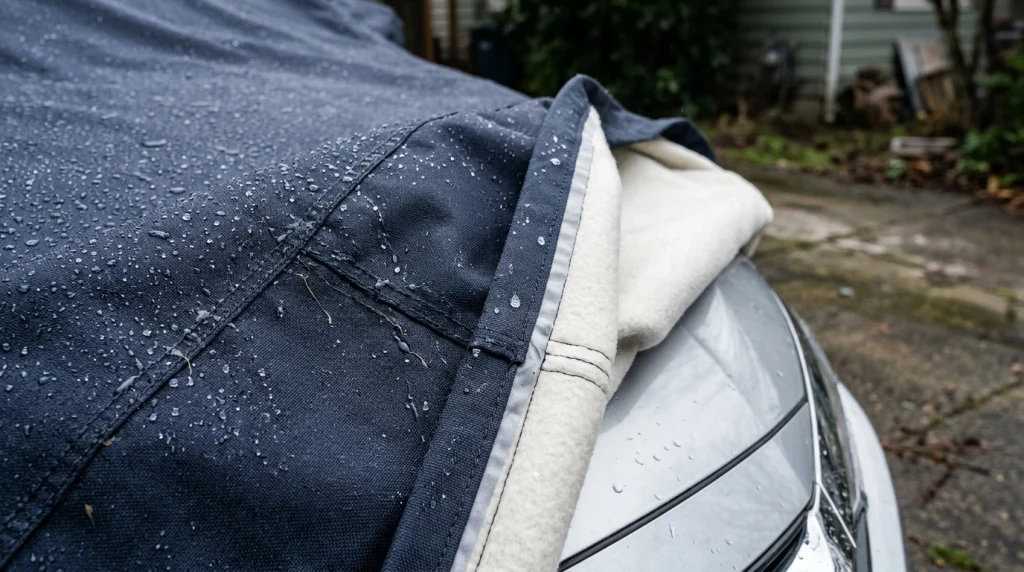
Waterproofing a car cover means improving its ability to prevent liquid water from passing through the fabric. For many outdoor covers, the more appropriate goal is restoring water repellency without sacrificing breathability.
Waterproof versus water-resistant car covers
A water-resistant car cover slows water penetration, often by using tightly woven fabric or a surface treatment that encourages water to bead and run off. A waterproof cover aims to block water more completely, although its construction determines how much moisture vapor can escape.
These terms aren’t interchangeable. Before treating a cover, check the product label or manufacturer’s specifications to understand which level of protection the material was designed to provide.
| Feature | Water-resistant cover | Waterproof cover |
|---|---|---|
| Rain protection | Repels or slows water penetration | Designed to resist water penetration more completely |
| Breathability | Often allows moisture vapor to escape | Depends on the membrane, coating, and construction |
| Common maintenance | Cleaning and compatible reproofing when approved | Manufacturer-approved cleaning and coating maintenance |
| Main concern | Water may penetrate during prolonged or heavy rain | Trapped condensation if moisture cannot escape |
Why does a car cover start leaking?
A cover that once repelled rain may gradually lose its performance through weather exposure, repeated cleaning, abrasion, or damage to its protective coating. Dirt can also interfere with water beading, making a cover appear worn before its material has deteriorated.
Common causes include:
- Worn surface treatment: The original water-repellent finish has deteriorated.
- Dirty fabric: Dust, grime, and residues affect how water spreads across the surface.
- Damaged seams: Stitching, pinholes, and tears create routes for water to enter.
- Material deterioration: Sunlight and repeated outdoor exposure weaken some fabrics over time.
Water soaking into the fabric doesn’t automatically mean the cover is defective. Some breathable materials are designed to shed rain without creating a completely waterproof barrier.
Section takeaway: Identify whether the cover needs cleaning, a compatible water-repellent treatment, or replacement before applying anything.
What should you check before waterproofing a car cover?
Check the cover’s care instructions and physical condition before purchasing a waterproofing product. The wrong chemical can change the fabric’s flexibility, surface finish, or ability to release moisture.
Identify the cover material
Start with the sewn-in label, packaging, original product listing, or manufacturer’s support page. If the material or coating remains unclear, contact the manufacturer instead of guessing.
- Polyester and polypropylene: Check whether the fabric has a factory-applied coating and whether topical treatments are permitted.
- Cotton and canvas blends: Look for treatments specifically approved for the relevant fibers.
- Multilayer covers: Confirm compatibility with the outer layer, inner lining, and any waterproof membrane.
- Specialty breathable covers: Follow the manufacturer’s care instructions, since additional coatings may interfere with the intended moisture management.
Inspect the cover for damage
Spread the cover over a clean surface in good light. Look closely at the roof section, seams, mirror pockets, elastic edges, and other areas exposed to rubbing or tension.
Small holes and separated seams may require material-specific repairs. A water-repellent spray cannot rebuild weakened fibers or reliably seal every damaged seam.
Check whether treatment is necessary
Test the cover’s current performance before changing it. If water beads and runs off normally, adding another treatment may offer little benefit and could interfere with the factory finish.
For general care guidance, consult the manufacturer’s instructions or the car cover care guide, which explains why fabric-specific cleaning and handling matter.
Pay attention to the vehicle’s condition, too. If the paint has been repaired or recently repainted, ask the body shop when covering the vehicle is appropriate.
Section takeaway: Don’t treat a cover until you’ve identified its material, ruled out serious damage, and confirmed that additional water-repellent treatment is suitable.
How do you waterproof a car cover step by step?
Once you’ve confirmed that the cover can be treated, follow a careful cleaning, application, and testing process. The treatment manufacturer’s instructions take priority over any general method because products differ in their application requirements.
Step 1: Choose a suitable work area
Work in a clean, well-ventilated area with enough room to spread the cover. Avoid windy conditions that could carry spray onto nearby vehicles, windows, plants, or other surfaces.
If you plan to treat the cover while it’s installed, make sure the product permits that method. Removing the cover usually makes it easier to inspect both sides and protect the vehicle from overspray.
Step 2: Clean the cover thoroughly
Shake off loose dust, leaves, and other debris before washing. Use the cleaning method and detergent specified for your particular cover.
- Remove loose grit before wetting the fabric.
- Clean dirty sections without aggressive scrubbing.
- Rinse away cleaning residue as directed.
- Allow the cover to reach the moisture condition required by the treatment label.
Don’t assume every cover must be completely dry before treatment. Some products require dry fabric, while others are designed for damp material.
Step 3: Test an inconspicuous area
Apply a small amount of the approved treatment to an inconspicuous section. Let it dry according to the product instructions, then inspect the fabric for changes.
Look for discoloration, stiffness, a sticky finish, unusual odor, or changes to the inner lining. If anything appears abnormal, stop and consult the manufacturer before treating the remaining cover.
Step 4: Apply the treatment evenly
Apply the product in consistent passes, following its stated coverage and application method. Avoid soaking the fabric or concentrating excessive product in one area.
Pay attention to the roof, hood, trunk, and other upward-facing sections that receive frequent rain exposure. Treat seams only if the product is suitable for those areas.
For example, a fabric reproofing product such as Nikwax’s outdoor fabric treatments has product-specific instructions that illustrate why application methods shouldn’t be assumed to be universal.
Step 5: Allow the cover to dry or cure
Keep the cover in the conditions specified on the treatment label until the product has fully dried or cured. Don’t rush this stage by putting the cover straight back on the car or folding it into a storage bag.
Follow the label for drying time, temperature, ventilation, and any second-coat requirements. There isn’t one universal curing time for all car-cover treatments.
Step 6: Test the finished cover
After the treatment has cured, test several areas using a gentle spray of clean water. Watch whether droplets bead and run off, and check for areas that immediately become saturated.
A successful result should improve water repellency without noticeably damaging the material. This test is useful, but it doesn’t certify the cover as completely waterproof under prolonged rain or standing water.
Section takeaway: Clean, test, treat, cure, and retest. Each stage matters more than applying a heavy layer of waterproofing spray.
Which waterproofing treatment should you use?
The right treatment depends on the cover’s fibers, construction, original finish, and intended use. Choose a product specifically approved for the material rather than relying on a general claim that it waterproofs fabric.
| Treatment option | When to consider it | Main precaution |
|---|---|---|
| Fabric reproofing spray | Compatible outdoor fabrics with declining water repellency | Confirm material compatibility and application requirements |
| Wash-in reproofing treatment | Fabrics whose manufacturer permits this treatment method | Check whether the cover can safely be washed this way |
| Canvas-specific treatment | Approved cotton or canvas materials | Check for changes to color, texture, and flexibility |
| Generic silicone or household sealer | Only if the manufacturer explicitly approves the product | May affect breathability, finish, or material performance |
| Replacement cover | Severely worn, torn, or delaminating material | Choose a suitable fit and outdoor protection level |
Are silicone waterproofing sprays safe for car covers?
Not automatically. A silicone spray may repel water on one material but alter the finish or moisture handling of another.
Don’t use a generic silicone spray simply because it’s marketed for outdoor protection. Confirm that the cover manufacturer approves that treatment and that the product is intended for the actual fabric.
Can you use wax or household waterproofing products?
Wax-based treatments and household sealers can change how a fabric bends, feels, or releases moisture. They may also leave residue that transfers to the vehicle or interferes with the original coating.
For an expensive fitted cover or an unfamiliar multilayer design, manufacturer-approved maintenance is a safer choice than experimenting with unverified chemicals.
When should you buy a different cover instead?
Replacement makes more sense when the fabric has lost its structural strength or the manufacturer prohibits additional treatment. A new cover also lets you choose the protection level that better matches your climate and parking arrangements.
As of 2026, material compatibility remains a more useful selection criterion than the word “waterproof” on a product label alone.
Section takeaway: Use fabric-specific reproofing only when permitted. If the cover is deteriorating or its material is unknown, seek manufacturer guidance or consider a suitable replacement.
How do you test and maintain water resistance?
Test water repellency after cleaning and again after any approved treatment has fully cured. Regular inspection helps you spot declining performance before it becomes a persistent problem during rainy weather.
Use a simple water-beading test
Choose a clean, inconspicuous section and gently spray it with water. Observe the droplets and compare the result across several sections of the cover.
- Droplets bead and roll away: Surface water repellency appears to be working.
- The fabric darkens quickly: The surface may be wetting out, although some fabrics naturally absorb water.
- Only one seam leaks: Investigate stitching or localized damage rather than recoating the entire cover.
- Moisture appears underneath without obvious leakage: Consider condensation or moisture trapped against the vehicle.
A beading test checks surface behavior, not the cover’s complete ability to withstand heavy rain. If you need dependable protection during prolonged storms, review the manufacturer’s stated weather limitations.
How often should you reapply waterproofing treatment?
There is no fixed schedule that applies to every car cover. Reapply only when the fabric’s performance declines and its manufacturer allows retreatment.
How often you need maintenance depends on several factors:
- Weather exposure: Frequent rain, strong sunlight, and temperature changes can accelerate material wear.
- Cleaning frequency: Washing may affect a surface treatment, depending on the fabric and detergent.
- Cover quality: Different constructions have different care and service-life requirements.
- Storage conditions: Dirt, damp storage, and poor ventilation can contribute to deterioration.
Don’t automatically recoat the cover every three or six months. A functioning factory finish may not need additional treatment, while a damaged fabric may need replacement instead.
How should you store a car cover after treatment?
Let the cover dry completely before folding or storing it. Keep it in a clean, dry, ventilated location away from unnecessary heat and prolonged direct sunlight.
Before reinstalling the cover, make sure the vehicle is clean and cool enough for safe covering. Dirt trapped between the fabric and paint can cause scratches as the cover moves.
It’s also worth checking the cover after heavy rain. Remove it when practical to inspect the vehicle and allow any trapped moisture to escape.
Section takeaway: Use water beading as a quick maintenance check, not a guarantee of complete waterproofing. Clean the cover as needed and retreat it only when appropriate.
What mistakes should you avoid, and when should you replace the cover?
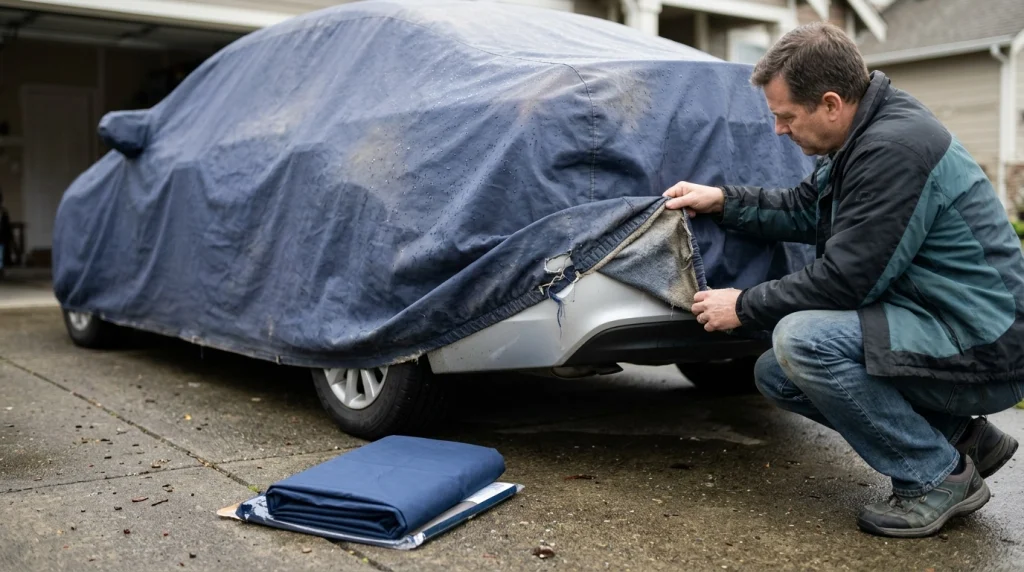
The biggest mistake is trying to solve every water problem with another coating. Leaks can come from dirt, condensation, damaged seams, or material failure, and each requires a different response.
Common waterproofing mistakes
- Skipping the care label: This risks damaging a factory-coated or multilayer cover.
- Applying treatment to dirty fabric: Dirt and detergent residue can contribute to uneven results.
- Using excessive product: More treatment doesn’t necessarily mean better protection and may affect breathability.
- Ignoring the curing instructions: An incompletely dried coating may transfer residue or affect the fabric.
- Storing the cover wet: Damp storage can encourage mildew, odors, and material deterioration.
- Ignoring the inner lining: A rough, dirty, or damaged lining may scratch the paint even if the outer surface sheds water.
How do you know when a cover needs replacing?
Waterproofing treatments cannot restore fabric that has physically broken down. Look for multiple tears, peeling layers, brittle material, failed seams, or a deteriorated vehicle-facing lining.
Replacement may also be appropriate if the cover continues to leak after approved maintenance or no longer fits securely. A loose cover can flap against the paint, creating wear even when its water repellency is excellent.
Choose a replacement according to the conditions in which you park:
- Outdoor parking: Look for appropriate rain protection, UV resistance, and a secure fit.
- Humid conditions: Prioritize suitable moisture management and ventilation.
- Frequent use: Consider easy installation, manageable storage, and durable construction.
- Long-term vehicle storage: Check the manufacturer’s guidance on moisture, inspections, and cover suitability.
Don’t assume the most waterproof material is always the best choice. A breathable outdoor cover may be more appropriate than an impermeable barrier when condensation is a concern.
Section takeaway: Reproof a sound cover when its manufacturer permits it. Replace material that has deteriorated rather than relying on additional chemicals to compensate for structural damage.
Frequently asked questions
Can I spray waterproofing directly on a car cover?
Yes, if the treatment is compatible with the fabric and the manufacturer allows additional coatings. Clean the cover first, test an inconspicuous area, and follow the product’s application and curing instructions. Avoid generic sealants that could affect breathability or the finish.
Why is my car cover letting water through?
Possible causes include dirt buildup, worn water repellency, damaged seams, holes, or deteriorating material. Moisture beneath the cover may also result from condensation. Inspect the cover and test a clean section before deciding whether reproofing, repair, or replacement is appropriate.
Can washing restore a car cover’s water resistance?
Sometimes. Dirt and residue can interfere with water beading, so cleaning may improve performance without another coating. Use the manufacturer’s recommended washing method, rinse as directed, and retest the fabric before purchasing a waterproofing product.
Can I use silicone spray on a car cover?
Only if the cover manufacturer confirms that the specific product is suitable. Silicone sprays intended for other applications may alter the fabric’s flexibility, appearance, or moisture handling. A compatible fabric reproofing product is preferable when retreatment is permitted.
How often should I waterproof my car cover?
There is no universal reapplication interval. Check the cover’s water repellency periodically and follow its care instructions. Reapply an approved treatment when performance declines, rather than adding coatings automatically after a set number of months.
Does a waterproof car cover cause condensation?
It can contribute to moisture retention if the construction prevents trapped moisture from escaping. Condensation may develop when humid air meets cooler surfaces. A suitable breathable cover, a clean and dry vehicle, and periodic inspections help manage this risk.
Is it better to waterproof an old cover or replace it?
Reproofing may be worthwhile when the fabric remains structurally sound and the manufacturer approves the treatment. Replace the cover if its material is brittle, torn, delaminating, or badly worn. A coating cannot restore damaged fibers or rebuild failed seams.
Final takeaway
Learning how to waterproof a car cover starts with identifying the material and finding out whether it can safely accept another treatment. Cleaning alone may restore water beading, while a compatible reproofing product can help when the original water-repellent finish has weakened.
My main recommendation is to protect the cover’s original design rather than trying to make every fabric completely impermeable. Follow the care label, test any treatment on a small area, and allow the material to dry fully before use.
If the cover is badly deteriorated or continues to leak after appropriate maintenance, replacing it with one suited to your parking conditions may be the more practical solution.
Editorial note: This guide provides general car-cover maintenance advice. Always follow the instructions supplied by the cover and treatment manufacturers.