
How to Remove Tree Sap From a Car Cover Without Damage

Quick Answer
To remove tree sap from a car cover, take the cover off the vehicle, remove loose dirt, soften the sap with lukewarm water, and gently blot it with mild soap and a soft microfiber cloth. For stubborn residue, check the cover manufacturer’s care label before trying any stronger cleaner, and avoid aggressive solvents that could damage waterproof coatings or fabric treatments. General exterior-cleaning guidance from Consumer Reports also supports using gentle, surface-appropriate cleaning methods.
Quick Steps
- Remove the cover: Never work on tree sap while the cover is stretched across your vehicle.
- Brush off debris: Remove leaves, dust, pollen, and grit before adding water.
- Soften the sap: Hold a lukewarm damp microfiber cloth against the affected area rather than scrubbing it dry.
- Clean gently: Use mild soap or the cleaner recommended by the cover manufacturer.
- Rinse thoroughly: Remove soap and loosened sap so residue does not remain in the fabric.
- Air-dry fully: Do not reinstall or store the cover until both sides are completely dry.
Most Important Rule
- If the label does not approve a solvent or stain remover, do not experiment with it on the visible fabric.
Tree sap can turn a clean car cover into a sticky mess surprisingly fast. The problem gets harder once sunlight warms the sap and it settles deeper into the fabric.
If you’re wondering how to remove tree sap from a car cover safely, the best approach is gradual. Start with the gentlest cleaning method and move to stronger options only when the cover’s care instructions allow them.
In This Guide
- Why Does Tree Sap Stick to a Car Cover?
- What Should You Check Before Cleaning Tree Sap?
- How Do You Remove Fresh Tree Sap From a Car Cover?
- How Do You Remove Dried or Hardened Tree Sap?
- Which Cleaning Method Is Safest for Different Car Cover Materials?
- What Mistakes Can Damage a Car Cover During Sap Removal?
- Frequently Asked Questions
Why Does Tree Sap Stick to a Car Cover?
Tree sap sticks because it contains naturally tacky compounds that cling to fibers and textured surfaces. Heat and time can make the residue harder and more difficult to lift.
Definition: Tree sap contamination on a car cover is sticky plant residue that has bonded to the cover’s outer fabric, coating, seams, or fibers.
Fresh sap and dried sap behave differently
Fresh sap usually feels soft and sticky. It may still sit mostly on the surface, which makes gentle removal easier.
Dried sap feels harder and may form a shiny or crusty spot. At that point, pulling or scraping it can damage the surrounding material.
- Fresh sap: Usually responds best to water, mild soap, and careful blotting.
- Partly dried sap: Often needs repeated softening before it releases.
- Hardened sap: May require a manufacturer-approved spot cleaner.
- Embedded residue: Can remain between woven fibers after the raised sap is gone.
Why a car cover needs different treatment than paint
A painted body panel has a hard clear coat. A car cover may use woven fabric, nonwoven material, waterproof coatings, soft lining, or several layers together.
That changes the cleaning strategy. A chemical that seems harmless on one surface may weaken a coating, discolor fabric, or leave a stiff patch on another.
For broader paint and exterior-care principles, I use resources such as Edmunds as a reference point. The cover itself, however, should always be cleaned according to its own care label.
What Should You Check Before Cleaning Tree Sap?
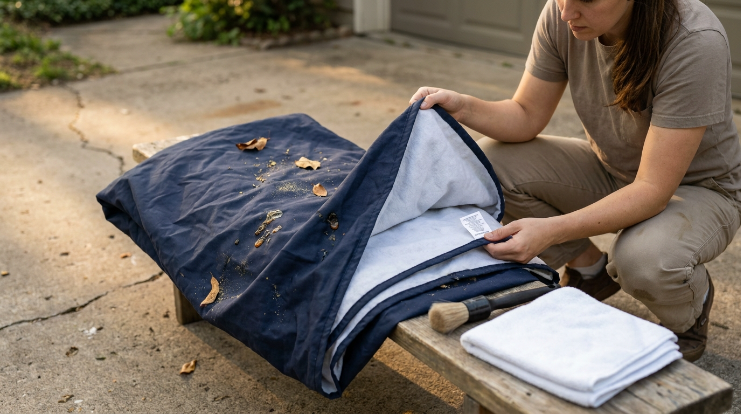
Before touching the sap, identify the cover material and read its cleaning instructions. This single step can prevent more damage than any special cleaning trick.
Remove the cover from the vehicle first
Do not clean sap while the cover is lying over the paint. Moisture and loosened residue can work through the fabric or spread onto the vehicle.
Place the cover on a clean surface instead. Keep its paint-contact side away from pavement, gravel, and dirty garage floors.
- Check the label: Look for washing, detergent, drying, and solvent restrictions.
- Find the sap spots: Inspect nearby seams because liquid residue can spread farther than expected.
- Check both sides: Make sure sap has not soaked through to the inner lining.
- Remove grit: Shake or gently brush away loose particles before wet cleaning.
Test any unfamiliar cleaner first
Spot-test an unfamiliar product on a hidden area before treating the main stain. Let the test area dry so you can check for fading, stiffness, staining, or coating changes.
The rule I use for DIY cleaning guidance is simple: increasing chemical strength should come after checking compatibility, not before.
How Do You Remove Fresh Tree Sap From a Car Cover?
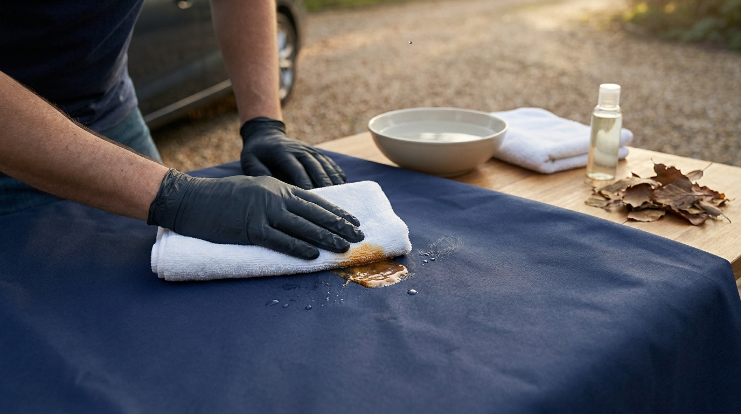
Fresh sap is usually the easiest type to remove. The goal is to lift it before it spreads deeper into the material.
- Lay the cover flat. Put the affected section on a clean surface with enough room to work without stretching the fabric.
- Remove loose debris. Shake away leaves, bark, pollen, and dry dirt before adding moisture.
- Soften the sap. Press a microfiber cloth dampened with lukewarm water against the sticky area.
- Blot instead of scrubbing. Lift softened sap with a clean section of the cloth.
- Add mild soap if needed. Use only a detergent compatible with the cover’s care instructions.
- Rinse the treated area. Remove soap and loosened residue completely.
- Air-dry the cover. Allow the material, seams, hems, and lining to dry before storage or reuse.
Why blotting works better than hard rubbing
Hard rubbing spreads sticky sap across a wider area. It can also push contamination farther into textured fabric.
Blotting lets the damp cloth pick up softened residue gradually. Rotate to a clean part of the microfiber towel as soon as it becomes sticky.
Should you use hot water?
I would avoid assuming hotter water is better. Some cover coatings, adhesives, elastic sections, and laminated materials may have temperature restrictions.
Lukewarm water is the safer starting point unless the manufacturer’s instructions specify another temperature.
Section Takeaway: Fresh sap calls for patience, not force. Remove debris, soften the spot, blot gently, rinse it clean, and let the cover dry completely.
How Do You Remove Dried or Hardened Tree Sap?
Dried tree sap needs repeated softening before removal. Do not try to break it off with a knife, razor blade, screwdriver, or other hard tool.
Start by rehydrating the affected area
Place a lukewarm damp microfiber cloth over the hardened spot. Give the moisture time to work before checking whether the sap has softened.
If it remains hard, repeat the process rather than increasing pressure. Slow softening is safer than forcing a brittle deposit away from the fabric.
- First attempt: Lukewarm water and gentle blotting.
- Second attempt: Mild manufacturer-approved detergent.
- Persistent residue: A spot cleaner specifically permitted for that cover material.
- Unknown material: Stop and contact the cover manufacturer before using a solvent.
Can you use rubbing alcohol on a car cover?
Do not assume isopropyl alcohol is safe for every cover. Alcohol can interact differently with dyes, water-resistant treatments, laminated layers, and other finishes.
If the manufacturer specifically approves it, use the recommended concentration and method. Otherwise, choose a cover-safe cleaner instead.
What if a sticky shadow remains?
A raised sap deposit may disappear while a slight tacky patch remains. Repeat the approved cleaning and rinsing process before moving to a stronger chemical.
Never reinstall a cover that still has sticky residue on its inner surface. That contamination could transfer directly to paint.
As of 2026, my preferred approach remains material-first rather than chemical-first. Different covers are built differently, so one universal solvent recipe creates unnecessary risk.
Section Takeaway: Hardened sap should be softened in stages. If water and approved detergent cannot remove it, check the manufacturer’s instructions before escalating to a stronger cleaner.
Which Cleaning Method Is Safest for Different Car Cover Materials?
The safest cleaning method depends on the material, coating, backing, and manufacturer’s instructions. There is no single chemical that should automatically be used on every car cover.
| Cover Type | Safest Starting Method | Main Concern | Before Using Stronger Cleaner |
|---|---|---|---|
| Woven polyester fabric | Lukewarm water, gentle blotting, approved mild detergent | Staining or spreading sap between fibers | Check detergent and solvent restrictions |
| Nonwoven synthetic cover | Gentle spot cleaning with minimal rubbing | Surface distortion or fiber damage | Confirm approved spot-cleaning products |
| Water-resistant or coated cover | Water plus manufacturer-approved mild cleaner | Removing or weakening the protective treatment | Verify coating-safe cleaner requirements |
| Soft-lined or fleece-backed cover | Treat the exterior face while limiting soak-through | Residue reaching the paint-contact lining | Check whether full washing is required |
| Unknown material | Water-only spot treatment until identified | Unpredictable chemical reaction | Identify the product or contact its manufacturer |
Why the care label matters more than internet cleaning hacks
Two covers that look similar can use different coatings or laminated layers. That means a cleaner tolerated by one product may damage another.
General automotive resources such as Car and Driver and Kelley Blue Book are useful for broader vehicle-care practices. For the cover fabric itself, its manufacturer remains the best source for chemical compatibility.
When should you wash the entire cover?
Full washing makes sense when sap has spread across several areas or cleaning has left soap throughout the material. Follow the cover’s machine-wash or hand-wash instructions exactly.
A large cover may exceed a household washer’s recommended capacity. Do not force it into a machine if the manufacturer requires another cleaning method.
Section Takeaway: Match the cleaner to the cover, not just the stain. Material construction and manufacturer instructions should decide how aggressive your cleaning method can be.
What Mistakes Can Damage a Car Cover During Sap Removal?
The biggest mistake is treating dried sap like something that needs to be scraped away. Most car covers respond better to controlled softening and gentle cleaning.
- Scraping with metal: Sharp edges can cut fabric, coatings, or stitching.
- Scrubbing dry sap: Heavy friction can distort fibers and spread contamination.
- Using household solvents: Strong degreasers or cleaners may attack dyes or protective treatments.
- Skipping the care label: Washing and drying requirements vary between products.
- Cleaning over the vehicle: Sap, detergent, and dirt can transfer through the cover onto paint.
- Using high heat: Heat may affect certain coatings, elastic parts, or laminated materials.
- Storing the cover damp: Moisture can encourage odors, staining, or mildew during storage.
- Reinstalling a dirty cover: Remaining grit or sticky residue may end up against the vehicle.
Don’t turn one sap spot into a paint problem
Inspect the inner side after cleaning. If sap, detergent, or dirty water reached the paint-contact surface, clean that area before putting the cover back on.
Also inspect the vehicle before installation. A clean cover should go onto clean, dry paint whenever practical.
What should you do if the fabric changes after cleaning?
Stop using the cleaner if the area fades, becomes stiff, loses its coating, or develops an unusual texture. Rinse away remaining product according to the manufacturer’s directions.
If the cover has become rough on its inner surface, I would not place that damaged section against paint until its condition is resolved.
Section Takeaway: Avoid scraping, strong unapproved chemicals, excessive heat, and aggressive rubbing. A clean cover is useful only when the cleaning process has not damaged the material protecting your car.
Frequently Asked Questions
Can I use vinegar to remove tree sap from a car cover?
Do not use vinegar automatically. Its compatibility depends on the cover’s fabric, dyes, waterproof treatment, and construction. Start with water and an approved mild cleaner instead. If the manufacturer specifically allows vinegar or another acidic cleaner, follow its dilution and rinsing instructions.
Can I use rubbing alcohol to get sap off a car cover?
Rubbing alcohol may affect certain coatings, dyes, adhesives, or water-resistant treatments. Only use it when the cover manufacturer approves alcohol for that material. When compatibility is unknown, repeated softening with water and an approved detergent is the safer first approach.
Will tree sap permanently stain a car cover?
Tree sap can leave discoloration or a stiff patch, especially after it dries deeply into the material. Quick treatment improves your chances of removal. If a stain remains after approved cleaning, avoid aggressive scrubbing because cosmetic discoloration is usually preferable to damaged fabric.
Can I pressure-wash tree sap off a car cover?
A pressure washer is not my first choice for spot cleaning. Concentrated water pressure can stress seams, coatings, and lightweight fabrics. Check the manufacturer’s instructions before using one, and use the gentlest cleaning method that can remove the contamination effectively.
Should I machine-wash the car cover after removing sap?
Machine-wash the cover only when its care instructions allow it. Some covers can use household machines, while others require hand washing or larger equipment. Remove heavy sap deposits first so sticky contamination does not spread throughout the fabric during the wash cycle.
Can I put the cover back on the car while it is slightly damp?
It is better to let the car cover dry completely before reuse. Pay attention to seams, hems, straps, and thick sections that can stay wet longer. Installing a damp cover may trap moisture against the vehicle and also makes proper storage harder later.
What is the safest way to prevent tree sap from ruining a car cover again?
Check the cover regularly when parking beneath trees and remove fresh contamination before it hardens. Keep the cover clean, dry it fully before storage, and follow its care instructions. When possible, moving the vehicle away from sap-producing trees reduces repeated cleanup.
Final Takeaway: Removing tree sap from a car cover is safest when you work from mild to strong. Take the cover off, soften the sap, blot instead of scrape, follow the care label, rinse thoroughly, and let everything dry before the cover touches your vehicle again.
If the sap will not release without aggressive chemicals or heavy scrubbing, stop before damaging the fabric. Checking the manufacturer’s cleaning instructions is usually cheaper than replacing a cover whose protective coating or soft lining has been ruined.