
How to Stop Car Cover Flapping: 7 Practical Fixes That Work

Quick Answer
To stop a car cover flapping, first center it correctly and seat the elastic hems around both bumpers. Then secure every manufacturer-provided strap or buckle, remove excess loose fabric, and confirm the cover is the correct size for your vehicle. Current car cover testing from Car and Driver also highlights proper sizing and secure outdoor straps as important considerations.
Quick steps to stop the flapping
- Re-center the cover: Make sure equal material reaches the front, rear, and both sides.
- Seat the hems: Pull the elastic front and rear edges into their intended positions around the bumpers.
- Fasten the straps: Use every underbody, belly, or buckle strap supplied with the cover.
- Remove loose panels: Large unsupported folds show that the cover may be oversized or poorly positioned.
- Inspect worn parts: Replace stretched elastic, broken buckles, damaged seams, or frayed straps.
- Change the cover if needed: Persistent ballooning after correct installation usually points to poor sizing or shape.
One safety rule
- Never attach improvised cords to exhaust parts, brake components, suspension pieces, wiring, or sharp vehicle edges.
A car cover that snaps and balloons in the wind is more than an annoying noise. That repeated movement can wear the cover, expose the car, and rub contaminated fabric against the paint.
I approach the problem in a simple order: installation, retention, fit, then replacement. That keeps you from adding extra straps to a cover that was simply installed wrong.
In This Guide
Why Does a Car Cover Flap in the Wind?
A car cover flaps when moving air gets beneath loose fabric and repeatedly lifts or shifts it. The usual causes are poor sizing, incorrect positioning, weak elastic, or unsecured retention straps.
Definition: Car cover flapping is repeated wind-driven movement of a vehicle cover after installation. It can range from light fabric flutter to large sections ballooning away from the body.
The cover is too large
An oversized cover leaves more unsupported fabric for wind to catch. Length alone does not determine proper fit.
Vehicle width, roof height, mirrors, spoilers, bumper shape, and body style all affect how the fabric sits.
- Loose door panels: Excess width can create large sections that pulse inward and outward.
- Ballooning roof: Excess height or length may let air collect above the roof.
- Loose bumper edges: Wind can enter when the front or rear hem cannot grip properly.
The cover is installed off-center
A correctly sized cover can still flap when it sits several inches too far forward, backward, or sideways. One end becomes tight while another develops loose fabric.
Before tightening anything, check the front label, mirror pockets, seams, and bumper hems.
The securing system is not being used
Many outdoor covers rely on more than elastic. Their underbody straps or buckle systems help stop wind from lifting the side panels.
If the cover includes those features, use them as the manufacturer intended.
The cover is worn out
Elastic hems gradually lose tension. Straps, stitching, buckles, and reinforced attachment points can also deteriorate.
A cover that fitted correctly last year but now moves excessively deserves a close inspection.
- Stretched front or rear elastic
- Cracked plastic buckles
- Frayed webbing
- Torn stitching near attachment points
- Distorted locking grommets
- Fabric that has stretched or lost its shape
My practical rule is simple. If a large loose panel remains after the cover is centered and its intended straps are secured, I question the fit before adding anything else.
How Do You Stop a Car Cover Flapping Right Now?
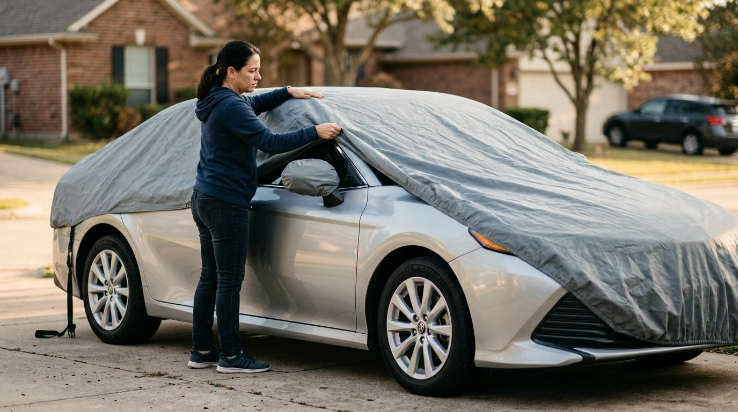
Start by reinstalling the cover rather than immediately tightening random cords around it. Correct installation fixes more wind problems than most owners expect.
1. Remove and inspect the cover
Take the cover off and check its orientation. Look for front and rear labels, mirror pockets, zipper locations, or shaped seams.
Inspect the elastic and attachment hardware while it is off the vehicle.
2. Center the roof section first
Place the main section over the roof without dragging it sideways across the paint. Allow roughly balanced material on every side.
Then work toward the front and rear.
3. Seat both bumper hems
Fit the front hem around its intended bumper area. Repeat the process at the rear.
Do not stretch one end aggressively to compensate for poor positioning at the other.
4. Fit mirror pockets correctly
If your cover has mirror pockets, seat them before fully tightening the cover. Misaligned pockets can pull the entire cover sideways.
Do not force a pocket around an oversized mirror or accessory.
5. Fasten the supplied retention straps
Connect underbody or belly straps according to the cover instructions. Tighten them enough to control movement without heavily distorting the fabric.
- Keep buckles away from painted panels.
- Keep straps away from hot exhaust parts.
- Avoid brake lines, wiring, steering components, and sharp edges.
- Do not crawl beneath a vehicle that has been lifted only to route a cover strap.
6. Watch the cover during a breeze
Look for one specific area moving more than the rest. That location usually reveals where air is getting underneath.
A corner lifting from the bumper indicates a different problem from a large side panel ballooning outward.
7. Reassess the size
If large folds remain everywhere, your cover may simply be too big. A universal cover can match vehicle length yet still fit poorly around the roof and sides.
As of 2026, model-specific and closely sized covers remain the easier option when wind stability matters.
What Is the Best Way to Secure a Car Cover?
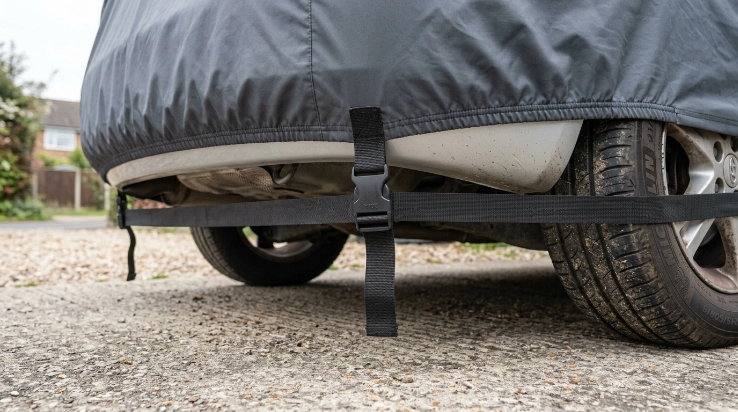
The best securing method is the retention system designed for that specific cover. Underbody straps, elastic hems, and manufacturer-approved gust straps usually control different types of movement.
| Retention Method | Best Use | What It Controls | Main Caution |
|---|---|---|---|
| Elastic bumper hems | Normal everyday fit | Front and rear edge lifting | Worn elastic loses holding force |
| Underbody or belly straps | Outdoor parking | Side-to-side lifting and ballooning | Keep clear of hot or moving components |
| Front and rear buckle straps | Covers designed with end retention | Bumper-end movement | Do not route across paint |
| Manufacturer-approved gust straps | Extra wind control | Large unsupported body panels | Use only compatible attachment locations |
| Locking cable | Discouraging quick cover removal | Usually very little fabric movement | Do not treat it as the main wind restraint |
A locking cable deserves special attention. It may pass beneath the car, but its main job is often security rather than controlling every loose panel.
Overtightening a cable through central grommets can concentrate wind load around a small reinforced area.
Should you use bungee cords?
I would not make generic bungee cords my first solution. Their hooks, tension, and routing may not match the cover design.
A released hook can also strike paint, glass, or nearby objects.
If extra retention is necessary, choose an accessory specifically approved for the cover whenever possible.
How Tight Should Car Cover Straps Be?
Car cover straps should be snug enough to reduce lifting but not so tight that they heavily stretch the cover. You want controlled fabric, not maximum tension.
A strap that feels tighter is not automatically safer.
Signs the straps are too loose
- The cover lifts several inches during moderate gusts.
- A buckle repeatedly bangs against the vehicle.
- The side panels balloon outward.
- The cover shifts sideways overnight.
- A strap visibly hangs below the vehicle.
Signs the straps may be too tight
- Seams look stretched around the buckle attachment.
- Fabric pulls hard against mirrors or spoilers.
- Grommets appear distorted.
- Elastic hems are pulled away from their normal positions.
- The cover becomes difficult to remove without dragging.
Adjust one retention point at a time. Then walk around the entire car before tightening another.
This helps you see whether a strap is controlling loose fabric or simply moving the problem somewhere else.
Can a Flapping Car Cover Scratch Paint?
Yes, repeated cover movement can contribute to paint marring when dirt or grit becomes trapped between the fabric and clear coat. A loose cover moving across clean paint is less concerning than the same movement over a contaminated surface.
Consumer Reports recommends removing loose dirt before rubbing a vehicle’s finish because trapped particles can cause scratching. That same contamination principle matters when fabric repeatedly moves across paint.
See its car-washing guidance for paint-safe cleaning practices.
Where does flapping usually cause the most rubbing?
- Mirror housings: They protrude into moving fabric.
- Fender peaks: High body contours can become repeated contact points.
- Roof edges: Loose fabric may lift and settle across the same area.
- Spoilers: They change the shape and tension of a fitted cover.
- Bumper corners: Loose hems can move against exposed paint and trim.
Keep the vehicle and the inner cover surface clean. Kelley Blue Book’s current exterior-care resources also emphasize proper vehicle-surface maintenance.
Do not drag the cover during removal
Gather the cover in sections and lift it away from the vehicle. Dragging a dusty cover across the hood, roof, or trunk increases unnecessary contact.
Keep the clean inner surface away from pavement during storage.
- Fold the cover while it remains on the car.
- Keep the inner lining folded inward.
- Store it in a clean bag or container.
- Wash it according to its care instructions.
- Dry it fully before reinstalling or storing it.
What Should You Do When a Car Cover Still Flaps in Strong Wind?
If a correctly fitted and secured cover still moves violently, removing it may be safer than adding increasingly aggressive tie-downs. No universal wind-speed limit applies to every cover.
Follow the cover manufacturer’s instructions and any stated weather limitations.
Do not create unsafe attachment points
A car has many tempting places to hook a cord underneath. That does not make those locations suitable tie-down points.
- Do not attach cords to brake lines.
- Do not route straps around exhaust components.
- Do not use steering or suspension parts as improvised anchors.
- Keep straps away from electrical wiring.
- Avoid sharp metal edges that can cut webbing.
- Do not place loose weights on the vehicle’s painted surfaces.
NHTSA’s vehicle safety resources are a useful general reference when checking vehicle-equipment and safety considerations.
Consider whether the cover is wrong for the environment
A lightweight indoor dust cover is not built for the same conditions as an outdoor weather cover. Persistent wind exposure changes what you should prioritize.
- Closer vehicle-specific sizing
- Strong reinforced strap points
- Durable buckles
- Secure front and rear hems
- Weather-appropriate fabric
- Replaceable or adjustable retention hardware
If your parking area experiences frequent strong gusts, a garage or sheltered parking spot may provide better protection than repeatedly fighting an unsuitable cover.
Edmunds also recommends proper exterior cleaning to prevent loose contaminants from becoming abrasive. Its car washing and exterior-care guide explains why removing grit matters.
My final test is straightforward. The cover should follow the vehicle’s basic shape without large uncontrolled panels, harsh stretching, or hardware striking the body.
Frequently Asked Questions
Why does my car cover flap even with straps?
Your cover may be oversized, installed off-center, or poorly matched to your vehicle’s body shape. Re-center it, seat both bumper hems, and inspect the strap positions before assuming you need more tie-downs.
How do I keep a car cover from blowing off?
Use the correct size, seat the elastic hems properly, and secure every manufacturer-provided outdoor strap or buckle. Replace stretched elastic or broken hardware that can no longer hold the cover securely.
Can I put weights on a car cover?
Avoid placing loose or hard weights directly on painted vehicle surfaces. They can shift, create pressure points, damage paint, or become hazardous during strong wind.
Are bungee cords safe for securing a car cover?
Generic bungee cords are not my first choice because hooks and excessive tension can damage the cover or vehicle. Use the cover’s intended retention system or compatible manufacturer-approved gust straps instead.
Should a car cover be completely tight?
No. It should fit closely and remain controlled without being stretched hard across mirrors, spoilers, seams, or bumpers. Excessive tension can damage both the cover and its attachment points.
Will a loose car cover damage my paint?
It can contribute to paint marring when wind repeatedly moves contaminated fabric across the clear coat. Keeping both the car and inner cover clean reduces that risk.
Should I remove my car cover during high winds?
Consider removing it if the cover cannot remain safely secured using its designed retention system. Follow the manufacturer’s instructions because wind limits and cover construction vary between products.
The takeaway: Stop car cover flapping by fixing the installation and fit before adding more hardware. A centered, correctly sized cover with sound elastic and properly used straps should stay controlled without excessive tension.
If it still balloons or shifts after those checks, replacing the cover with a better-fitting outdoor design is usually smarter than improvising more tie-downs.