
Car Cover Troubleshooting Guide: Problems, Causes, and Fixes

Quick Answer
Most car cover problems come from poor fit, trapped moisture, dirt between the cover and paint, wind movement, worn fabric, or using the wrong cover for the storage environment. Start by removing the cover and checking whether the vehicle and cover are clean and completely dry, since proper paint-cleaning practices reduce the abrasive dirt that can cause scratches.
What to check first
- Loose or flapping: Re-center the cover, seat the elastic hems, secure approved straps, and confirm the size.
- Water underneath: Determine whether the moisture is rain penetration, condensation, or water trapped from installation.
- Paint marks: Inspect the vehicle and inner lining for grit, dirt, rough material, and repeated wind movement.
- Leaks: Inspect seams, fabric wear, dirty material, and areas where wind can push rain below the hem.
- Tears or weak elastic: Check seams, straps, grommets, hems, and high-tension areas before using the cover again.
- Musty odor: Dry the cover completely and inspect it for trapped moisture, mildew, and contaminated storage conditions.
My basic troubleshooting rule
- If the cover cannot stay clean, dry, correctly fitted, and reasonably stable on the vehicle, stop using it until you find the cause.
I’ve dealt with enough outdoor covers to know that the cover itself is not always the real problem. Installation, weather, dirt, storage, and vehicle shape can turn a decent cover into a frustrating one.
This 2026 car cover troubleshooting guide walks through the symptoms I check first. You can diagnose most problems without special tools.
In This Guide
- What Are the Most Common Car Cover Problems?
- Why Is My Car Cover Loose, Flapping, or Blowing Off?
- Why Is There Moisture or Condensation Under My Car Cover?
- Can a Car Cover Scratch or Damage Paint?
- Why Is My Car Cover Leaking, Tearing, or Wearing Out?
- How Do You Clean, Store, and Reinstall a Car Cover Safely?
- Frequently Asked Questions
What Are the Most Common Car Cover Problems?
The most common car cover problems involve fit, moisture, contamination, wind, water resistance, or material wear. Several symptoms can come from the same underlying problem.
Definition: Car cover troubleshooting is the process of identifying whether a protection problem comes from the cover’s fit, material, installation, condition, storage environment, or the way it interacts with the vehicle.
I start by looking at the symptom rather than blaming the fabric. A puddle, scratch, loose panel, or musty odor gives you a useful starting point.
| What You Notice | Likely Cause | First Check | Best First Action |
|---|---|---|---|
| Cover balloons in wind | Oversized cover, weak hem, poor fastening | Fit around bumpers and sides | Re-center and secure correctly |
| Water droplets underneath | Condensation, damp vehicle, rain intrusion | Whether the moisture appears after rain | Remove cover and dry both surfaces |
| Fine scratches or haze | Grit plus fabric movement | Paint and inner lining cleanliness | Clean before reinstalling |
| Rain gets inside | Seepage, seam wear, loose edges | Wet pattern after rainfall | Dry and inspect fabric and seams |
| Musty smell | Stored damp or poor ventilation | Folds, seams, bag, and storage area | Clean and air-dry completely |
| Fabric tears repeatedly | Age, excessive tension, sharp contact | Location of each tear | Remove the cause before repairing |
Indoor and outdoor problems are different
An indoor cover mainly deals with dust, accidental contact, and storage contamination. Heavy weather protection usually is not its main job.
An outdoor car cover must also manage rain, sun, wind, airborne debris, and temperature changes. Those extra conditions make fit and moisture management more important.
- Indoor cover: Prioritize softness, cleanliness, breathability, and a secure fit.
- Outdoor cover: Prioritize appropriate weather resistance, secure fastening, breathability, and durability.
- Long-term storage: Pay extra attention to moisture, dirt, rodents, corrosion, and periodic inspections.
- Daily use: Consider whether repeated installation on a dusty vehicle creates more contact than the protection is worth.
One problem can create another
A loose cover does more than look untidy. Wind can move it across contaminated paint and turn a fit problem into a paint problem.
Moisture works the same way. A damp cover can create odors, slow drying, and keep vulnerable metal surfaces wet longer.
Section Takeaway: Diagnose the whole system rather than one symptom. Fit, cleanliness, weather, moisture, and material condition often interact.
Why Is My Car Cover Loose, Flapping, or Blowing Off?
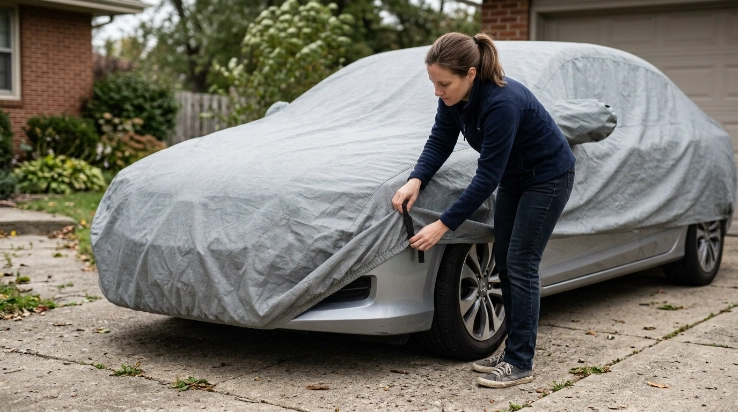
A loose car cover is usually too large, positioned incorrectly, poorly matched to the vehicle shape, or no longer held securely by its hems and fastening system. Fix the fit before adding improvised ropes or excessive tension.
This is one of the first problems I check outdoors. Large unsupported fabric panels give wind more material to grab.
Check whether the cover is centered
Put the cover on without tightening anything first. Compare the amount of material hanging over the front, rear, left, and right sides.
- Identify the front and rear using labels, mirror pockets, seams, or the manufacturer’s instructions.
- Center the main roof panel over the vehicle.
- Fit mirror pockets gently if your cover uses them.
- Seat the front hem in its intended position.
- Seat the rear hem without pulling the entire cover backward.
- Secure only the straps or retention points intended by the manufacturer.
If one bumper is barely covered while the other has extra fabric, alignment is probably the issue. Reinstall it before deciding the size is wrong.
Check whether the size is wrong
Vehicle length alone does not determine fit. Roof height, body width, mirrors, spoilers, bumpers, roof racks, and body style can change how a cover sits.
- Too long: Excess material gathers near one or both bumpers.
- Too wide: Large side panels hang away from the doors.
- Too tall: Fabric may bunch around the rocker panels and lower body.
- Wrong shape: Mirror pockets, rooflines, or spoiler areas do not line up naturally.
- Too small: The cover feels stretched and may pull hard on seams or accessories.
A universal cover can fit several vehicles reasonably well without following every contour. A true application-specific cover should normally follow the vehicle more closely.
Inspect elastic hems and straps
Elastic loses tension as it ages. Straps can also stretch, tear, or separate from their mounting points.
I run my hands around the lower edge and look for sections that no longer grip. One weak end can let wind work underneath the entire cover.
- Look for stretched or hardened elastic.
- Check stitching around strap anchors.
- Inspect buckles for cracks.
- Check grommets for distortion or tearing.
- Replace missing manufacturer-supplied retention parts.
What should you do in strong wind?
Do not assume tighter is always safer. Excessive strap tension can concentrate force around seams, grommets, and painted contact points.
Follow the instructions for your exact product. For example, Coverking’s vehicle-cover instructions include specific wind precautions and advise removal in high-wind conditions rather than relying only on the elastic hem.
That threshold is manufacturer-specific. Your own cover may have different limits or fastening requirements.
- Light movement: Recheck alignment and normal fastening points.
- Repeated ballooning: Investigate sizing and exposed gaps.
- Severe gusts: Follow the manufacturer’s removal guidance.
- Storm conditions: Do not improvise a fastening system that could damage the vehicle.
Section Takeaway: A cover should be secure because it fits and is installed correctly, not because it has been pulled excessively tight.
Why Is There Moisture or Condensation Under My Car Cover?
Moisture under a car cover can come from rain penetration, condensation, a damp vehicle, a wet cover, or humid air that cannot escape quickly enough. First determine whether water entered from outside or formed underneath.
Finding droplets after rain does not automatically mean the cover leaked. Condensation can appear even when the outer fabric kept direct rainfall away.
How do you tell condensation from a leak?
Look at where and when the moisture appears. The pattern often gives you the best clue.
| Moisture Pattern | Possible Explanation | What to Check |
|---|---|---|
| Broad light droplets | Condensation | Humidity and temperature changes |
| Wet area below one seam | Possible seam leakage | Stitching and seam condition |
| Water near lower edge | Wind-driven rain | Loose hems and exposed gaps |
| Vehicle already damp at installation | Trapped wash or rain water | Mirrors, trim, seams, wheels |
| Musty dampness after storage | Cover stored wet | Storage bag and folded sections |
Never cover a wet vehicle
A vehicle can look dry while still holding water. Mirrors, weather stripping, grilles, door handles, wheel areas, spoilers, and trim seams can hide it.
After washing, I give those areas extra drying time. A few trapped pockets of water can make the underside of a cover feel surprisingly damp later.
- Dry paint and glass fully.
- Check mirror housings.
- Check door, trunk, and hatch seams.
- Dry around badges and trim.
- Make sure the cover itself is dry.
Does a breathable car cover stop condensation?
Breathable fabric helps water vapor escape, but it cannot eliminate every moisture problem. High humidity, wet ground, poor garage ventilation, or rapid temperature changes can still create condensation.
Breathability also does not automatically mean waterproofing. A material may allow vapor movement while providing only a certain level of rain resistance.
Check the parking environment
Sometimes the vehicle and cover are fine. The storage environment keeps supplying moisture.
- Damp garage floor: Moisture can remain high around the vehicle.
- Grass or soil: Ground moisture can increase humidity beneath an outdoor vehicle.
- Roof leak: Water may be landing on the cover repeatedly.
- Poor ventilation: Humid air may remain trapped in an enclosed garage.
- Coastal or winter conditions: Moisture combined with salt contamination deserves extra attention.
If you discover rust starting at a stone chip or exposed metal, address it rather than simply drying the cover. Prolonged moisture can make an existing paint defect more important.
Mechanic Alert: If you find significant corrosion, bubbling paint, or rust around structural or hard-to-access areas, have a qualified body or repair professional inspect it.
Section Takeaway: Moisture under a cover is a symptom, not a diagnosis. Dry everything first, then identify whether the source is condensation, rain, storage conditions, or installation.
Can a Car Cover Scratch or Damage Paint?
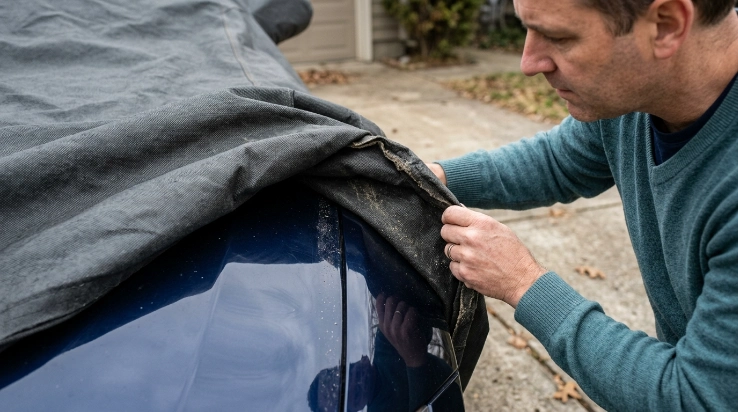
Yes, a car cover can contribute to paint scratches when abrasive dirt becomes trapped between the fabric and vehicle and the cover moves. Cleanliness and movement usually matter more than whether the lining feels soft in your hand.
A clean soft fabric resting on clean paint is one situation. That same fabric with sand or road grit underneath is completely different.
What causes car cover scratches?
- Dust on the paint: Fine particles can move beneath the fabric.
- Dirty inner lining: A cover can pick up grit during removal or storage.
- Wind movement: Repeated rubbing concentrates contact on raised body lines.
- Poor fit: Excess material creates more movement.
- Dragging the cover: Pulling fabric sideways can move contamination across paint.
- Ground contact: The paint-side surface can collect debris if dropped on pavement.
I pay particular attention to mirror housings, fender peaks, roof edges, spoiler corners, and hood edges. Those areas often become repeated contact points when fabric shifts.
What should you do if you find new marks?
Stop reinstalling the cover until you know what created the marks. Continuing to use it can make diagnosis harder.
- Wash and dry the vehicle carefully.
- Inspect the marks under good lighting.
- Check the corresponding area inside the cover.
- Look for sand, grit, rough seams, or hardened contamination.
- Check whether the cover moves across that area in wind.
- Correct the contamination or fit problem before reuse.
Do not assume every mark came from the cover. Old swirl marks can become easier to notice after washing or under different lighting.
Can a cover scratch ceramic coating or wax?
Ceramic coatings and waxes do not make paint immune to abrasion. Grit moving under a cover can still create visible marring.
Fresh paint and recently applied protection products need special care. Follow the coating, wax, paint shop, or product manufacturer’s stated curing instructions rather than using a generic waiting period.
- Fresh repaint: Ask the body shop when a cover can safely touch the finish.
- Ceramic coating: Follow the coating maker or installer’s cure instructions.
- Wax or sealant: Allow the product to finish its stated application or curing process.
- Paint protection film: Follow the installer’s care instructions around fresh edges and seams.
Is a soft-lined cover always safer?
No lining stays safe if it becomes contaminated. A plush surface can hold particles that you cannot immediately see.
This is why I treat the inner surface almost like a large detailing towel. I try to keep it away from pavement, tires, dirty shelves, and garage floors.
Section Takeaway: Fabric alone rarely tells the full story. Clean paint, a clean inner surface, correct fit, and minimal movement are the four checks I prioritize.
Why Is My Car Cover Leaking, Tearing, or Wearing Out?
A leaking or deteriorating car cover may have worn fabric, damaged seams, stretched elastic, UV degradation, excessive wind movement, or material that does not match the weather exposure. Inspect the entire cover before trying to repair one obvious spot.
A single hole can be local damage. Multiple weak areas usually point to broader wear.
Why is rain getting through my car cover?
First determine whether the material is supposed to be completely waterproof or water-resistant. Those terms are not interchangeable.
- Fabric seepage: Water may pass through material during prolonged exposure.
- Worn seams: Stitching areas can become vulnerable as the cover ages.
- Loose edges: Wind can drive rain underneath the hem.
- Dirty material: Contamination can affect how some fabrics manage water.
- Physical damage: Holes and tears provide direct entry points.
Let the cover dry before evaluating it. Wet fabric often looks and behaves differently from dry material.
Why does the fabric keep tearing?
The location of the tear matters. Repeated failure in the same area suggests a contact or tension problem.
| Damage Location | What I Would Inspect |
|---|---|
| Mirror pocket | Wrong alignment, pocket too tight, wrong application |
| Spoiler or antenna area | Sharp contact or unsupported accessory |
| Lower hem | Wind stress, ground contact, weak elastic |
| Grommet | Excess tension or repeated movement |
| Large sun-exposed panel | Age and environmental degradation |
Repair it or replace it?
A small isolated defect may be repairable if your manufacturer provides an approved method. Do not assume ordinary tape, glue, or stitching is suitable for every multilayer fabric.
Replacement makes more sense when failure is widespread. I would stop trusting a cover that has several major problems at the same time.
- Fabric has become brittle or powdery.
- Multiple seams are opening.
- Elastic no longer holds the cover.
- The lining has become rough or damaged.
- Several repairs have already failed.
- The cover no longer fits because it has stretched or distorted.
- Water management has become consistently poor.
Age alone is not enough to condemn a cover. Condition and performance matter more than a calendar number.
Section Takeaway: Find out why the cover failed before repairing it. A patch will not solve poor fit, excessive wind movement, or widespread material deterioration.
How Do You Clean, Store, and Reinstall a Car Cover Safely?
Clean a car cover according to the instructions for its exact material, dry it completely, keep the inner surface off dirty ground, and reinstall it only on a clean, dry vehicle. Do not assume every car cover uses the same washing method.
This is an area where generic advice can cause problems. Different manufacturers and materials have different cleaning restrictions.
Check the label before washing
Some covers can be washed in certain machines, while others require hand washing or special care. Heat and detergents can also affect materials differently.
For example, Covercraft provides material-specific car cover cleaning guidance. That is a better reference for one of its covers than a universal washing rule from another brand.
Use this basic decision process:
- Identify the cover brand and material.
- Read the attached care label.
- Check the manufacturer’s current instructions.
- Use only the recommended cleaner and wash method.
- Follow the stated drying instructions.
- Do not reinstall until the cover is fully dry.
Keep the inside clean during removal
Removal is one of the easiest times to contaminate a cover. A gust of wind can drop several feet of fabric onto the driveway in seconds.
I prefer to fold the sides upward onto the vehicle rather than throwing them onto the ground. Then I work toward the center and remove the cover in a controlled bundle.
- Keep the inner lining away from pavement.
- Do not drag the cover behind the vehicle.
- Keep dirty exterior fabric from rubbing against the clean inner surface.
- Inspect it if it falls onto sand, gravel, or a dirty garage floor.
Never store the cover damp
A damp cover folded into a small bag dries slowly. Moisture can remain inside seams and thick folded sections even when the exposed surface feels almost dry.
Open the cover fully and allow enough airflow before storage. Check the elastic hems and straps before packing it away.
How should you reinstall it?
Reinstallation should be controlled rather than dragged from one end. The goal is to keep the clean side clean while minimizing sliding contact.
- Make sure the vehicle is cool, clean, and dry.
- Inspect the inner surface for visible debris.
- Identify the front and rear.
- Position the center portion over the roof.
- Fit mirror pockets without forcing them.
- Seat the front and rear hems evenly.
- Secure the manufacturer’s intended fastening system.
- Walk around the vehicle and check for excessive slack or tension.
A two-minute inspection can prevent days of wondering where a scratch, damp patch, or torn seam came from. I consider that inspection part of installing the cover.
Section Takeaway: Manufacturer-specific care instructions outrank generic washing advice. Keep both surfaces clean and dry from removal through storage and reinstallation.
Frequently Asked Questions
Why does my car cover keep blowing off?
A car cover usually blows off because wind gets underneath a loose edge, the cover is oversized, the elastic has weakened, or the intended fastening system is not being used correctly. Re-center the cover, inspect the hems and straps, and follow the manufacturer’s wind instructions.
Why is my car wet underneath the cover?
The moisture may be condensation, rain penetration, trapped wash water, or moisture from a wet cover. Remove the cover, dry both surfaces completely, then inspect the wet pattern and storage environment before reinstalling it.
Can I put a car cover on a dusty car?
I would avoid it when possible. Dust and grit can become trapped between the fabric and clear coat, and movement during installation or windy weather can rub those particles across the paint.
Is a waterproof car cover better than a breathable one?
Not automatically. Outdoor protection requires a balance between keeping weather away and allowing trapped moisture vapor to escape, so choose a cover designed for your actual parking environment rather than relying on one marketing term.
Can I leave my car covered for months?
Long-term coverage still needs periodic inspection. Check for moisture, dirt, pest activity, wind damage, fabric deterioration, corrosion, tire condition, and other storage-related problems rather than assuming the vehicle is protected simply because it stays covered.
Does a locking car cover prevent vehicle theft?
A cover lock can make quick removal less convenient, but it should not replace normal security precautions. Keep the vehicle locked and follow established NHTSA vehicle theft-prevention guidance for protecting the vehicle itself.
When should I replace my car cover?
Replace it when widespread fabric damage, failed seams, rough lining, stretched elastic, persistent leakage, or poor fit means it can no longer protect the vehicle without creating new risks. Condition is a better guide than age alone.
Final takeaway: When a car cover starts causing trouble, remove it and work from the simplest checks first: cleanliness, dryness, alignment, fit, fastening, fabric condition, and storage environment. A cover should reduce exposure without creating repeated rubbing, trapped moisture, excessive tension, or another problem of its own.
If those basics are right and the problem keeps returning, check the manufacturer’s instructions for your exact material and vehicle application. Sometimes replacement is safer and simpler than repeatedly repairing a cover that no longer does its job.
