Will a Chevy 350 Bolt Up to a Jeep Transmission

Contents
- 1 Key Takeaways
- 2 📑 Table of Contents
- 3 Introduction: The Dream and The Reality
- 4 Understanding Compatibility: It’s All About the Patterns
- 5 Bellhousing & Flywheel: The Heart of the Matter
- 6 Starter Motor and Flexplate: The Hidden Hurdle
- 7 Crossmember, Mounts, and Physical Fitment
- 8 Drivetrain Implications: It’s Not Just the Transmission
- 9 Practical Examples and Common Jeep Swaps
- 10 Conclusion: Yes, But…
- 11 Frequently Asked Questions


The short answer is no—a Chevy 350 won’t directly bolt to most Jeep transmissions. Compatibility depends on your Jeep’s model, transmission type, and the Chevy 350’s generation. You’ll likely need adapters, a different bellhousing, or even a transmission swap. Proper research and planning are crucial to avoid costly mistakes and ensure your project runs smoothly.
Key Takeaways
- No Direct Bolt-Up: A Chevy 350 will not bolt directly to the vast majority of Jeep transmissions due to mismatched bellhousing patterns and other mounting differences.
- Bellhousing is Key: The core issue is the engine’s bellhousing pattern. GM’s small-block pattern differs from Chrysler’s (used in most Jeeps), requiring adapters or a bellhousing swap.
- Generation Matters: The specific year of your Chevy 350 matters. Early (pre-1987) and late (1987+) blocks have different patterns, affecting compatibility and adapter needs.
- More Than Just the Bellhousing: Even with an adapter, you must address the flywheel/flexplate, starter motor, crossmember, driveshaft, and sometimes the transmission mount.
- Transmission Choice is Critical: Some Jeep transmissions (like the T18) have a GM pattern and may bolt more easily, while others (AX15, NSG360) require significant adaptation.
- Professional Help Recommended: Unless you have extensive fabrication skills, consulting with a swap shop or using proven adapter kits from companies like Novak or Advanced Adapters is highly advised.
- Plan for Supporting Mods: An engine swap often necessitates other changes like a lift for clearance, regearing for proper performance, and upgraded cooling. Understanding these costs upfront is essential.
📑 Table of Contents
- Introduction: The Dream and The Reality
- Understanding Compatibility: It’s All About the Patterns
- Bellhousing & Flywheel: The Heart of the Matter
- Starter Motor and Flexplate: The Hidden Hurdle
- Crossmember, Mounts, and Physical Fitment
- Drivetrain Implications: It’s Not Just the Transmission
- Practical Examples and Common Jeep Swaps
- Conclusion: Yes, But…
Introduction: The Dream and The Reality
So, you’re dreaming of more power in your Jeep. The iconic Chevy 350 small-block V8 is a tempting choice—reliable, powerful, and with a mountain of aftermarket support. But then the big question hits: will a Chevy 350 bolt up to a Jeep transmission? It’s a fantastic question, and the answer is the cornerstone of your entire project. The short, frustrating answer is: almost never, straight out of the box. But don’t let that discourage you. This incompatibility isn’t a deal-breaker; it’s just the first puzzle to solve. The journey of mating a GM engine to a Jeep chassis is a classic American hot-rodding adventure, filled with challenges, solutions, and the immense satisfaction of creating a one-of-a-kind machine. This guide will walk you through every layer of that puzzle, from bellhousings to driveshafts, so you can go from dreaming to driving with confidence.
Think of it like trying to connect two people who speak different languages. They might both be great, but without a translator (an adapter) or a shared native tongue (a compatible pattern), they’re not going to work together smoothly. The “language” here is the physical interface between engine and transmission: the bolt pattern, the crankshaft flange, the starter motor location, and more. We’ll decode all of it.
Understanding Compatibility: It’s All About the Patterns
To answer will a Chevy 350 bolt up to a Jeep transmission, we must first understand the two main “languages” in play: the GM small-block pattern and the Chrysler (or Mopar) pattern. Almost all Jeep transmissions from the late ’80s onward use the Chrysler pattern. The Chevy 350 uses the GM pattern. They are not interchangeable without help.
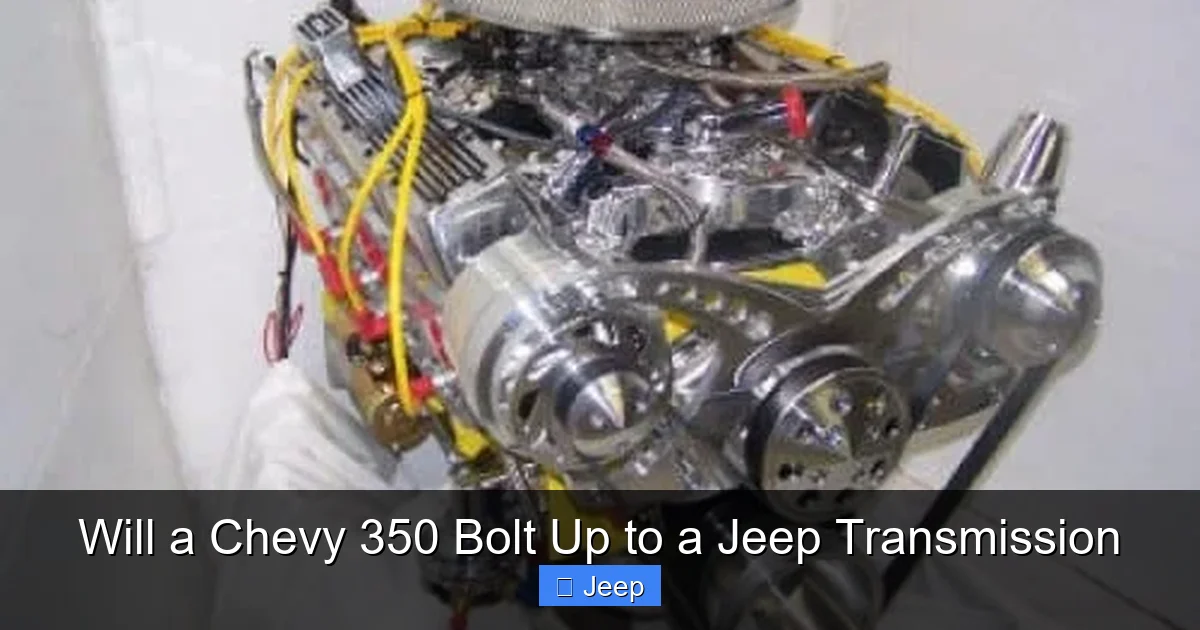
Visual guide about Will a Chevy 350 Bolt Up to a Jeep Transmission
Image source: tdmotion.com
The GM Small-Block Bellhousing Pattern
This is the pattern on your Chevy 350’s rear block. It’s been used on countless GM engines from the 1950s through the mid-1990s. However, there’s a critical split: pre-1987 (often called “early” or “pre-307” pattern) and post-1986 (“late” or “one-piece rear main seal” pattern). Visually, the late pattern has a distinct, larger, kidney-shaped oil pump opening. This matters because adapter kits are often specific to one pattern or the other. If you have a later-model 350 (like from a 1990s truck), you have the late pattern.
The Chrysler (Mopar) Transmission Pattern
This is the pattern found on most Jeep manual and automatic transmissions from the AMC era (1984+) through the modern JK/JL era. Key transmissions using this pattern include:
- AX15: The legendary 5-speed manual found in 1987-2006 TJ, LJ, and XJ/Wrangler Cherokee models.
- NSG360/NSG370: The robust 6-speed manuals in 2007+ JK/JLU Wranglers and 2005+Liberty/Commander.
- 42RLE: The 4-speed automatic in many late-model Jeeps.
- AW4: The 4-speed automatic from the XJ era.
Because these are Chrysler patterns, they will not bolt to a GM bellhousing. This is the primary reason the answer to will a Chevy 350 bolt up to a Jeep transmission is “no” for these common units.
The Rare Exceptions: GM-Pattern Jeep Transmissions
Not all hope is lost! There are a few Jeep transmissions that actually use a GM pattern, meaning they could, in theory, bolt directly to a Chevy 350 with the right bellhousing.
- T18/T19: These heavy-duty 4-speeds were used in some early CJ and full-size Jeep trucks (like the J-series). They have a GM pattern. If you have one of these, direct bolting is possible, but you’ll still face other challenges like input shaft length and pilot bearing issues.
- Some Chrysler Torqueflite A-727: While the A-727 is predominantly a Chrysler pattern, some heavy-duty versions (like those in Dodge trucks) used a GM pattern. This is rare in Jeeps but worth investigating if you have a specific model.
For the vast majority of Jeep owners with an AX15, NSG360, or 42RLE, an adapter or bellhousing swap is mandatory.
Bellhousing & Flywheel: The Heart of the Matter
This is the core of the Chevy 350 bolt up to Jeep transmission conundrum. You have three main paths forward here.
Visual guide about Will a Chevy 350 Bolt Up to a Jeep Transmission
Image source: tdmotion.com
Path 1: Use a Dedicated Adapter Kit
This is the most popular and reliable solution for modern Jeeps (YJ/TJ/JK with AX15/NSG360). Companies like Novak Conversions and Advanced Adapters manufacture precision-machined adapter plates that bolt between the Chevy 350’s block and the Jeep transmission’s bellhousing.
How it works: The adapter plate has the GM bolt pattern on the engine side and the Chrysler pattern on the transmission side. It’s typically a thick, rigid plate that also provides a thrust surface for the transmission bearing. You will still need a specific flywheel and sometimes a modified pilot bushing/bearing. These kits are engineered for specific engine/transmission combinations (e.g., “Chevy 350 to AX15” or “Chevy 350 to NSG360”), so you must buy the correct one for your year Jeep and transmission.
Pro: Well-tested, includes all necessary hardware and shims, comes with instructions.
Con: Cost ($300-$800+), adds a small spacer length which may affect driveshaft length.
Path 2: Swap to a GM-Pattern Bellhousing on the Transmission
Some Jeep transmissions, particularly the T18 and some older automatics, use a bolt-on bellhousing. If your transmission has a removable bellhousing, you could theoretically source a GM-pattern bellhousing that fits your transmission’s case. This is a more “factory” look but can be a nightmare to find. You’d need the exact bellhousing for your transmission model that also matches your Chevy 350’s pattern (early or late). This path is more common for people swapping a Chevy engine into a classic CJ with a T18.
Path 3: Use a Complete “Hybrid” Transmission
For automatic swaps, some builders use a GM transmission (like a TH350 or 700R4) and then adapt the Jeep’s transfer case. This flips the problem: instead of adapting the engine to the Jeep transmission, you’re adapting the Jeep’s transfer case to a GM transmission. This often uses a different adapter (like a Rubicon Express or Sky Manufacturing kit) and can be a great solution, especially for automatics. It’s a major modification but can be very clean.
Flywheel/Flexplate and Pilot Bearing
This is a critical detail often overlooked when asking will a Chevy 350 bolt up to a Jeep transmission. The Chevy 350 uses a specific flywheel or flexplate with a particular bolt circle and a recessed area for the starter gear. The Jeep transmission’s input shaft has a specific size and spline count.
- Manual Transmissions (AX15, NSG360): You must use a flywheel designed for the adapter kit you choose. These are often special “one-piece” flywheels or flexplates that match the Chevy 350’s crankshaft and have the correct hub for the transmission’s input shaft. The pilot bearing/bushing is also critical. The adapter kit will specify exactly what you need—usually a special pilot bushing that fits into the crankshaft and aligns with the transmission input shaft.
- Automatic Transmissions: You’ll need a flexplate for the Chevy 350 and a converter that matches both the Chevy’s stall speed and the Jeep transmission’s pump. Again, adapter kits will specify compatible parts.
Never assume your old Jeep flywheel will work. It almost certainly won’t.
Starter Motor and Flexplate: The Hidden Hurdle
Even if the bellhousing bolts on, the starter motor is a frequent source of frustration. The Chevy 350’s starter is mounted on the driver’s side (left) of the engine block. The starter gear (Bendix) must engage the ring gear on the flywheel/flexplate perfectly.
Gear-Drive vs. Integral Starter
Early Chevy 350s used a “gear-drive” starter where the motor and gear are separate. Later models (mid-1980s+) use an “integral” starter where the gear is built into the motor body. The location and mounting bolt pattern differ. Your adapter kit will be designed for one type or the other. You may need to source a specific starter for your engine year. Some adapter kits even relocate the starter to the passenger side to clear the transmission crossmember or exhaust—this requires a special starter and modified bellhousing.
Ring Gear Teeth Count
The Chevy 350 flywheel has a ring gear with a specific number of teeth (usually 153 or 168). The starter’s gear must match this count. Most Chevy starters are interchangeable between these two counts, but it’s something to verify. The Jeep transmission doesn’t care about this; it’s purely an engine-starter interface.
Crossmember, Mounts, and Physical Fitment
Will it physically fit in the engine bay? This is the next big question after will a Chevy 350 bolt up to a Jeep transmission. The answer is usually yes, but with caveats.
Crossmember Modifications
The Jeep’s factory transmission crossmember is positioned for the original engine/transmission combination. Adding an adapter plate (often 1-2 inches thick) pushes the transmission rearward. Your stock crossmember may no longer align with the transmission’s mount holes. You’ll likely need to:
- Cut and relocate the crossmember (welding required).
- Use a crossmember adapter that bolts to the stock crossmember and provides new mounting points.
- Fabricate a completely new crossmember. This is common in custom builds.
Some adapter kits (like Novak’s) offer specific crossmember adapters for popular Jeep models, which simplifies this significantly.
Engine Mounts
The Chevy 350 is physically larger than a Jeep 4.0L or 2.5L engine. You may need:
- New engine mounts (motor mounts) that are longer or positioned differently.
- Modified or repositioned engine mount brackets on the block.
- A different oil pan to clear the front axle, steering linkage, or exhaust. Many swap-specific oil pans (from companies like Milodon or Canton) are available with front sump designs or deep pans that clear obstacles.
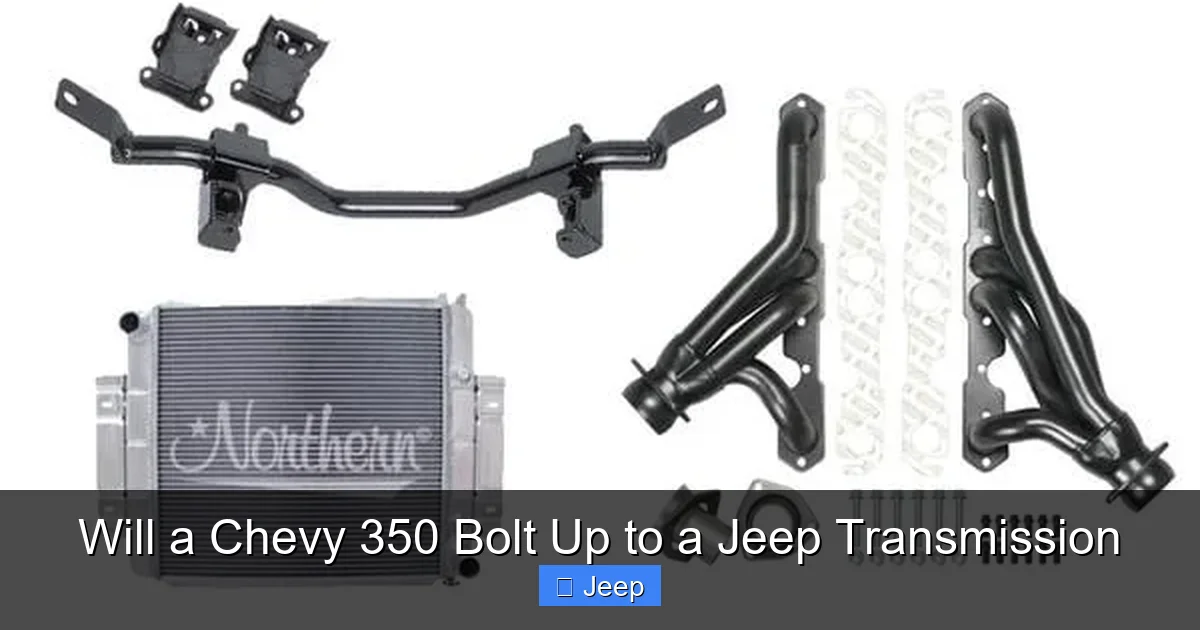
Clearance for the exhaust manifolds/headers is another common issue. The Chevy’s exhaust ports are on the outside, while the Jeep’s 4.0L ports are more inward. You may need custom headers or modified stock manifolds to clear the frame, steering box, or transfer case.
Drivetrain Implications: It’s Not Just the Transmission
Successfully mating the engine to the transmission is only step one. The rest of the drivetrain must handle the new power and torque, and the driveshaft must now connect properly.
Driveshaft Length and U-Joints
Moving the transmission rearward (due to the adapter) or changing the transmission model will almost certainly change the driveshaft length and the position of the transmission yoke. You will need to:
- Have your existing driveshaft measured and either shortened or lengthened by a professional shop.
- Ensure the transmission output shaft yoke matches the rear driveshaft’s U-joint size (most Jeep axles use 1310 or 1350 U-joints).
- Check the pinion angle and driveshaft operating angles after the engine/transmission are installed. Improper angles cause vibration and U-joint failure.
Transfer Case Considerations
For 4×4 Jeeps, your transfer case bolts to the back of the transmission. If you kept the Jeep’s original transmission (with an adapter), the transfer case should bolt on as before. If you switched to a GM transmission (like a TH350), you need an adapter between the transmission and the Jeep transfer case. Companies like Sky Manufacturing and Rubicon Express make these kits. You must also ensure the transfer case input shaft matches the transmission’s output shaft (spline count and length).
Rear Axle and Gearing
Here’s a crucial point: a Chevy 350, even a mild one, has more torque than a stock Jeep 4.0L. This puts more stress on the rear axle shafts, especially Dana 35s and some Dana 44s. It also changes your effective gear ratio. A Jeep with 3.73 gears and a 4.0L might feel sluggish with a 350; you’ll likely need to regear to 4.10 or 4.56 to get the truck to feel responsive and to take stress off components. This is a significant cost factor. Understanding the cost to regear a Jeep is a vital part of your project budget planning. Neglecting this can lead to broken axle shafts or poor performance.
Transmission Cooling
More power means more heat, especially for automatic transmissions. The stock Jeep transmission cooler may be inadequate for a V8. You should strongly consider adding a large auxiliary transmission cooler in front of the radiator. A hot transmission is a failed transmission. If you’re wondering can a transmission cause a car to overheat, the answer is yes, and an under-cooled transmission in a high-torque V8 Jeep is a prime candidate for overheating issues.
Practical Examples and Common Jeep Swaps
Let’s make this concrete. Here are common scenarios and what they entail.
Example 1: 1996-2006 Jeep Cherokee (XJ) or Wrangler (TJ/YJ) with AX15
This is one of the most popular platforms. You have a Chrysler-pattern AX15. You need a Chevy 350-to-AX15 adapter kit (Novak offers the “Swap Plate” for this). You will need a specific flywheel (often a one-piece billet steel unit), a pilot bushing, and likely a starter relocation or a specific starter. You’ll modify the crossmember. Driveshaft will need shortening. Expect to spend $1,000-$2,500 on parts (adapter, flywheel, mounts, etc.) plus fabrication and driveline work. A lift kit is often installed simultaneously for engine clearance and tire size. Researching how much does it cost to get a Jeep lifted alongside your engine swap budget is a smart move.
Example 2: 2007-2018 Jeep Wrangler (JK/JLU) with NSG360 or 42RLE
The NSG360 (manual) and 42RLE (automatic) are newer. Adapter kits exist ( Novak’s “Swap Plate” for NSG360). The process is similar to the AX15 but with different part numbers. The NSG360 is a very strong transmission, but the 42RLE is known to be weaker and may not be the best choice behind a 350 without extensive internal upgrades. For the 42RLE, many builders opt for a complete transmission swap to a GM 4L80E or a Chrysler 545RFE, which changes the entire game and requires more adapters (transmission to transfer case).
Example 3: Classic CJ with T18 Transmission
This is the golden ticket. The T18 has a GM pattern. If your Chevy 350 is an early block (pre-1987), it might bolt directly to the T18 bellhousing. You still need to verify input shaft length and pilot bearing depth. You may need a shorter pilot bushing or a spacer. The starter should be the gear-drive type. This is the simplest path, but classic CJs have their own fitment challenges (hood clearance, radiator sizing).
Conclusion: Yes, But…
So, will a Chevy 350 bolt up to a Jeep transmission? The definitive answer is: not without deliberate, planned modifications. For the overwhelming majority of Jeep transmissions (AX15, NSG360, 42RLE, AW4), you will need a high-quality adapter kit, a correct flywheel/flexplate, and will need to address the starter, crossmember, and driveshaft. For the rare T18, it’s possible with minor tweaks.
The key to success is treating this as a system swap, not just an engine swap. Research your specific Jeep model, year, and transmission. Identify your Chevy 350’s generation. Purchase a proven adapter kit from a reputable company—this is not the place to save a few dollars on a homemade plate. Budget for supporting modifications: a potential lift, a regear, a new driveshaft, and an auxiliary transmission cooler. Connect with online forums dedicated to your Jeep model; there are thousands of documented swaps with invaluable tips and part numbers.
The reward is a Jeep with legendary V8 torque, a sound that turns heads, and a driving experience that is uniquely yours. It’s a challenging but incredibly fulfilling project. Do your homework, plan meticulously, and you’ll have a Chevy-powered Jeep that bolts up—with a little help—and runs like a dream.
Frequently Asked Questions
Will a Chevy 350 bolt directly to a Jeep AX15 transmission?
No. The AX15 uses a Chrysler bellhousing pattern, while the Chevy 350 uses a GM pattern. You must use a dedicated adapter plate, a specific flywheel, and address the starter motor and crossmember modifications.
What is the best Jeep transmission to pair with a Chevy 350?
For strength and availability, the AX15 (in TJ/XJ) and NSG360 (in JK/JLU) are excellent choices when used with a proper adapter kit. For automatics, many builders prefer to swap to a robust GM transmission like the 4L80E and then adapt the Jeep transfer case, as this can be stronger than adapting the stock Jeep automatics.
Do I need to change my Jeep’s crossmember when swapping a Chevy 350?
Almost certainly. The adapter plate adds thickness, pushing the transmission rearward. Your stock crossmember mount holes will not align. You will need to cut, relocate, or replace the crossmember, or use a crossmember adapter specifically designed for your Jeep model and adapter kit.
Is the Chevy 350 starter motor compatible with a Jeep transmission setup?
Not directly. The starter’s mounting location and gear engagement depend on your Chevy 350’s generation (early vs. late block) and the adapter kit used. Some kits require a specific starter or even a starter relocation to the passenger side. You must follow the adapter manufacturer’s instructions exactly.
Will I need to modify my Jeep’s driveshaft after a Chevy 350 swap?
Yes. The added length from the adapter and/or a different transmission will change the distance between the transfer case and rear axle. Your existing driveshaft will almost certainly be the wrong length. It must be professionally measured, cut, and re-tubed with new U-joints to ensure proper length and operating angles.
Can I keep my Jeep’s original transfer case with a Chevy 350 and adapter?
Yes, if you are keeping the Jeep’s original transmission (e.g., AX15) and using an adapter plate, the transfer case will bolt on as it did originally. If you swap to a GM transmission, you will need a separate adapter between that transmission and your Jeep transfer case.