Why Is Tesla Registration So Expensive?

Contents
- 1 Key Takeaways
- 2 📑 Table of Contents
- 3 Demystifying the Registration Fee: It’s Not Just a Flat Tax
- 4 State-by-State Variations: A Patchwork of Policies
- 5 The Insurance Connection: A One-Two Punch
- 6 Comparing Tesla to Traditional ICE Vehicles: It’s Not Just the “E”
- 7 What Can You Do? Practical Tips to Manage Costs
- 8 The Future: Will Tesla Registration Stay So High?
- 9 Frequently Asked Questions

Power Steering Fluid

Reflective Stickers

Rear View Camera

Car Roof Rack Cross Bars
Tesla registration fees often surprise new owners with their high cost, but this isn’t due to the brand alone. The primary drivers are weight-based registration fees, luxury/excise taxes in many states, and specific EV policies designed to offset lost gas tax revenue. These factors combine to make the annual or biennial bill significantly higher than for a comparable gasoline car, varying dramatically by location.
You just bought your dream Tesla. The sleek design, the instant torque, the tech-filled interior—it’s everything you wanted. Then, the paperwork arrives. You sit down to pay your registration, and your jaw hits the floor. The fee is hundreds, sometimes even thousands, of dollars more than you paid for your old Honda Civic or Toyota Camry. What gives? Why is Tesla registration so expensive? The answer is a perfect storm of modern automotive engineering, state revenue strategies, and the unique position of electric vehicles in the market. It’s rarely a simple “Tesla tax.” Instead, it’s a complex equation of weight, value, and state law.
This isn’t just about being a premium brand. While Teslas have a high base price, the registration fee is calculated separately from the purchase price in most states. The shock comes from how that calculation is done. Let’s pop the hood on this issue and break down exactly why your Tesla’s registration bill is so high, what factors are at play in your specific state, and what you can (and cannot) do about it.
Key Takeaways
- Weight is a major factor: Most states base a portion of registration fees on vehicle weight, and Teslas are substantially heavier than similar-sized gas cars due to their massive battery packs.
- Luxury and excise taxes apply: Many states classify Teslas as luxury vehicles or impose specific excise taxes on high-value or electric vehicles, adding a significant flat fee or percentage.
- State policies vary wildly: There is no national standard. States like California, Texas, and Michigan have unique fee structures that can drastically increase the total cost.
- Insurance costs compound the expense: Higher registration often coincides with higher insurance premiums for Teslas, creating a double financial impact for owners.
- It’s not about the “Tesla” name alone: The cost is driven by legislative formulas targeting vehicle weight and value, not a Tesla-specific markup. Any heavy, expensive EV faces similar fees.
- You can estimate and sometimes reduce costs: By understanding your state’s DMV fee calculator and potential exemptions (e.g., for clean air vehicles in some areas), you can anticipate and possibly lower the bill.
📑 Table of Contents
- Demystifying the Registration Fee: It’s Not Just a Flat Tax
- State-by-State Variations: A Patchwork of Policies
- The Insurance Connection: A One-Two Punch
- Comparing Tesla to Traditional ICE Vehicles: It’s Not Just the “E”
- What Can You Do? Practical Tips to Manage Costs
- The Future: Will Tesla Registration Stay So High?
Demystifying the Registration Fee: It’s Not Just a Flat Tax
First, we need to understand what “registration” actually entails. It’s not a single fee but a bundle of charges your state Department of Motor Vehicles (DMV) or equivalent agency collects. This bundle typically includes:
- Vehicle License Fee (VLF): The core fee, often calculated on the vehicle’s original market value, depreciated over time.
- Weight Fee: An additional charge based on the vehicle’s gross vehicle weight rating (GVWR) or unladen weight.
- Local/County/City Fees: Additional charges imposed by your specific municipality for roads, bridges, or local services.
- Special Plate Fees: If you want a specialty or personalized license plate.
- Highway/Transportation Funds: Dedicated fees for infrastructure maintenance.
- State-Specific Excise/Luxury Taxes: Flat fees or percentages applied to certain vehicle classes.
The “Tesla tax” feeling usually comes from the combination of the weight fee and any state-specific excise taxes hitting a vehicle that is both very heavy and very valuable. To understand the disparity, we must look at the two biggest culprits.
The Heavyweight Champion: Battery Weight
This is the single most common reason. A standard Tesla Model 3 Long Range weighs about 4,250 lbs. A similarly sized, well-equipped Toyota Camry weighs around 3,500 lbs. That’s a difference of 750 pounds, primarily from the battery pack. The Model Y, Tesla’s popular SUV, weighs over 4,400 lbs. Compare that to a Honda CR-V or Ford Escape, which are typically in the 3,300-3,600 lb range.
Many states, including California, Texas, Michigan, and Washington, use a formula that adds a per-pound charge or moves the vehicle into a higher weight class, increasing the base fee. For example, a state might charge $0.50 per 100 lbs over 3,000 lbs. That extra 1,000+ lbs on a Model 3 adds $5-$10+ to the annual fee. For a Model X, which weighs nearly 5,500 lbs, this can add $50 or more annually compared to a 4,000 lb SUV. It’s a direct, mechanical consequence of the battery technology.
The Luxury/Excise Tax Factor: Punishing Price and Powertrain
Beyond weight, many states have targeted fees for “luxury” vehicles or, more recently, for electric vehicles. These are often flat fees or percentages of the vehicle’s value.
- California: Has a “Vehicle License Fee” (VLF) that is 1% of the vehicle’s original market value (not purchase price) in the first year, decreasing each year. For a $50,000 Model 3, that’s a $500 first-year VLF, whereas a $30,000 Camry would be $300. California also has an annual $100 “Electric Vehicle” fee (as of 2023) to compensate for lost gas tax revenue, though this is separate from the standard registration.
- Texas: Imposes a 6.25% state sales tax *at the time of purchase* (not annual registration), but this upfront cost sets a high “taxable value” for future registration calculations. More critically, Texas has a weight fee and many counties add their own substantial local fees.
- Michigan: Uses a formula based on the vehicle’s “base value” (original MSRP) and applies a 6% “use tax” (similar to sales tax) at titling. The annual registration fee is then calculated from this depreciated value. A high MSRP Tesla leads to a higher starting point.
- Special EV Fees: States like Iowa, Ohio, and Utah have passed annual flat fees for EV owners (e.g., $100-$200) explicitly to make up for lost gasoline tax revenue that funds road repairs. This is an add-on to the standard registration.
These aren’t “Tesla” fees per se; they are fees that disproportionately affect expensive, heavy vehicles—which is the exact niche Tesla occupies.
State-by-State Variations: A Patchwork of Policies
This is where the confusion and frustration peak. A Tesla owner in California pays a completely different bill than one in Oregon or Florida, even for the same model. Let’s look at a few key states to illustrate the range.

Visual guide about Why Is Tesla Registration So Expensive?
Image source: automotivesimple.com
California: The High-Cost Benchmark
California is often the poster child for expensive Tesla registration. Why?
- High Base Value: The 1% VLF on original value is steep for the first 5-10 years.
- Weight Fees: California charges additional fees based on weight for trucks and certain vehicles, but for passenger cars like the Model 3/Y, the primary weight impact is in the local county fees, which often have their own weight-based components.
- Local County Leashes: Counties and cities add their own registration fees. Los Angeles County, for instance, has a “Vehicle License Fee” and other local transportation fees that can add $100-$200+ to the state bill.
- The $100 EV Fee: The annual statewide electric vehicle fee is a direct add-on.
Practical Example: A 2022 Tesla Model 3 Long Range (original MSRP ~$52,990) registered in Los Angeles County in its first year could easily see a total registration bill of $600-$800+. This includes the 1% VLF (~$530), the $100 EV fee, county fees, and the base registration. Five years later, the VLF drops, but the flat fees remain. For a deep dive into California’s specific calculations, you can review resources like this guide on Tesla Model 3 registration in California.
Texas: Upfront Tax Meets Local Fees
Texas doesn’t have an annual property tax on vehicles like some states, but its 6.25% sales tax is paid upfront on the full purchase price of the new Tesla. This is a massive one-time cost. However, the annual registration fee itself is relatively modest at the state level (~$50-$100 depending on weight). The catch? Local counties and municipalities impose their own registration fees, which can be substantial. In large counties like Harris (Houston) or Travis (Austin), these local fees can push the total annual registration to $200-$350, especially for a heavy vehicle.
Michigan: Depreciation-Based Fees
Michigan’s system is unique. You pay a 6% use tax when you first title the vehicle (effectively a sales tax). The annual registration fee is then calculated using a “base value” set by the state, which depreciates each year. For a high-value Tesla, this base value starts very high. While the fee decreases annually, it starts from a much higher point than a conventional car. Combined with county fees, the first few years can be costly.
The “Friendlier” States
Some states have simpler, flatter fee structures that don’t penalize weight or value as harshly. For example:
- Florida: Has a relatively flat annual fee based on vehicle type (e.g., $225 for an electric vehicle under 5,000 lbs, $250+ for heavier). It doesn’t use value-based formulas.
- Oregon: Has a flat annual registration fee for EVs ($154 as of 2023) to replace gas tax, but no separate weight or luxury surcharges on top of that.
- Pennsylvania: Fees are primarily based on vehicle type and weight class, but the value component is less aggressive than in CA or MI.
Your location is the single biggest variable. Always check your specific state DMV website and your local county treasurer’s office for the exact fee schedule.
The Insurance Connection: A One-Two Punch
Here’s where the pain really compounds. Expensive registration often coincides with expensive insurance. Insurers cite several reasons for higher Tesla premiums:
Visual guide about Why Is Tesla Registration So Expensive?
Image source: automotivesimple.com
- Repair Costs: Tesla’s unique construction (aluminum, advanced sensors, integrated battery) and exclusive parts lead to much higher repair bills after an accident. A minor fender bender can cost thousands more to fix than on a conventional car.
- Technology Risk: The advanced driver-assistance systems (Autopilot, Full Self-Driving capability) are expensive components. Insurers are still gathering data on failure rates and repair costs, leading to cautious pricing.
- Vehicle Value: Higher replacement value means higher premiums.
- Claim Frequency: Some studies suggest Tesla drivers may engage Autopilot in a way that leads to specific types of claims (e.g., rear-end collisions), though data is debated.
So, you’re not just paying a high registration bill once a year; you’re likely also writing a larger check each month for insurance. The cumulative cost of ownership is significantly impacted by this combination. For owners trying to budget, understanding both sides is crucial. You can explore more about the specific insurance challenges with articles like Is Tesla Car Insurance Expensive?.
Comparing Tesla to Traditional ICE Vehicles: It’s Not Just the “E”
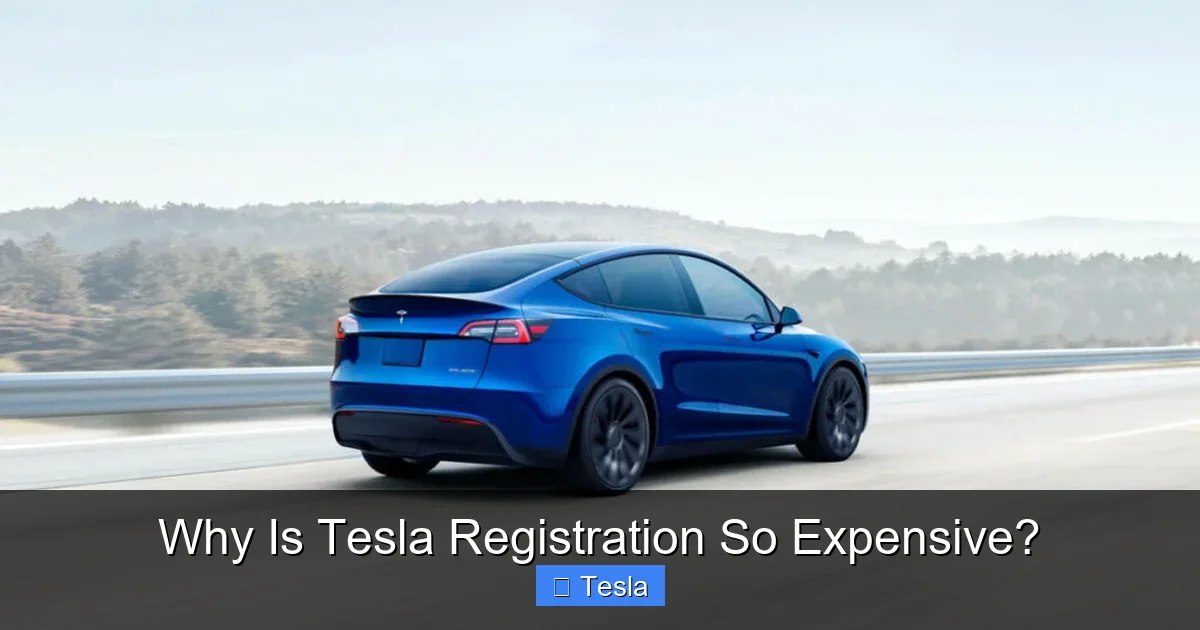
Let’s do a direct apples-to-apples comparison to see the difference. Take a 2022 Tesla Model 3 Long Range (MSRP ~$53k, weight ~4,250 lbs) vs. a 2022 BMW 330i (MSRP ~$45k, weight ~3,600 lbs) in California.
Visual guide about Why Is Tesla Registration So Expensive?
Image source: drivecanvas.com
- California VLF: Tesla: 1% of $53k = $530. BMW: 1% of $45k = $450. Difference: $80.
- Weight/County Fees: The Tesla’s extra 650 lbs will trigger slightly higher county weight-based fees, perhaps $10-$30 more.
- EV Fee: Tesla pays an extra $100. The BMW does not.
- Total First-Year Difference: Roughly $190-$210 more for the Tesla.
Now, compare the Tesla to a non-luxury, lighter sedan like a Toyota Camry (MSRP ~$26k, weight ~3,500 lbs) in the same county.
- VLF: Tesla: $530. Camry: 1% of $26k = $260. Difference: $270.
- EV Fee: Tesla: +$100. Camry: $0.
- Total First-Year Difference: ~$370+, before even considering potential local weight fee differences.
The gap widens dramatically when comparing to a non-luxury car because the value-based component (VLF) is so much lower. The “expensive” registration is really a function of two things: having a high original MSRP and being an EV in a state that targets them with fees. Any vehicle that shares those traits—like a Porsche Taycan or a Rivian R1T—will see similar or even higher bills due to greater weight and price.
What Can You Do? Practical Tips to Manage Costs
While you can’t change your state’s laws or your Tesla’s weight, you can take steps to understand and potentially reduce your bill.
- Calculate Before You Buy: Use your state’s online DMV fee calculator. Input the exact make, model, and year you’re considering. This gives you a realistic annual cost to factor into your ownership budget.
- Check for Clean Air Vehicle (CAV) Exemptions: Some states and localities offer reduced or waived fees for zero-emission vehicles to incentivize adoption. California, for example, allows some CAVs to get a $100 reduction on the $100 EV fee if they meet certain criteria (though this is changing). Always ask the DMV or check your state’s environmental agency website.
- Consider Registration Period: Some states offer a small discount for a two-year registration versus two separate one-year payments, as the processing fee is sometimes waived.
- Local, Local, Local: A huge portion of the variance comes from your city/county. If you live in a high-fee county but work in a lower-fee one, you generally must register in your residence county, but it’s good to know the landscape.
- Advocate: These fees are set by legislation. If you feel the weight-based or EV fees are unfair, join Tesla Owners Groups or EV advocacy organizations that lobby for more equitable fee structures based on actual road wear (which is minimal for EVs) rather than lost gas tax.
- Factor in Total Cost of Ownership (TCO): When comparing a Tesla to a gas car, don’t just look at the sticker price and fuel savings. Add in the estimated registration and insurance costs over 5 years. The “fuel savings” might be partially eaten by higher fixed fees.
Ultimately, the high registration fee is a policy choice. States are grappling with how to fund road maintenance as the gas tax revenue pool shrinks. Weight fees are a proxy for road wear (though studies show EVs cause similar wear to gas cars of the same weight), and EV fees are a direct replacement for gas taxes. As an EV owner, you’re navigating the transition period of these new funding models.
The Future: Will Tesla Registration Stay So High?
This is a moving target. As EVs become mainstream, the political calculus will change.
- Fee Structures May Evolve: The current punitive fees on early EV adopters may soften as EVs become a larger percentage of the fleet. There is a growing push for “vehicle miles traveled” (VMT) fees as a more equitable replacement for gas taxes, which would charge all vehicles based on road use, not powertrain.
- Battery Weight May Decrease: Future battery technologies (solid-state) promise similar range with less weight. A lighter Tesla would face lower weight fees.
- Market Saturation: As Tesla introduces more affordable models (like the rumored $25k car), the average value of a Tesla will drop, reducing the value-based fee component for the brand’s core offerings.
For now, though, if you buy a current-model, long-range Tesla, you are buying a heavy, expensive vehicle in a regulatory environment that hasn’t fully caught up with the EV revolution. The high registration fee is a tangible symptom of that gap.
Conclusion: Your Tesla’s expensive registration isn’t a random “Tesla tax.” It’s the mathematical result of a heavy battery pack triggering weight-based fees, a high original MSRP triggering value-based fees, and state-level policies that often include specific charges for electric vehicles. The exact cost is a lottery determined by your ZIP code. The best defense is informed purchasing: calculate the fees before you buy, investigate local and state exemptions, and budget for this non-negotiable aspect of EV ownership. As the automotive world shifts, these fee structures will undoubtedly change, but for the current generation of Teslas, a high registration bill is simply part of the ownership package.
Frequently Asked Questions
Is Tesla registration expensive in every state?
No. The cost varies dramatically by state. States like Florida and Oregon have relatively flat, modest fees for all vehicles. The highest costs are typically in states with value-based formulas (California, Michigan) or heavy local fees (some Texas counties), combined with any statewide EV surcharges.
Why does my Tesla’s weight affect registration?
Many states use vehicle weight as a factor in calculating registration fees, under the theory that heavier vehicles cause more wear and tear on roads. Since Teslas have very heavy battery packs, they often weigh 20-30% more than comparable gas cars, pushing them into higher fee brackets.
Can I get my Tesla registration fee reduced?
Possibly. Some states offer Clean Air Vehicle (CAV) exemptions that can reduce or eliminate specific EV fees. You must apply for this with your DMV, often requiring proof of your vehicle’s eligibility (like a CARB or EPA certification). Always check your state’s DMV website for current programs.
Is the registration fee the same for all Tesla models?
No. A Model 3 will generally have a lower registration fee than a Model X or Cybertruck because it is both less expensive and lighter. The fee is calculated per vehicle based on its specific weight, model year, and original MSRP.
How is Tesla registration different from registration for other luxury cars?
The key difference is the EV-specific fees (like California’s $100 annual charge) and the disproportionate impact of weight fees. A similarly priced Porsche 911 is much lighter than a Tesla Model S, so it would not incur the same weight-based penalties. The combination of high value *and* high weight is unique to EVs like Teslas.
Will Tesla registration fees go down in the future?
They may. As battery technology improves, vehicles may become lighter. More importantly, as EVs become more common, states may reform fee structures to be more equitable (e.g., switching to mileage-based fees). However, for the foreseeable future, purchasing a new, heavy, high-value Tesla means accepting higher-than-average registration costs.