
Why Is My Jeep Making a Knocking Sound?

A knocking sound in your Jeep is one of the most serious engine warnings you can hear. It almost always points to internal mechanical wear or failure, like worn rod bearings, piston slap, or severe detonation. Unlike other noises, engine knock typically indicates a problem that will cause catastrophic damage if you continue driving. Immediate diagnosis and repair are essential to avoid a complete engine failure.
Hey there, fellow Jeep enthusiast. Let’s have a real talk. You’re out on the trail, or maybe just cruising down the highway, and you hear it. That distinct, rhythmic knock-knock-knock coming from under the hood. Your heart sinks a little. Your mind races. “Why is my Jeep making a knocking sound?” It’s one of the most unsettling noises a vehicle can make, and for good reason. This isn’t a squeaky belt or a rumbling exhaust. This is your engine’s cry for help. In the world of Jeeps, known for their durability and go-anywhere attitude, an internal engine knock is a particularly grave warning. It’s the sound of metal-on-metal where there should be a perfect, oiled harmony. Ignoring it doesn’t just mean a breakdown; it means a very expensive, very final breakdown. So, take a deep breath. We’re going to break down exactly what that noise is, why your specific Jeep might be prone to it, what you can do about it, and when you need to stop driving. Right. Now.
Key Takeaways
- Knocking is a Serious Red Flag: A rhythmic metallic knock is rarely a minor issue. It signals internal engine component wear or failure that requires immediate attention.
- Rod Bearings Are the Prime Suspect: The most common and dangerous cause is worn connecting rod bearings, often from low oil pressure, poor maintenance, or high mileage.
- Model History Matters: Certain Jeep models and engine families, like the 4.0L inline-six in TJ/LJ Wranglers and early 3.8L V6s in JK Wranglers, have known bearing wear patterns as they age.
- Diagnosis is Non-Negotiable: You must pinpoint the exact cause. Using a mechanic’s stethoscope, checking oil pressure, and scanning for codes are critical first steps before any repair.
- Driving with Knock is a Gamble with a Total Loss: Continuing to operate the vehicle with a rod knock will eventually destroy the crankshaft, block, and pistons, leading to an engine replacement that often exceeds the vehicle’s value.
- Prevention is Meticulous Maintenance: Regular, timely oil changes with the correct oil weight, using quality fuel, and addressing minor issues (like oil leaks) are the best defenses against premature bearing wear.
- Professional Help is Usually Required: Except for very specific, minor cases, diagnosing and repairing internal engine knock requires specialized tools and expertise. Consult a trusted mechanic immediately.
📑 Table of Contents
- The Anatomy of a Knock: Understanding Engine Noise Types
- The Usual Suspects: Why Your Jeep’s Engine is Knocking
- Model-Specific Vulnerabilities: Which Jeeps Are Prone?
- Diagnostic Roadmap: How to Pinpoint the Source
- When to Panic vs. When to Chill: A Severity Guide
- Fixes and Repairs: From Cheap Additives to Engine Rebuilds
- Prevention is Key: Maintenance Habits for a Quiet Jeep
The Anatomy of a Knock: Understanding Engine Noise Types
Before we point fingers, we need to identify the culprit. Not all knocks are created equal, and the sound’s character tells a different story. Your job as a detective is to listen carefully. Is it a heavy, slow knock that speeds up with engine RPM? That’s often the classic, dreaded rod bearing knock. Is it a lighter, faster rattle that’s loudest on cold starts and fades as the engine warms up? That could be piston slap. Or is it a sharp, high-pitched pinging or ping-ping-ping under acceleration? That’s detonation (or “spark knock”), a combustion issue. Let’s decode the sounds.
Rod Knock: The Deep, Rhythmic Death Rattle
This is the big one. The sound is a deep, metallic knock-knock-knock that is in direct sync with the engine’s revolutions per minute (RPM). As you rev the engine, the knock gets faster and often louder. It’s usually most audible under load, like when you’re accelerating or climbing a hill. The cause is catastrophic wear in the connecting rod bearings. These are the shell bearings that sit between the connecting rod (which connects the piston to the crankshaft) and the crankshaft journal. They are designed to have a perfect, microscopic clearance filled with a film of pressurized oil. When that bearing wears out, the clearance becomes too large. The rod now has a tiny bit of “play,” and it slaps against the crankshaft with every power stroke. That’s the knock you hear. This is not a “maybe” problem. A rod knock means the engine is on a countdown to complete disintegration. The metal debris from the failing bearing will circulate and destroy everything else—the crankshaft, the piston pins, the cylinder walls.
Piston Slap: The Cold-Start Rattle
Piston slap is a confusing noise because it sounds like a knock but is often less immediately destructive. It’s a hollow, rattling, metallic sound, loudest when the engine is cold and typically quiets down or disappears completely once the engine reaches operating temperature. It happens when there’s too much clearance between the piston and the cylinder wall. When the engine is cold, the metal is contracted, and the piston rocks side-to-side in the cylinder, slapping the wall. As it heats up and expands, the fit tightens, and the noise stops. While annoying, a mild piston slap in an older, high-mileage engine isn’t always an instant death sentence. However, it indicates excessive wear and poor sealing, which leads to lost compression, oil consumption, and eventually, it can progress into a more serious issue. Some Jeep engines, particularly certain 4.0L straight-sixes, are notorious for developing a minor piston slap as they age without failing catastrophically. But you still need a mechanic to verify it’s just slap and not the onset of bearing failure.
Detonation / Pre-Ignition (Spark Knock): The Ping Under Load
This isn’t a mechanical knock; it’s a combustion event gone wrong. You’ll hear a sharp, metallic pinging or spark knock sound, usually when accelerating under load, going uphill, or when the engine is hot. It’s the sound of the air/fuel mixture detonating explosively in the cylinder rather than burning smoothly. This creates immense, sudden pressure spikes that hammer the pistons, rods, and bearings. Chronic detonation is like taking a tiny sledgehammer to your engine’s internals every time it occurs. It can quickly lead to hole-punched pistons, melted spark plugs, and yes, destroyed rod bearings. Causes in a Jeep are often bad gasoline (low octane for your compression ratio), carbon buildup creating hot spots, incorrect spark plugs, a faulty knock sensor, or engine overheating. If you suspect detonation, you must address the cause immediately. It’s a silent assassin of engines.
The Usual Suspects: Why Your Jeep’s Engine is Knocking
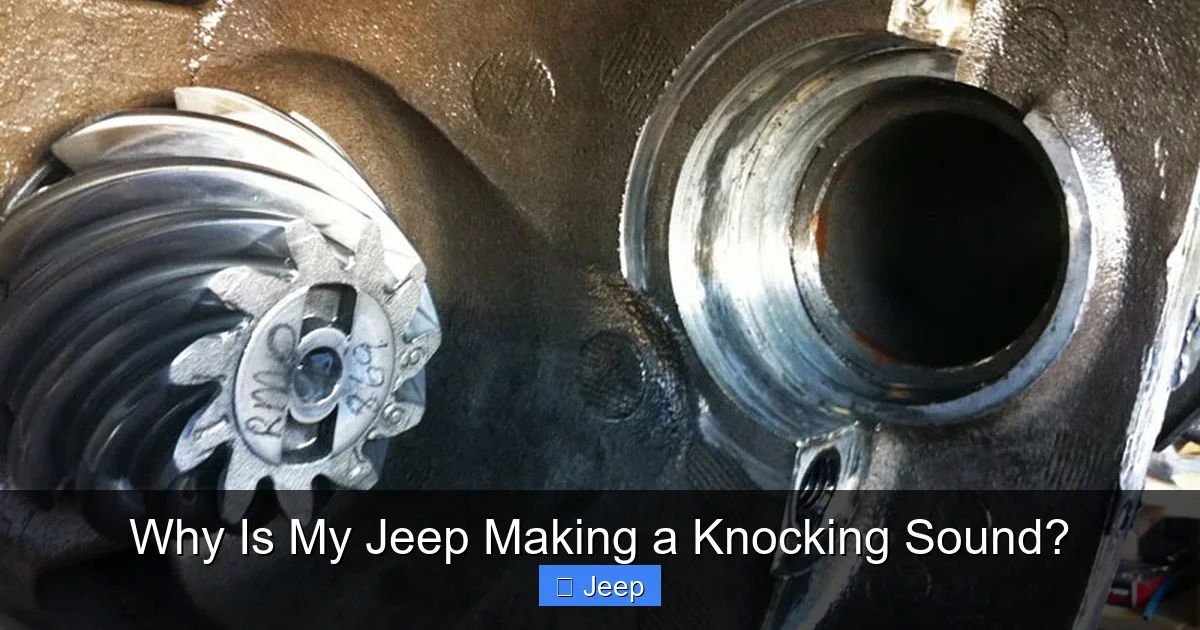
Now that we can identify the sound, let’s talk about the why. The vast majority of rhythmic, RPM-dependent knocks in Jeeps come down to one thing: insufficient oil film between rotating and reciprocating parts. That film is everything. It’s what keeps metal from touching metal. Anything that compromises that film leads to wear, clearance, and ultimately, knock. Here are the primary paths to failure.
Visual guide about Why Is My Jeep Making a Knocking Sound?
Image source: indiavrtours.com
1. Worn or Failing Rod Bearings (The #1 Culprit)
As discussed, this is the classic. But why do the bearings wear out prematurely? It’s rarely a manufacturing defect in a well-maintained engine. It’s almost always a lubrication or contamination issue.
- Low Oil Pressure: The oil pump can’t generate enough pressure to force oil into the tight bearing clearances. This can be caused by a worn pump, a clogged oil pickup screen (common in Jeeps that go through deep water/mud), or simply low oil level from neglect or leaks.
- Poor Quality or Incorrect Oil: Using oil that’s too thin (low viscosity) for your engine’s age and climate won’t maintain a thick enough film, especially under high load. Jeep’s recommended oil weights are there for a reason.
- Extended Oil Change Intervals: Oil breaks down. It loses its viscosity, its additives deplete, and it gets contaminated with fuel, water, and metal particles. Dirty, degraded oil is a terrible lubricant and an excellent abrasive.
- Oil Starvation During High Load: Hard cornering, steep climbs, or towing can cause oil to slosh away from the pickup tube momentarily in a nearly empty oil pan, starving the engine.
2. Main Bearing Wear
The main bearings support the crankshaft itself in the engine block. If they wear, you can get a deeper, heavier knock that is also RPM-dependent. It’s less common than rod knock but equally terminal. The causes are identical to rod bearing wear: oil starvation, contamination, and low pressure.
3. Piston Slap (As Described)
This is caused by cylinder/piston wear. It’s a symptom of high mileage and normal wear in some engines, but it can be accelerated by chronic overheating or poor oil quality that doesn’t protect the cylinder walls.
4. Accessory or Exhaust Leak (The False Alarm)
This is the hope you cling to. A loud, rhythmic knock can sometimes be an exhaust manifold leak. A broken manifold bolt or a warped manifold can create a ticking or knocking sound that mimics internal engine noise. It will often change with engine temperature and be louder at idle. Similarly, a failing harmonic balancer (the rubber damper on the crankshaft) can separate and cause a loud knocking that feels like it’s coming from deep inside. Always rule these out first because they are cheap fixes compared to an engine rebuild. A mechanic will often use a stethoscope or even a long screwdriver to listen directly to the block to confirm if the noise is internal.
Model-Specific Vulnerabilities: Which Jeeps Are Prone?
While any engine can fail with enough abuse, some Jeep powertrains have developed reputations for bearing issues as they accumulate miles. Knowledge of these patterns can help you be extra vigilant.
Visual guide about Why Is My Jeep Making a Knocking Sound?
Image source: cdn.carcomplaints.com
The Legendary 4.0L Inline-Six (1991-2006 TJ/LJ Wrangler, 1993-2004 Grand Cherokee)
This engine is famous for its near-indestructible reputation and its tendency to develop a piston slap after 150,000+ miles. Many high-mileage 4.0Ls have a characteristic rattle on cold starts that disappears when warm. For the vast majority, it’s a harmless (if annoying) wear characteristic. However, it can sometimes mask or be confused with the beginning of a rod bearing issue. The key is the temperature dependency. If the knock never goes away, or gets worse as the engine warms, it’s likely bearing-related. These engines are also very sensitive to oil pressure. A failing oil pump or a clogged pickup (from sludge or a failed oil filter) can cause a rapid drop in pressure and bearing failure.
The 3.8L V6 (2007-2011 JK Wrangler, 2008-2010 Liberty)
This engine, borrowed from Chrysler’s minivan line, was never a powerhouse, but it was generally reliable. However, as these Jeeps age into the 150,000-200,000-mile range, reports of rod bearing knock have become more common. The cause is often linked to the same triad: delayed oil changes, the use of incorrect oil (some owners mistakenly use 5W-20 when 5W-30 is specified for higher temperatures), and general high-load use in heavier Wranglers. It’s a known wear point for this engine family.
The 3.6L Pentastar V6 (2012-Present Wrangler JL, Grand Cherokee WK2)
This is a modern, efficient, and generally very robust engine. Is it immune? No. But catastrophic bearing failure is rare. The more common issue that can cause a knock-like noise is detonation from carbon buildup, especially in direct-injection engines like the Pentastar. If you’re using low-grade fuel or have a clogged injector, you might hear pinging under load. This needs to be fixed to prevent secondary damage. True rod knock in a well-maintained 3.6L is unusual and would point to a severe oiling issue or a catastrophic failure of a specific component.
The 2.5L & 4.0L Inline-Four (Early XJ Cherokee, Comanche)
These older engines are simple and tough, but age catches up. Piston slap is common. Rod bearing failure is usually from extreme neglect or a sudden oiling incident (like running the oil pump dry after a major leak).
Diagnostic Roadmap: How to Pinpoint the Source
Hearing the knock is step one. Step two is professional diagnosis. Do not guess. Here is the logical path a good mechanic will follow.
Visual guide about Why Is My Jeep Making a Knocking Sound?
Image source: cdn.carcomplaints.com
Step 1: The Listen Test
A skilled mechanic will use a mechanic’s stethoscope or even a long screwdriver held against the engine block to isolate the noise. They’ll listen to each cylinder bank, the top end (valve train), and the bottom end (crankcase). A rod knock is loudest directly on the rod journal area of the block. They’ll also check if the noise changes with a cylinder “kill test” (disconnecting one cylinder’s ignition or fuel at a time on a running engine). If the knock disappears or diminishes when a specific cylinder is disabled, that cylinder’s bottom end (rod bearing) is the source.
Step 2: Oil Pressure Check
This is critical. A mechanical oil pressure gauge is hooked up directly to the engine. The mechanic will check pressure at idle and at higher RPM. Low oil pressure at operating temperature is a smoking gun for bearing wear. The bearings have worn so large that they can no longer hold pressure. If pressure is good, it doesn’t rule out a knock (it could be a very early stage), but it’s a better sign.
Step 3: Scan for Codes & Check for TSBs
Plug in an OBD-II scanner. You might not get a specific “rod knock” code, but you might see codes for knock sensor circuit (P0325, etc.) or misfires. A constantly active knock sensor code can indicate the ECU is constantly trying to adjust timing to combat detonation. Also, check for Technical Service Bulletins (TSBs) from Jeep/Stellantis for your specific model year and engine. There may be known issues with oil pumps, sensors, or even internal components that are under extended warranty or have specific repair procedures.
Step 4: The “Feel” Test
Sometimes, a severe rod knock can be felt as a vibration through the seat, floorboard, or steering wheel, especially at certain RPMs. This is a very bad sign.
Step 5: Rule Out External Causes
As mentioned, the mechanic will inspect the exhaust manifold for cracks, the harmonic balancer for separation, and the accessories (power steering pump, alternator) for failing bearings that can transmit noise through the belts and brackets.
When to Panic vs. When to Chill: A Severity Guide
Not all knocks are equal in their immediacy, but all require action.
RED LIGHT: STOP DRIVING IMMEDIATELY
- Loud, metallic knock that is getting louder quickly.
- Knock is present at all RPMs and loads, including idle.
- You have confirmed low oil pressure.
- You see metal shavings in the oil (check the dipstick or during a change).
- Severe loss of power, smoking, or knocking that changes to a grinding sound.
Driving any further will turn a potentially repairable engine (with a new bearing set) into a pile of scrap metal requiring a full engine replacement or a catastrophic failure that can strand you anywhere.
YELLOW LIGHT: SCHEDULE REPAIR URGENTLY (Within 24-48 Hours)
- Knock is only audible under load (acceleration, hill climb) and disappears at steady cruise or idle.
- Knock is present only when engine is cold and goes away when fully warm (possible piston slap, but get it verified).
- You have a persistent, mild knock but oil pressure is normal.
Do not ignore this. You can drive a short distance to a trusted shop, but no road trips, no towing, no off-roading. The problem is active and will worsen.
AMBER LIGHT: MONITOR AND DIAGNOSE SOON
- Intermittent pinging/detonation under heavy acceleration only.
- A new, light rattle that you can’t quite place.
This could be an exhaust leak or a minor issue, but it still needs to be checked during your next service appointment. Start using higher-octane fuel if you suspect detonation.
Fixes and Repairs: From Cheap Additives to Engine Rebuilds
The repair path is dictated entirely by the diagnosis. There is no one-size-fits-all.
Scenario A: It Wasn’t the Engine (External Noise)
If the problem is an exhaust manifold leak or a failing harmonic balancer, the fix is relatively inexpensive and straightforward. This is the best-case scenario. A harmonic balancer replacement might cost $300-$600. An exhaust manifold repair could be $200-$800 depending on parts and labor.
Scenario B: Detonation (Pinging)
Fix the cause. This means:
- Switch to premium, high-octane fuel.
- Perform a decarbonization service (chemical treatment or manual cleaning of intake valves and chambers).
- Replace spark plugs with the correct heat range.
- Check and replace the knock sensor if faulty.
- Ensure cooling system is working perfectly to prevent hot spots.
Cost: $150 – $1,000+ depending on the service.
Scenario C: Piston Slap (Benign)
If a mechanic confirms it’s harmless slap in an old engine, you may choose to do nothing but monitor oil pressure and consumption. Some people use heavier oil (e.g., 10W-30 or 15W-40) in the summer to slightly quiet it. This is a “live with it” situation.
Scenario D: Bearing Failure (Rod or Main)
This is the major league repair. The engine must be removed from the vehicle and disassembled.
- Bearings Only: If caught extremely early and the crankshaft is undamaged, you might get away with just replacing the rod bearings and possibly honing the cylinders. This is a complete rebuild, involving machining the crankshaft, installing new bearings, new piston rings, a new timing chain/gears, and a full gasket set. Labor is immense. Cost: $3,000 – $6,000+.
- Crankshaft Damaged: If the knock was allowed to continue, the crankshaft journal will be scored, grooved, or out-of-round. It will need to be reground to an undersize and fitted with thicker bearings, or replaced entirely. This adds significant cost. A new crankshaft can be $1,000-$2,500+ for the part alone.
- Complete Engine Replacement: Often, the most cost-effective solution for a car with a rod knock is to replace the engine with a used or remanufactured unit. A remanufactured long-block for a 4.0L might be $3,500-$5,000 plus $1,500-$2,500 in labor. For a common Jeep, this can still be cheaper than a full in-frame rebuild.
Prevention is Key: Maintenance Habits for a Quiet Jeep
You bought a Jeep for adventure. The best way to keep it adventuring and out of the shop is obsessive maintenance.
1. Oil Changes are Religion
Change the oil and filter every 5,000 miles without fail, even if you use synthetic. Use the exact viscosity and specification recommended in your owner’s manual. For older, high-mileage Jeeps, consider a high-mileage oil with seal conditioners. Never, ever let the oil level drop below the dipstick’s “add” mark. Check it every 1,000 miles.
2. Address Oil Leaks Immediately
A small drip is a big problem. Low oil level is the #1 cause of bearing failure. Fix oil leaks from the valve cover gaskets, oil pan gasket, or rear main seal as soon as you notice them. It’s cheaper than an engine.
3. Use Quality Fuel
Especially for the 3.6L Pentastar and any turbocharged engine (like the 2.0T in some Wranglers 4xe), use top-tier gasoline. It has better detergent additives that help keep combustion chambers clean, preventing carbon-related detonation and knock.
4. Warm Up, But Don’t Idle for Ages
After a cold start, drive gently for the first 5-10 minutes. This allows oil to circulate fully and the engine to reach operating temperature evenly. However, don’t let it idle for 20 minutes to “warm up”—that causes more wear and doesn’t warm the drivetrain effectively.
5. Listen and Act
Get familiar with your Jeep’s normal sounds. When something changes, investigate it immediately. That faint new noise is your engine giving you a chance to fix a small problem before it becomes a huge one. A diagnostic fee ($100-$150) is cheap insurance against a $5,000 mistake.
6. Don’t Abuse It (Unnecessarily)
Jeeps are tough, but they have limits. Don’t consistently redline the engine. Don’t tow loads beyond the rated capacity. Don’t go through deep water with a clogged air filter or a worn crankshaft seal. Respect the machine, and it will respect you back.
In the end, a knocking Jeep is a serious diagnostic challenge that demands respect. It’s the sound of internal warfare in your most valuable component. Your immediate next step is to stop driving the vehicle if the knock is loud and consistent. Have it towed to a reputable, independent Jeep specialist or a dealer you trust. Describe the noise perfectly: “A metallic, rhythmic knock that increases with engine speed.” Provide any history: recent oil changes? Any dash warnings? Any recent work? Your detailed input combined with their professional diagnosis is the only way to save your engine—and your wallet.
Frequently Asked Questions
Is it safe to drive my Jeep with a knocking sound?
No, it is generally not safe. A rhythmic metallic knock almost always indicates internal engine damage that will worsen rapidly. Driving even a short distance can cause total engine failure, leaving you stranded and facing a much more expensive repair. The only exception is confirming a harmless external noise like an exhaust leak. If you suspect internal knock, have the vehicle towed.
What does a rod knock sound like compared to other noises?
A rod knock is a heavy, dull, metallic knock-knock-knock that is perfectly synchronized with engine RPM. It’s loudest under load (acceleration, hill climb). It is distinct from a tick (valve train), a rattle (piston slap or exhaust), or a ping (detonation). Piston slap is a lighter rattle that usually disappears when the engine is warm.
Can I fix a knocking engine myself?
For the vast majority of internal knocks (rod bearings, main bearings), no. These repairs require complete engine removal, disassembly, machine work, and expert reassembly. Attempting it without a full shop and experience will likely result in a destroyed engine. External causes like an exhaust leak or harmonic balancer may be DIY for an experienced mechanic, but diagnosis must come first.
How much does it cost to fix a knocking Jeep?
The cost ranges from a few hundred dollars (for an external noise fix) to over $8,000. A full engine rebuild or replacement for a rod knock typically starts at $3,500-$4,000 for a remanufactured engine plus installation. An in-frame rebuild with machine work can easily exceed $6,000. The specific model and engine type greatly affect the final cost.
Why do Jeeps, especially older ones, seem to have this problem?
Jeeps are often driven hard, used for off-roading, towing, and in demanding conditions, which increases stress on the engine. Many popular Jeep engines (like the 4.0L inline-six and 3.8L V6) are now 20+ years old and have high mileage. Age and wear on bearings, combined with potential lapses in maintenance over the years, make these engines susceptible to developing clearance and knock as they approach or pass 200,000 miles.
Will an oil change or additive stop the knock?
No. If the knock is from worn bearings (the most common cause), an oil change will not restore the lost clearance. It might temporarily quiet it if the oil is extremely degraded, but it will return. “Miracle” additives are not a solution for mechanical wear. They are a temporary band-aid at best and can cause other problems. The only fix for worn bearings is a mechanical rebuild.
