Why Do Jeep Windshields Crack So Easily?

Contents
- 1 Key Takeaways
- 2 📑 Table of Contents
- 3 The Iconic Design: A Blessing and a Curse
- 4 Off-Road and Open-Air Lifestyle: It’s a Target, Not a Shield
- 5 Engineering Trade-Offs: Weight, Flexibility, and Cost
- 6 Environmental and Installation Stressors
- 7 Aftermarket Modifications: The Unintended Consequences
- 8 Protection and Prevention: Your Action Plan
- 9 The Bottom Line: Embrace the Adventure, Protect Your Glass
- 10 Frequently Asked Questions

Tire Repair Kit

Car Seat Cover (Universal Fit)
Waterless Car Wash Spray

Car LED Headlight Bulb
Jeep windshields crack more easily than many other vehicles due to a combination of design, usage, and manufacturing factors. The iconic flat, vertical windshield design, while classic, creates more stress points and direct impact exposure. Frequent off-road use subjects the glass to rocks and debris at high speeds. Additionally, many Jeeps use thinner, lighter glass to save weight and maintain the vehicle’s rugged, open-air feel. Understanding these reasons helps owners take proactive steps to protect their investment and ensure safety.
Why Do Jeep Windshields Crack So Easily?
You’re cruising down a dusty backcountry trail in your Wrangler, the wind in your hair, the world unfolding before you through that iconic, upright piece of glass. Then—ping—a tiny pebble flies up from a tire ahead. A week later, you notice a hairline crack spiderwebbing from that exact spot. If you own a Jeep, this story is all too familiar. The reputation is well-earned: Jeep windshields, particularly on the Wrangler and Gladiator models, seem to crack with alarming ease compared to many modern cars and SUVs. But it’s not bad luck or poor manufacturing quality alone. It’s physics, design philosophy, and lifestyle colliding on that single pane of glass. Let’s break down exactly why your Jeep’s windshield is so vulnerable and, more importantly, what you can do about it.
Key Takeaways
- The iconic vertical windshield design is a primary culprit. Unlike sloped windshields that deflect debris, Jeep’s flat glass takes direct hits, concentrating force on a smaller area and making cracks more likely from minor impacts.
- Off-road and frequent open-air driving dramatically increases risk. Jeep owners use their vehicles for adventure, exposing the windshield to gravel, rocks, and tree branches that would rarely hit a standard commuter car’s windshield.
- Manufacturers often use thinner glass for weight and flexibility. To maintain the Jeep’s lightweight, fold-down capability and overall agility, the glass may be less thick than in luxury SUVs, sacrificing some impact resistance.
- Stress from body flex and suspension is a silent contributor. The solid axle, short wheelbase, and body-on-frame construction cause more chassis twist and vibration, putting cyclic stress on the windshield seal and glass itself.
- Environmental factors and poor installation exacerbate problems. Extreme temperature swings, existing stone chips, and improper windshield bonding or urethane work can turn a small nick into a large crack quickly.
- Prevention is more cost-effective than replacement. Investing in protective film, careful driving habits, and addressing chips immediately can save significant money and hassle compared to full windshield replacement.
- Aftermarket modifications can increase vulnerability. Lift kits, larger tires, and accessories that change the vehicle’s geometry or aerodynamics can alter wind flow and debris trajectory toward the windshield.
📑 Table of Contents
- The Iconic Design: A Blessing and a Curse
- Off-Road and Open-Air Lifestyle: It’s a Target, Not a Shield
- Engineering Trade-Offs: Weight, Flexibility, and Cost
- Environmental and Installation Stressors
- Aftermarket Modifications: The Unintended Consequences
- Protection and Prevention: Your Action Plan
- The Bottom Line: Embrace the Adventure, Protect Your Glass
The Iconic Design: A Blessing and a Curse
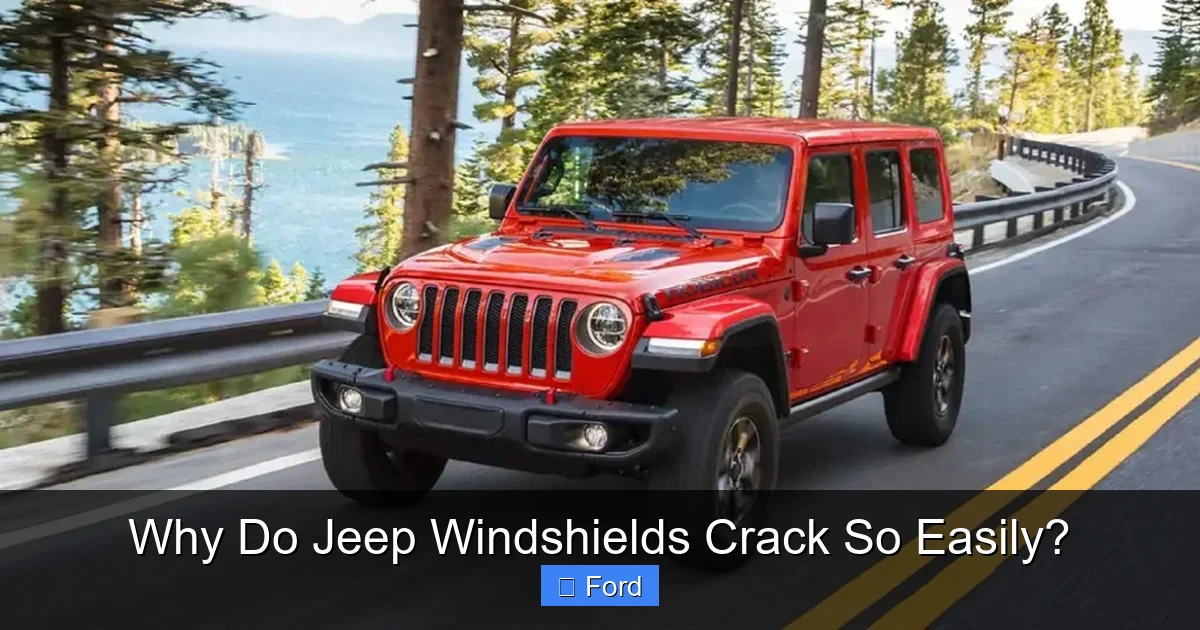
That tall, flat, nearly vertical windshield is the soul of a Jeep. It’s what gives the Wrangler its unmistakable silhouette and allows for that magical feeling of openness when the doors and top are off. However, this classic design is the single biggest reason Jeeps are windshield-crack magnets.
The Physics of a Flat Plane
Think about a modern sedan or crossover. Its windshield is steeply raked, often at a 60-degree angle or more. When a stone or piece of gravel is kicked up, it hits that sloped surface at an oblique angle. The force is deflected upward and outward, often just glancing off or leaving a tiny, barely noticeable mark. The energy is dispersed over a larger area and a longer time.
Now look at your Jeep. The windshield is closer to 70-75 degrees from the ground, almost a flat plane facing the world. There is no slope to deflect anything. A projectile hits it nearly dead-on. All that kinetic energy is delivered to a very small, concentrated point on the glass. This direct impact dramatically increases the pressure on the glass surface, far exceeding its tensile strength and causing it to fracture. It’s the difference between a boxer taking a glancing blow and a full-on, center-mass punch.
The Fold-Down Compromise
The ability to fold the windshield down on Wranglers and Gladiators is another engineering factor. To allow this movement, the glass can’t be bonded to the frame with the same thick, unyielding urethane bead used in fixed windshields. The seal must allow for movement. This inherently creates a slightly less rigid mounting system. While perfectly safe and functional, it means the glass has a tiny bit more give. Under impact, this can sometimes mean the stress isn’t absorbed and distributed as effectively as it would be in a permanently sealed unit.
Off-Road and Open-Air Lifestyle: It’s a Target, Not a Shield
Jeeps aren’t bought to be garage queens. They are tools for adventure. This usage pattern puts their windshields in harm’s way far more often than a family hauler.
Visual guide about Why Do Jeep Windshields Crack So Easily?
Image source: carnewsbox.com
Gravel, Rocks, and Road Rash
Follow a Jeep on a dirt road, and you’ll see a constant spray of gravel and small stones ejected from its tires—especially the front tires, which are directly in the path of the windshield. On paved roads, this is less of an issue, but for the dedicated off-roader, it’s a daily reality. Larger rocks dislodged by your own tires or the vehicle in front can become terrifyingly accurate projectiles. Even on highways, the “sweet spot” where a trailing vehicle’s tire can launch a stone directly into your windshield is a common hazard, and Jeeps, with their higher seating position and flatter glass, present a larger target for such shots.
The “Top-Down” and “Doorless” Factor
When you drive with the doors off and the windshield up (or even folded down), you’ve removed a significant barrier. The A-pillars are exposed, and there’s no side glass to catch debris that might glance off from the side. More importantly, the cabin pressure dynamics change. With the vehicle’s sides open, wind and debris flow more directly toward the windshield from angles that a closed car’s aerodynamics would normally divert. You’re essentially inviting the elements to test your glass’s mettle. If you frequently drive with the doors off on trails, you’re accepting a higher probability of windshield damage as part of the experience.
Engineering Trade-Offs: Weight, Flexibility, and Cost
Jeep engineers have to balance the legendary off-road capability, durability, and on-road manners of these vehicles. The windshield is one area where compromises are made.

Visual guide about Why Do Jeep Windshields Crack So Easily?
Image source: glennsaid.com
Lighter Glass for a Lighter Vehicle
Jeeps are relatively lightweight for their size and capability, especially compared to heavy, fully enclosed luxury SUVs. Every pound counts for fuel economy and suspension load. One way to save weight is by using a thinner windshield glass laminate. While still meeting all safety standards (laminated safety glass is mandatory), the glass plies and the overall thickness can be less than what you’d find in, say, a Toyota Land Cruiser, which is built with a heavier-duty, all-weather expedition focus. Thinner glass has less mass to absorb an impact without breaking.
The Role of Flex
The solid front and rear axles, short wheelbase, and body-on-frame construction of a Jeep mean it flexes and twists more than a unibody crossover. This chassis flex puts cyclic stress on every rigidly mounted component, including the windshield. The glass is bonded to the frame, and as the frame twists slightly under hard cornering, articulation on rocks, or even rough roads, the glass experiences shear forces. Over time, this constant flexing can weaken the glass or its bond, making it more susceptible to cracking from a much smaller impact than a rigidly mounted windshield in a stiff unibody vehicle.
Environmental and Installation Stressors
It’s not always what hits the windshield. Sometimes, it’s the world around it and how it was put in.
Visual guide about Why Do Jeep Windshields Crack So Easily?
Image source: glennsaid.com
Extreme Temperature Swings
Jeeps are driven in deserts, mountains, and everywhere between. A scorching hot windshield (from sun beating down) can expand the glass slightly. If a rock hits it in that expanded state, or if you then blast the AC, causing a rapid contraction, the thermal stress can be the final straw that turns a micro-fracture into a visible crack. This is also why rock chips often spread on very hot or very cold days.
The Critical Role of Urethane and Bonding
Windshield replacement is not just about popping in a new piece of glass. It’s about the urethane adhesive that bonds it to the frame. This bead must be applied at the correct thickness, with the right cure time, and with pristine surface preparation. A poor installation—too little urethane, contaminated bonding surfaces, or incorrect curing—means the windshield isn’t fully supported. It can move more than it should, increasing stress on the glass itself. A flaw in the urethane bead can also create a stress point where a crack will initiate and propagate. Always use a reputable shop that follows OEM procedures. For a vehicle that flexes as much as a Jeep, a perfect bond is even more critical.
Aftermarket Modifications: The Unintended Consequences
Jeep owners love to modify their rigs. While lift kits, bigger tires, and light bars enhance capability, some can inadvertently increase windshield vulnerability.
Lift Kits and Tire Size
Lifting a Jeep changes the vehicle’s geometry and the angle at which air and debris flow over the hood. A higher vehicle with larger tires can “scoop” up more rocks and road debris, throwing them at a higher trajectory. This can change the flight path of projectiles, sometimes sending them directly into the lower portion of the windshield where the glass is often strongest, but also where impacts are most common from your own front tires. Furthermore, the increased suspension travel and altered angles can slightly change how the chassis flexes, potentially altering stress patterns on the glass.
Aerodynamic Disruptions
Adding a large light bar or a roof rack that isn’t carefully designed can disrupt laminar airflow over the hood. This can create turbulence that actually pulls more dust and small particles upward toward the windshield base, increasing the sandblasting effect that etches the glass over time and creates thousands of microscopic flaws that weaken the entire surface.
Protection and Prevention: Your Action Plan
Knowing why it happens is step one. Step two is taking smart steps to mitigate the risk. You can’t eliminate it, but you can make it much less likely.
Paint Protection Film (PPF) for Glass
This is the single most effective prevention tool. Clear, urethane-based film—the same stuff used to protect leading edges of hoods and bumpers—can be professionally applied to the entire windshield. It’s not a cheap solution (typically $300-$600 for a good quality film), but it’s a fraction of the cost of a new OEM windshield with sensors and camera recalibration. The film absorbs the energy of small stones and sand, preventing them from chipping the glass underneath. High-quality films are virtually undetectable and come with long warranties against yellowing and peeling. It’s the ultimate “sacrificial layer.”
Smart Driving and Following Distance
On gravel or dirt roads, increase your following distance dramatically. This gives you more time to see and avoid the spray from the vehicle ahead. On highways, avoid following large trucks, vans, or vehicles with worn tires too closely. They are the primary source of windshield-damaging highway debris. When you see a pothole or a patch of loose gravel, try to go around it if safe, or at least slow down to reduce the force of any impact from your own tires.
Immediate Chip Repair
This is non-negotiable. The moment you see a chip or star break, get it repaired by a professional using a resin injection process. A proper repair will seal the chip, restore structural integrity to that spot, and prevent it from cracking out due to thermal stress or vibration. Most insurance policies cover chip repairs with little or no deductible. Waiting is the biggest mistake; a repairable chip can become an irreparable crack overnight. For a vehicle you plan to keep, this is a must-do habit.
Consider Aftermarket Windshield Options
If you do need a replacement, you have options beyond the OEM (original equipment manufacturer) glass. Some aftermarket brands, like Pilkington or PGW, produce glass to OEM specifications. Others may offer thicker options or different laminate formulations. Discuss with your installer if a heavier-duty aftermarket glass is available for your specific Jeep model. Be aware that if your Jeep has a forward-facing camera (for ADAS systems like automatic emergency braking), the replacement glass must be camera-compatible, and the camera must be recalibrated after installation—a crucial step that adds cost but is essential for safety systems to work properly.
The Bottom Line: Embrace the Adventure, Protect Your Glass
So, do Jeep windshields crack easily? Yes, the statistics and owner experiences confirm it. But it’s not a flaw; it’s a direct result of the Jeep’s core identity. The design that gives you that unparalleled open-air view and off-road prowess also makes the windshield a primary target. The lifestyle that defines Jeep ownership exposes it to more hazards. The engineering that keeps it lightweight and flexible introduces unique stresses.
As a Jeep owner, you’ve already accepted a certain level of trade-off for the capability and fun. Windshield vulnerability is part of that package. But it’s a manageable part. By understanding the “why”—the flat design, the off-road exposure, the flex, the temperature swings—you can make informed decisions. Invest in a PPF wrap if you drive frequently on rocks or highways. Be meticulous about chip repairs. Choose your driving paths and following distances wisely. And when replacement is inevitable, ensure it’s done with precision, especially on models with advanced safety cameras.
Your Jeep’s windshield is your window to the world and a critical safety component. Protecting it isn’t about avoiding adventure; it’s about ensuring you can keep having adventures, safely and without the constant financial sting of unexpected glass repairs. It’s part of the Jeep life—acknowledge it, prepare for it, and then get back out on the trail with a clear view ahead.
Frequently Asked Questions
Is it normal for a Jeep windshield to crack so easily?
Yes, it is a common and well-documented issue across Jeep models, especially the Wrangler. It’s due to the iconic vertical design, off-road usage, and engineering trade-offs, not necessarily a defect in your specific vehicle.
Should I use my insurance to fix a small chip in my Jeep windshield?
Absolutely. Most comprehensive auto insurance policies cover chip repairs with a very low or $0 deductible. It’s almost always in your best interest to use insurance for a repair, as it’s inexpensive for the insurer and prevents a costly full replacement later.
Will a windshield replacement fix the cracking problem forever?
No. A new windshield is just as vulnerable as the old one to the same design and environmental factors. Without changing your driving habits or adding protection like film, you are likely to experience another chip or crack in the future.
Does a cracked Jeep windshield affect its safety?
Yes, significantly. The windshield provides up to 70% of a vehicle’s roof crush strength in a rollover accident. A crack, especially one that’s spreading, compromises this structural integrity. It also impairs the driver’s vision and can interfere with the proper deployment of passenger-side airbags, which often use the windshield as a backstop.
What’s the best way to protect my Jeep’s windshield?
The most effective method is installing professional-grade Paint Protection Film (PPF) on the entire windshield. Combining this with immediate chip repairs and maintaining safe following distances on gravel and highways provides the best multi-layer defense.
Are aftermarket windshields for Jeeps any good?
Many are. Reputable aftermarket brands produce glass that meets or exceeds OEM standards. However, for Jeeps with front-facing cameras (like those with adaptive cruise control or automatic emergency braking), you must use camera-compatible glass and ensure the camera is professionally recalibrated after any replacement. Always discuss your options with a specialist.