
Why Is Jeep Wrangler Towing Capacity So Low?

The Jeep Wrangler’s towing capacity is low because its design prioritizes off-road capability, durability, and a compact, convertible form factor over heavy-duty hauling. Key factors include its solid axles, short wheelbase, body-on-frame construction tuned for flexibility, and a powertrain focused on torque for crawling, not sustained pulling. This makes it a specialist vehicle, not a general-purpose hauler.
Key Takeaways
- Off-Road First Design: The Wrangler’s architecture—solid axles, short wheelbase, and flexible suspension—is engineered for articulation and obstacle clearance, which inherently limits stable, high-weight towing.
- Powertrain Priorities: Its engines and transmissions are tuned for low-end torque and ruggedness for rock crawling, not the sustained horsepower and cooling needed for heavy trailer towing.
- Weight and Structure: While body-on-frame, the Wrangler’s overall vehicle weight and frame design are optimized for a lightweight, agile off-roader, not the heavy-duty reinforcement a high tow rating requires.
- Safety and Stability: A high center of gravity and short wheelbase make controlling a heavy trailer dangerous; Jeep deliberately caps towing capacity to ensure safe, predictable handling.
- Market Position: Jeep positions the Wrangler as a lifestyle icon and off-road tool. For serious towing, buyers are directed to the Jeep Gladiator truck or other brands’ SUVs/trucks.
- Real-World Implications: Understanding the ~3,500 lb limit is crucial; exceeding it risks severe sway, brake failure, transmission damage, and voided warranties.
- Smart Alternatives: For Wrangler owners needing to haul more, consider cargo management solutions like a high-quality bike rack for your Jeep Wrangler or a lightweight utility trailer.
📑 Table of Contents
- The Towing Paradox: Why the Rugged Jeep Wrangler Can’t Haul Much
- 1. The Uncompromising Off-Road Architecture
- 2. Powertrain and Cooling: Built for Torque, Not Duration
- 3. The Axle, Gear Ratio, and Brake Equation
- 4. Real-World Comparison: It’s Not Just About the Number
- 5. Practical Implications and What You Can (Safely) Tow
- 6. The Philosophy: A Specialist, Not a Generalist
- Conclusion: Respecting the Limit
The Towing Paradox: Why the Rugged Jeep Wrangler Can’t Haul Much
You look at a Jeep Wrangler. You see the legendary ground clearance, the massive tires, the solid front axle that looks like it could bend a railroad tie. This thing is a mountain goat, a desert storm, a swamp conqueror. It’s built for the apocalypse. So why, then, does its towing capacity seem so… modest? If you’ve ever shopped for a Wrangler and compared its max tow rating (typically around 3,500 pounds for newer models) to a similarly sized SUV from another brand, you’ve felt the sting of confusion. That number feels low for a vehicle that seems so physically capable. It’s a classic automotive paradox: a vehicle that appears supremely strong is actually quite limited in one fundamental task.
The answer isn’t a simple case of “Jeep cut corners.” Far from it. The low towing capacity is a direct, deliberate consequence of a hundred engineering and design decisions, all made in service of a single, unwavering philosophy: the Wrangler must be the best off-road vehicle on the planet, period. Every other capability—including its ability to pull a heavy trailer—is secondary. To understand why the towing capacity is low, we must first understand what the Wrangler is, and more importantly, what it is not.
1. The Uncompromising Off-Road Architecture
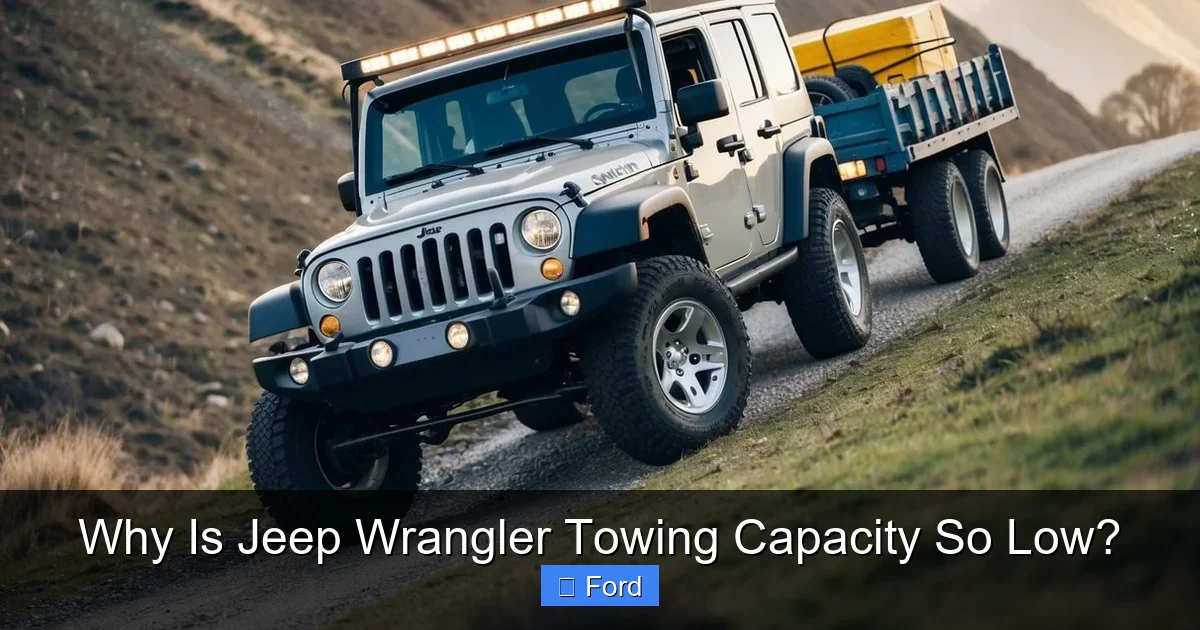
Let’s start with the foundation. The Wrangler uses a body-on-frame construction, which is a good start for towing—it’s sturdy. But the details of that frame and the suspension attached to it tell the real story.
Visual guide about Why Is Jeep Wrangler Towing Capacity So Low?
Image source: koala.sh
Solid Axles: The Double-Edged Sword
The Wrangler’s front and rear solid axles are its holy grail for off-roading. They provide incredible strength to handle massive wheels and tires, and their design allows for incredible vertical wheel articulation. When a tire hits a deep hole, a solid axle lets the opposite tire stay planted on the ground, maintaining traction. This is gold for rock crawling. However, for towing, solid axles are a compromise. They add unsprung weight and create a less stable platform for a hitch compared to an independent front suspension. The entire axle acts as a single unit, which can magnify trailer sway. Modern trucks with independent front suspensions can better resist the side-to-side forces of a trailer, making them inherently more stable tow vehicles.
The Short Wheelbase Challenge
Think about a long-wheelbase truck pulling a trailer. The distance between the front axle and the hitch is long, giving the driver more “lever arm” to control the trailer. The Wrangler’s wheelbase is short—around 96 inches for a two-door and 118 inches for a four-door (JK/JL models). This short distance between the rear axle and the hitch point means the tongue weight of the trailer has a much larger effect on the front axle’s load. Too much tongue weight can lighten the front end, destroying steering control. Too little, and the trailer will sway. The short wheelbase makes finding that perfect, stable balance much harder and limits the safe total weight.
High Center of Gravity
The Wrangler sits tall. This is for ground clearance and visibility. But a high center of gravity is the enemy of stability when you add a long lever (a trailer) behind the vehicle. The combination of a tall, boxy vehicle and a short wheelbase creates a recipe for rollover risk if a trailer begins to sway or if a sudden evasive maneuver is needed. Jeep’s engineers must account for this in their tow rating, deliberately keeping the number low to ensure the vehicle-trailer combination remains within a safe stability envelope under a wide range of conditions.
2. Powertrain and Cooling: Built for Torque, Not Duration
You might think, “But my Wrangler has a V6 or a turbo four! That should be plenty of power.” Power is one thing; sustained, heavy-duty work is another.
Visual guide about Why Is Jeep Wrangler Towing Capacity So Low?
Image source: cartireinflator.com
Engines Tuned for Low-End Grunt
The Wrangler’s engines—the 3.6L Pentastar V6 and the 2.0L turbo I4—are indeed torquey. That low-end torque is perfect for tackling a steep rock ledge from a stop. Towing also needs low-end torque to get a heavy trailer moving. But towing a max-weight trailer up a long grade at highway speeds requires sustained horsepower and, crucially, a cooling system that can handle the extra heat generated by the engine and transmission working at a higher percentage of their capacity for extended periods. The Wrangler’s cooling system is sized for its own weight and typical off-road use (which involves short bursts of high load), not for the continuous thermal load of dragging 3,500 lbs up a mountain pass on a summer day.
Transmission Choices
For decades, the Wrangler was only available with a manual transmission. Even now, the automatic is the more popular choice for towing. But the ZF 8-speed automatic in the current Wrangler, while excellent, is calibrated for smooth, responsive shifting in an off-road context. Heavy-duty truck transmissions often have deeper first gears, more robust clutch packs, and dedicated tow/haul modes that hold gears longer and provide engine braking. The Wrangler’s transmission is robust, but it’s not a heavy-duty unit designed for the constant stress of max-weight towing. Its role is to serve the Wrangler’s primary mission first.
3. The Axle, Gear Ratio, and Brake Equation
Even if the engine and transmission could handle it, other drivetrain components become limiting factors.
Axle Ratios and Strength
Towing requires a numerically higher axle gear ratio (like 4.10 or 4.56) to keep the engine in its power band without over-revving. Many Wrangler models come with lower ratios (e.g., 3.21 or 3.73) optimized for tire size and off-road performance. While higher ratios are available in packages like the Rubicon’s 4.10 gears, the axle housings themselves (Dana 30 front, Dana 44 rear) are strong but not built to the same heavy-duty specifications as a 2500-series truck’s axle. The Wrangler’s axles are designed for the shock loads of off-roading, not the constant, twisting torque of a heavy trailer.
Braking Capacity
This is a huge, often overlooked factor. Towing adds massive kinetic energy that your brakes must dissipate. The Wrangler’s brake system—discs all around—is sized for stopping the Wrangler’s own weight. Adding a 3,500-pound trailer means your brakes must now stop a combined weight potentially over 8,000 pounds. The factory brakes will fade much more quickly on long descents. The tow rating must account for the vehicle’s ability to stop the combined mass safely under repeated braking. The Wrangler’s brakes, while good for the vehicle, are not oversized for heavy trailer duty.
4. Real-World Comparison: It’s Not Just About the Number
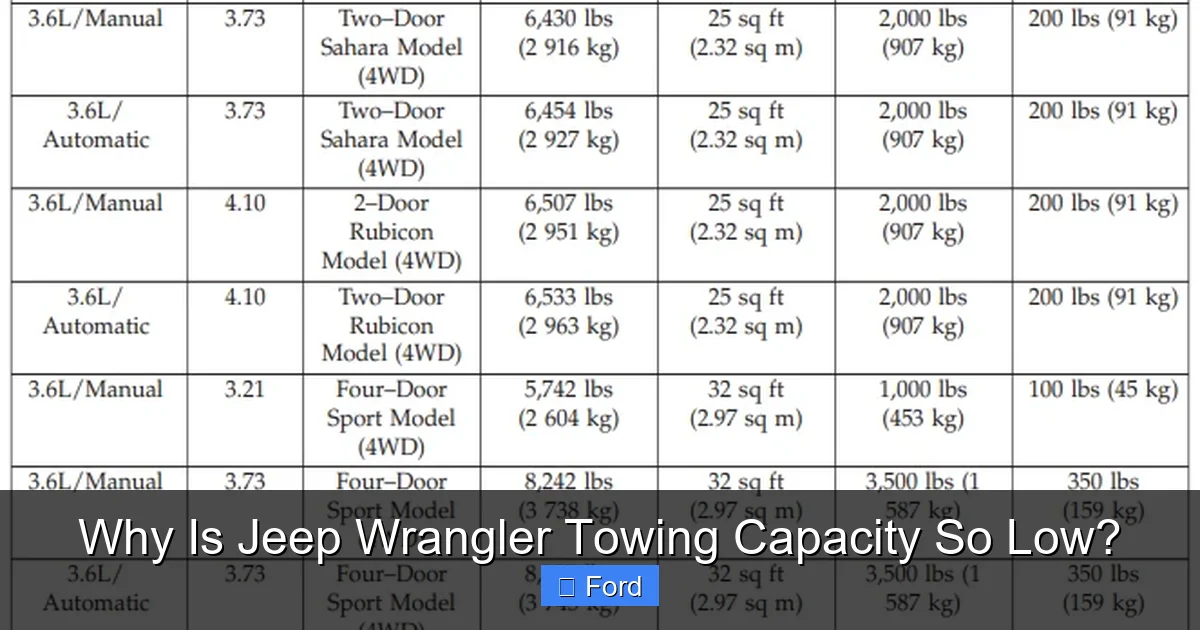
Let’s put that 3,500 lbs in perspective. A small pop-up camper might weigh 1,500-2,500 lbs dry. A medium-sized A-frame camper can easily hit 3,000-3,500 lbs. A decent-sized boat and trailer combo? That’s often 4,000 lbs and up. So right away, the Wrangler’s limit rules out a huge segment of common towables.
Visual guide about Why Is Jeep Wrangler Towing Capacity So Low?
Image source: towstats.com
How Does It Compare?
Look at some competitors. A base Toyota RAV4 has a max tow rating of 3,500 lbs—similar to a Wrangler. But a V6-powered Ford Explorer can tow up to 5,300 lbs. A Honda Pilot? Up to 5,000 lbs. Even the Subaru Crosstrek, a much smaller crossover, has a rating around 1,500 lbs. You can check the specific numbers for a Subaru Crosstrek’s towing capacity to see where it sits. The point is, the Wrangler isn’t uniquely low; it’s in a segment of unibody or light SUVs not built for heavy towing. Where it differs is in its *appearance* and *off-road capability*—it looks like it *should* be able to do more, which creates the perception problem.
For a true apple-to-apples comparison, look at the Jeep Gladiator. It shares the Wrangler’s DNA but is a pickup truck. Its maximum tow rating is 7,650 lbs. That number isn’t magic; it comes from a longer wheelbase, a different rear suspension setup (solid axle but with a leaf-spring pack designed for payload), a more robust frame in the bed area, and a transmission tuned for truck duty. This starkly illustrates how the Wrangler’s specific form factor and suspension design cap its ability.
5. Practical Implications and What You Can (Safely) Tow
So, with a 3,500 lb max, what are your realistic, safe options? First, understand that number is for a *braked* trailer. If your trailer has its own brakes (which any trailer over ~1,500 lbs should have), that’s the number to use. Unbraked trailer limits are much lower, often around 1,000 lbs.
Safe, common towables for a Wrangler include:
- Small Jet Skis or Snowmobiles: A single large ski or sled on a lightweight trailer can often be under 1,500 lbs.
- Compact Utility Trailer (with gear): A 5×8 utility trailer loaded with landscaping equipment, motorcycles, or ATVs can be kept under 3,500 lbs if careful.
- Small Fishing/Hunting Boat: A aluminum john boat or a very small fiberglass boat on a custom trailer might fit.
- Lightweight Pop-Up Camper: This is the most common “camping” tow. You must *weigh the actual loaded weight* at a truck scale. The dry weight is never the real weight; water, propane, gear, and food add hundreds of pounds fast.
Critical Setup: You must use a weight-distributing hitch with sway control for anything near the limit. This system uses spring bars to distribute some of the trailer’s weight to the Wrangler’s front axle and the trailer’s own axles, improving stability and reducing rear-end squat. It’s not optional for max-weight towing; it’s essential safety equipment. Also, ensure your Wrangler is equipped with the factory tow package, which includes a heavy-duty radiator, transmission cooler, and upgraded wiring harness.
The “What If I Exceed It?” Question
This is the most dangerous line of thinking. Exceeding the tow rating by even 500 pounds dramatically increases the risk of:
- Trailer Sway: At highway speeds, the trailer can begin to oscillate side-to-side. The Wrangler’s short wheelbase and high center of gravity make it exceptionally poor at damping this sway, which can lead to a loss of control.
- Brake Failure: You will experience severe brake fade on downgrades. Stopping distances will increase dangerously.
- Transmission Overheating: The transmission will run hot, leading to premature wear, slipping, and catastrophic failure. Replacing a Wrangler transmission is a multi-thousand-dollar job.
- Voided Warranty: If an accident or component failure occurs while towing over the rated capacity, Jeep will almost certainly deny any warranty claim.
- Structural Stress: You are overloading the hitch receiver, the frame’s hitch mounting points, and the suspension components beyond their design limits, leading to metal fatigue and potential failure.
6. The Philosophy: A Specialist, Not a Generalist
Ultimately, the low towing capacity isn’t a flaw; it’s a feature of the design philosophy. The Jeep Wrangler is a specialist tool. Its engineering budget, its chassis tuning, its very soul is dedicated to being the best open-air, go-anywhere, trail-conquering vehicle you can buy. Every pound saved, every inch of suspension travel gained, every degree of approach angle maximized, comes at the expense of something else. In this case, that “something else” is unibody stiffness for towing, long-wheelbase stability, and heavy-duty cooling.
If your primary need is to pull a large boat, a travel trailer, or a sizable cargo trailer, the Wrangler is the wrong tool for the job. You need a dedicated truck or a passenger SUV designed with a longer wheelbase and heavier-duty components from the start. For the Wrangler buyer who occasionally needs to move a small, light load, its capacity is sufficient and safe when respected. The frustration comes when the Wrangler’s iconic, capable image sets an expectation that the engineering reality cannot meet. It’s a reminder that a vehicle’s most celebrated strengths often define its most significant limitations.
For Wrangler owners looking to maximize their cargo-carrying potential without towing, exploring aftermarket cargo solutions is a better path. Things like a heavy-duty floor mat system to protect the interior while hauling muddy gear, or a roof rack for lighter, bulky items, can be more effective and safer than trying to push the tow limit. The Wrangler excels at carrying gear on or in itself, not behind it.
Conclusion: Respecting the Limit
The Jeep Wrangler’s towing capacity is low because it is the calculated, engineering-driven result of a vehicle that refuses to compromise on its core mission. Its solid axles, short wheelbase, tall stance, and powertrain tuned for off-road torque are all choices that inherently limit stable, heavy towing. This isn’t a failure of design; it’s a testament to a singular focus. The Wrangler is arguably the best pure off-road vehicle in the world, and that excellence in one domain necessitates mediocrity in another. Understanding and respecting the 3,500-pound limit isn’t about accepting a shortcoming—it’s about appreciating the Wrangler for what it truly is and using it safely and wisely within its intended capabilities. For the tasks it can do, it’s unmatched. For the tasks it can’t, another vehicle in Jeep’s lineup or from another brand will serve you far better.
Frequently Asked Questions
What is the maximum towing capacity of a modern Jeep Wrangler?
For the current JL-generation Wrangler (2018-present), the maximum rated towing capacity is 3,500 pounds when properly equipped with the factory tow package, the available V6 engine, and the correct axle gearing. This is for a braked trailer. The limit is the same for both two-door and four-door models.
Why is the Wrangler’s tow rating so much lower than a Jeep Gladiator’s?
The Gladiator is a midsize pickup truck with a longer wheelbase, a rear suspension tuned for payload (leaf springs), a more robust frame in the bed area, and a transmission calibrated for truck duty. These fundamental design differences, despite sharing many components with the Wrangler, give it a much higher structural and stability foundation for towing, resulting in a rating nearly double that of the SUV.
Can I increase my Wrangler’s towing capacity with aftermarket parts?
No. Towing capacity is a factory-set, legally defined rating based on the entire vehicle’s engineering—frame, suspension, brakes, cooling, and stability. Adding a bigger hitch, stronger bumpers, or auxiliary coolers does not change this certified rating. You can improve safety and component longevity within the limit, but you cannot legally or safely exceed the manufacturer’s stated maximum.
Is it dangerous to tow at the Wrangler’s maximum rated capacity?
Towing at any limit requires extreme caution and proper equipment. At the Wrangler’s max rating, you must use a weight-distributing hitch with sway control, ensure your trailer brakes are perfectly functional, and drive conservatively. The vehicle will be at the absolute edge of its stability envelope, especially in windy conditions or on mountain roads. It is not inherently unsafe if done perfectly, but there is very little margin for error.
What is a safe, realistic trailer weight to tow with a Wrangler for a family?
For a comfortable safety margin, aim for a loaded trailer weight of no more than 2,500-3,000 pounds. This leaves headroom for gear, fuel, and passengers in the Wrangler itself. A small teardrop camper, a lightweight aluminum boat, or a single-axle utility trailer with cargo are good candidates. Always weigh your fully loaded setup at a public scale.
Does the two-door or four-door Wrangler have a higher towing capacity?
No. Both body styles have the same maximum manufacturer-rated towing capacity of 3,500 pounds when identically equipped. While the four-door has a longer wheelbase (which generally aids stability), the overall chassis design, suspension, and frame limitations are the same, so the official rating does not change. The four-door may feel slightly more stable, but the legal limit remains identical.
