
How to Use 4-wheel Drive on a Ford F-150

Understanding your Ford F-150’s 4-wheel drive (4WD) system is key to maximizing its capability and safety. This guide breaks down the different systems— electronically shifted 4WD and manual transfer cases— and provides clear, step-by-step instructions for engaging and disengaging each mode. Learn the critical rules of when to use 4WD (and when not to) to protect your drivetrain and get the most traction for towing, off-roading, or tackling snow and ice.
So, you’ve got a Ford F-150. You know it’s a truck built for work and adventure. But that “4×4” badge on the tailgate? It’s only as good as your understanding of how to use it. Using your F-150’s four-wheel drive system correctly isn’t just about clicking a switch and feeling more powerful; it’s about knowing when to engage it, which mode to choose, and, just as importantly, when to turn it off. Misusing your 4WD can lead to expensive drivetrain damage, poor handling, and wasted fuel. Let’s demystify everything, from the basics to pro tips, so you can confidently tackle winter roads, muddy job sites, and backcountry trails.
Key Takeaways
- Know Your System: Your F-150 likely has an electronic shift-on-the-fly 4WD system (4×4) or a manual transfer case (4×4 Low/High). The procedure differs significantly.
- Use 4WD on Low-Traction Surfaces Only: Engage 4WD for snow, ice, mud, sand, rocks, or when towing heavy loads on slippery inclines. Never use 4WD on dry, high-traction pavement for extended periods.
- 4WD High is for Variable Conditions: Use 4Hi for snowy roads, loose gravel, or wet surfaces where you need extra traction but still normal road speeds.
- 4WD Low is for Extreme Challenges: Engage 4Lo only for rock crawling, deep mud/sand, or steep, slippery hill climbs. It provides maximum torque but limits speed (typically under 25 mph).
- Disengage on Dry Pavement: Always return to 2WD (2H) on dry, clean pavement to prevent “binding” (crowding) in the drivetrain and unnecessary wear.
- Engage at a Stop or Slow Roll: For 4Lo, you usually must stop or creep forward slowly (1-3 mph). For 4Hi on most modern F-150s, you can shift while moving up to ~55 mph.
- Read Your Manual: Your owner’s manual is the final authority. Specific speeds, procedures, and indicator lights can vary slightly by model year and trim.
📑 Table of Contents
- Understanding Your F-150’s 4WD System: It’s Not All the Same
- When to Use 4WD: The Golden Rules
- How to Engage 4WD High (4Hi) on a Modern F-150 (ESOF System)
- How to Engage 4WD Low (4Lo) on a Modern F-150
- How to Engage 4WD on an Older F-150 (Manual Transfer Case)
- Common Mistakes & Pro Tips for F-150 4WD Use
- Maintenance and Troubleshooting
- Conclusion: Confidence Through Competence
Understanding Your F-150’s 4WD System: It’s Not All the Same
Before we talk about “how,” we need to talk about “what.” Ford has used several 4WD systems in the F-150 over the years. The two primary types you’ll encounter are:
Electronic Shift-On-The-Fly (ESOF) 4WD
This is the most common system on modern F-150s (typically 2009 and newer). It uses electronics and an electric motor on the transfer case to engage the front axle. You control it via a rotary dial, buttons on the dashboard, or a floor-mounted selector. The beauty of ESOF is that you can shift from 2WD to 4WD High (4Hi) while driving at moderate speeds (check your manual, but usually up to 55-60 mph). This is perfect for sudden changes in road conditions, like hitting a patch of ice on a highway. The system automatically disengages the front axle when you return to 2WD.
Manual Transfer Case 4WD
Found on older models (pre-2009 often) and some heavy-duty or specialty packages, this system has a physical lever on the floor or a manual knob. It requires you to stop the vehicle (or be moving very slowly, 1-3 mph) to shift into 4Low (4Lo). Shifting into 4Hi might be possible while moving slowly. This system is robust and mechanically simple but requires more driver involvement.
Pro Tip: Look at your selector. If it’s a rotary knob with “2H,” “4H,” “4L,” and “N” (Neutral), you have a manual transfer case. If it’s a dial or set of buttons labeled “2WD,” “4WD,” and “4WD LOW,” you almost certainly have the electronic ESOF system. Dodge Ram 2500 owners with similar electronic systems will recognize this intuitive shift-on-the-fly capability.
When to Use 4WD: The Golden Rules
This is the most critical section. Using 4WD at the wrong time is the #1 cause of user-induced damage. Think of 4WD not as a “power boost” but as a “traction enhancer” for specific situations.
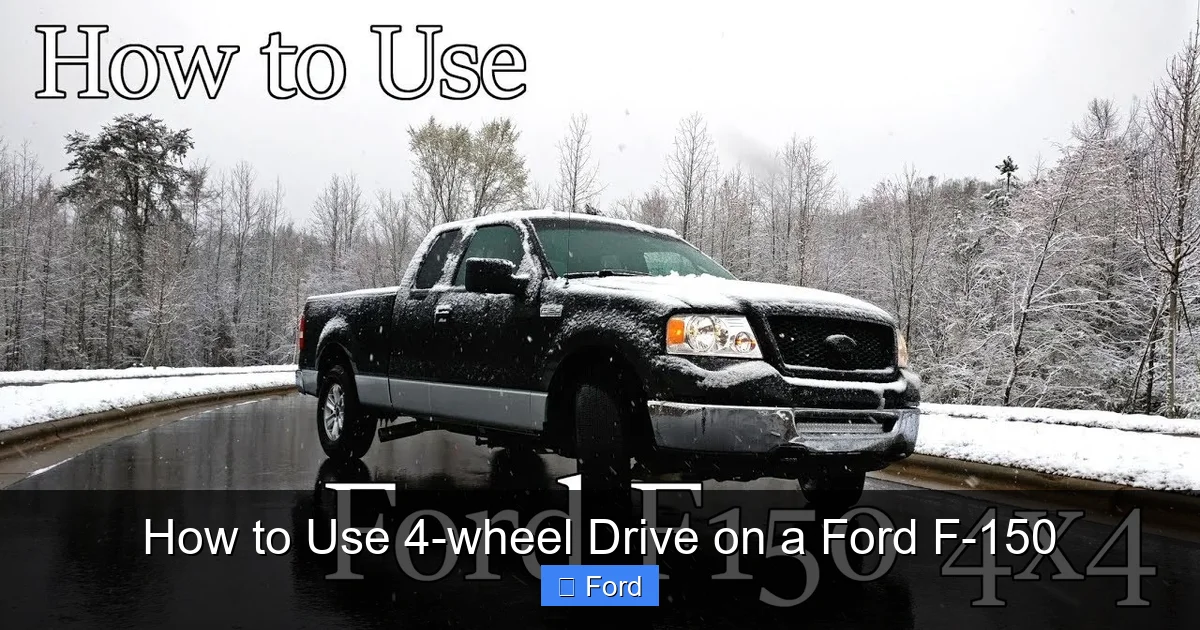
Visual guide about How to Use 4-wheel Drive on a Ford F-150
Image source: i.ytimg.com
Use 4WD High (4Hi) For:
- Snow-Covered Roads: The most common use. 4Hi provides constant power to all four wheels, helping you accelerate, brake, and corner more safely on packed snow or ice.
- Loose Gravel or Dirt Roads: Prevents wheel spin when accelerating on loose surfaces.
- Wet or Muddy Pavement: Extra grip for slippery highway ramps or muddy access roads.
- Towing on Slippery Inclines: If you’re pulling a heavy trailer up a wet, gravel, or snowy hill, 4Hi can prevent the drive wheels from spinning.
- Standing Water: Helps maintain forward momentum when driving through deep puddles (but always check depth first!).
Use 4WD Low (4Lo) For:
- Rock Crawling: The extreme low-range gearing multiplies engine torque, allowing you to creep over large obstacles at controlled speeds without riding the clutch or brakes.
- Deep, Soft Sand or Mud: The slow, high-torque control helps you “plow” through without bogging down.
- Steep, Slippery Hills: For controlled descent or ascent on very steep grades where traction is minimal. The low range gives you more “grunt” at very low speeds.
- Extreme Off-Camber Situations: When wheels are in the air, 4Lo helps maintain some momentum.
NEVER Use 4WD On:
- Dry, Clean, High-Traction Pavement: This is the cardinal sin. On dry asphalt, 4WD creates “torque steer” or “crowding” (also called “binding”) because the front and rear axles are forced to rotate at slightly different speeds during turns. This stresses u-joints, differentials, and the transfer case, leading to premature wear or catastrophic failure. Your F-150’s 2WD (2H) mode is designed for this.
- Ice: Counterintuitive, but 4WD does not help you stop or steer on ice. It only helps you accelerate. On pure ice, 4WD can create a false sense of security. Use extreme caution, slow speeds, and winter tires. Subaru Outback drivers know their AWD system is always engaged and better suited for constant icy conditions than a traditional part-time 4WD system.
How to Engage 4WD High (4Hi) on a Modern F-150 (ESOF System)
For the vast majority of modern F-150s with the electronic dial or buttons, engaging 4Hi is designed to be effortless. Here’s the standard procedure:
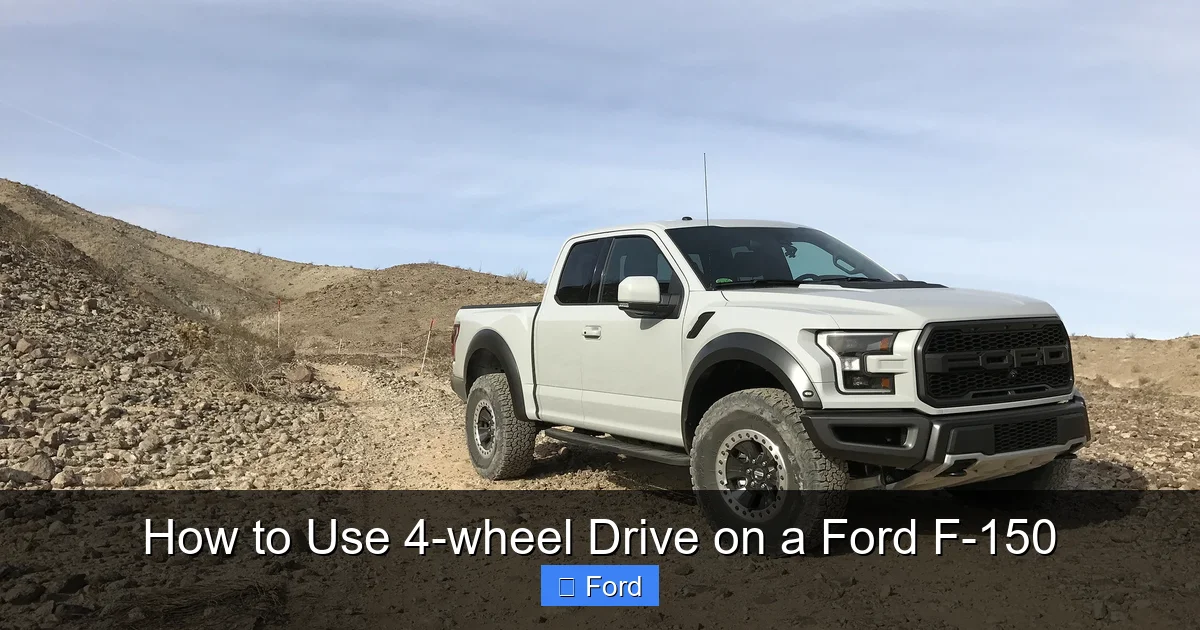
Visual guide about How to Use 4-wheel Drive on a Ford F-150
Image source: cdn.motor1.com
- Start your truck. Ensure the engine is running.
- Check your speed. You can typically shift from 2H to 4Hi while driving at speeds up to 55-60 mph (88-97 km/h). Consult your manual for the exact speed. The system is designed for “shift-on-the-fly.”
- Locate your 4WD selector. This is usually a rotary dial on the center console or a set of buttons on the dashboard or steering wheel stalk. Common labels: “2WD,” “4WD,” “4WD LOW.”
- Rotate the dial or press the button to select “4WD” or “4Hi.” You will often feel a slight vibration or hear a motor whirring from under the truck as the transfer case engages. This lasts 1-2 seconds.
- Check your instrument cluster. A “4WD” or “4Hi” indicator light (usually a small icon of a truck with all four wheels highlighted) should illuminate and stay solid. If it blinks, the system is trying to engage and may not have succeeded (e.g., if wheel speeds are too different).
Important: You do not need to press the brake pedal or come to a stop for 4Hi on an ESOF system. It’s that simple. To disengage, simply rotate back to “2WD” while driving. The light will go out.
How to Engage 4WD Low (4Lo) on a Modern F-150
4Lo is a different beast. It requires the vehicle to be moving very slowly or stopped. The process is deliberate.
Visual guide about How to Use 4-wheel Drive on a Ford F-150
Image source: autovfix.com
- First, engage 4Hi. Your truck must be in 4Hi before you can drop into 4Lo on most systems. So, follow the steps above to get the 4Hi light on solid.
- Reduce speed to a crawl. Slow to between 1 and 3 mph (2-5 km/h). A slow, steady roll is ideal. You can also be at a complete stop.
- Press the brake pedal firmly and hold it. This is a critical step for many models. It tells the computer you’re serious about shifting.
- While holding the brake, shift from “4Hi” to “4WD LOW” or “4Lo.” You will hear a much louder, more mechanical clunk as the front axle engages and the transfer case drops into low range.
- Check your cluster. A “4Lo” indicator light (often a different color or with an “L” next to it) should illuminate solidly.
To exit 4Lo: You must again be moving slowly (1-3 mph) or stopped. Shift back to 4Hi first (you’ll feel/hear another clunk). Then, from 4Hi, you can shift to 2WD at any speed. Remember: Never attempt to shift directly from 2WD to 4Lo or from 4Lo to 2WD while moving faster than a crawl. The system is not designed for that.
How to Engage 4WD on an Older F-150 (Manual Transfer Case)
If your F-150 has a floor-mounted lever, the process is more mechanical but follows similar logic.
Engaging 4Hi:
You can often engage 4Hi while moving slowly (under 10 mph) or from a stop. To do so:
- Come to a complete stop or move at a very slow, steady pace.
- Press the clutch pedal (if manual) or keep your foot on the brake (if automatic).
- Move the transfer case lever from “2H” (or “2WD”) into the “4H” (or “4Hi”) position. You may need to apply moderate force. A distinct “clunk” is normal as the gears mesh.
- Release the clutch/brake and proceed. The 4WD light should come on.
Engaging 4Lo:
This requires the vehicle to be completely stopped.
- Bring the truck to a full stop.
- Place the transmission in Neutral (N).
- Press the clutch (if manual) or brake (if auto).
- Move the transfer case lever from “4H” into “4L.” This will require significant force. The “clunk” will be more pronounced.
- Return the transmission to Drive (or 1st gear for manual). The 4Lo light should illuminate.
Disengaging: To go from 4Lo to 2H, you must stop, put the transmission in Neutral, move the lever back to 4H, then to 2H. It’s a two-step process. Getting a Toyota 4Runner out of 4WD can have similar requirements for older models with manual cases, so the process feels familiar.
Common Mistakes & Pro Tips for F-150 4WD Use
Even with the right procedure, pitfalls exist. Here’s how to avoid them and use your system like a pro.
Mistake 1: “Binding” on Pavement
As mentioned, driving in 4Hi on dry pavement for more than a few hundred feet can cause drivetrain binding. The solution is simple: be vigilant. As soon as you hit a dry, clean road, switch back to 2WD. Your truck will handle better and save fuel. The slight delay in traction when you re-engage 4WD is a small price to pay for drivetrain health.
Mistake 2: Forgetting to Disengage 4Lo
It’s easy to get focused on a task and forget you’re still in low range. Driving at highway speeds in 4Lo is impossible and dangerous. The engine will scream at high RPMs while you crawl. Make it a habit: when you return to pavement, your first mental check is “4WD selector.” Shift to 2WD immediately.
Mistake 3: Shifting Under Too Much Load
If you’re stuck in mud or sand and the wheels are spinning furiously, the system may not engage 4Lo. The computer sees the massive difference in wheel speeds and refuses to shift to prevent damage. The solution? Stop spinning. Let the truck come to a stop or a very slow creep. Then try shifting into 4Lo. You can also try gently rocking the truck back and forth to gain a little traction before engaging.
Pro Tip: Use 4Hi for Towing on Slippery Days
If you’re towing a boat or heavy trailer and the launch ramp is wet and slippery, or if you’re navigating a steep, wet gravel road at the campground, switch to 4Hi before you start the maneuver. It gives all four wheels of your truck pulling power, reducing the chance of the rear wheels (your drive wheels in 2WD) spinning. Just remember to switch back to 2WD for the highway cruise to save fuel and wear.
Pro Tip: The “2WD” Button is Your Friend
Many F-150s have a dedicated “2WD” button that automatically disengages the front axle and returns you to two-wheel drive. Use it! It’s faster than scrolling through a menu. Get in the habit of hitting it as soon as conditions improve.
Maintenance and Troubleshooting
Your 4WD system is mechanical and electrical. A little care goes a long way.
Routine Maintenance:
- Transfer Case Fluid: This is the lifeblood of your 4WD system. It should be changed according to your owner’s manual schedule (often every 50,000-100,000 miles). Old, contaminated fluid can cause harsh shifting or failure to engage.
- Front Differential Fluid: When in 4WD, the front differential is active. Its fluid also needs regular service.
- U-Joints and CV Joints: These are the components that allow the front axle shafts to move with the suspension. Have them inspected for wear, especially if you hear clicking when turning in 4WD.
Troubleshooting: “Why Won’t My 4WD Engage?”
If you select 4Hi or 4Lo and the light blinks but doesn’t go solid, or nothing happens:
- Speed: Are you moving too fast? Slow down for 4Lo. For 4Hi, ensure you’re under the max shift speed.
- Wheel Spin: Are your wheels spinning? The system prevents engagement to avoid shock. Stop spinning.
- Blown Fuse: The ESOF system has electrical components. A blown fuse in the 4WD circuit can disable it. Check your fuse box diagram.
- Faulty Switch/Sensor: The selector switch or a position sensor on the transfer case can fail. This requires a diagnostic scan tool and professional repair.
- Low Fluid: Severely low transfer case fluid can prevent engagement.
Never force a manual lever. If it won’t move, ensure you’re in the correct gear (Neutral for 4Lo) and the vehicle is stopped. Forcing it can break the shift forks inside the transfer case.
Conclusion: Confidence Through Competence
Your Ford F-150’s 4-wheel drive system is a powerful tool. It’s the difference between being stranded and being self-reliant when the weather turns or the trail gets tough. But power without knowledge is dangerous. By understanding the difference between 4Hi and 4Lo, respecting the rule of “no dry pavement in 4WD,” and following the simple engagement procedures for your specific system, you protect your investment and unlock your truck’s true potential. Make it a habit to check your 4WD selector every time you start the truck, especially before heading into uncertain conditions. A quick glance ensures you’re in the right mode for the road ahead. Now, get out there and use that F-150 for what it was built to do—with confidence and competence.
Frequently Asked Questions
Can I shift from 2WD to 4Hi while driving at highway speeds?
Yes, on modern F-150s with electronic shift-on-the-fly (ESOF) systems, you can safely shift from 2H to 4Hi at speeds up to 55-60 mph. This is designed for sudden changes in traction, like hitting a snowy patch. Always consult your owner’s manual for your specific model’s speed limit.
What’s the maximum speed I can drive in 4WD Low (4Lo)?
You should never exceed 25 mph (40 km/h) in 4Lo, and even that is often too fast. 4Lo is for maximum torque at very low speeds—rock crawling, deep mud, steep hills. Driving faster than 25 mph in 4Lo can severely damage your transfer case.
My 4WD light blinks but won’t stay on. Why?
A blinking light means the system is trying to engage but failing. The most common cause is that your wheels are spinning at different speeds (e.g., on dry pavement with a lot of wheel slip). Stop the vehicle or slow to a crawl and try again. Other causes include a faulty switch, sensor, or blown fuse.
Is it bad to leave my F-150 in 4WD all the time?
For part-time 4WD systems like most F-150s, yes. Driving on dry, high-traction pavement in 4WD causes “crowding” or “binding,” which stresses and wears out u-joints, differentials, and the transfer case. Always return to 2WD on dry roads. Some models have an “Auto” mode that engages 4WD as needed; that mode is safe for constant use on pavement.
Can I use 4WD to get unstuck if I’m high-centered?
4WD can help, but it’s not a magic solution. If your truck is high-centered (stuck on a obstacle with all wheels off the ground), 4WD won’t help because no wheels have traction. You need to reduce weight or create a path. 4WD is most effective when at least two wheels have some grip.
Do I need to press the brake to engage 4Lo?
On most modern electronic F-150s, yes. You must have your foot firmly on the brake pedal while shifting from 4Hi to 4Lo. This is a safety interlock. On older manual transfer cases, you typically need to be in Neutral. Always check your owner’s manual for the exact procedure for your year and model.
