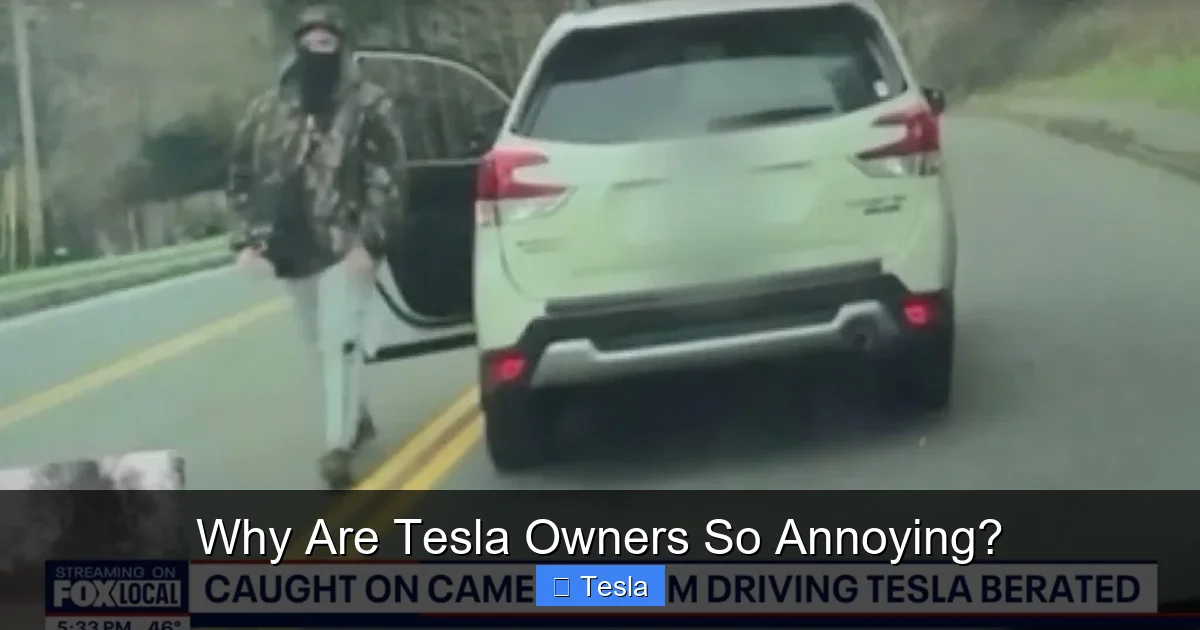
Why Are Tesla Owners So Annoying?

Contents
- 1 Key Takeaways
- 2 📑 Table of Contents
- 3 The “Tesla Tribe”: How a Brand Builds a Cult Following
- 4 Tech Evangelism and the “I Told You So” Syndrome
- 5 The Performance Privilege: Smugness in Silence
- 6 Eco-Elitism and the Moral High Ground
- 7 The Cult of Elon: Loyalty to a Man, Not Just a Car
- 8 Why It’s Not (Entirely) Fair: The Other Side of the Coin
- 9 How to Navigate the Tesla Owner in Your Life (Without Losing Your Mind)
- 10 Conclusion: It’s Complicated, But Understandable
- 11 Frequently Asked Questions



Tesla owners’ intense enthusiasm for their vehicles often manifests as evangelism, technical bragging, or moral superiority, which can grate on non-owners. This stems from the brand’s disruptive tech, performance perks, and strong eco-identity. While not every owner fits this mold, these cultural traits fuel a widespread perception of annoyance—but understanding the ‘why’ reveals a more nuanced picture.
You’re at a dinner party. The conversation turns to cars. Someone mentions their new Honda Civic. Before they finish the sentence, Dave from accounting chimes in: "Oh, you should get a Tesla. I have a Model 3. The software updates are incredible. It’s like your phone on wheels. And the acceleration? Unmatched. You’re basically driving the future." Everyone rolls their eyes. Dave isn’t even done bragging about the frunk. Sound familiar?
This scene plays out constantly. Tesla owners have developed a reputation—fair or not—for being, well, a bit much. But why? It’s not just about the cars. It’s about what the cars represent, how they’re marketed, and the intense community that’s grown around them. Let’s dive into the psychology, the culture, and the very real reasons why Tesla owners can grate on nerves, all while acknowledging that most are just passionate people who love their vehicles.
Key Takeaways
- Evangelical Zeal: Many Tesla owners passionately advocate for EV adoption, which can feel preachy or dismissive of traditional car choices.
- Tech Snobbery: The constant focus on software updates, “sentient” features, and autonomous driving can alienate those who value mechanical simplicity.
- Performance Privilege: Instant torque and silent acceleration create a smugness that rubs petrolheads the wrong way, especially during traffic light races.
- Eco-Elitism: The moral high ground of zero emissions sometimes translates into judgmental attitudes toward ICE vehicle owners.
- Cult of Elon: Loyalty to Elon Musk’s persona intertwines with car ownership, making criticism feel personal to some owners.
- Tribal Identity: Tesla fosters a strong in-group community, which can unconsciously create an “us vs. them” dynamic with other drivers.
- It’s Not All Bad: Many owners are genuinely excited about innovation; the annoyance often comes from a vocal minority, not the entire base.
📑 Table of Contents
- The “Tesla Tribe”: How a Brand Builds a Cult Following
- Tech Evangelism and the “I Told You So” Syndrome
- The Performance Privilege: Smugness in Silence
- Eco-Elitism and the Moral High Ground
- The Cult of Elon: Loyalty to a Man, Not Just a Car
- Why It’s Not (Entirely) Fair: The Other Side of the Coin
- How to Navigate the Tesla Owner in Your Life (Without Losing Your Mind)
- Conclusion: It’s Complicated, But Understandable
The “Tesla Tribe”: How a Brand Builds a Cult Following
Tesla isn’t just selling cars; it’s selling a mission. From day one, Elon Musk framed Tesla as the company that would "accelerate the world’s transition to sustainable energy." This isn’t a tagline—it’s a calling. Buyers aren’t just purchasing a sedan or SUV; they’re joining a movement. That creates an intense tribal identity.
The Power of a Shared Mission
When you buy a Toyota, you’re buying reliability. When you buy a Subaru, you’re buying adventure. But when you buy a Tesla, you’re buying a stake in the future. This narrative attracts early adopters, tech enthusiasts, and climate-conscious consumers who feel they’re part of something bigger. The "Tesla Tribe" communicates via forums, Facebook groups, and owner meetups. They share charging tips, software beta test results, and referral codes. This camaraderie is powerful—but it also breeds an in-group mentality.
Think about it: when you’re part of a group that sees itself as "saving the planet" or "leading the automotive revolution," it’s easy to develop an unconscious superiority complex. You’re not just driving a car; you’re making a statement. That statement can feel like a critique to anyone not in the club. It’s similar to the passionate followings seen with brands like Subaru, where owner culture is deeply intertwined with lifestyle, but Tesla’s mission adds a layer of moral urgency.
Referral Programs and VIP Perks
Tesla’s legendary referral program—offering free Supercharging, exclusive events, or even a free car—turned owners into active salespeople. Suddenly, owning a Tesla wasn’t just a purchase; it was a potential profit center and a status symbol. This incentivized aggressive promotion. Friends would pressure friends to use their referral code. Strangers on forums would debate the ethics of sharing codes. This gamification of ownership amplified the "evangelist" behavior, making every interaction a potential recruitment opportunity.
The result? A community that’s deeply engaged but also hyper-aware of its growth. New owners are welcomed with open arms, but the constant talk of referrals, rewards, and "getting in early" can feel cultish to outsiders. It’s not just a car club; it’s a network where membership has tangible benefits, and everyone wants to expand their network.
Tech Evangelism and the “I Told You So” Syndrome
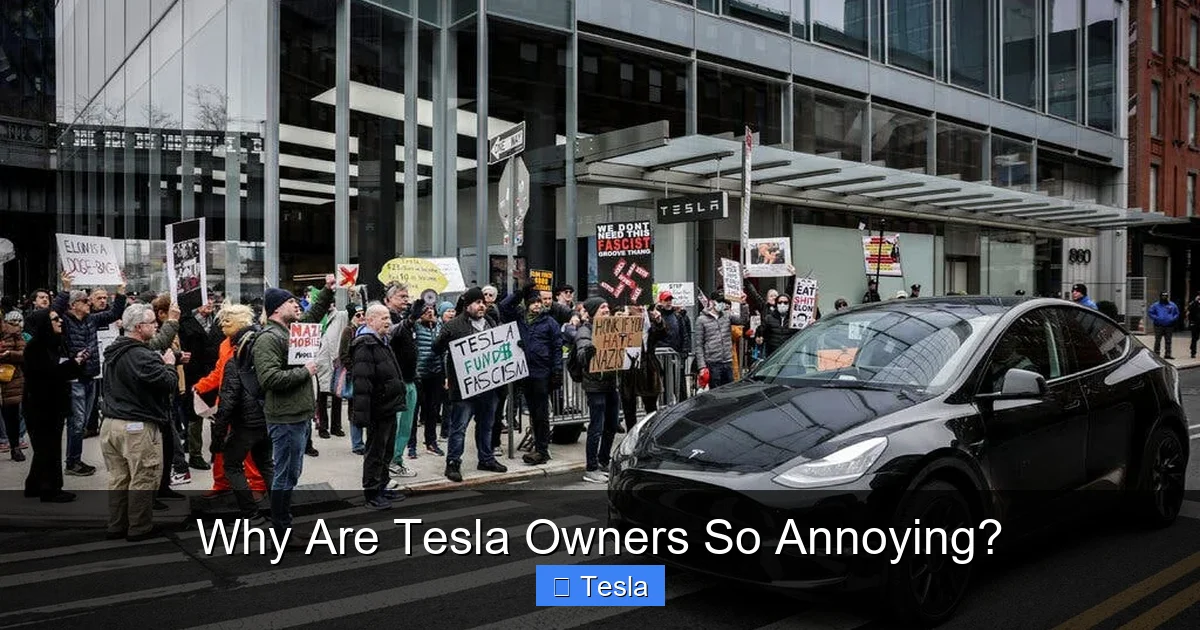
Tesla’s core differentiator is technology. Over-the-air updates, a giant touchscreen, "Full Self-Driving" (FSD) beta, and a minimalist interior make traditional cars look like horse-and-buggies to some owners. This tech advantage is a point of pride—and a frequent source of annoyance for others.
Visual guide about Why Are Tesla Owners So Annoying?
Image source: static01.nyt.com
The Never-Ending Software Update
Remember when your car’s radio was the height of tech? Tesla owners get regular updates that add features, improve range, or even change the user interface. It’s like getting a new phone every few months. While cool, this leads to a phenomenon: the constant comparison. "My 2021 Model 3 just got the new dashcam viewer via update. Your 2023 BMW still can’t do Apple CarPlay wirelessly?" This isn’t just bragging; it’s a technical one-upmanship that feels dismissive of other brands’ innovation cycles.
Owners become amateur software reviewers, dissecting every patch note. They’ll explain at length how the latest update improved phantom drain or added a new game. To a non-owner, this is tedious. To them, it’s proof they’re on the cutting edge. The annoyance peaks when they imply your car is "obsolete" because it doesn’t receive OTA updates. This attitude overlooks the fact that many drivers prefer proven, stable systems over constant, sometimes buggy, digital flux.
The FSD Debate and Autopilot Arrogance
Nothing divides Tesla owners and non-owners like Full Self-Driving. Owners in the beta program often post videos of their cars navigating complex streets "autonomously." They’ll argue that Level 5 autonomy is just around the corner, while critics call it dangerous hype. This creates a "I told you so" dynamic. When a Tesla on Autopilot avoids an accident, the owner might say, "See? This is why I paid for FSD." When it fails, they blame the driver or the road.
This defensiveness can be maddening. It’s not just about safety; it’s about being part of an elite test group. The tech becomes a badge of honor, and skepticism is seen as Luddism. For context, discussions about advanced features in other brands, like ambient lighting systems or driver aids, rarely inspire such fervent debates. Tesla has merged car ownership with beta-testing, and that blurs the line between user and evangelist.
The Performance Privilege: Smugness in Silence
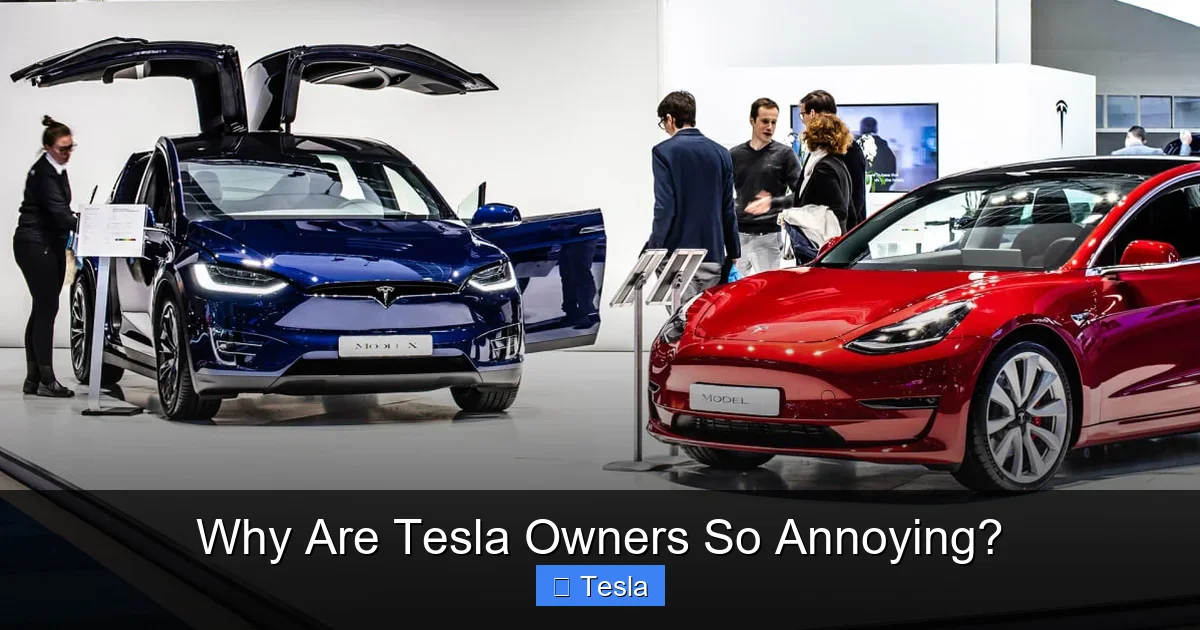
Electric motors deliver instant torque. A base Model 3 can out-accelerate a Porsche 911. This performance is accessible, silent, and surprisingly cheap relative to its rivals. But with great power comes great smugness.
Visual guide about Why Are Tesla Owners So Annoying?
Image source: thestreet.com
The Traffic Light Grand Prix
Every Tesla owner has a story about leaving a Mustang or Camaro in the dust off a stoplight. They love it. They’ll recount these moments with glee, often framing it as "showing the ICE guys." While harmless fun, the repetition can feel like gloating. It reduces driving to a series of drag races, ignoring the joy of handling, sound, and mechanical connection that petrolheads cherish. The silence of the EV makes it even more frustrating—there’s no roar, just a silent "whoosh" that feels like a mic drop.
This isn’t unique to Tesla; sports car owners brag too. But Tesla’s performance is democratized. You don’t need a $100k car to feel superior. A $40k Model 3 can humble a $60k muscle car. That accessibility broadens the bragging audience. It also creates a sense of "gotcha"—proving that electric can be fun, which is a valid point, but delivered with a side of schadenfreude.
Efficiency as a Weapon
Performance isn’t just about speed; it’s about efficiency. Tesla owners will meticulously track Wh/mi, discuss tire pressure’s impact on range, and plan trips around Supercharger locations. This data-driven approach can come across as obsessive. When a non-owner complains about gas prices, a Tesla owner might say, "I pay $5 for a full ‘tank’ that goes 300 miles. You’re getting robbed."
This efficiency superiority complex extends to environmental guilt-tripping. "My car produces zero emissions. Yours is polluting the air." Even if true, the delivery can feel judgmental. It ignores that many drivers have legitimate needs—towing, long-distance travel without charging infrastructure, or budget constraints—that make EVs impractical. The Tesla owner’s focus on their own efficiency can blind them to these realities, making their comments seem tone-deaf.
Eco-Elitism and the Moral High Ground
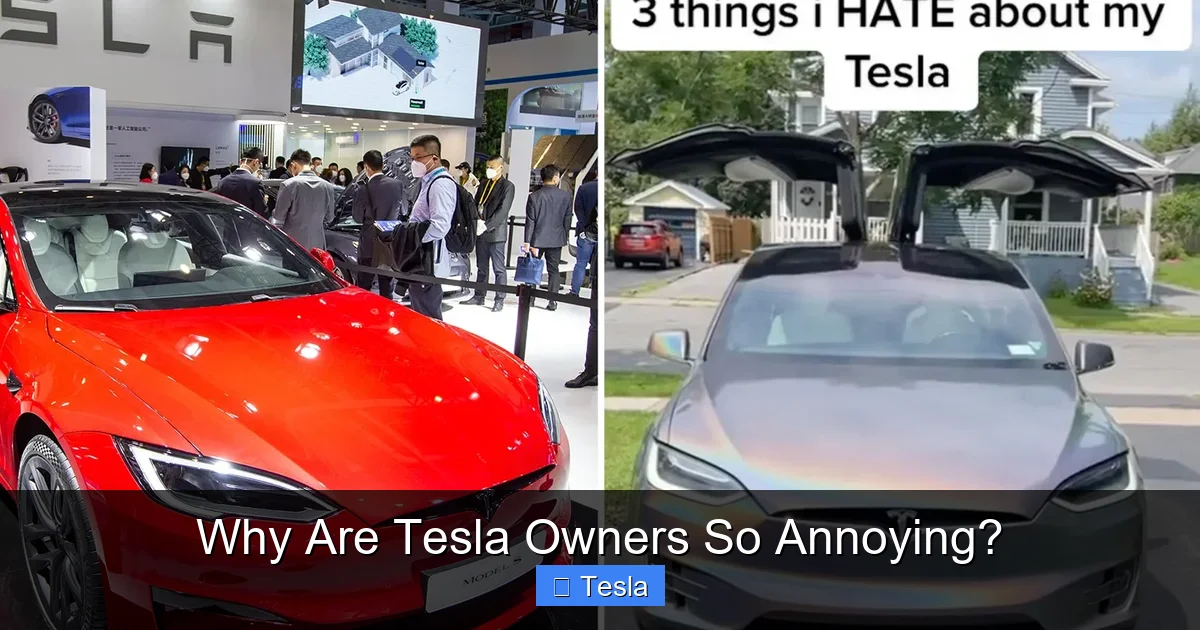
Climate change is a moral issue for many. Tesla owners, by choosing an EV, often see themselves as "doing their part." That’s commendable. But sometimes, it morphs into eco-elitism—a belief that their choice makes them morally superior.
Visual guide about Why Are Tesla Owners So Annoying?
Image source: the-sun.com
The “Green” Judgment
You’ll hear it: "I don’t get why people still drive gas cars. It’s 2024." Or, "Every time you fill up, you’re harming the planet." These statements, while factually grounded, lack nuance. They ignore the carbon footprint of battery production, the sourcing of rare earth minerals, and the fact that many regions still rely on coal-powered grids. More importantly, they dismiss socioeconomic factors—not everyone can afford a Tesla, even with incentives.
This moral posturing is particularly grating because it’s often delivered with a hint of pity or contempt. It frames car ownership as a binary choice: virtuous (EV) or villainous (ICE). That black-and-white thinking ignores the complex transition to sustainable transport. It also overlooks that many Tesla owners aren’t environmental saints; they bought the car for performance, tech, or status. Yet the "eco-hero" narrative is a powerful part of the brand identity, and some owners lean into it heavily.
Ignoring the Bigger Picture
The eco-elitism often misses larger systemic issues. Focusing on individual car choices can distract from corporate pollution, lack of public transit, or urban planning that mandates car dependency. A Tesla owner might feel proud of their zero-emission vehicle while living in a sprawling suburb that requires a 20-mile drive to buy groceries. The moral high ground is shaky when the entire lifestyle is car-centric.
This isn’t to say EVs aren’t important—they are. But the self-righteousness can alienate people who might otherwise be allies. It creates a "holier-than-thou" vibe that’s hard to shake. Compare this to the community around Toyota, where owners praise practicality and longevity without necessarily claiming moral superiority. Tesla’s mission ties personal identity to planetary fate, amplifying the stakes and the potential for condescension.
The Cult of Elon: Loyalty to a Man, Not Just a Car
Elon Musk is inextricable from Tesla. His persona—brilliant, mercurial, visionary—shapes the brand. For many owners, loving their Tesla means loving Musk. This adds a layer of political and personal defensiveness that other brands don’t have.
Defending the Indefensible
Musk says or does something controversial (on Twitter, of course). Suddenly, Tesla owners are asked to defend it. "Do you agree with Elon’s latest tweet?" The car and the CEO become a package deal. This forces owners into a position of defending not just their vehicle, but a polarizing figure. Some lean in, citing Musk’s SpaceX achievements or Tesla’s impact on EVs. Others distance themselves, but the association remains.
This dynamic is unique. You don’t see Ford owners being asked about Jim Farley’s political takes. But because Musk is so vocal and so central to Tesla’s mythos, ownership carries his baggage. It turns car talk into culture-war talk, which is exhausting. It also means criticism of Tesla can feel like a personal attack to owners who see Musk as a genius pioneer. That defensiveness can manifest as snark or dismissal in conversations.
The "True Fan" Hierarchy
Within the Tesla community, there’s a hierarchy. Those who bought pre-2016, when the Model S was a rare luxury item, are "OG" owners. Those who got in early on FSD beta are visionaries. Those who use referral codes are team players. This creates a subtle one-upmanship. "I’ve had my Tesla since 2018. You just got yours? Wait until you experience the next update." It’s not always malicious, but it establishes a pecking order based on tenure and access, which can be exclusionary to new owners and bewildering to outsiders.
This cult-like hierarchy is reinforced by Musk’s own rhetoric—talking about "the Tesla family" or "our mission." It fosters loyalty but also an us-vs-them mentality. Non-owners are "sleeping." Competitors are "legacy automakers stuck in the past." This language, repeated by owners, makes casual car talk feel like an ideological battle.
Why It’s Not (Entirely) Fair: The Other Side of the Coin
Laying all this out makes Tesla owners sound insufferable. But it’s crucial to remember: we’re describing a vocal subset. Many owners are normal people who love their cars without the baggage. The reputation is amplified by a few key factors.
The Vocal Minority Effect
In any community, the most enthusiastic members are the loudest. Tesla forums, Reddit, and YouTube are dominated by power users who live and breathe the brand. They’re the ones posting daily update videos, debating FSD v12.3, and organizing meetups. The quiet majority—who just use their car to commute and occasionally charge—don’t post. So the online perception is skewed. It’s like thinking all Subaru owners are off-road warriors because the loudest ones post rally photos.
This vocal minority sets the tone. Their enthusiasm is contagious but also overwhelming. When you meet a Tesla owner in real life, there’s a good chance they’re not this person—but the stereotype precedes them. You’re braced for a lecture on battery chemistry, and sometimes you get one. That anticipation colors every interaction.
The Media Amplification
Tesla is a media magnet. Every product launch, every Musk tweet, every Autopilot crash gets covered. Stories about "Tesla fanboys" or "Tesla cultists" are clickbait. They reinforce the stereotype. Meanwhile, stories about reasonable Tesla owners don’t trend. The narrative builds itself: Tesla owners = annoying. It’s a feedback loop. The more the media highlights the extreme behavior, the more people expect it, and the more owners feel pressured to defend their brand, sometimes coming off as defensive or aggressive.
Let’s not forget that traditional automakers have their own fanatics. Go to a Mustang or Corvette forum and you’ll see similar tribal loyalty, trash talk of rivals, and obsession with specs. But Tesla’s story is intertwined with tech disruption and climate politics, making it hotter and more polarizing. That intensity gets labeled as "annoying" more readily.
So your friend won’t stop talking about their Cybertruck’s stainless steel body. What do you do? Here are some practical tips for dealing with the enthusiastic Tesla owner, whether you’re at a party, on a road trip, or in the office parking lot.
Set Gentle Boundaries
If the conversation veers into Tesla evangelism, it’s okay to redirect. Try: "I get that you love your car, and it sounds awesome. But I’m really interested in hearing about your new puppy/that hiking trip/your work project." Most people will take the hint. If they persist, be firmer: "I’m glad you’re happy with your Tesla, but I’m not looking to buy an EV right now, so let’s talk about something else." You don’t have to engage in a debate about lithium mining to be polite.
Ask Specific, Non-Threatening Questions
Instead of asking, "Is it better than my Audi?" (which invites comparison), ask about practical experiences: "What’s the charging situation like on long trips?" or "How’s the winter range?" These are factual questions that don’t trigger a defensive tech lecture. Owners often enjoy sharing practical tips, and it keeps the conversation grounded in reality rather than ideology. You might even learn something useful about aftermarket accessories for their Model Y or charging networks.
Acknowledge the Positives, Then Move On
Validate their excitement without feeding the one-upmanship. Say, "Cool, the tech sounds impressive. I saw the new update added a light show—that’s a fun feature." Then pivot. This shows you’re listening but aren’t interested in a deep dive. It disarms the need to convince you. Most Tesla owners just want to share their joy; they don’t necessarily want to convert you. Giving a little positive reinforcement can satisfy their urge to share without derailing the entire conversation.
Remember, their enthusiasm likely comes from a genuine place of excitement. They’ve bought into a vision that’s rare in the auto world—a car that evolves, that feels like sci-fi, that aligns with a sustainable future. That’s worth something. A little empathy goes a long way, even if you’d still rather drive a manual Miata.
Conclusion: It’s Complicated, But Understandable
Why are Tesla owners so annoying? Because Tesla isn’t just a car company. It’s a tech company, a climate movement, a cult of personality, and a status symbol rolled into one. Ownership comes with a dense set of associations—innovation, superiority, moral duty, exclusivity. When owners talk about their Teslas, they’re often unconsciously promoting all those things. That can feel like preaching, bragging, or judgment.
But it’s also human. People get passionate about what they buy, especially when it’s expensive and identity-forming. Think of the zeal of an Apple fan in the 2000s, or a Jeep Wrangler owner who does nothing off-road. Tesla has simply created a more intense version of automotiveenthusiasm, fused with tech beta-testing and environmental ethics. The "annoying" owner is usually just a passionate advocate who hasn’t learned to read the room—or who’s surrounded by skeptics who challenge their worldview.
The next time you encounter a Tesla evangelist, try to see past the smugness. Ask yourself: what are they really excited about? Is it the silent acceleration? The promise of autonomy? The feeling of being on the right side of history? There’s usually a core of genuine enthusiasm there. You don’t have to agree, and you certainly don’t have to listen to a 20-minute monologue about Supercharger v4 speeds. But understanding the "why" can turn irritation into empathy—or at least give you a polite exit strategy.
In the end, Tesla owners are car lovers like any other. They’ve just bought into a brand that asks them to be missionaries. That’s a heavy burden, and sometimes it shows. But as the EV market matures and Tesla loses its underdog status, maybe the evangelism will cool. Until then, keep a snack handy for those long charging chats, and remember: their car might be the future, but your patience is timeless.
Frequently Asked Questions
Are all Tesla owners really this annoying?
No. The "annoying" stereotype largely comes from a vocal minority of early adopters and tech enthusiasts who are highly active online. Many Tesla owners are quiet, everyday drivers who appreciate the car’s practicality and don’t evangelize. The perception is amplified by media and the brand’s intense community culture.
Is the annoyance just jealousy because Teslas are popular?
Partly. Tesla’s rapid rise and cultural cachet can trigger envy, especially as traditional automakers struggle to match its tech appeal. But the annoyance often stems from specific behaviors—preachy attitudes, constant tech comparisons, and moral superiority—rather than mere popularity. It’s the delivery, not the desire for the car itself.
Do Tesla owners really talk about their cars all the time?
Some do, especially new owners experiencing the "honeymoon phase" with a vehicle that feels radically different. The constant software updates and novelty keep conversations fresh. However, most grow out of it. Like any new gadget or car, the initial excitement fades, and the Tesla becomes just a car—albeit a cool one.
How can I politely tell a Tesla owner I’m not interested in hearing about their car?
Use "I" statements to avoid sounding confrontational. Try: "I’m really not in the market for an EV right now, so I don’t need to hear all the details. How about we talk about [other topic]?" Or, "That’s great you love your Tesla! I’m more of a [your preference] person, so let’s agree to disagree." Most will respect a clear, friendly boundary.
Is Tesla’s marketing responsible for creating this annoying owner behavior?
Absolutely. Tesla markets a mission, not just a product. The "accelerate sustainable energy" narrative and Elon Musk’s cult-of-personality branding encourage owners to see themselves as pioneers. Referral programs also incentivize promotion. The company fosters a tribal community, which naturally produces evangelists. Other brands don’t tie identity to a CEO or a planetary-saving mandate in the same way.
Will this annoyance go away as EVs become mainstream?
Likely yes. As EVs normalize and Tesla loses its "early adopter" exclusivity, the missionary zeal will diminish. When there are 50 EV brands and charging is ubiquitous, owning a Tesla won’t feel like belonging to a select club. The tech will become table stakes, not a differentiator. The annoying evangelist will fade, replaced by the average car owner who just wants to get from A to B.