Where Is the Tpms Reset Button on a 2016 Toyota Corolla?

Contents
- 1 Key Takeaways
- 2 📑 Table of Contents
- 3 Introduction: That Persistent TPMS Light
- 4 Understanding Your Corolla’s TPMS
- 5 The Exact Location: Steering Wheel & Dashboard Display
- 6 Step-by-Step: How to Perform the TPMS Reset
- 7 Common Issues and Troubleshooting
- 8 When to Seek Professional Help
- 9 Pro Tips and Best Practices
- 10 Conclusion: Knowledge is Power (and a Quiet Dashboard)
- 11 Frequently Asked Questions

Car GPS Navigator

Car Glass Cleaner

Anti-Slip Dashboard Mat

Tool Roll Bag
The TPMS reset button on a 2016 Toyota Corolla is not a physical button you press. Instead, you reset the system through the vehicle’s multi-information display using the steering wheel controls. The process involves navigating to the TPMS settings menu, selecting “Set” or “Initialize,” and confirming the reset after ensuring all tires are properly inflated to the correct PSI. This procedure must be done with the ignition on but the engine off, and sometimes requires a short drive for the system to fully recognize the new sensor values.
Key Takeaways
- No Physical Button: The 2016 Corolla does not have a dedicated, stand-alone TPMS reset button under the dash or in the fuse box; the reset is performed via the car’s digital menu system.
- Steering Wheel Controls are Key: You use the “DISP” or “Mode” switch and the “Enter” button on the steering wheel to navigate the multi-information display to the TPMS menu.
- Correct Tire Pressure is Mandatory: You must inflate all four tires (and the spare, if equipped with a sensor) to the exact pressure listed on the driver’s door jamb sticker before initiating the reset. The reset tells the car “these are the correct pressures.”
- Ignition ON, Engine OFF: The reset procedure requires the car’s electronics to be powered (turn key to “ON” or press start button twice without braking), but the engine should remain off.
- Drive Time May Be Needed: After a successful reset, the TPMS light may go off immediately, or it may require 5-15 minutes of driving at speeds above 25 mph for all sensors to communicate and the system to verify pressures.
- Faulty Sensor or Dead Battery: If the light returns immediately or won’t reset, a TPMS sensor battery (lasts ~7-10 years) may be dead, or a sensor itself could be damaged, requiring professional replacement and reprogramming.
- Consult Your Manual: Your owner’s manual has the definitive, model-year-specific procedure. Procedures can vary slightly between trims (LE, SE, XLE) and model years.
[FEATURED_IMAGE_PLACEHOLDER]
📑 Table of Contents
- Introduction: That Persistent TPMS Light
- Understanding Your Corolla’s TPMS
- The Exact Location: Steering Wheel & Dashboard Display
- Step-by-Step: How to Perform the TPMS Reset
- Common Issues and Troubleshooting
- When to Seek Professional Help
- Pro Tips and Best Practices
- Conclusion: Knowledge is Power (and a Quiet Dashboard)
Introduction: That Persistent TPMS Light
You’re driving your reliable 2016 Toyota Corolla, and a bright yellow light with an exclamation point inside a tire cross-section illuminates your dashboard. It’s the Tire Pressure Monitoring System (TPMS) warning. Your first instinct might be to hunt for a little reset button, maybe tucked away near the fuse box or under the steering column. You’ve seen them before in older cars. But if you’ve started looking in your Corolla and come up empty-handed, don’t panic—you’re not missing a hidden switch. The 2016 Toyota Corolla, like most modern vehicles, uses a software-based reset process instead of a physical button. This guide will walk you through exactly where to find the reset function and, more importantly, how to perform the reset correctly to silence that warning light for good. We’ll cover the precise location of the controls, the critical pre-reset steps, and what to do if the light stubbornly refuses to go away.
Understanding Your Corolla’s TPMS
Before we talk about resetting, let’s quickly understand what we’re dealing with. The TPMS in your 2016 Corolla is a direct system. This means each wheel has a small electronic sensor mounted inside the valve stem. These sensors constantly monitor the air pressure and temperature of each tire and transmit that data wirelessly to the car’s computer. If the pressure in any tire drops 25% or more below the manufacturer’s recommended level, the system triggers the warning light on your dash. It’s a crucial safety feature, as under-inflated tires lead to poor fuel economy, uneven tread wear, and increased risk of a blowout.
Visual guide about Where Is the Tpms Reset Button on a 2016 Toyota Corolla?
Image source: tiregrades.com
Why a Software Reset Instead of a Button?
In older vehicles, a TPMS reset button was often used to manually re-learn the position of each sensor after rotating tires or replacing a sensor. In your 2016 Corolla, the system is designed to automatically recognize the unique ID of each sensor. The “reset” or “re-learn” function you perform through the menu doesn’t teach the car new sensor IDs; it tells the car’s computer, “Okay, the pressures I’m about to input are the correct, target pressures. From now on, use these as the baseline.” It’s essentially a calibration of the system’s thresholds. This is why the physical button disappeared—the function moved into the car’s digital brain, accessible via the steering wheel controls and instrument cluster display.
The Exact Location: Steering Wheel & Dashboard Display
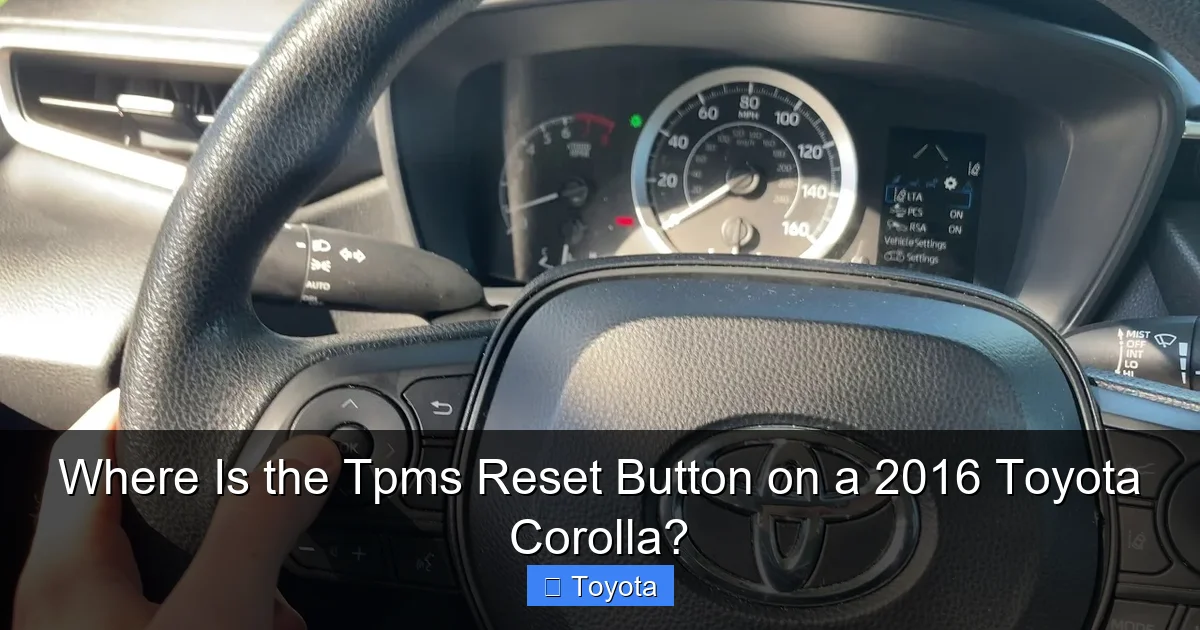
So, where is the reset? It’s not a button; it’s a menu option. You will access it using two components:
Visual guide about Where Is the Tpms Reset Button on a 2016 Toyota Corolla?
Image source: i.ytimg.com
- The “DISP” or “Mode” Switch: This is a small button or toggle on the left spoke of your steering wheel (for US-market models). It’s often labeled with a document icon or the word “DISP.” Its primary job is to cycle through the different pages of information in the Multi-Information Display (MID) behind your steering wheel—things like odometer, trip meters, fuel economy, and, crucially, the TPMS settings.
- The “Set” or “Enter” Button: This is the button with a “Set” label or a checkmark/enter symbol, located directly below or next to the “DISP” switch on the steering wheel spoke. You use this to select menu items and confirm actions like the TPMS reset.
The actual “button” you are looking for is the sequence of presses on these two controls to navigate to the correct screen. You’ll be looking at the small LCD screen in your gauge cluster, not the center infotainment screen.
Step-by-Step: How to Perform the TPMS Reset
Follow these steps meticulously. Skipping the preparation is the most common reason resets fail.
Visual guide about Where Is the Tpms Reset Button on a 2016 Toyota Corolla?
Image source: tirehubz.com
Step 1: Prepare the Vehicle and Tires
Park your Corolla on a level surface. Turn the ignition to the “ON” position (press the start/stop button twice without touching the brake pedal, or turn the key to “ON”). Do not start the engine. Now, using a reliable tire pressure gauge, check the pressure in all four tires. Inflate or deflate them as needed to match the exact specifications. These numbers are on a sticker on the driver’s door jamb or in your owner’s manual. For a 2016 Corolla, typical pressures are 32 PSI for all four tires on most trims, but always verify your specific sticker. If your car has a compact spare tire with a TPMS sensor, check and adjust its pressure to the spare’s specification (usually 60 PSI) as well.
Step 2: Navigate to the TPMS Menu
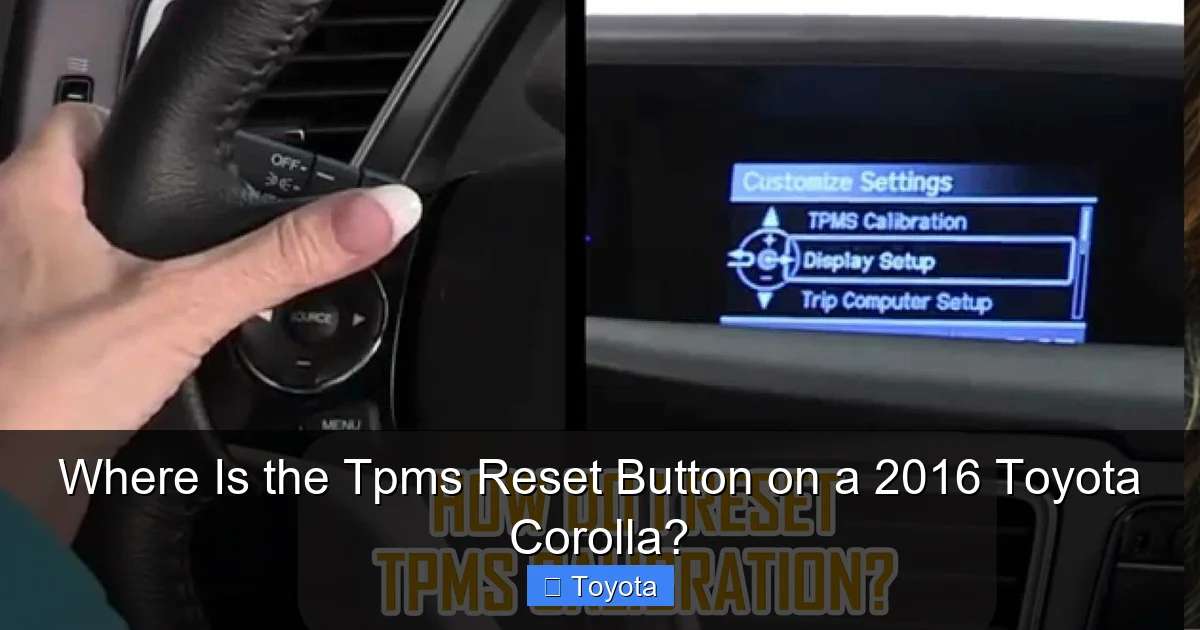
With the ignition ON and the engine OFF, look at your MID. Press the “DISP” button repeatedly until you see a screen that says “TPMS” or shows a tire pressure graphic. On some models, you might need to press “DISP” until you get to a “Customize” or “Vehicle Settings” menu first, and then use the “Set” button to enter sub-menus. The exact path can vary:
- Common Path A: DISP -> TPMS screen (direct).
- Common Path B: DISP -> Settings -> TPMS -> Set.
You may need to consult your owner’s manual for the exact sequence for your specific trim (LE, SE, XLE). Once you are on the main TPMS screen, you will see options like “Pressure” (to view current pressures) and “Set” or “Initialize.”
Step 3: Initiate the Reset/Initialize
Using the “Set” or “Enter” button, highlight the “Set” or “Initialize” option. Press the button to confirm. The display will likely change, perhaps showing a message like “Initializing” or a progress bar. It may beep. This is the car telling you it is now listening for the current pressure values from all four sensors to set them as the new “full” benchmark.
Step 4: Confirmation and Drive Cycle
After a few seconds, you should see a confirmation message like “TPMS initialization complete” or the screen may return to the normal TPMS pressure readout. The warning light on your dash should turn OFF. If it does not turn off immediately, don’t panic. Drive the car normally for about 10-15 minutes, maintaining speeds above 25 mph. This allows all four sensors to transmit multiple signals, ensuring the computer has received consistent data from each one. After this drive cycle, the light should extinguish. If it remains on, return to Step 1 and ensure all pressures are exactly to spec. Sometimes a very slow leak in a tire can cause the pressure to drop enough during the reset process to trigger the light again.
Common Issues and Troubleshooting
What if the light won’t cooperate? Here are the most frequent problems and solutions.
The Light Comes Back On Immediately After Reset
This almost always means one of two things: 1) A tire’s pressure is not exactly to spec. Re-check all four (and the spare) with your gauge. Temperature changes can affect pressure; do this when tires are cold. 2) There is an actual fault in the TPMS system. A sensor battery is dead (they last 7-10 years, and 2016 models are now in that range), or a sensor has been physically damaged. In this case, a TPMS warning light that won’t reset usually requires a visit to a tire shop or dealer. They will use a scan tool to read which sensor (or sensors) is failing and will need to be replaced. Important: When a sensor is replaced, it must be programmed to the vehicle’s computer, which is a professional procedure.
I Can’t Find the TPMS Menu in My Display
First, double-check you are in the correct ignition mode (ON, engine off). Then, methodically press the “DISP” button slowly, pausing on each screen. Look for any icon that resembles a tire or says “TPMS.” On some Corolla trims, the menu structure is: DISP -> scroll to “Settings” -> press SET -> scroll to “TPMS” -> press SET. If after 20-30 presses you see no TPMS option, your specific model year or market configuration might not have a user-initiated reset feature—a rare but possible scenario. Your owner’s manual is the final authority here.
The Reset Menu is Grayed Out or Says “Not Available”
This usually indicates the system has detected a problem it considers more severe than a simple pressure variance. It could be a failed sensor, a communication error, or a dead sensor battery. The system disables the manual reset function because it needs diagnostics. You will need a professional scan tool to identify the fault code. For general dashboard light resets, procedures like how to reset the check engine light on a Toyota Corolla exist, but TPMS faults are different and often require part replacement.
When to Seek Professional Help
While the reset procedure itself is a simple DIY task, there are clear instances where you should call in the pros:
- Flashing or Blinking TPMS Light: A rapidly flashing TPMS light (for more than a few seconds) usually indicates a system malfunction, not just low pressure.
- Multiple Sensor Failures: If more than one sensor is failing, it’s less likely to be a coincidence and may point to an underlying issue.
- After Tire Service: If you’ve just had tires rotated, replaced, or repaired, and the light is on, a professional can ensure the sensors are functioning and, if necessary, perform a full re-learn procedure with specialized tools. Some shops also offer services related to Toyota Camry TPMS resets and other models, showing how common this procedure is across the brand.
- Persistent Light After Multiple Resets: If you’ve correctly inflated the tires and followed the reset steps three times, and the light is still on, a sensor is almost certainly faulty.
A professional diagnosis will tell you exactly which wheel is the culprit. Replacing a TPMS sensor typically costs $50-$150 per sensor for the part, plus labor. It’s a good practice to replace the sensor valve stem seal and nut at the same time for a proper, leak-free seal.
Pro Tips and Best Practices
Check Pressures Monthly and When Cold
Tires lose about 1 PSI per month. Get in the habit of checking all pressures with a good digital gauge once a month and before long trips. Always check when tires are “cold” – meaning the car has been parked for at least 3 hours or driven less than a mile. Driving heats the tires and air inside, giving a falsely high reading.
Don’t Forget the Spare!
If your Corolla’s spare tire is a full-size, temporary spare that also has a TPMS sensor (common on many Corollas), it needs to be inflated to its specified pressure (usually much higher, like 60 PSI) and included in the reset process. A dead or low spare is a common reason for a surprise TPMS light.
Reset After Any Tire Work
Anytime you have tires removed from the wheels (for rotation, repair, or replacement), there is a chance the sensor’s signal is disrupted or the sensor is damaged. It’s a smart habit to perform the TPMS reset procedure after any such work, even if the light isn’t on yet, to ensure the system is perfectly calibrated.
Accessing the Hood for Checks
While you don’t need to pop the hood to reset the TPMS, it’s good to know how. The hood release on a 2016 Corolla is a lever inside the car, below the dashboard on the driver’s side. Pull it firmly to pop the primary latch. Then, go to the front of the car, locate the secondary latch under the hood lip near the center, and push it sideways or upward (the exact motion varies) to release it fully. If you’re ever checking other components, knowing how to open the hood on a Toyota Corolla is essential basic knowledge.
Conclusion: Knowledge is Power (and a Quiet Dashboard)
That little TPMS light is your car’s way of asking for a quick check-up. For the 2016 Toyota Corolla, the answer to “where is the reset button?” is: it’s in your steering wheel controls and dashboard display. By understanding that the process is a digital calibration rather than a physical button press, you’ve already solved half the mystery. Remember the golden rules: always inflate tires to the exact door jamb spec first, use the “DISP” and “Set” buttons to navigate to the TPMS menu, and allow for a short drive cycle. Armed with this knowledge, you can confidently handle this simple maintenance task yourself, save a trip to the shop, and enjoy a warning-free drive. However, if the problem persists after correct reset attempts, respect the system’s signal—it’s likely telling you a sensor needs professional attention.
Frequently Asked Questions
Why is my TPMS light on if my tires look fine?
The TPMS system measures air pressure electronically, not visually. A tire can appear perfectly inflated but be 25% below the recommended PSI, which will trigger the light. Always use a tire pressure gauge for an accurate reading, as visual inspection is notoriously unreliable.
Can I just ignore the TPMS light?
You should never ignore it. Driving on significantly under-inflated tires is dangerous, reduces fuel efficiency, causes premature tire wear, and increases the risk of a tire failure. It’s a critical safety system designed to alert you to a problem that needs immediate attention.
Do I need to reset the TPMS after adding air?
Yes, almost always. Once you have corrected the pressure in all tires to the proper level, you must perform the reset procedure to tell the car’s computer that the current pressures are now the correct baseline. The light will not turn off on its own.
How much does it cost to fix a TPMS sensor?
Replacing a single TPMS sensor (including the part and labor) typically costs between $100 and $250 at a tire shop or dealership. Prices vary by location and whether you replace just the sensor or the entire valve stem assembly.
Will disconnecting the battery reset the TPMS?
No. Disconnecting the battery will reset the car’s radio and clock settings, but it will not clear or reset the TPMS system. The TPMS has its own memory and requires the specific menu-driven reset procedure to recalibrate.
My TPMS light turned off on its own after I added air. Do I still need to reset it?
If the light turns off by itself after inflating the tires, it means the system automatically re-checked and verified the pressures were back within range. In this case, a manual reset is not strictly necessary, as the system has already self-calibrated. However, performing the reset manually can ensure the system is perfectly synchronized and is a good practice after any pressure adjustment.