
Where Can I Buy a Jeep in a Crate?

Buying a “Jeep in a crate” means purchasing a disassembled, factory-direct vehicle kit. It’s primarily a specialty offering for the Jeep Wrangler and Gladiator through official channels like the Jeep® Adventure Network. This route is for enthusiasts seeking a unique, hands-on build experience but requires significant mechanical skill, time, and careful navigation of titling and insurance. It’s not a simple online purchase and involves complex logistics and regulations.
So, you’ve heard the rumors. The dream. The myth of a brand-new Jeep, delivered to your driveway in a big wooden crate, like a life-sized, ultra-capable toy. You picture yourself, maybe with a friend, unboxing the parts and building your ultimate adventure machine from the ground up. It sounds exhilarating, custom, and deeply personal. But where can you actually buy a Jeep in a crate? Is it even a real thing you can buy, or just an automotive legend? Let’s pop the lid on this fascinating and complex topic and see what’s truly inside.
The short answer is: yes, you can buy a Jeep in a crate, but it’s not as simple as adding it to an Amazon cart. It’s a specialized, niche process with specific rules, significant costs, and immense requirements. This isn’t a factory-direct-to-consumer model like some electric vehicle startups. Instead, it’s a legacy program designed for specific markets and dedicated enthusiasts. To understand where to buy one, you first need to understand what “a Jeep in a crate” actually means.
Key Takeaways
- Crate Jeeps are real but limited: Officially, Jeep offers “crate” or “knock-down” kits mainly for the Wrangler (JL/JT) and Gladiator through the Jeep® Adventure Network for international markets and specific U.S. scenarios.
- It’s a major project, not a convenience: You receive major components on a pallet. Full assembly requires professional-grade tools, a large workspace, significant mechanical expertise, and dozens of hours of labor.
- You must handle titling and registration: The vehicle will arrive as a “kit” or “parts.” You are responsible for obtaining a VIN (often from the engine/ chassis), completing a thorough state-specific inspection, and navigating the titling process as a newly constructed vehicle.
- Warranties are different: Factory warranties typically apply to complete, dealer-assembled vehicles. Crate vehicle warranties are often limited or different; you must confirm coverage details directly with Jeep or the kit supplier.
- Cost can be misleading: The base crate price might seem lower than a loaded dealership model, but you must add essential missing parts (tires, battery, fluids, sometimes axles/transmission), shipping, tools, and your labor value.
- Consider your end goal: This is ideal for off-road purists wanting a no-holds-barred, serial-numbered build or for exporting to restrictive markets. For most buyers, a standard, dealer-assembled Jeep is far more practical and cost-effective.
- Research is non-negotiable: Before spending a dime, deeply research your state’s DMV rules for “assembled vehicles” or “kit cars,” understand the complete parts list, and realistically assess your mechanical capability and available time.
📑 Table of Contents
- What Does “Jeep in a Crate” Actually Mean?
- Official Channels: The Jeep® Adventure Network (JAN)
- The Alternative (and Often Problematic) “Crate Jeep” Market
- The Reality of the Build: Time, Tools, and Talent
- Cost Breakdown: The Illusion of Savings
- Legal & Titling: The Biggest Hurdle
- So, Should You Buy a Jeep in a Crate?
- Conclusion: A Niche Path for a Specific Purpose
What Does “Jeep in a Crate” Actually Mean?
When people say “Jeep in a crate,” they are typically referring to a Complete Knock-Down (CKD) kit or a Major Assembly Kit. This is not a box of random parts. It’s a strategically packaged collection of major, pre-assembled sub-components shipped from the factory. For Jeep, this program is officially managed through the Jeep® Adventure Network (JAN), which handles global distribution and specialty orders.
The Core Concept: Semi-Assembled, Not Disassembled
Contrary to the image of thousands of loose bolts and panels, a modern Jeep crate kit is surprisingly cohesive. You’ll typically receive:
- A body-on-frame assembly: The chassis with the front and rear axles, suspension, and often the engine and transmission already installed and connected. The body (the “tub”) is usually mounted on the frame but may have its hood, doors, and top removed for shipping efficiency.
- A pre-wired electrical “harness”: The main wiring looms are installed in the frame and body, but final connections to components like the dashboard, lights, and infotainment must be completed.
- Interior “buckets”: The dashboard, seats, and interior panels are often packaged separately.
- All major hardware: Bolts, brackets, and necessary hardware are included, usually in organized bags.
What is almost certainly NOT included: Tires and wheels, battery, fluids (engine oil, coolant, brake fluid, etc.), some final drive components like driveshafts (sometimes included, sometimes not), and any accessories or upgrade packages. You must source these separately. The goal is to provide the core vehicle structure, leaving the final assembly, finish work, and component installation to the buyer.
Official Channels: The Jeep® Adventure Network (JAN)
This is the primary and legitimate source for purchasing a factory Jeep crate kit. The Jeep® Adventure Network is Jeep’s specialized division for handling exports, specialty vehicle programs, and motorsport support. You do not walk into a local Jeep dealership and order one. The process is direct with JAN and is designed for two main customer types:
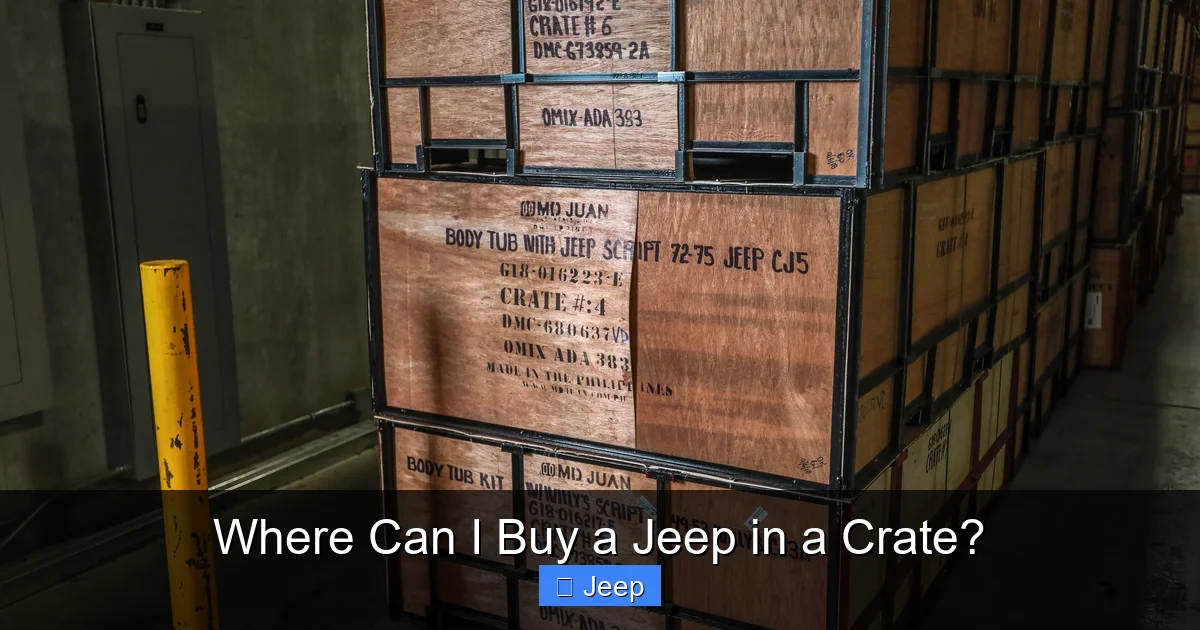
Visual guide about Where Can I Buy a Jeep in a Crate?
Image source: media.hagerty.com
1. International Buyers & Export Markets
This is the program’s original purpose. Many countries have high import tariffs on fully assembled vehicles but lower rates on CKD kits. A local dealer or importer can buy the crate kit, assemble it locally (creating jobs), and sell it as a new vehicle, often at a competitive price. For an individual, this is a complex path involving an export/import agent, but it’s the most common legitimate route. You would work through an authorized Jeep distributor in your target country who participates in the JAN program.
2. U.S. Specialty Buyers & Motorsports
Within the United States, JAN sells crate kits for specific purposes:
- Racing & Competition: For sanctioned off-road racing series (like Baja, King of the Hammers) where vehicles must be based on production models but allow extensive modification. The crate provides a clean-sheet, serial-numbered starting point.
- Government & Military Contracts: For specialized fleet vehicles.
- Extreme Customization: For builders who want to create a one-of-a-kind vehicle with a factory VIN and warranty pedigree from the ground up, avoiding any “salvage” or “rebuilt” title stigma.
For the average consumer, accessing this U.S. channel is difficult. JAN typically requires a business entity, proof of intent (like racing documentation), and a substantial order. It’s not a retail “add to cart” experience.
The Alternative (and Often Problematic) “Crate Jeep” Market
If you search online, you might find listings for “Jeep Wrangler in a crate” on auction sites, eBay, or from specialty importers. This is the wild west of the crate Jeep world and requires extreme caution.
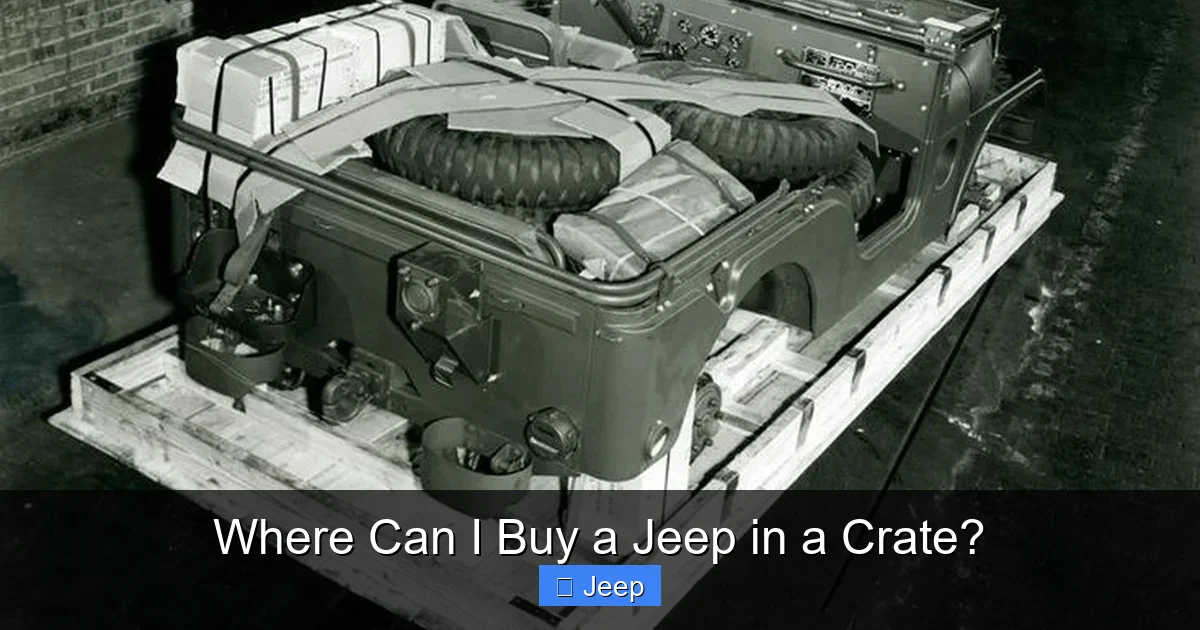
Visual guide about Where Can I Buy a Jeep in a Crate?
Image source: s-media-cache-ak0.pinimg.com
Gray Market Imports & Re-exported Kits
These often originate from one of two places:
- Failed International Shipments: A crate kit intended for a dealer in, say, Dubai, might be abandoned or sold off if the import deal falls through.
- Used CKD Kits: A dealer in an export market may have assembled some vehicles and have leftover crate stock.
Sellers in this space are not official Jeep partners. They are brokers or importers. The risks are high:
- Incomplete or Incorrect Kits: You may receive a kit missing critical components that were “cannibalized” for other builds.
- No Factory Support: Jeep will not recognize the sale. Warranty is void. Technical support is nonexistent.
- Title and VIN Nightmares: The VIN might be for a vehicle destined for a different country with different emissions/safety standards. Getting it titled in your state as a “newly constructed vehicle” or “import” can be a bureaucratic quagmire, potentially requiring it to be treated as a reconstructed vehicle with all the inspections and restrictions that entails. You might need to prove the kit is “new” and never assembled.
- Scams: The classic “pay for a crate that doesn’t exist” scam is prevalent. Always use escrow services and verify the seller’s history meticulously.
If considering this route, your first call must be to your state’s DMV or title office to understand exactly what documentation they require to issue a title for a vehicle built from a CKD kit. This step is more important than finding the crate itself.
The Reality of the Build: Time, Tools, and Talent
Let’s be brutally honest. If you are not a professional mechanic or an exceptionally skilled and equipped amateur, building a Jeep from a crate is likely beyond your capability—and certainly beyond your available time. People often romanticize the “build,” but they underestimate the scale.
Visual guide about Where Can I Buy a Jeep in a Crate?
Image source: i.redd.it
The Workshop & Tool Requirements
You need a large, clean, dry, and well-lit garage or shop with a concrete floor and high enough ceilings. You’ll need:
- Heavy-duty lifts or jack stands: To safely handle the frame and body.
- Impact wrenches and air compressor: For hundreds of bolts.
- Engine hoist/crane: If the engine isn’t pre-installed in the frame.
- Full socket sets, torque wrenches, specialty tools: Jeep-specific tools for axle work, ball joints, etc.
- Body alignment tools: To ensure the tub sits perfectly on the frame without gaps or misalignment—a critical and difficult step.
The Skill & Time Investment
We’re not talking about a weekend project. A complete, careful assembly from a major sub-assembly kit will take a dedicated professional shop 80-150+ man-hours. For a skilled amateur with all tools, it could be 200-300 hours spread over months. This involves:
- Final torqueing of every critical chassis bolt to factory spec.
- Routing and connecting all wiring harnesses (a single mistake can cause a no-start or electrical fire).
- Installing the dash, seats, and trim.
- Bleeding the brake system, filling all fluids, and initial engine start-up procedures.
- Alignment and suspension tuning.
Every step has the potential for error that could compromise safety, void any remaining warranty, or cause damage. For most people, the cost of paying a professional shop to do the assembly ($5,000 – $15,000+ depending on location and shop rates) completely erases any perceived cost savings of the crate.
Cost Breakdown: The Illusion of Savings
Let’s look at a hypothetical 2024 Jeep Wrangler Sport S crate kit price from JAN (for export). The kit might have a base price of $35,000 – $40,000. A similarly equipped, dealer-assembled 2024 Wrangler Sport S has an MSRP of around $40,000 – $45,000. Wait, the crate is cheaper! Not so fast. Your out-the-door cost on the crate will be:
- Crate Kit Price: ~$37,500
- International Shipping & Insurance: (For a U.S. buyer, this is complex) ~$2,000 – $5,000+
- Missing Essential Components: (Tires/wheels ~$1,500, battery $200, fluids $150, maybe driveshafts/axles if not included $1,000+) ~$3,000+
- Assembly Labor: (If you can’t do it all yourself) ~$8,000 – $12,000
- State Inspection & Titling Fees: (Often requiring a special inspector) ~$300 – $1,000
Realistic Total Before Registration: $50,800 – $57,700+
Now compare that to walking into a dealership, negotiating a price on a new, fully assembled, warrantied, titled, and ready-to-drive Jeep off the lot. The crate Jeep path is a passion project and a financial commitment, not a bargain hunt.
Legal & Titling: The Biggest Hurdle
This is the most critical and variable part of the process. You are not buying a “car”; you are buying a “kit” to build a “newly constructed vehicle” or “assembled vehicle.” Your state’s DMV will dictate the entire process.
Understanding Your State’s “Kit Car” or “Reconstructed Vehicle” Laws
Every state has different rules. Some are friendly (like Montana or South Dakota for certain classifications), others are incredibly difficult (like California with its strict emissions and certification requirements). You will likely need to:
- Obtain a VIN: The crate kit should come with a Manufacturer’s Statement of Origin (MSO) or a Certificate of Origin from Jeep/JAN. This document, along with the engine number, is used to apply for a new VIN assignment from your state.
- Pass a Comprehensive Inspection: This is not a standard safety inspection. It’s often a “thorough inspection” by a specially designated DMV inspector or police officer who verifies that all major components (frame, engine, transmission, body) are present, new (not salvage), and match the documentation. They will check the VINs on all major components.
- Meet Emissions & Safety Standards: The vehicle must comply with your state’s emissions (smog) requirements. For a brand-new Jeep crate, this should be fine as it’s a current model, but you must have proof (the MSO). Federal motor vehicle safety standards (FMVSS) must also be met. A brand-new factory kit inherently does, but you must prove it.
- Title as “Assembled” or “Reconstructed”: The resulting title will likely have a branding like “ASSEMBLED” or “RECONSTRUCTED.” This can affect insurance, resale value, and in some states, registration fees. It is NOT a standard “new” title from a dealership.
Action Step: Before you even call JAN, call your local DMV title office. Say: “I am considering purchasing a factory-direct, complete knock-down (CKD) vehicle kit from a manufacturer for the purpose of building a new vehicle. What is the exact process, required documentation, and inspection procedure to obtain a title and registration for this vehicle in this state?” Get the answer in writing if possible.
So, Should You Buy a Jeep in a Crate?
After all this, the question remains. For whom is this the right path?
The Ideal Crate Jeep Buyer Profile
- The Serious Competitor: Building a dedicated, serial-numbered race or competition rig where factory provenance matters.
- The International Buyer: Living in a country with high import duties on finished vehicles, where CKD assembly is the only viable way to get a new, official Jeep.
- The Ultimate Purist Builder: A master fabricator and mechanic with a full shop, who wants the ultimate “from the ground up” experience with a genuine Jeep VIN, and for whom the journey is 90% of the reward. They treat the cost and time as part of the hobby.
The Buyer Who Should Walk Away
- Someone seeking a deal: You will not save money. You will spend more, and your time has value.
- The first-time or casual Jeep owner: The complexity is immense. A standard dealership purchase offers a seamless, warrantied, and simple experience.
- Anyone without a confirmed, detailed understanding of their state’s titling process: Do not buy the crate first. Get the titling promise in writing from the DMV.
- The person without a proper workspace, tools, and a network of expert mechanics: Attempting this without the proper environment and support is a recipe for a stalled project in your garage.
Conclusion: A Niche Path for a Specific Purpose
Where can you buy a Jeep in a crate? The official answer is through the Jeep® Adventure Network, primarily for export and specialty purposes. The unofficial answer is a risky, complex gray market that is fraught with potential pitfalls. The dream of unboxing your own Jeep is powerful, but the reality is a multi-year, expensive, and skill-intensive endeavor that is fundamentally about the build process itself, not the convenience of ownership.
For the vast majority of people dreaming of a new Jeep, the far wiser, simpler, and more economical path is to work with an authorized Jeep dealership. You’ll get a fully assembled, inspected, titled, warranted, and ready-to-drive vehicle. If your goal is a unique build, consider modifying a standard new or used Jeep after purchase—you keep the warranty, the clear title, and the support network. The crate Jeep is the ultimate enthusiast’s pilgrimage, not a practical purchasing strategy. Know exactly what you’re stepping into before you even think about placing an order.
Frequently Asked Questions
Is buying a Jeep in a crate actually cheaper than buying one at a dealership?
Almost never. While the base crate kit price may be slightly lower than an MSRP, you must add thousands in missing parts (tires, battery, fluids), potentially very high shipping costs, and the enormous cost of professional assembly. After titling and inspection fees, your total will almost certainly exceed the price of a similarly equipped, dealer-assembled Jeep with a standard title and full warranty.
Can I get a loan or financing for a Jeep crate kit?
Traditional auto loans are for titled, registered vehicles. A crate kit is considered “personal property” or “equipment,” not a vehicle. You would need a personal loan or a specialty construction loan, which often have higher interest rates and stricter requirements. Banks are hesitant to lend on an asset that cannot be legally driven until a complex, state-dependent build and titling process is complete.
What Jeep models are available as crate kits?
Officially, the program has focused on the current-generation Jeep Wrangler (JL) and Jeep Gladiator (JT). These are the primary models offered through the Jeep® Adventure Network for export and specialty markets. Older models (like the TJ or JK) may appear on the gray market as surplus or used kits, but they are not current factory offerings.
Do crate Jeeps come with a warranty?
Warranties are limited and complex. The factory (Jeep/Stellantis) warranty typically applies to vehicles assembled by authorized dealers. A crate kit assembled by a private individual usually has a severely limited or no powertrain/bumper-to-bumper warranty. Some components (like the engine) may have their own transferable warranties if uninstalled. You must get the exact warranty terms in writing from Jeep® Adventure Network before purchase.
How long does it take to assemble a Jeep from a crate?
For a professional shop with all tools and lifts, a careful, thorough assembly from a major sub-assembly kit takes approximately 80 to 150 man-hours. For a skilled enthusiast working part-time in a home garage, it can easily take 200-300 hours or more over several months. This does not include the time for sourcing missing parts, troubleshooting, or the subsequent state inspection and titling process, which can add weeks or months.
What is the biggest mistake people make when considering a crate Jeep?
The single biggest mistake is not researching their state’s titling and registration laws for “assembled” or “kit” vehicles FIRST. They get excited by the crate, buy it, and then discover their state requires nearly impossible inspections, bans the model year for emissions reasons, or brands the title in a way that makes insurance prohibitively expensive or resale impossible. The titling process dictates the entire project’s feasibility. Always start there.
