
When Was the Suzuki Hayabusa Released?

The Suzuki Hayabusa was officially released in 1999, quickly becoming the world’s fastest production motorcycle. Known for its aerodynamic design and powerful engine, the Hayabusa set new standards in speed, performance, and style.
Key Takeaways
- Release Year: The Suzuki Hayabusa was launched in 1999, marking a turning point in high-speed motorcycle engineering.
- Record-Breaking Speed: It became the fastest production bike at the time, with a top speed of over 194 mph (312 km/h).
- Engine Power: Powered by a 1299cc inline-four engine, it delivered 175 horsepower, making it a performance powerhouse.
- Aerodynamic Design: Its sleek, wind-tunnel-tested body reduced drag and improved stability at high speeds.
- Cultural Impact: The Hayabusa gained fame in movies, video games, and pop culture, becoming a symbol of speed and rebellion.
- Evolution Over Generations: Multiple updates have kept the Hayabusa relevant, including the 2021 redesign with modern electronics and Euro 5 compliance.
- Legacy: Over two decades later, the Hayabusa remains one of the most iconic motorcycles ever made.
📑 Table of Contents
When Was the Suzuki Hayabusa Released?
If you’ve ever dreamed of riding a motorcycle that feels like a jet on two wheels, chances are you’ve heard of the Suzuki Hayabusa. This legendary bike didn’t just enter the market—it exploded onto the scene. The Suzuki Hayabusa was officially released in 1999, and from the moment it hit the streets, it redefined what a production motorcycle could be. It wasn’t just fast—it was the fastest, and that changed everything.
Back in the late 1990s, the motorcycle world was buzzing with competition among manufacturers to build the ultimate speed machine. Kawasaki had the Ninja ZX-11, Honda had the CBR1100XX Super Blackbird, and Yamaha had the YZF-R1. But Suzuki had a different idea. They didn’t want to just compete—they wanted to dominate. And so, the Hayabusa was born. Its name, “Hayabusa,” is Japanese for “peregrine falcon,” the fastest bird in the world, capable of diving at over 200 mph. It was a fitting name for a bike designed to fly.
The Hayabusa wasn’t just about raw speed. It was a complete package—power, handling, comfort, and style all rolled into one. It looked like something from the future, with its long, low profile and aggressive stance. Riders loved it not just for how fast it went, but for how stable it felt at triple-digit speeds. It wasn’t just a speed demon; it was a well-engineered marvel.
The Birth of a Legend: 1999 and the First Generation
Visual guide about When Was the Suzuki Hayabusa Released?
Image source: cdn.suwalls.com
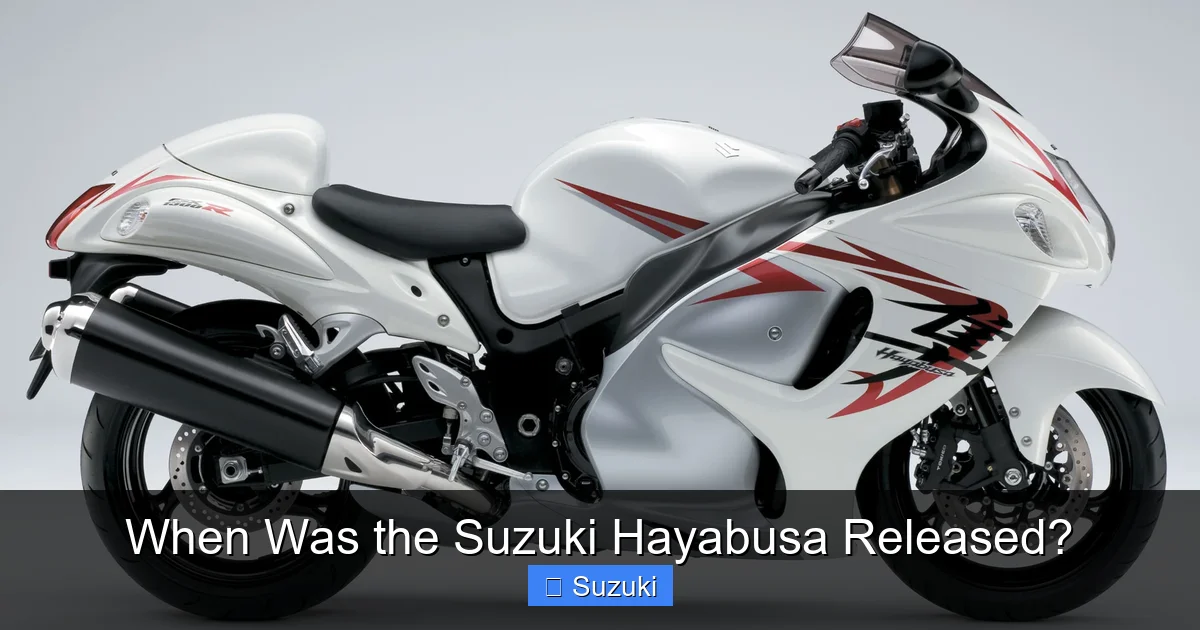
The Suzuki Hayabusa made its global debut at the 1998 Intermot motorcycle show in Cologne, Germany. But it wasn’t until 1999 that it became available to the public. The first generation, known as the GSX1300R, hit dealerships with a bang. It was an instant sensation.
At the heart of the Hayabusa was a 1299cc inline-four engine, derived from the GSX-R1100 but heavily modified for even more power and torque. This engine produced around 175 horsepower and 100 lb-ft of torque, numbers that were mind-blowing at the time. The bike could go from 0 to 60 mph in under 3 seconds and reach a top speed of 194 mph (312 km/h), officially making it the fastest production motorcycle in the world.
But speed alone doesn’t make a legend. Suzuki engineers focused heavily on aerodynamics. The Hayabusa’s bodywork was designed in a wind tunnel to minimize drag and maximize stability. The result was a bike that felt planted even at insane speeds. The fairing was sleek and functional, with integrated lights and a low drag coefficient. It wasn’t just fast—it was efficient.
The first-gen Hayabusa also introduced several innovations. It had a six-speed transmission, a slipper clutch, and a robust chassis with a twin-spar aluminum frame. The suspension was fully adjustable, and the braking system featured dual front discs with four-piston calipers. It was a complete performance package.
Riders quickly fell in love with the Hayabusa. It wasn’t just for track days—it was comfortable enough for long-distance touring. The upright riding position, wide seat, and wind protection made it a favorite among sport-touring enthusiasts. It was a bike that could do it all: speed, comfort, and style.
Why the Hayabusa Was a Game-Changer
Visual guide about When Was the Suzuki Hayabusa Released?
Image source: cdn.dealeraccelerate.com
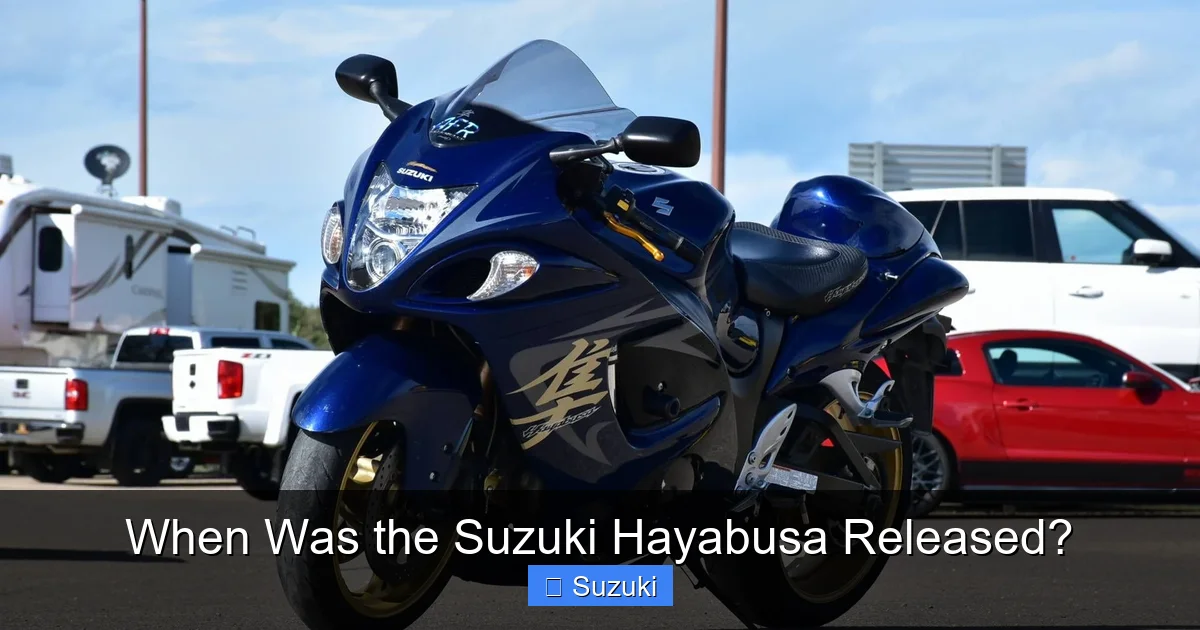
The Suzuki Hayabusa didn’t just break records—it changed the motorcycle industry. Before its release, the title of “world’s fastest production bike” was a hotly contested trophy. But the Hayabusa didn’t just win—it dominated.
Breaking the Speed Barrier
When the Hayabusa hit 194 mph, it shattered the previous record held by the Honda CBR1100XX Super Blackbird, which topped out at around 178 mph. This wasn’t just a small improvement—it was a leap forward. For the first time, a production motorcycle could truly rival supercars in terms of top speed.
But Suzuki didn’t stop there. The Hayabusa’s engine was so powerful that tuners and racers quickly began modifying it for even more performance. With aftermarket parts, some Hayabusas have been pushed beyond 250 mph. While not street-legal, these builds showed the bike’s incredible potential.
The “Gentleman’s Agreement” and Speed Limits
The Hayabusa’s speed didn’t go unnoticed. By the early 2000s, European regulators and manufacturers grew concerned about the rising top speeds of production motorcycles. Safety became a major issue, especially after several high-profile accidents involving modified Hayabusas.
In 2000, Suzuki, along with Honda, Kawasaki, and Yamaha, entered into an informal “gentleman’s agreement” to electronically limit the top speed of their motorcycles to 186 mph (300 km/h). This was done to avoid stricter regulations and to promote safer riding.
While this agreement slowed the Hayabusa’s top speed, it didn’t diminish its reputation. Riders still admired its power, handling, and presence. The Hayabusa remained a symbol of speed, even if it was electronically capped.
Design That Turned Heads
The Hayabusa’s design was just as revolutionary as its performance. Its long, low profile and aggressive stance made it stand out in any crowd. The dual headlights, sculpted fuel tank, and integrated tail section gave it a futuristic look that still turns heads today.
The bike’s aerodynamics were a key part of its success. The fairing was designed to reduce drag and improve high-speed stability. Even the mirrors were shaped to cut through the wind. It was a bike built for speed, and it showed.
The Evolution: Second and Third Generations
Visual guide about When Was the Suzuki Hayabusa Released?
Image source: images.hdqwalls.com
The Suzuki Hayabusa didn’t stay the same for long. Over the years, it evolved to meet changing regulations, technology, and rider expectations.
Second Generation (2008–2020)
In 2008, Suzuki introduced the second-generation Hayabusa. While the engine displacement remained the same at 1299cc, it received a major update. The engine was redesigned with new pistons, connecting rods, and a revised intake and exhaust system. This boosted power to around 197 horsepower and improved fuel efficiency.
The second-gen Hayabusa also got a new chassis with a stiffer frame and improved suspension. The brakes were upgraded to larger discs with six-piston calipers, providing better stopping power. The electronics package was enhanced with a new digital instrument cluster and improved traction control.
Styling was updated too. The bodywork was more angular and aggressive, with LED lighting and a more modern look. The bike retained its iconic shape but looked sharper and more refined.
Despite these improvements, the Hayabusa faced increasing pressure from emissions regulations. By the late 2010s, it was becoming harder to meet Euro 4 and Euro 5 standards with the large-displacement engine. In 2020, Suzuki announced that the Hayabusa would be discontinued in Europe due to emissions compliance issues.
Third Generation (2021–Present)
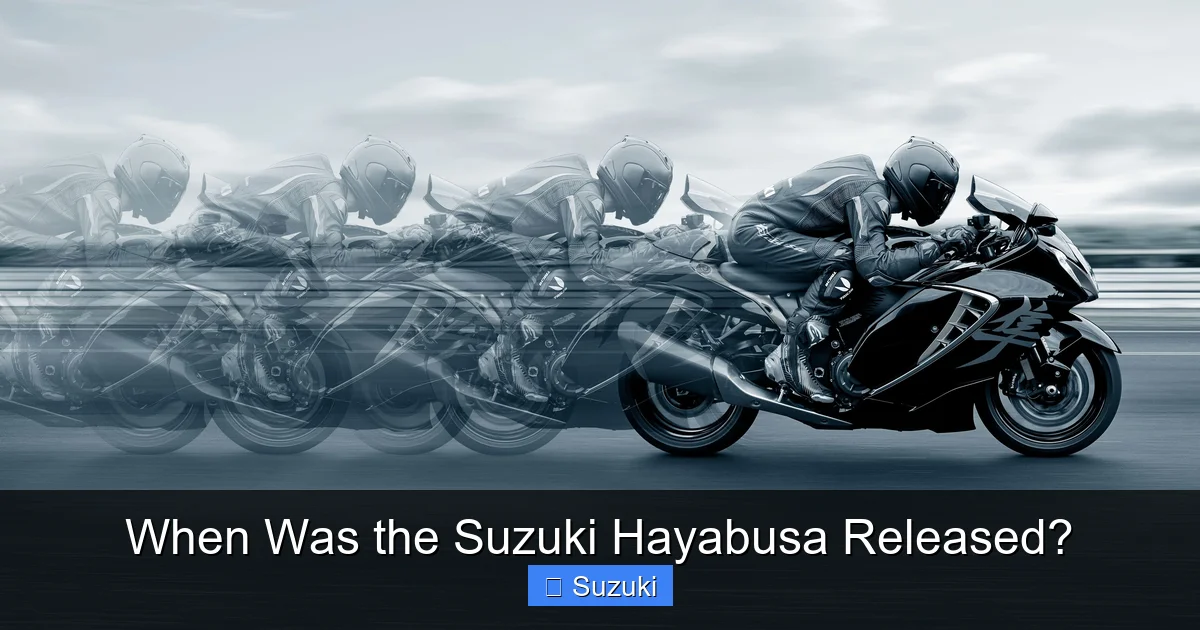
But the Hayabusa wasn’t gone for long. In 2021, Suzuki surprised fans with a completely redesigned third-generation model. This new Hayabusa was built to meet Euro 5 emissions standards while maintaining its legendary performance.
The engine was updated with new fuel injection, variable valve timing, and a revised exhaust system. Power dropped slightly to around 187 horsepower, but torque remained strong at 112 lb-ft. The bike was still incredibly fast, with a top speed of 186 mph (electronically limited).
The new Hayabusa featured a host of modern electronics. It came with a 6-axis IMU (inertial measurement unit), cornering ABS, traction control, launch control, and multiple riding modes. The instrument cluster was a full-color TFT display with smartphone connectivity via Suzuki’s Rideology app.
The design was updated with a more aerodynamic fairing, LED lighting, and a sleeker profile. It looked modern but still paid homage to the original Hayabusa’s iconic shape.
The third-gen Hayabusa also improved comfort and ergonomics. The seat was redesigned for better support, and the riding position was slightly more relaxed. It was still a sportbike, but it was more usable for everyday riding.
Cultural Impact and Pop Culture Fame
The Suzuki Hayabusa isn’t just a motorcycle—it’s a cultural icon. Over the years, it has appeared in movies, video games, music videos, and even art. Its name is synonymous with speed, power, and rebellion.
Movies and TV
The Hayabusa has made appearances in several films and TV shows. One of its most famous roles was in the 2005 movie “The Island,” where it was ridden by Scarlett Johansson. The bike’s sleek design and high speed made it a perfect fit for futuristic scenes.
It has also appeared in TV shows like “Top Gear,” where Jeremy Clarkson famously praised its speed and handling. The Hayabusa has become a favorite among motorcycle enthusiasts and celebrities alike.
Video Games
The Hayabusa is a staple in motorcycle racing games. It appears in titles like “Gran Turismo,” “Need for Speed,” and “Ride.” Gamers love its speed and handling, and it’s often one of the first bikes unlocked in racing games.
Music and Art
The Hayabusa has inspired musicians and artists. It’s been featured in music videos by artists like Jay-Z and Kanye West, often symbolizing wealth, power, and freedom. Custom builders have also created wild versions of the Hayabusa, from stretched choppers to turbocharged monsters.
Owning and Riding the Hayabusa: What to Expect
If you’re thinking about buying a Suzuki Hayabusa, there are a few things you should know. This isn’t just any motorcycle—it’s a high-performance machine that demands respect.
Performance and Handling
The Hayabusa is built for speed, but it’s also surprisingly stable. The long wheelbase and low center of gravity make it feel planted at high speeds. The suspension is firm but compliant, absorbing bumps without losing composure.
Acceleration is brutal. The engine delivers power smoothly across the rev range, with a strong pull from low RPMs. The six-speed transmission is precise, and the slipper clutch helps prevent rear-wheel hop during downshifts.
Comfort and Ergonomics
Despite its sporty nature, the Hayabusa is comfortable for long rides. The seat is wide and supportive, and the riding position is upright enough to reduce fatigue. The wind protection is excellent, with a large fairing that deflects wind away from the rider.
The third-gen model improved comfort even further with a redesigned seat and better ergonomics. It’s still a sportbike, but it’s more usable for touring than you might expect.
Maintenance and Reliability
The Hayabusa is known for its reliability. The engine is robust and built to last, with many owners reporting over 100,000 miles without major issues. Regular maintenance is key—oil changes, valve adjustments, and chain care are essential.
Parts are widely available, and there’s a strong aftermarket for performance upgrades. Whether you want to boost power, improve handling, or customize the look, there are plenty of options.
Insurance and Cost
Insurance for a Hayabusa can be expensive, especially for younger riders. Its high performance and top speed make it a high-risk vehicle in the eyes of insurers. Expect to pay more than for a standard motorcycle.
The cost of a new Hayabusa starts around $18,000, while used models can be found for $8,000 to $15,000 depending on year and condition. It’s a significant investment, but for many, it’s worth it.
The Legacy of the Suzuki Hayabusa
More than two decades after its release, the Suzuki Hayabusa remains one of the most iconic motorcycles ever made. It’s not just a bike—it’s a symbol of what’s possible when engineering, design, and passion come together.
The Hayabusa changed the game. It pushed the limits of speed, challenged regulations, and inspired a generation of riders. It proved that a motorcycle could be both incredibly fast and surprisingly practical.
Even today, the Hayabusa continues to evolve. The third-generation model shows that Suzuki is committed to keeping the legend alive. With modern electronics, improved efficiency, and timeless design, it’s a bike that honors its past while embracing the future.
Whether you’re a speed junkie, a touring enthusiast, or just a fan of great design, the Hayabusa has something to offer. It’s more than a motorcycle—it’s a legend.
Frequently Asked Questions
When was the Suzuki Hayabusa first released?
The Suzuki Hayabusa was first released in 1999. It made its debut at the 1998 Intermot show and became available to the public the following year.
What does “Hayabusa” mean?
“Hayabusa” is Japanese for “peregrine falcon,” the fastest bird in the world. The name reflects the bike’s incredible speed and agility.
How fast is the Suzuki Hayabusa?
The original Hayabusa had a top speed of 194 mph (312 km/h). Modern models are electronically limited to 186 mph (300 km/h) due to industry agreements.
Is the Hayabusa still in production?
Yes, the Hayabusa is still in production. The third-generation model was released in 2021 and meets current emissions standards.
What engine does the Hayabusa have?
The Hayabusa is powered by a 1299cc inline-four engine. It produces around 187–197 horsepower, depending on the generation.
Is the Hayabusa good for long-distance riding?
Yes, the Hayabusa is comfortable for long rides. Its upright position, wind protection, and smooth power delivery make it a great sport-touring bike.
