
When the Suzuki Hayabusa Was Released

The Suzuki Hayabusa was officially released in 1999, quickly becoming the world’s fastest production motorcycle. Known for its aerodynamic design and powerful engine, it redefined speed limits and set new standards in the sportbike world.
Key Takeaways
- Release Year: The Suzuki Hayabusa was first launched in 1999, marking a new era in high-speed motorcycles.
- Top Speed: It quickly earned the title of the world’s fastest production bike with a top speed of over 190 mph.
- Engine Power: Powered by a 1340cc inline-four engine, it delivered over 175 horsepower and impressive torque.
- Aerodynamic Design: Its sleek, wind-tunnel-tested body reduced drag and improved high-speed stability.
- Cultural Impact: The Hayabusa became a pop culture icon, appearing in movies, video games, and music videos.
- Evolution Over Time: Multiple generations have been released, with updates in electronics, styling, and performance.
- Legacy: Even decades later, the Hayabusa remains a benchmark for speed, engineering, and rider admiration.
📑 Table of Contents
- When the Suzuki Hayabusa Was Released: A Game-Changer in Motorcycle History
- The Birth of a Legend: Origins and Development
- The 1999 Launch: Making History
- Generations of the Hayabusa: Evolution Over Time
- Cultural Impact and Legacy
- Why the Hayabusa Still Matters
- Conclusion: The Enduring Legacy of the Hayabusa
When the Suzuki Hayabusa Was Released: A Game-Changer in Motorcycle History
Imagine a motorcycle so fast, so sleek, and so powerful that it instantly became the stuff of legend. That motorcycle is the Suzuki Hayabusa. When the Suzuki Hayabusa was released in 1999, it didn’t just enter the market—it shattered expectations. At a time when sportbikes were already pushing the limits of speed, Suzuki took things to a whole new level. The Hayabusa wasn’t just another fast bike; it was a statement. A declaration that engineering, design, and performance could come together in perfect harmony to create something extraordinary.
The name “Hayabusa” itself means “peregrine falcon” in Japanese—a bird known for its incredible speed and precision in flight. It was a fitting name for a machine designed to dominate the highways. From the moment it hit the streets, riders and critics alike were stunned. This wasn’t just a motorcycle built for speed; it was built for control, comfort, and confidence at triple-digit speeds. The Hayabusa quickly became a symbol of automotive ambition, blending raw power with surprising practicality.
The Birth of a Legend: Origins and Development
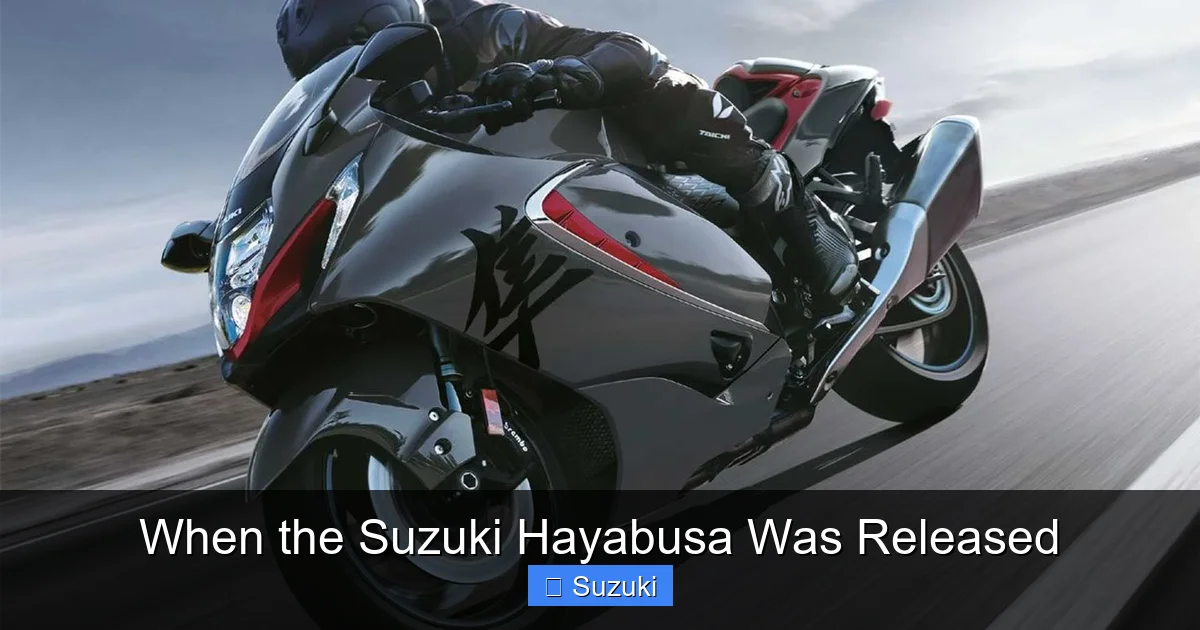
Visual guide about When the Suzuki Hayabusa Was Released
Image source: cdn.motor1.com
To understand why the Suzuki Hayabusa was such a big deal when it was released, we need to look back at the late 1990s. The motorcycle world was in a speed race. Honda had the CBR900RR FireBlade, Kawasaki had the ZX-9R, and Yamaha had the YZF-R1. Each of these bikes was fast, agile, and cutting-edge. But Suzuki wanted more. They wanted to build the fastest production motorcycle ever made.
The project began in the mid-1990s under the leadership of Suzuki’s engineering team. Their goal was clear: create a bike that could exceed 300 km/h (about 186 mph) while still being rideable on public roads. That meant balancing speed with stability, aerodynamics with comfort, and power with control. It wasn’t enough to just make it fast—it had to be safe, reliable, and usable.
The Engineering Breakthrough
The heart of the Hayabusa was its 1340cc inline-four engine, derived from the Suzuki GSX-R1100 but heavily modified for higher performance. This engine produced around 175 horsepower and 100 lb-ft of torque—numbers that were unheard of for a production bike at the time. The engine was liquid-cooled, fuel-injected, and featured a dual overhead camshaft (DOHC) design. It was built to rev high and deliver power smoothly across the entire RPM range.
But power alone wasn’t enough. Suzuki engineers knew that at speeds over 180 mph, aerodynamics become just as important as horsepower. So they took the Hayabusa to the wind tunnel. The result was a body design that minimized drag while maximizing downforce. The iconic front fairing, with its dual headlights and smooth curves, wasn’t just for looks—it was functional. It helped the bike cut through the air like a knife, reducing turbulence and improving high-speed stability.
Design Philosophy: Form Meets Function
The Hayabusa’s design was a departure from the sharp, angular styling of other sportbikes. Instead, it featured smooth, flowing lines that gave it a futuristic look. The bike was long and low, with a wheelbase of 60.4 inches, which contributed to its excellent high-speed handling. The seat was relatively comfortable for a sportbike, and the riding position was more relaxed than on race replicas like the R1 or FireBlade.
Suzuki also paid attention to细节 (details). The exhaust system was carefully tuned to reduce backpressure and improve performance. The suspension was fully adjustable, allowing riders to fine-tune the bike for different conditions. Even the instrumentation was advanced for its time, with a digital speedometer, analog tachometer, and a comprehensive LCD display.
The 1999 Launch: Making History
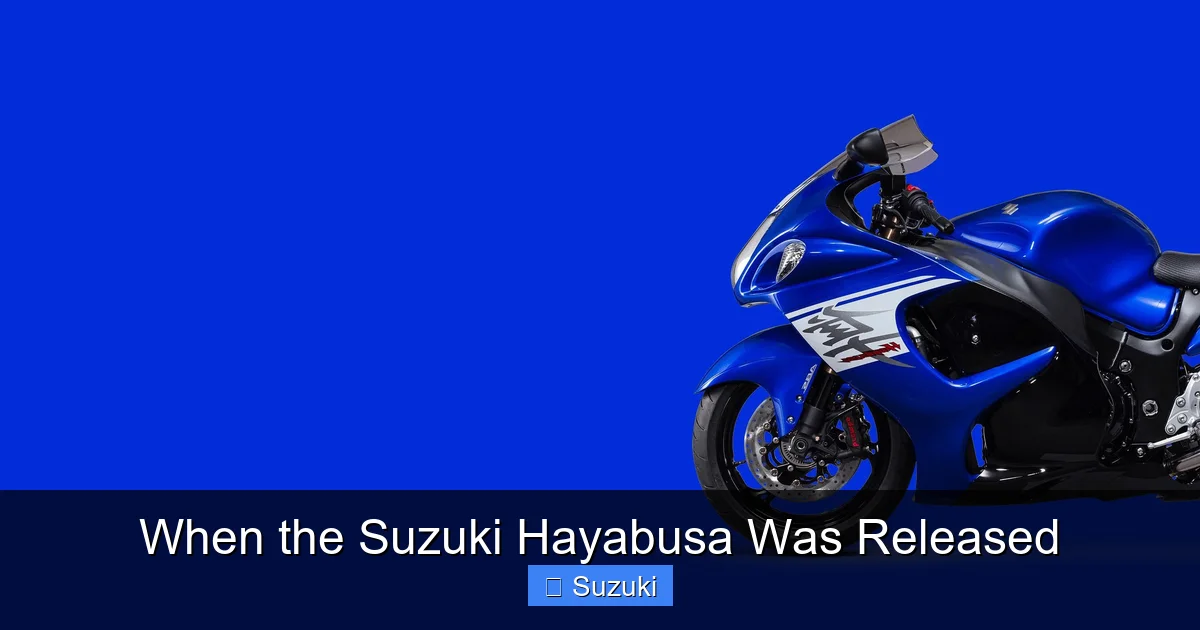
Visual guide about When the Suzuki Hayabusa Was Released
Image source: hdwallpapers.in
When the Suzuki Hayabusa was officially released in 1999, it made headlines around the world. At the Tokyo Motor Show, the bike was unveiled to gasps and applause. Journalists and riders alike were amazed by its specs. With a claimed top speed of 194 mph (312 km/h), it immediately became the fastest production motorcycle in the world, surpassing the Honda CBR1100XX Super Blackbird, which had held the title just months earlier.
The Hayabusa wasn’t just fast—it was also surprisingly practical. It had a large fuel tank (5.5 gallons), which gave it a range of over 200 miles at highway speeds. The seat was wide and well-padded, making long rides more comfortable than on most sportbikes. And despite its size, it handled well in corners, thanks to its balanced chassis and advanced suspension.
First Impressions and Reviews
Early reviews were overwhelmingly positive. Motorcycle magazines praised the Hayabusa for its combination of speed, comfort, and usability. One reviewer called it “the ultimate highway cruiser with a race bike’s heart.” Another said, “It’s not just fast—it’s stable, smooth, and surprisingly easy to ride.”
Riders who tested the bike reported that it felt planted at high speeds, with minimal wind buffeting thanks to its aerodynamic design. The engine was smooth and responsive, and the brakes were powerful enough to slow the bike down from 150 mph in a hurry. Even the transmission was praised for its smooth shifting and durability.
The “Gentleman’s Agreement” and Speed Limits
The Hayabusa’s speed didn’t go unnoticed by regulators and other manufacturers. By the early 2000s, there was growing concern about the safety of ultra-fast motorcycles. In 2000, European manufacturers reached an informal agreement—often called the “gentleman’s agreement”—to limit the top speed of production motorcycles to 186 mph (300 km/h). This was done to avoid further regulatory crackdowns and to promote safer riding.
Suzuki complied with the agreement, and later models of the Hayabusa were electronically limited to 186 mph. While this may have disappointed some speed enthusiasts, it didn’t diminish the bike’s reputation. In fact, it helped the Hayabusa gain wider acceptance and sales, especially in Europe.
Generations of the Hayabusa: Evolution Over Time
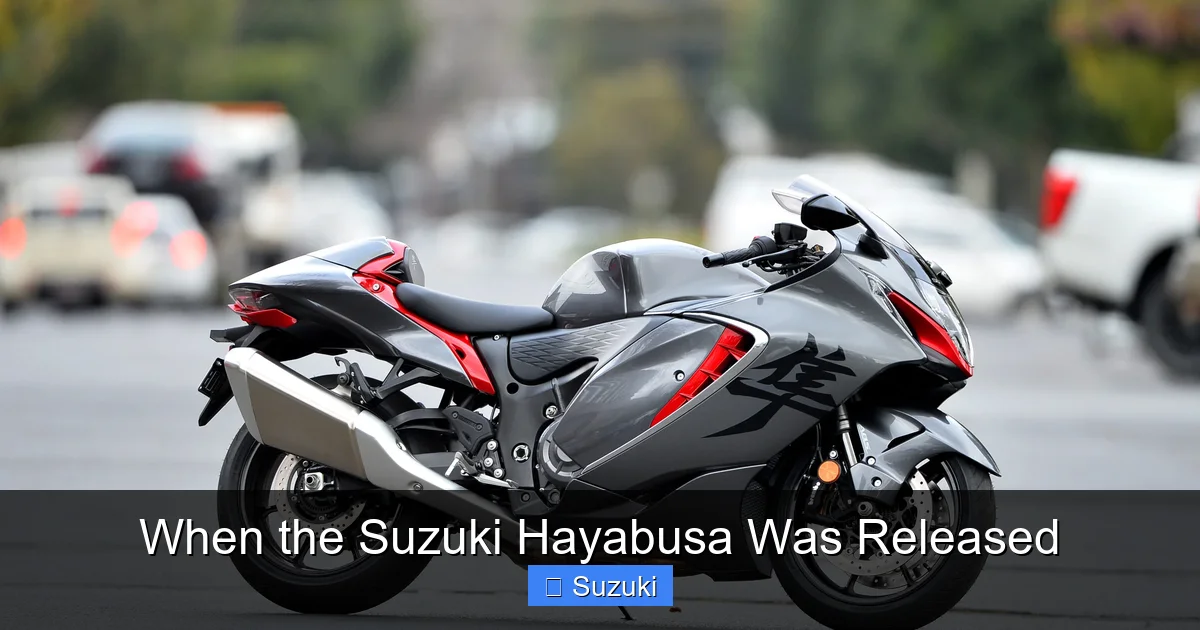
Visual guide about When the Suzuki Hayabusa Was Released
Image source: suzukimotorcycles.com.au
Since its release in 1999, the Suzuki Hayabusa has gone through several updates and redesigns. Each generation has brought improvements in performance, technology, and styling, keeping the bike relevant in a rapidly evolving market.
First Generation (1999–2007)
The original Hayabusa, known as the GSX1300R, set the standard for high-speed motorcycles. It featured the 1340cc engine, a steel frame, and basic electronics. While it lacked modern features like traction control or ride modes, it was incredibly reliable and powerful. Many riders still consider this generation the purest form of the Hayabusa—raw, unfiltered, and thrilling.
Second Generation (2008–2020)
In 2008, Suzuki introduced the second-generation Hayabusa. This version featured a completely redesigned body with sharper lines and a more aggressive stance. The engine was updated with dual fuel injectors per cylinder, improving throttle response and fuel efficiency. The frame was lighter and stiffer, and the suspension was upgraded with better components.
One of the biggest changes was the addition of advanced electronics. The second-gen Hayabusa came with Suzuki’s Dual Throttle Valve (DTV) system, which improved low-end torque and smoothness. It also featured a more sophisticated ECU and improved fuel mapping. While it was still mechanically limited to 186 mph, the bike felt more refined and responsive.
Third Generation (2021–Present)
After a brief hiatus, Suzuki revived the Hayabusa in 2021 with a third-generation model. This version is a complete overhaul, designed to meet modern emissions standards while retaining the spirit of the original. The engine is now Euro 5 compliant, with updated fuel injection and exhaust systems. Power is slightly reduced—around 170 horsepower—but torque remains strong.
The new Hayabusa features a host of modern technology, including:
– Six-axis IMU (Inertial Measurement Unit) for advanced traction control and cornering ABS
– Multiple ride modes (Active, Basic, Comfort)
– Quick shifter for clutchless up and down shifts
– TFT color display with smartphone connectivity
– LED lighting throughout
Despite these changes, the third-gen Hayabusa still looks and feels like a Hayabusa. The iconic shape is preserved, and the bike still delivers that unmistakable sense of power and presence.
Cultural Impact and Legacy
The Suzuki Hayabusa isn’t just a motorcycle—it’s a cultural phenomenon. When it was released, it became an instant icon. It appeared in movies like “The Matrix Reloaded,” where it was ridden by the character Persephone. It’s been featured in video games like “Gran Turismo” and “Need for Speed.” Even musicians have referenced it in songs, celebrating its speed and style.
A Symbol of Speed and Freedom
For many riders, the Hayabusa represents the ultimate expression of freedom. It’s a bike that lets you feel the wind, hear the engine, and experience the road in a way few other machines can. It’s not just about going fast—it’s about the thrill, the control, and the confidence that comes with riding something truly special.
The Hayabusa has also inspired a passionate community of owners and enthusiasts. There are clubs, forums, and events dedicated to the bike. Custom builders have created wild versions with turbochargers, stretched frames, and wild paint jobs. Some have even broken land speed records on modified Hayabusas.
Influence on the Motorcycle Industry
The Hayabusa’s release forced other manufacturers to step up their game. It raised the bar for what a production motorcycle could achieve. In response, companies like Kawasaki, Honda, and BMW developed faster, more advanced sportbikes. The Hayabusa also influenced the design of touring and sport-touring motorcycles, proving that speed and comfort could coexist.
Even today, the Hayabusa remains a benchmark. When new sportbikes are released, they’re often compared to the Hayabusa—not just for speed, but for overall performance, build quality, and rider experience.
Why the Hayabusa Still Matters
More than two decades after it was first released, the Suzuki Hayabusa continues to captivate riders around the world. It’s not just a relic of the past—it’s a living legend. Whether you’re a speed junkie, a touring rider, or just someone who appreciates great engineering, the Hayabusa has something to offer.
Performance That Stands the Test of Time
Even by today’s standards, the Hayabusa is an impressive machine. Its engine delivers smooth, linear power that’s easy to manage, even for less experienced riders. The chassis is stable and predictable, making it confidence-inspiring at high speeds. And with modern electronics, the latest version is safer and more capable than ever.
A Bike for Every Rider
While the Hayabusa is often associated with speed, it’s also a surprisingly versatile motorcycle. It’s comfortable enough for long-distance touring, with a relaxed riding position and plenty of storage options (with aftermarket luggage). It’s also great for weekend canyon carving, thanks to its responsive handling and strong brakes.
For those who want pure speed, the Hayabusa still delivers. Even with the electronic limiter, it can reach 186 mph—faster than most cars on the road. And with a few modifications, some owners have pushed their bikes well beyond that.
Tips for New Hayabusa Owners
If you’re thinking about buying a Hayabusa, here are a few tips:
– Start with a used first or second-gen model if you’re on a budget. They’re reliable and still incredibly fast.
– Invest in good tires. The Hayabusa’s power demands high-quality rubber for grip and stability.
– Consider upgrading the suspension if you plan to ride aggressively. Stock suspension is good, but aftermarket options can improve handling.
– Don’t ignore maintenance. Regular oil changes, valve adjustments, and chain care are essential for longevity.
– Ride responsibly. The Hayabusa is fast, but it’s not a toy. Respect the power and always wear proper gear.
Conclusion: The Enduring Legacy of the Hayabusa
When the Suzuki Hayabusa was released in 1999, it didn’t just break speed records—it broke the mold. It showed the world that a motorcycle could be fast, comfortable, and practical all at once. It challenged conventions, inspired innovation, and became a symbol of what’s possible when engineering and passion come together.
Today, the Hayabusa is more than just a motorcycle. It’s a legend. A benchmark. A dream machine for riders around the globe. Whether you’re chasing speed, exploring the open road, or simply admiring its timeless design, the Hayabusa delivers an experience like no other.
As Suzuki continues to evolve the Hayabusa for the modern era, one thing remains constant: its spirit. The spirit of speed. The spirit of freedom. The spirit of the peregrine falcon—soaring above the rest.
Frequently Asked Questions
When was the Suzuki Hayabusa first released?
The Suzuki Hayabusa was officially released in 1999. It quickly became the world’s fastest production motorcycle, setting a new standard for speed and performance.
What does “Hayabusa” mean?
“Hayabusa” is Japanese for “peregrine falcon,” a bird known for its incredible speed and precision. The name reflects the motorcycle’s high-speed capabilities and agile nature.
How fast is the Suzuki Hayabusa?
The original Hayabusa had a top speed of over 194 mph (312 km/h). Later models are electronically limited to 186 mph (300 km/h) due to a voluntary industry agreement.
What engine does the Hayabusa have?
The Hayabusa is powered by a 1340cc inline-four engine. It produces around 170–175 horsepower and over 100 lb-ft of torque, depending on the generation.
Is the Hayabusa comfortable for long rides?
Yes, the Hayabusa is known for its surprisingly comfortable riding position and large fuel tank, making it suitable for long-distance touring despite its sportbike roots.
Has the Hayabusa been updated since 1999?
Yes, the Hayabusa has gone through three major generations. The latest model, released in 2021, features modern electronics, improved emissions compliance, and updated styling while retaining the classic Hayabusa design.
