When Should a Toyota Tacoma Timing Chain Be Replaced?

Contents
- 1 Key Takeaways
- 2 📑 Table of Contents
- 3 Introduction: The Silent Heartbeat of Your Tacoma’s Engine
- 4 How a Timing Chain Works (And Why It’s Different from a Belt)
- 5 The Tacoma’s Timeline: Which Years Are Most At Risk?
- 6 Symptoms of a Failing Timing Chain: Don’t Ignore the Warnings
- 7 The Replacement Interval: There Is No “Schedule”
- 8 The “Why”: What Causes a Tacoma Timing Chain to Fail?
- 9 The Replacement Process and Cost: What to Expect
- 10 Proactive Maintenance: Your Best Defense
- 11 Conclusion: Knowledge is Power (and Engine Longevity)
- 12 Frequently Asked Questions

Tool Roll Bag

Torque Wrench Set

Engine Oil Additive

Car Scratch Remover
The Toyota Tacoma timing chain is designed to last the life of the engine under normal conditions, but it’s not indestructible. High mileage, poor maintenance, and specific model years can lead to wear and potential failure. Recognizing early symptoms like rattles or check engine lights is critical to prevent catastrophic engine damage. While no strict replacement schedule exists, proactive inspection around 150,000 miles is wise for high-mileage or older Tacomas.
Key Takeaways
- Designed for Longevity: Unlike timing belts, the Tacoma’s timing chain is meant to last the engine’s lifetime with proper oil maintenance.
- No Fixed Mileage Interval: Toyota does not list a scheduled replacement; failure is often due to wear from mileage, maintenance neglect, or design flaws in specific years.
- Listen for Symptoms: A rhythmic rattling (especially on cold start), poor performance, or a check engine light with codes P0010-P0017 are major red flags.
- High-Mileage Risk: Tacomas with over 150,000 miles, particularly 2005-2015 models, are the most common candidates for chain and tensioner inspection.
- Neglect is the Main Killer: Infrequent oil changes, low oil levels, and poor-quality oil accelerate chain stretch and tensioner wear dramatically.
- Costly If It Fails: A timing chain failure on an interference engine (like most Tacomas) results in bent valves and massive engine damage, costing thousands.
- Prevention is Key: Regular oil changes with the correct oil, using OEM filters, and addressing rattles immediately are the best defenses against a failed chain.
📑 Table of Contents
- Introduction: The Silent Heartbeat of Your Tacoma’s Engine
- How a Timing Chain Works (And Why It’s Different from a Belt)
- The Tacoma’s Timeline: Which Years Are Most At Risk?
- Symptoms of a Failing Timing Chain: Don’t Ignore the Warnings
- The Replacement Interval: There Is No “Schedule”
- The “Why”: What Causes a Tacoma Timing Chain to Fail?
- The Replacement Process and Cost: What to Expect
- Proactive Maintenance: Your Best Defense
- Conclusion: Knowledge is Power (and Engine Longevity)
Introduction: The Silent Heartbeat of Your Tacoma’s Engine
Deep inside your Toyota Tacoma’s rugged engine, a metal chain is quietly orchestrating one of the most critical ballet performances in all of automotive engineering. This is the timing chain, the unsung hero that synchronizes the dance between the crankshaft and camshafts. Get it wrong, and your engine turns into a pile of expensive scrap metal. For years, Tacoma owners have enjoyed a reputation for reliability, and a big part of that story is the timing chain. But “lifetime” doesn’t mean “invincible.” So, when should you actually replace a Toyota Tacoma timing chain? The answer is more nuanced than a simple mileage number. It’s about understanding your specific truck, its history, and listening to the subtle (and not-so-subtle) whispers of wear before they become screams of destruction.
This guide will cut through the myths. We’ll explore the engineering, the real-world failure points, the unmistakable symptoms, and the practical steps every Tacoma owner should take. Whether you have a high-mileage workhorse or a cherished low-mileage gem, knowing the truth about your timing chain is non-negotiable for protecting your investment.
How a Timing Chain Works (And Why It’s Different from a Belt)
The Metal Link vs. The Rubber Ribbon
First, a quick primer. A timing chain is a series of metal links, much like a bicycle chain but far more robust, running inside the engine’s front cover. It’s lubricated by engine oil. A timing belt is a toothed rubber belt with fabric reinforcement, typically requiring replacement every 60,000-100,000 miles. The Tacoma has used a chain since its inception in the 1995 model year (for the 3.4L V6 and later the 2.7L I4 and 3.5L V6). The theoretical advantage is clear: a metal chain shouldn’t stretch, break, or need service like a rubber belt.

Visual guide about When Should a Toyota Tacoma Timing Chain Be Replaced?
Image source: partsgeek.com
The Critical Supporting Cast: Tensioners and Guides
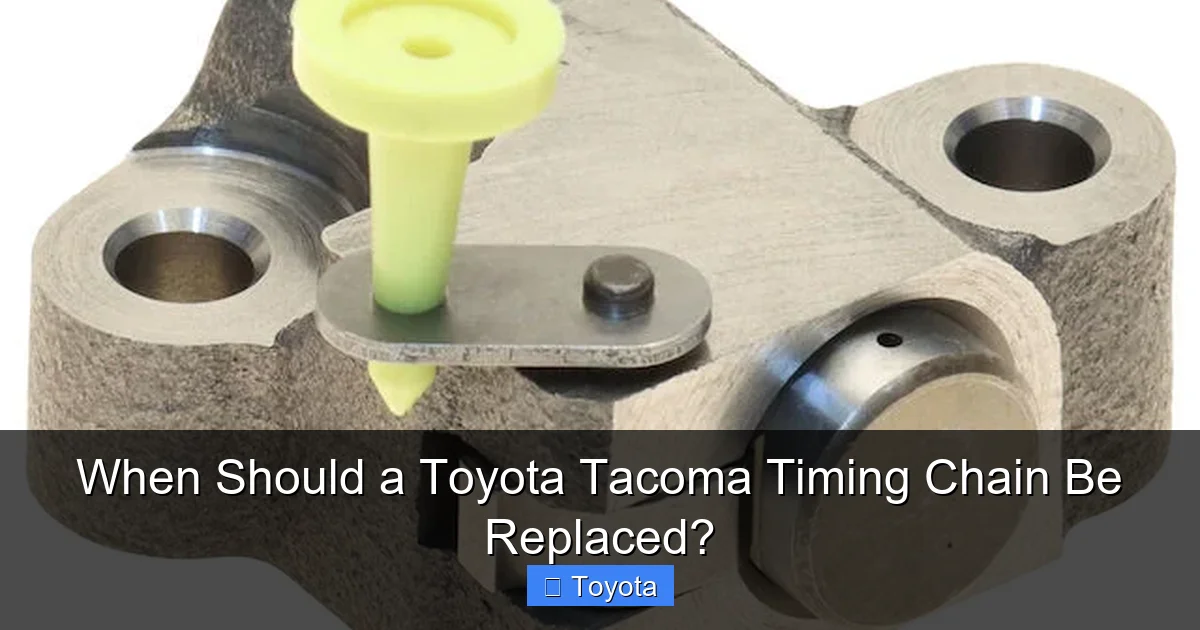
However, a chain doesn’t run on its own. It’s kept taut and guided by plastic or metal rails (guides) and a hydraulic or mechanical tensioner. The tensioner uses oil pressure to keep constant tension on the chain. Here’s the crucial point: these plastic guides and the tensioner’s internal components are often the first parts to fail. A worn guide can break, allowing the chain to slap around. A weak tensioner can’t maintain proper tension, leading to chain “jump” and misalignment. So, when we talk about “timing chain replacement,” we’re almost always talking about replacing the entire assembly: the chain, tensioner(s), and all guides.
The Tacoma’s Timeline: Which Years Are Most At Risk?
While the chain itself is robust, the supporting components have evolved. The most discussed and problematic era for Tacoma timing chain issues centers on the 2005 through 2015 model years, particularly with the 2.7L 4-cylinder and 4.0L V6 engines. Why?
Visual guide about When Should a Toyota Tacoma Timing Chain Be Replaced?
Image source: partsgeek.com
- Early 2.7L (2005-2015): These engines use a single-row chain with a hydraulic tensioner and plastic guides. The plastic guides are known to become brittle with age and heat, leading to cracking and failure. The tensioner’s internal seal can also wear, causing a loss of oil pressure and tension.
- 4.0L V6 (2005-2015): This engine uses a dual-row chain (more robust) but still relies on plastic guides and a hydraulic tensioner. The same aging and wear issues apply, though the dual-row design is slightly more forgiving.
- Post-2016 Refresh: For the 2016+ Tacomas with the 2.7L and 3.5L V6, Toyota revised the design. They moved to a more durable metal guide for the critical path and improved the tensioner design. These later models are significantly less prone to the catastrophic guide failures of the previous generation.
If you own a pre-2016 Tacoma with over 150,000 miles, your risk profile increases substantially. This isn’t to say all these trucks will fail, but the probability of worn components rises exponentially. For comparison, Toyota’s full-size truck, the Tundra, saw a similar evolution. You can learn more about the Tundra’s specific timing chain history here, which mirrors the Tacoma’s transition from early plastic guides to more durable setups.
Symptoms of a Failing Timing Chain: Don’t Ignore the Warnings
A timing chain doesn’t fail without warning. It gives you clues. Heed them immediately.

Visual guide about When Should a Toyota Tacoma Timing Chain Be Replaced?
Image source: partsgeek.com
The Classic “Cold Start Rattle”
This is the most famous symptom. You start your Tacoma on a cold morning, and for 1-3 seconds, you hear a distinct, metallic rattling or slapping noise from the front of the engine (timing chain cover area). It often goes away once oil pressure builds and the tensioner engages. This is the sound of a worn chain slapping against a loose guide or a weak tensioner struggling to take up slack. A healthy chain should be quiet. If your 2008-2015 Tacoma does this, get it inspected now. Don’t wait for it to get louder.
Check Engine Light with Specific Codes
The engine control module (ECM) monitors camshaft and crankshaft position. If the chain has stretched enough to cause timing misalignment (even a few degrees), it will trigger codes like:
- P0010: “A” Camshaft Position Actuator Circuit (Bank 1)
- P0011: “A” Camshaft Position – Timing Over-Advanced or System Performance (Bank 1)
- P0012: “A” Camshaft Position – Timing Over-Retarded (Bank 1)
- P0016: Crankshaft Position – Camshaft Position Correlation (Bank 1)
These codes indicate the ECM has detected that the camshafts are not in the exact position relative to the crankshaft that they should be. This is a direct result of chain stretch or guide failure causing the camshaft timing to “walk.”
Poor Performance and Fuel Economy
Advanced or retarded camshaft timing messes with valve overlap. You might notice:
- Rough idle, especially when cold.
- Noticeable loss of power, particularly at lower RPMs.
- Decreased fuel economy as the engine runs inefficiently.
- Backfiring or popping from the intake.
Metal Shavings in the Oil
This is a dire sign. During an oil change, if the magnetic drain plug (if equipped) or the oil itself shows excessive fine metal particles, it could mean the chain is wearing excessively. Combined with other symptoms, this is a major red flag.
The Replacement Interval: There Is No “Schedule”
Let’s be crystal clear: Toyota does not publish a recommended replacement interval for the timing chain on the Tacoma. In their official maintenance guide, it’s considered a “lifetime” part. This is a common point of confusion. “Lifetime” in engineering terms often means “the expected life of the engine under ideal conditions.” In the real world, with heat, friction, and variable oil quality, components wear out.
So, when should you consider it? Based on thousands of real-world failure reports and mechanic experiences, here is a practical, risk-based guideline:
- For 2005-2015 Tacomas (2.7L & 4.0L): Proactive inspection is mandatory at 100,000-120,000 miles. If you have the original chain/tensioner/guides at 150,000+ miles, you are on borrowed time. Budget for replacement. Many mechanics will strongly recommend replacing the entire assembly as a preventive measure at this mileage, even if no symptoms are present.
- For 2016+ Tacomas: The risk is significantly lower due to design improvements. However, nothing is forever. A inspection at 200,000 miles is a prudent check, especially if you notice any odd noises or have a history of delayed oil changes.
- Regardless of Mileage: If you experience any of the symptoms in the previous section, stop driving the vehicle and have it diagnosed immediately. Driving with a compromised timing chain is playing Russian roulette with your engine.
Think of it like this: you wouldn’t wait for your timing belt to break before replacing it at its 90,000-mile interval. With a chain, the interval is dictated by wear and tear, not a preset number. Your maintenance habits are the single biggest factor determining that interval.
The “Why”: What Causes a Tacoma Timing Chain to Fail?
Understanding the causes helps you prevent the problem.
Poor Oil Maintenance – The #1 Culprit
This cannot be overstated. The timing chain is a lubricated system. It bathes in engine oil.
- Infrequent Oil Changes: Old, dirty oil loses its lubricity and becomes abrasive. It also allows sludge and varnish to build up, which can clog the tiny oil passages that feed the tensioner and chain.
- Low Oil Level: If the oil level is chronically low, the oil pump may not be able to supply enough pressure to the hydraulic tensioner, causing it to fail to maintain tension.
- Wrong Oil: Using oil with the wrong viscosity (too thin) can reduce the oil film strength on the chain rollers. Always use the oil grade specified in your owner’s manual, typically 0W-20 or 5W-30 for newer Tacomas.
Design of Plastic Guides
Plastic is lighter and quieter than metal, but it degrades. Heat cycles, oil exposure, and simple age cause the plastic guides to become brittle. They can crack, warp, or even break into pieces. A broken guide allows the chain to whip violently, leading to rapid failure.
High Load and Towing
While Tacomas are built for work, constant heavy towing or loading puts extra stress on the entire engine. This includes the timing chain system. It’s not that towing will instantly break it, but combined with marginal oil maintenance, it accelerates wear.
Manufacturing Variability
In any mass-produced part, there is a tolerance range. Some tensioners or guides from a bad production batch may fail prematurely. This is less common now but was a factor in some of the early 2000s Tacoma complaints.
The Replacement Process and Cost: What to Expect
If your Tacoma needs a timing chain assembly replacement, it is a major, labor-intensive service. It is not a beginner DIY job unless you are a very experienced mechanic with the proper tools.
What Gets Replaced?
A proper job involves:
- Timing Chain(s): The main chain(s). Some engines have a secondary chain.
- Tensioner(s): Hydraulic or mechanical.
- Chain Guides: All plastic and metal guides along the chain’s path.
- Chain Damper: A part that quiets chain vibration.
- Gaskets and Seals: The timing cover gasket, and often the oil pump seal or front crank seal.
You should never just replace the chain alone. The guides and tensioner are almost certainly worn if the chain is stretched. Replacing only the chain is a recipe for a repeat failure in 20,000 miles.
Estimated Cost Breakdown
Cost varies wildly by region, shop type (dealer vs. independent), and engine type (4-cylinder is generally cheaper than V6).
- Parts: A complete OEM or high-quality aftermarket timing chain kit (chain, tensioner, guides) typically runs $400 – $900.
- Labor: This is the big one. The engine must be partially disassembled. Labor times range from 8 to 12+ hours. At a shop rate of $120-$180/hour, labor costs are $1,000 – $2,200+.
Total Project Cost: Expect a bill between $1,500 and $3,500+ for a proper, comprehensive replacement at a professional shop. A dealership will be at the higher end. This is why prevention through oil maintenance is so valuable—it avoids a bill that can equal 10-20% of your truck’s value.
Can You DIY It?
Technically, yes, if you have:
- A full set of metric sockets, torque wrenches, and special tools (camshaft locking tools, crankshaft holding tool, tensioner winder).
- A thorough, model-year-specific repair manual (e.g., from Toyota or Chilton/Haynes).
- Mechanical patience and precision. One wrong turn on a bolt can cause immediate engine damage.
For most owners, this is a “pay a professional” job due to the complexity and risk. The cost of a mistake is a destroyed engine.
Proactive Maintenance: Your Best Defense
Since there’s no factory interval, your driving and maintenance habits define your chain’s lifespan.
- Strict Oil Change Discipline: This is your #1 defense. Change the oil and filter every 5,000 miles (or every 6 months) with high-quality oil and a genuine Toyota oil filter. The filter’s quality affects oil flow and pressure. You can learn exactly how to check your oil level and which oil to use in our detailed guide for your Tacoma here and here.
- Never Ignore the Rattle: That cold-start rattle is your truck’s SOS. Get it diagnosed immediately. Early tensioner replacement (which is less labor-intensive than a full chain job) might be possible if caught very early.
- Use the Correct Oil: Stick to the recommended viscosity. Using a “better” or “thicker” oil is not better; it can cause inadequate flow to the tensioner.
- Address Low Oil Pressure Warnings: Any oil pressure warning light must be investigated instantly. Low pressure starves the tensioner.
- Consider a High-Quality Aftermarket Kit for Repairs: If you do need a replacement, some aftermarket manufacturers (like Iwis, Cloyes, or Aisin) offer upgraded kits with metal guides or improved tensioners that may be more durable than the original plastic-guided units.
Conclusion: Knowledge is Power (and Engine Longevity)
The Toyota Tacoma timing chain is a testament to engineering that, when cared for, can indeed last the life of the truck. But it is not a “fit-and-forget” component. Its health is intrinsically tied to the one maintenance item you control completely: engine oil. For owners of the 2005-2015 models, especially those with the 2.7L 4-cylinder, a healthy dose of skepticism and proactive inspection around the 150,000-mile mark is a wise strategy. Listen to your truck. That cold-start rattle is not normal; it’s a diagnostic tool. A check engine light with camshaft/crankshaft codes is a direct message from the computer that the delicate synchronization is off.
Ultimately, the answer to “when should it be replaced?” is this: when inspection shows wear, or when symptoms appear. There is no magic number. By treating your Tacoma to immaculate oil service, you are directly investing in the longevity of its timing chain and, by extension, its entire heart. A $50 oil change every 5,000 miles is the best insurance policy against a $3,000 engine repair. Stay vigilant, stay informed, and your Tacoma will reward you with countless more miles of reliable adventure.
Frequently Asked Questions
Will a Toyota Tacoma timing chain last forever?
In theory, yes, it’s designed as a “lifetime” part. In reality, the plastic guides and hydraulic tensioner can wear out, especially in high-mileage (150k+) or poorly maintained engines. So, it may not literally last the truck’s entire life without issues.
How much does it cost to replace a timing chain on a Tacoma?
A full assembly replacement (chain, tensioner, guides, gaskets) typically costs between $1,500 and $3,500 at a professional shop. The high labor cost is due to the extensive disassembly required to access the chain.
Can I replace the timing chain myself on a Tacoma?
It is an extremely complex job requiring special tools, precision, and a detailed service manual. One mistake in setting the timing can destroy the engine. It is only recommended for expert mechanics with significant experience on this specific engine.
What happens if a Tacoma timing chain breaks while driving?
It causes catastrophic engine damage on these interference engines. The pistons will collide with the open valves, bending them and likely damaging the pistons and cylinder head. This results in a complete engine failure requiring a rebuild or replacement.
Is the 2.7L or 4.0L Tacoma engine more prone to timing chain problems?
Both engines from 2005-2015 have known issues with plastic guide wear. The 2.7L uses a single-row chain and is often cited as having a slightly higher incidence of the cold-start rattle symptom. The 4.0L’s dual-row chain is a bit more robust, but both share the same vulnerable plastic guide design.
What is the difference between a timing chain and a timing belt?
A timing chain is a metal roller chain lubricated by engine oil and designed to last the engine’s life. A timing belt is a rubber toothed belt that requires scheduled replacement (usually every 60k-100k miles) as it can crack, stretch, and break over time. The Tacoma has always used a chain.