
How Many Miles Can a Toyota Camry Go on a Full Tank?

The distance a Toyota Camry can travel on a full tank varies significantly by model year, engine type, and driving conditions. Most modern gasoline Camry models achieve between 400 to 500 miles per fill-up, while hybrid versions can exceed 600 miles. Understanding your specific vehicle’s fuel capacity and MPG, along with smart driving habits, is key to getting the most out of every tank.
One of the most common questions for any car owner, especially for a reliable daily driver like the Toyota Camry, is about fuel range. “How many miles can this car go on a full tank?” It’s a practical question that touches on budgeting, trip planning, and general peace of mind. The answer isn’t a single number because it depends on a combination of your specific Camry’s hardware and how you drive it. This guide will break down everything you need to know, from the size of the gas tank to the real-world factors that shrink or expand your miles-per-tank. We’ll look at different model years, engine types, and give you actionable tips to maximize every drop of fuel.
Think of your Camry’s range as a simple equation: Fuel Tank Capacity (in gallons) x Fuel Efficiency (MPG) = Total Miles. Sounds easy, right? But the “MPG” part is a moving target. The EPA provides estimates, but your personal driving habits, the weather, and even your tires play a huge role. Whether you have a 2018 SE with the 2.5L 4-cylinder or a brand-new 2024 XLE Hybrid, understanding these variables empowers you to drive smarter and avoid that low-fuel anxiety. Let’s dive in and turn that guess into a reliable estimate for your specific vehicle.
Key Takeaways
- Tank Size Matters: The Toyota Camry’s fuel tank capacity ranges from 15.8 to 16 gallons depending on the model year and trim level, directly impacting total range.
- MPG is the Multiplier: Your Camry’s EPA-estimated miles per gallon (MPG) is the critical number. Multiplying MPG by tank capacity gives the theoretical maximum range.
- Real-World Range Varies: Actual miles per tank are heavily influenced by driving style (city vs. highway), weather, vehicle load, and overall maintenance.
- The Gas Light is a Warning, Not a Gauge: When the low fuel light illuminates, you typically have 30-50 miles remaining, but this is an emergency reserve, not for regular use.
- Hybrids Offer Superior Range: Toyota Camry Hybrid models consistently provide the longest range, often over 600 miles, due to exceptional combined MPG ratings.
- Maintenance is Key: Simple upkeep like proper tire inflation, clean air filters, and timely oil changes can noticeably improve fuel efficiency and miles per tank.
- Your Results Will Differ: The best way to know your Camry’s true range is to track your own fuel fill-ups over several tanks under normal driving conditions.
📑 Table of Contents
- Understanding Your Camry’s Fuel Tank Capacity
- Fuel Efficiency: The Other Half of the Equation
- Real-World Factors That Change Your Miles Per Tank
- The Gas Light: Your Emergency Reserve Explained
- Practical Tips to Maximize Your Camry’s Range
- How Does the Camry Compare to Its Competitors?
- Conclusion: Know Your Camry, Maximize Your Miles
Understanding Your Camry’s Fuel Tank Capacity
The first variable in our range equation is the most straightforward: how much fuel your Camry can hold. Toyota has used slightly different tank sizes across the Camry’s recent generations. Knowing your exact capacity is the foundation for any accurate calculation.
Gas Tank Sizes Across Model Years and Trims
For the current generation (2018-present), most gasoline-powered Toyota Camry models are equipped with a 16-gallon fuel tank. This has been a consistent standard for the LE, SE, XLE, and XSE trims with the 2.5L 4-cylinder engine. The sportier TRD trim, which also uses the 2.5L engine, typically has the same 16-gallon capacity.
The V6-powered Camrys (3.5L engine) in the XLE and XSE trims from 2018-2021 also used a 16-gallon tank. However, for the 2022 model year and beyond, Toyota made a subtle change. The V6 models received a slightly smaller 15.8-gallon tank. This minor reduction doesn’t drastically change the overall range because the V6’s lower MPG somewhat offsets the smaller tank.
Now, let’s talk about the range champion: the Camry Hybrid. For the 2018-2023 model years, the Hybrid LE and SE trims used a 14.5-gallon tank, while the Hybrid XLE and XSE used a 13.2-gallon tank. The logic here is that hybrids need less fuel to go much farther due to their superior MPG. For the 2024 model year, Toyota standardized the hybrid tank to a larger 14.5-gallon unit across all hybrid trims, simplifying the calculation.
If you want to confirm your exact tank size, your owner’s manual is the ultimate source. You can also find it listed on a sticker inside the driver’s door jamb or sometimes on the fuel filler door itself. For a quick online reference, you can check detailed resources like our article on how big the gas tank is on a Toyota Camry, which breaks it down by year and trim.
How to Find Your Specific Camry’s Tank Size
If you don’t have the manual handy, here are three foolproof methods:
- Owner’s Manual: The “Capacities and Specifications” section will list “Fuel Tank Capacity” in gallons and liters.
- Driver’s Door Jamb Sticker: Look for a yellow and white sticker. It often lists tire pressure and sometimes vehicle capacity weight, but not always fuel capacity.
- Fuel Filler Door: Some model years have the capacity printed on the inside of the fuel door or on a label nearby.
- Online VIN Decoder: Using your Vehicle Identification Number (VIN) on a site like Toyota’s official owner portal or a trusted automotive database can reveal your exact build specifications, including tank size.
Once you have this number locked in, you’ve completed half the equation. The other half is the ever-important MPG.
Fuel Efficiency: The Other Half of the Equation
Miles Per Gallon is the magic multiplier. A larger tank is useless without efficient use of that fuel. The Camry is renowned for its efficiency, but there’s a significant spread between the base 4-cylinder, the V6, and the Hybrid powertrains. Furthermore, EPA estimates for “combined” driving don’t always match your personal “city” or “highway” reality.

Visual guide about How Many Miles Can a Toyota Camry Go on a Full Tank?
Image source: autozonic.com
MPG Ratings by Engine Type and Model Year
Let’s look at the EPA estimates for the current generation (2018+) as a baseline. Remember, these are optimized lab numbers; real-world results are often 1-3 MPG lower.
2.5L 4-Cylinder Gasoline (Most Common):
- City MPG: 28-29
- Highway MPG: 39-41
- Combined MPG: 32-34
3.5L V6 Gasoline:
- City MPG: 22
- Highway MPG: 32-33
- Combined MPG: 26-27
2.5L Hybrid:
- City MPG: 44-51 (varies by year/trim)
- Highway MPG: 44-47
- Combined MPG: 44-52
Notice the hybrid’s incredible efficiency. That high MPG is what allows it to achieve massive range even with a slightly smaller tank.
Hybrid vs. Gasoline: A Significant Difference
The math clearly shows the hybrid advantage. Let’s do a quick theoretical calculation for a 2023 model:
- Gas 4-Cylinder (16 gal tank, 32 combined MPG): 16 gallons x 32 MPG = 512 miles.
- Hybrid (14.5 gal tank, 47 combined MPG): 14.5 gallons x 47 MPG = 681.5 miles.
That’s a potential difference of nearly 170 miles per fill-up! This is why for long-distance commuters or road-trippers, the Camry Hybrid is often the undisputed range king. If you’re curious about how other Toyota hybrids perform, you might look at the RAV4 Hybrid’s capabilities, but for sedans, the Camry Hybrid is in a class of its own.
Real-World Factors That Change Your Miles Per Tank
Now we get to the part where theory meets reality. The EPA numbers are a great starting point, but your actual “miles to empty” reading on the dashboard (and your real-world experience) is a living, breathing number that changes daily. Here are the biggest factors that will make your range fluctuate.

Visual guide about How Many Miles Can a Toyota Camry Go on a Full Tank?
Image source: motorbiscuit.com
Driving Habits: City vs. Highway
This is the single largest factor. Stop-and-go city driving with frequent acceleration and braking is terrible for fuel economy. Expect your MPG to drop to the low end of the EPA’s city estimate, or even below it. Conversely, steady-state highway cruising at 65-70 mph is where your Camry shines. You can often achieve MPG numbers at or even slightly above the EPA highway estimate.
Practical Example: A driver with a 2022 Camry XE (2.5L, 16 gal tank) might see:
- Pure City Driving: 26 MPG x 16 gal = 416 miles per tank.
- Pure Highway Driving: 42 MPG x 16 gal = 672 miles per tank.
- Mixed Driving (50/50): ~34 MPG x 16 gal = 544 miles per tank.
Your personal commute mix is the most important determinant of your real-world range.
Weather, Terrain, and Vehicle Load
These are the stealth range killers:
- Cold Weather: Engine oil is thicker, the battery works harder, and you use the heater more. MPG can drop 10-20% in freezing temps. Warm-up cycles before driving also burn extra fuel.
- Hot Weather & A/C: The air conditioning compressor puts a significant load on the engine. In extreme heat, expect a 5-15% drop in MPG, especially in city traffic.
- Hilly Terrain: Climbing hills requires massive energy. Your Camry will burn fuel rapidly ascending, and while regenerative braking on the descent helps a little, it doesn’t fully recoup the loss. Mountain driving can slash MPG by 25% or more.
- Extra Weight & Cargo: Every 100 pounds of extra weight in the vehicle can reduce MPG by about 1%. Roof racks, even empty, create aerodynamic drag that hurts highway efficiency.
Maintenance: The Silent Range Killer
A poorly maintained Camry will drink fuel like a thirsty horse. Simple neglect has a direct, negative impact on your miles per tank:
- Under-inflated Tires: This is the #1 cause of poor fuel economy. Low rolling resistance is key. Check your tire pressure monthly. The correct PSI is on the driver’s door jamb sticker, not the tire sidewall.
- Dirty Air Filter: A clogged filter restricts airflow to the engine, forcing it to work harder and burn more fuel. Replace it as recommended in your manual (often every 15,000-30,000 miles).
- Old Spark Plugs: Worn plugs cause inefficient combustion. Replacing them on schedule (typically every 60,000-120,000 miles on modern iridium plugs) ensures optimal fuel burn.
- Improper Oil: Using the wrong viscosity oil (e.g., 5W-30 instead of recommended 0W-16) creates internal engine drag. Always use the oil specified by Toyota.
- Stuck Brake Calipers: If a brake caliper is dragging, it creates constant resistance. You’ll feel it as a pull to one side and see a drastic drop in MPG.
Staying on top of these maintenance items is the single best way to protect your Camry’s designed fuel efficiency and range.
The Gas Light: Your Emergency Reserve Explained
That moment the low fuel warning light (often a yellow gas pump icon) flickers on the dashboard is a universal experience. It sparks the immediate question: “How far can I *really* go?” Understanding this reserve is crucial for safety and planning.
Visual guide about How Many Miles Can a Toyota Camry Go on a Full Tank?
Image source: thecarhow.com
How Many Miles Are Left When the Light Comes On?
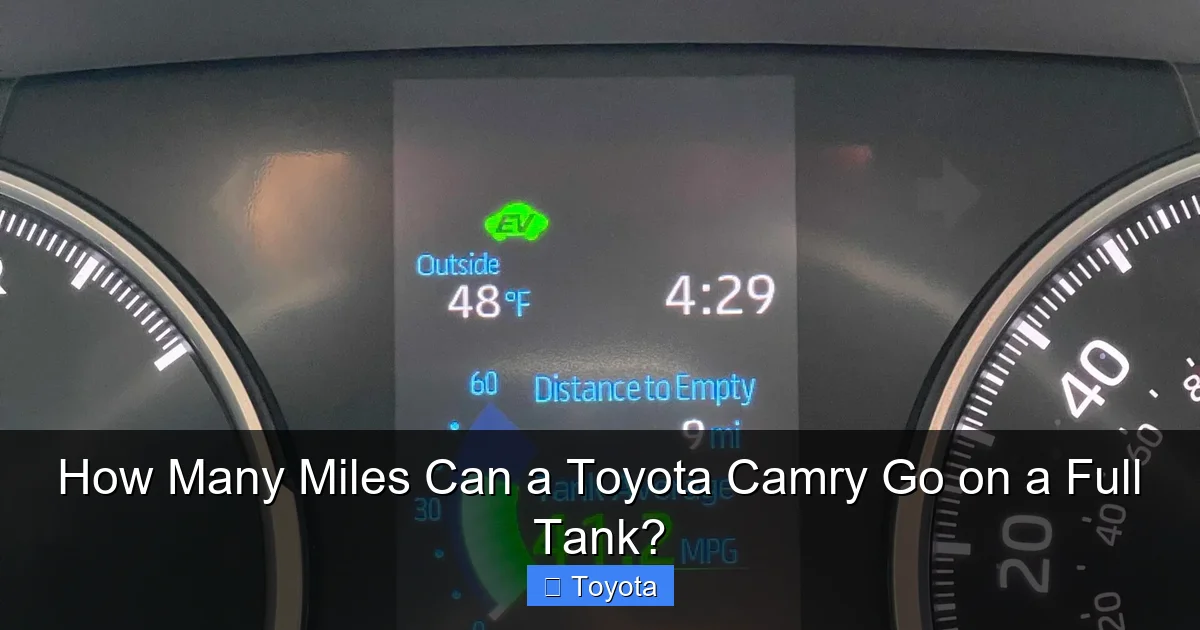
There is no universal number. Toyota does not publish an exact reserve distance for the Camry because it depends on your recent driving conditions. The light is triggered by a float sensor in the tank that drops below a certain level. The general industry consensus and owner reports for the Camry suggest you have approximately 30 to 50 miles remaining after the light illuminates.
However, this is a highly variable estimate. If you’ve been driving on the highway at steady speeds, your reserve might be closer to 50 miles. If you’ve just been battling stop-and-go city traffic, your fuel gauge may be less accurate, and the reserve could be closer to 30 miles. The only way to know for sure is to carefully drive to a gas station the first time the light comes on and note exactly how many gallons you add to fill the tank. Subtract that from your total tank capacity to see your true reserve. For a deep dive into this very topic, we have a dedicated article on how many miles you can drive when the gas light comes on in a Toyota Camry, which compiles owner data and expert advice.
Should You Push Your Luck? The Risks of Running on Empty
Using this reserve regularly is a bad habit with serious consequences:
- Damage to the Fuel Pump: The fuel pump is submerged in fuel, which cools and lubricates it. Running consistently low starves the pump of cooling fluid, leading to premature failure. A fuel pump replacement is an expensive repair.
- Sediment Clogging: Dirt and debris settle at the bottom of the tank. When you run on fumes, you suck this sediment into the fuel system, potentially clogging filters or injectors.
- Stranded Risk: Estimates are just that. A miscalculation, an unexpected detour, or a gas station being out of order can leave you stranded in a dangerous location.
- Catalytic Converter Damage: Running lean (too little fuel) can overheat and damage the catalytic converter, another costly component.
Rule of Thumb: Refuel when your gauge reaches the 1/4 mark. This gives you a comfortable buffer, protects your fuel system, and ensures you always have ample range for unexpected trips.
Practical Tips to Maximize Your Camry’s Range
Now that you understand the variables, let’s focus on what you can control to stretch that full tank as far as possible. These are actionable, proven techniques.
Driving Techniques for Better Fuel Economy
Your right foot is your most powerful tool for saving fuel:
- Drive Smoothly: Avoid jackrabbit starts and hard braking. Accelerate gently and anticipate traffic flow to coast more. This single habit can improve MPG by 15-30% in city driving.
- Use Cruise Control on Highways: Maintaining a constant speed is far more efficient than constant acceleration and deceleration. Set it to the legal speed limit (often 65-70 mph is the sweet spot for efficiency vs. time).
- Observe the “Lead Car” Rule: In traffic, leave a larger gap to the car in front. This gives you more room to coast and brake gently instead of slamming on the pedal.
- Reduce Idling: If you’re stopped for more than 60 seconds (not in traffic), turn the engine off. Modern engines use minimal fuel on start-up.
- Plan Trips: Combine errands into one trip. A warm engine is more efficient than multiple cold starts. Use navigation apps to avoid congested routes, even if they are slightly longer.
Maintenance Checklist for Optimal Efficiency
Stick to a disciplined maintenance schedule:
- Tire Pressure: Check monthly and before long trips. Inflate to the door jamb spec, not the max on the tire sidewall.
- Oil Changes: Use the exact oil grade specified (often 0W-16 for newer models). Don’t overfill.
- Air Filter: Inspect and replace as needed. A visual check is easy—if you can’t see light through it, it’s time.
- Spark Plugs & Wires: Replace at the manufacturer’s interval.
- Wheel Alignment: A misaligned wheels cause tire scrub, increasing rolling resistance. Get it checked annually or after hitting a pothole.
Using Technology to Your Advantage
Your Camry’s computer can help you drive efficiently:
- Eco Mode: This setting (usually a button on the dash or steering wheel) softens throttle response, adjusts A/C operation, and can subtly change shift points in automatics to favor efficiency. Use it for daily commuting.
- Trip Meter A/B: Reset one trip meter at each fill-up. Use it to track your actual MPG (Miles Driven / Gallons Added). This is the best way to monitor your real-world range and see the impact of your driving habits.
- Hybrid-Specific Tips: If you have a hybrid, learn to drive in “EV mode” for short, low-speed trips (under 25 mph, light throttle) to use electric-only power. Brake smoothly to maximize regenerative braking.
How Does the Camry Compare to Its Competitors?
The Toyota Camry’s reputation for reliability and fuel efficiency is well-earned, but how does its actual on-road range stack up against its main rival, the Honda Accord, and the broader midsize sedan segment?
Camry vs. Honda Accord: A Close Race
The Honda Accord is the Camry’s perennial competitor. In terms of raw fuel range, they are incredibly close, with slight advantages shifting between model years and powertrains.
- Gas 4-Cylinder: Both offer similar combined MPG (around 32-33). The Accord’s tank is 15.8 gallons, while the Camry’s is 16 gallons. This gives the Camry a theoretical edge of about 10-15 miles per tank in this direct comparison.
- Hybrid: This is where both excel. The Accord Hybrid offers similar, sometimes slightly higher, combined MPG (up to 44-48) with a 12.7-gallon tank. The Camry Hybrid’s larger 14.5-gallon tank (on most trims) often gives it a decisive real-world range advantage, potentially 50-100 miles more per fill-up than the Accord Hybrid.
For drivers prioritizing maximum distance between gas stations, the current Camry Hybrid’s larger fuel tank combined with stellar MPG gives it a tangible lead over its closest competitor. If you’re also considering SUVs for more space, the range dynamics change entirely, which is a different conversation.
Camry vs. Other Mid-Size Sedans
Against the rest of the field—the Hyundai Sonata, Kia K5, Nissan Altima, and Mazda6—the Camry holds its own very well. The Sonata and K5 offer strong MPG numbers but often have smaller tanks (14.2-15.4 gallons), which can negate their efficiency advantage. The Altima’s 2.5L engine is very efficient, but its 16-gallon tank puts it in the same range ballpark as the Camry. The Mazda6, while a fantastic driver’s car, typically has a smaller tank and slightly lower MPG than the Camry/Accord duo.
The key takeaway is that the Camry, especially in hybrid form, is consistently at or near the top of the class for total fuel range, making it an excellent choice for those who dislike frequent gas station stops.
Conclusion: Know Your Camry, Maximize Your Miles
So, how many miles can a Toyota Camry go on a full tank? For the vast majority of drivers with a modern gasoline model, the realistic answer is 400 to 500 miles under mixed driving. For hybrid owners, that number leaps to 550 to 700+ miles. Your specific number lives somewhere in that spectrum, determined by your exact tank size, your dominant driving environment (city vs. highway), and your commitment to maintenance.
The power is in your hands. By understanding your vehicle’s specifications, adopting efficient driving habits, and keeping your Camry well-maintained, you can consistently hit the upper end of its potential range. Don’t just rely on the dashboard’s “miles to empty” estimate—it’s a helpful guide but not infallible. Instead, track your own fill-ups for a few months. You’ll learn your Camry’s true personality and capabilities, turning that simple question into a confident, data-driven answer that saves you time, money, and stress on the road.
Frequently Asked Questions
What is the exact range of a 2023 Toyota Camry?
A 2023 Camry with the 2.5L 4-cylinder (16-gallon tank, ~32 MPG combined) has a theoretical range of about 512 miles. Real-world mixed driving typically yields 450-500 miles. The 2023 Hybrid (14.5-gallon tank, ~47 MPG combined) can achieve 600-680 miles per tank.
Does the Camry Hybrid really go over 600 miles on a tank?
Yes, absolutely. With its combined EPA rating often exceeding 47 MPG and a 14.5-gallon tank, the Camry Hybrid’s math works out to over 680 miles. In real-world highway driving, many owners report 650-700 miles, making it one of the longest-range sedans available.
How much does using the A/C affect my Camry’s range?
Using the air conditioning can reduce fuel economy by 5-15%, depending on outside temperature and driving conditions. The impact is most noticeable in city traffic. On a hot highway, you might see a 5-8% drop. This translates to losing roughly 20-50 miles from your total range per tank.
Is the 30-50 mile gas light reserve accurate for all Camrys?
It’s a reliable general estimate, but it’s not a fixed number. The reserve distance depends heavily on your recent driving. After steady highway driving, you might have closer to 50 miles. After aggressive city driving, it could be as low as 30 miles. The only way to know your car’s exact reserve is to test it carefully once by driving to a station when the light first comes on.
How does the Camry’s range compare to a Toyota Sienna minivan?
This is an interesting comparison. A Sienna minivan (which is now hybrid-only) has a larger 18-gallon tank but a lower MPG (around 36 combined) than the Camry Hybrid. Its math works out to about 648 miles per tank, which is similar to the Camry Hybrid. However, the Sienna’s efficiency drops more significantly with weight and city driving due to its size and mass.
Will my Camry’s fuel range decrease as it ages?
Yes, potentially. As an engine accumulates miles, components like fuel injectors, oxygen sensors, and the catalytic converter can become less efficient. Poorly maintained seals and gaskets can also cause minor vacuum leaks. This can lead to a gradual 5-15% drop in MPG over 150,000+ miles compared to when it was new. Rigorous maintenance is the best defense against this age-related efficiency loss.