

What Year Hyundai Elantra Should You Avoid?

Contents
- 1 Key Takeaways
- 2 📑 Table of Contents
- 3 The Generational Breakdown: Mapping the Problem Years
- 4 The Theta II Engine Debacle: A Class-Action Nightmare
- 5 Transmission Troubles: The Dual-Clutch Catastrophe
- 6 The 2017-2020 “New” Elantra: Better But Not Perfect
- 7 The Safest Bets: Which Elantra Years Are Actually Good?
- 8 Your Action Plan: How to Buy a Used Elantra Without Regret
- 9 Comparing the Competition: Context Matters
- 10 Frequently Asked Questions


Choosing the wrong Hyundai Elantra model year can lead to costly repairs and frustrating ownership. Based on extensive data, the 2011-2016 models are the most problematic due to widespread engine and transmission failures. Always verify a vehicle’s history and consider newer, more reliable years for peace of mind.
So, you’re in the market for a used Hyundai Elantra. Smart move. For years, the Elantra has been a top contender in the compact sedan segment, offering a lot of car for the money with stylish looks and a strong warranty when new. But here’s the critical question that separates a savvy buyer from someone stuck with a money pit: What year Hyundai Elantra should you avoid? The answer isn’t as simple as “avoid this one year.” It’s about understanding generations, specific faulty components, and how Hyundai’s quality evolved. One wrong model year can mean a $4,000 engine replacement or a transmission that leaves you stranded. This guide will cut through the noise, point you directly to the problematic years, explain exactly why they’re trouble, and show you how to find an Elantra that’s actually a reliable, joyful ride. Let’s get into it.
Key Takeaways
- The 2011-2016 Elantras are the highest risk: These models suffer from the notorious Theta II engine defect and problematic dual-clutch transmissions.
- Engine failures are the #1 concern: The Theta II 2.0L and 2.4L engines can seize or catch fire due to manufacturing debris, leading to a massive recall and lawsuits.
- Transmission issues plague specific years: The 6-speed dual-clutch (DCT) in 2011-2016 models is notoriously unreliable, often failing completely.
- Later models (2017+) have different problems: While engines improved, watch for electronic gremlins, infotainment bugs, and build quality concerns in 2017-2020.
- 2019 and newer are generally the safest used bets: These received significant mechanical and electronic refinements, offering much better long-term reliability.
- A thorough pre-purchase inspection is non-negotiable: Always get a trusted mechanic to check for signs of engine knock, transmission slippage, and review the full recall history.
- Check the VIN for recall status: Use Hyundai’s official recall tool or NHTSA.gov to ensure all critical safety recalls have been performed before buying.
📑 Table of Contents
- The Generational Breakdown: Mapping the Problem Years
- The Theta II Engine Debacle: A Class-Action Nightmare
- Transmission Troubles: The Dual-Clutch Catastrophe
- The 2017-2020 “New” Elantra: Better But Not Perfect
- The Safest Bets: Which Elantra Years Are Actually Good?
- Your Action Plan: How to Buy a Used Elantra Without Regret
- Comparing the Competition: Context Matters
The Generational Breakdown: Mapping the Problem Years
To understand which Elantras to steer clear of, you first need to know the generational timeline. Hyundai completely redesigns the Elantra roughly every five years. Each generation brings a new platform, engine options, and technology. The most troublesome issues are almost always confined to specific generations, not scattered randomly. Here’s a simple breakdown:
- Sixth Generation (2011-2016): This is the primary red zone. It’s the generation most experts and owner forums point to as the absolute worst for reliability. It introduced the flawed Theta II engine family and the problematic dual-clutch transmission. If your budget only allows for a car from this era, you must be extremely selective and insist on a flawless vehicle history report and a mechanic’s inspection.
- Seventh Generation (2017-2020): A major redesign that fixed the big mechanical sins of the previous gen. The engine and transmission were replaced with much more reliable units. However, this generation introduced a host of new electronic and build quality quirks that make some model years within it less desirable than others.
- Eighth Generation (2021-Present): The current model. This is the golden era for used Elantra shoppers. It’s refined, tech-heavy, and mechanically sound. You generally don’t need to “avoid” any specific year here, but a low-mileage 2021-2022 model offers the best value before the latest refresh.
Think of it this way: the 2011-2016 models have a fundamental design flaw in their core powertrain. The 2017-2020 models have a fundamentally sound powertrain but suffer from execution and teething problems common to a first-of-its-kind redesign. The 2021+ models are the polished product. Now, let’s dive into the specific disasters.
The Theta II Engine Debacle: A Class-Action Nightmare
If you hear one thing about the Hyundai Elantra, let it be this: the 2011-2018 model years with the 2.0L or 2.4L “Theta II” gasoline engine are a known, widespread defect. This isn’t an opinion; it’s a matter of public record and legal settlement. Hyundai and Kia (which shares the engine) have recalled millions of vehicles for this issue.

Visual guide about What Year Hyundai Elantra Should You Avoid?
Image source: rerev.com
What Exactly Goes Wrong?
The problem stems from machining debris left in the engine during manufacturing. These tiny metal particles circulate with the oil, causing premature wear on the connecting rod bearings. The result? A catastrophic engine failure. Symptoms include a loud knocking sound from the engine bay, a sudden loss of power, and in the worst cases, an engine fire. The failure often happens without warning, leaving you stranded or worse.
Hyundai attempted to address this with multiple recalls and extended warranties. For affected Elantras, they offered a 10-year/100,000-mile powertrain warranty extension specifically for the engine. However, this warranty is only valid if all required service bulletins and recall repairs were performed at a Hyundai dealership on time. Many used cars changed hands without this paperwork, voiding the extension for the new owner.
Which Elantras Have This Engine?
You must avoid any Elantra from 2011 through 2018 with the 2.0L or 2.4L engine. The easiest way to check is the VIN. The Theta II engines have VINs starting with “G4FA,” “G4FC,” “G4FD,” or “G4FJ.” You can also simply use Hyundai’s official recall lookup tool by entering the VIN. If the recall for “engine failure” or “theta II” is listed as “incomplete” or “not performed,” run. This is the single biggest reason to avoid a specific Elantra year.
Transmission Troubles: The Dual-Clutch Catastrophe
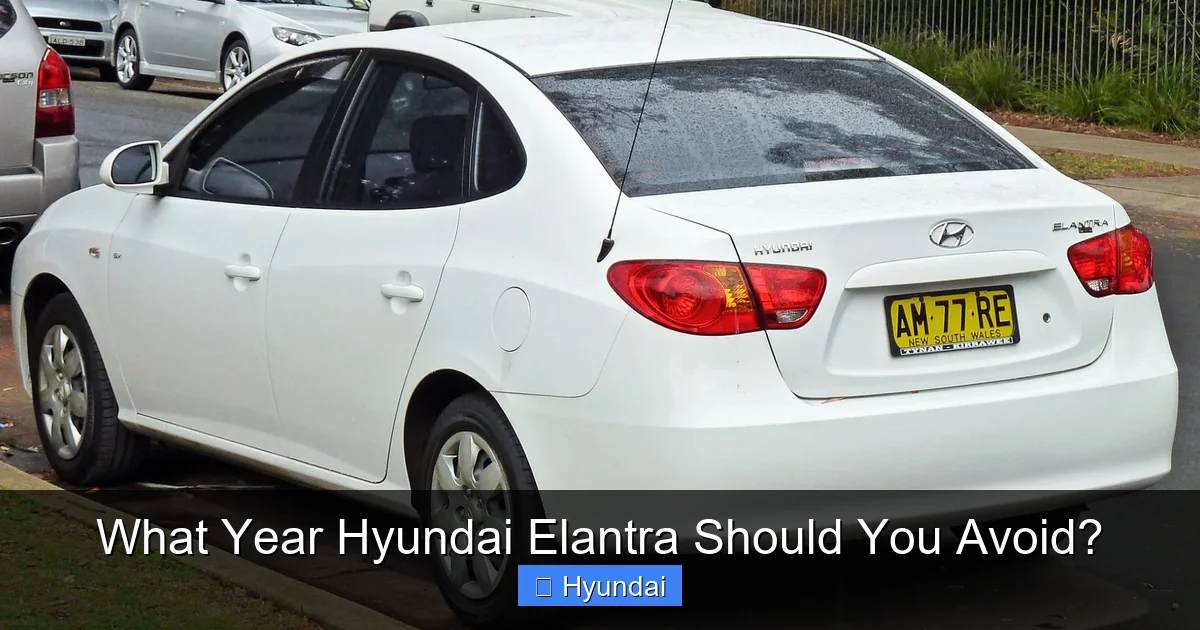
Paired perfectly (unfortunately) with the Theta II engine in the 2011-2016 Elantra was Hyundai’s in-house 6-speed dual-clutch transmission (DCT). This transmission was designed to offer the efficiency of a manual and the smoothness of an automatic. In reality, it delivered neither. It became infamous for sudden, violent shuddering, slipping, failing to shift, and complete breakdowns.
Visual guide about What Year Hyundai Elantra Should You Avoid?
Image source: rerev.com
Why Was It So Bad?
The DCT used in these years was a dry-clutch design, which is less robust and more prone to overheating and wear than wet-clutch systems used by competitors. The software logic was also notoriously poor, making the transmission feel jerky and unpredictable in stop-and-go traffic. Failures often occurred well before 100,000 miles, with repair costs frequently exceeding $3,000.
Hyundai issued multiple technical service bulletins (TSBs) and eventually extended the warranty on the transmission for some model years, but like the engine warranty, it’s tied to the original owner and dealership records. For a used buyer, a 2011-2016 Elantra with this transmission is a massive gamble. The later Elantras (2017+) switched to a conventional 6-speed or 8-speed automatic, which are far more durable.
The 2017-2020 “New” Elantra: Better But Not Perfect
With the seventh-generation redesign for 2017, Hyundai addressed the powertrain sins of the past. The Theta II engine was replaced by the new, more reliable 2.0L MPI and 1.6L Turbo engines. The DCT was gone, replaced by a conventional and robust 6-speed automatic. Mechanically, this was a huge step forward. However, this generation introduced a new set of issues that make some years within it slightly less desirable.
Electronics and Infotainment Gremlins
The 2017-2020 Elantra was Hyundai’s first mainstream car with a large, central touchscreen (standard on most trims). For many owners, this meant constant frustration. Common complaints include:
- Infotainment system freezing, rebooting, or refusing to turn on.
- Bluetooth connectivity dropping constantly.
- Apple CarPlay/Android Auto malfunctioning or not recognizing devices.
- Backup camera display failures.
These are often software-related and sometimes fixed with a dealer update, but many persist. The 2019 and 2020 model years saw more software refinement, so they tend to have fewer of these glitches than the early 2017-2018 models.
Build Quality and “Cheap Feel”
To hit an aggressive price point, Hyundai used more hard plastics and lighter materials in the interior of these models. Owners report excessive wind and road noise, squeaks and rattles, and door panels that feel loose. The suspension tuning can also feel harsh over bumps. While not a “avoid at all costs” issue, it contributes to a less satisfying ownership experience compared to the more refined 2021+ models or competitors like the Toyota Corolla.
The Safest Bets: Which Elantra Years Are Actually Good?
Now for the good news! Hyundai learned from its mistakes. If you’re looking for a used Elantra that offers great value without the nightmare repair bills, here are your best targets:

Visual guide about What Year Hyundai Elantra Should You Avoid?
Image source: carscounsel.com
- 2019-2020 Models: These are the final years of the seventh generation. They benefit from all the mechanical fixes (reliable engine/transmission) and most of the software updates for the infotainment system. They are often priced very attractively on the used market as dealers and shoppers eye the newer eighth generation. A well-maintained 2019 or 2020 Elantra is an excellent compromise between price and modern features.
- 2021 and Newer (Eighth Generation): This is the top recommendation. The redesign brought a more sophisticated platform, a much-improved interior, a standard hybrid option, and vastly better infotainment (with a larger, clearer screen). The powertrain is carryover from the reliable 2019+ models. These are the most trouble-free, feature-packed, and enjoyable Elantras on the market. A certified pre-owned (CPO) 2021 model can be a fantastic find.
- Pre-2011 Models (Fifth Generation, 2006-2010): This is an older, simpler car. It lacks the Theta II engine and modern tech. It’s not as refined or efficient, but it’s mechanically basic and can be very durable if well-cared for. They are cheap to buy and repair. However, parts availability is decreasing, and they lack modern safety features. Only consider if you need a very cheap, basic commuter and are comfortable with older vehicle quirks.
Your Action Plan: How to Buy a Used Elantra Without Regret
Knowing which years are bad is only half the battle. The other half is execution. Here is a step-by-step checklist to protect yourself, regardless of the year you’re looking at.
Step 1: The VIN is Your Best Friend
Before you even look at a car, get the VIN from the seller. Immediately run it through:
- Hyundai’s Official Recall Site: Check for any open recalls, especially the Theta II engine and any transmission-related campaigns.
- NHTSA.gov: The National Highway Traffic Safety Administration database for recalls and complaints.
- Carfax or AutoCheck: Pay for a report. Look for:
- Number of previous owners (fewer is better).
- Accident history (major red flag).
- Service records (proof of maintenance is huge).
- Title problems (salvage, flood damage).
Step 2: The Pre-Purchase Inspection (PPI) is Non-Negotiable
Never buy a used Elantra (or any used car) without a PPI by an independent mechanic you trust. This costs $100-$200 and can save you $5,000. Specifically instruct the mechanic to:
- Check for engine knock on cold start (Theta II symptom).
- Perform a thorough transmission test, feeling for shuddering, slipping, or delayed shifts.
- Scan for any stored trouble codes in the computer, even if the check engine light is off.
- Inspect for any signs of prior engine or transmission work (fresh paint, new parts).
- Check all electronics: windows, locks, infotainment, backup camera.
If the seller refuses a PPI, walk away immediately. That’s the biggest red flag of all.
Step 3: Focus on Service History, Not Just Mileage
A 2015 Elantra with 80,000 miles and a stack of dealer service records is a far better buy than a 2018 with 50,000 miles and zero paperwork. Look for consistent oil changes (every 5,000-7,500 miles), transmission fluid services (if applicable), and timing belt/chain inspections. A well-documented service history is the single best indicator of a car that has been cared for, reducing the risk of hidden problems.
Comparing the Competition: Context Matters
It’s useful to put the Elantra’s issues in context. Every popular model has its trouble spots. For instance, researching reliable compact sedans often leads buyers to also consider the Toyota Avalon, which is in a different class but shares the “family sedan” space. The Avalon is famously overbuilt and reliable, setting a high bar. Conversely, other Hyundai-Kia products shared the Theta II engine. You’ll find similar problems in the Kia Soul from the same years. This isn’t to pick on Hyundai—it’s to show that the 2011-2016 Elantra’s issues were part of a corporate-wide engineering misstep. When shopping, it’s wise to check the “years to avoid” lists for any model you’re considering, just as you would for a Subaru Outback or a Dodge Charger. Each has its own Achilles’ heel.
Frequently Asked Questions
What is the absolute worst year for the Hyundai Elantra?
The 2011 and 2012 models are widely considered the worst due to being the first years of the flawed Theta II engine and the problematic dual-clutch transmission. They carry the highest risk of catastrophic and expensive failures.
What is the best year Hyundai Elantra to buy used?
The 2021 and newer (eighth generation) models are the best overall, offering refined mechanics and modern tech. For older budgets, the 2019 and 2020 models are excellent, having fixed the major powertrain issues of earlier generations while being more reliable than the early 2017-2018 tech.
What are the most common problems with Hyundai Elantras to avoid?
For 2011-2016 models: Engine failure (Theta II recall) and transmission failure (DCT). For 2017-2020 models: Infotainment system bugs, excessive road noise, and occasional electrical gremlins. Always verify recall completion status before purchasing.
How can I check if a specific used Elantra has the bad engine?
Get the 17-digit VIN from the seller. Enter it for free on Hyundai’s recall website or NHTSA.gov. Look specifically for recalls related to the “Theta II” engine or “engine failure.” Also, have a mechanic listen for rod knock during a cold start.
If a recall was performed, is a 2012 Elantra safe to buy?
It’s less risky, but not “safe.” The recall repair (usually an engine software update and extended warranty) is a band-aid, not a permanent fix. Many repaired engines still fail later. A 2012 with the recall done is better than one without, but a 2019+ is a far smarter choice.
Should I avoid all Hyundai Elantras from before 2017?
Not all, but you must be extremely cautious. Models from 2006-2010 (fifth gen) are mechanically simpler and can be reliable if maintained, but they are old. The 2011-2016 sixth-gen models are the ones with the known, widespread design defects and should be avoided unless you get one with a fully documented, recent engine and transmission replacement at a dealer—which is rare.


