What Year Does the Toyota Camry Get the Best Gas Mileage?

Contents
- 1 Key Takeaways
- 2 📑 Table of Contents
- 3 The Hybrid Hierarchy: Unmatched Efficiency
- 4 The Gas Engine Champion: The 2.5L Four-Cylinder
- 5 Model Year Evolution: The Technology Leap
- 6 Real-World Factors That Trump Model Year
- 7 Buyer’s Guide: How to Choose Your Best Year
- 8 Conclusion: The Real “Best Year” is the One You Maintain
- 9 Frequently Asked Questions

Car Ambient Light Kit

Anti-Slip Dashboard Mat

Windshield Washer Fluid

Car Armrest Cushion
The Toyota Camry Hybrid consistently achieves the best gas mileage, with the 2023 and 2024 model years leading the pack thanks to their refined powertrains. For conventional gas models, the 2018-2021 generations offer excellent efficiency. Ultimately, your driving habits and maintenance play a huge role in hitting those EPA estimates.
Hey there, fellow car enthusiast! If you’re shopping for a Toyota Camry, one of the biggest questions on your mind is probably fuel costs. The Camry has a legendary reputation for reliability and value, but which specific year model truly gives you the most miles per gallon? It’s a great question, and the answer isn’t as simple as pointing to one single year. We’re going to break it down, separating the hybrid champions from the efficient gas models, and giving you the real-world scoop on how to get the absolute best gas mileage from whatever Camry you choose.
First, let’s set the stage. The Toyota Camry has been a midsize sedan staple for decades. Its engineering focus has always included efficiency, but the last decade has seen a revolutionary shift, especially with the hybridization of the lineup. The “best” year for gas mileage depends heavily on whether you’re looking at the hybrid or the traditional gasoline engine. We’ll explore both paths, look at the technological leaps that made the biggest differences, and arm you with practical tips to ensure your Camry, whatever its model year, sips fuel like a hybrid.
Key Takeaways
- Hybrid Dominance: The Camry Hybrid is the undisputed mileage champion, with recent models (2023-2024) achieving up to 52 MPG combined.
- Sweet Spot for Gas Models: The 2018-2021 eighth-generation Camry with the 2.5L 4-cylinder engine offers the best balance of power and efficiency for non-hybrid buyers.
- Real-World vs. EPA: Actual mileage often differs from EPA estimates; conservative driving and proper maintenance are key to achieving the best numbers.
- Technology Matters: Engine tech like the Dynamic Force engine and continuously variable transmission (CVT) in newer hybrids are game-changers for efficiency.
- Condition is Critical: A well-maintained used Camry from a good model year can often outperform a neglected newer one in fuel economy.
- Your Driving Style is the Biggest Variable: Aggressive acceleration and high speeds will lower MPG more than any single model year difference.
📑 Table of Contents
The Hybrid Hierarchy: Unmatched Efficiency
If maximizing MPG is your absolute top priority, your search begins and ends with the Camry Hybrid. This isn’t just a slight improvement; it’s a class-leading leap in efficiency that consistently puts the Camry Hybrid at or near the top of its category. The hybrid system cleverly combines a gasoline engine with electric motors, allowing the car to run on electric-only power at low speeds and under light acceleration, recapturing energy during braking, and optimizing engine operation for peak efficiency.
The 2023-2024 Hybrid Peak
For the hybrid model, the current 2023 and 2024 model years represent the absolute pinnacle of Camry fuel efficiency. These models utilize Toyota’s latest-generation hybrid powertrain, featuring a 2.5L 4-cylinder engine paired with electric motors. The result is an EPA-estimated 52 MPG combined (51 city / 53 highway) for the LE and SE trims. The XLE and XSE trims, which have slightly different tire sizes and weights, are rated at a still-excellent 47 MPG combined. This is not just a paper number; in real-world mixed driving, owners consistently report seeing 48-50+ MPG, which is astonishing for a comfortable, spacious midsize sedan.
The reason these years are so special is the refinement of the “Hybrid Synergy Drive” system. The transition between gas and electric is nearly seamless, the CVT is better tuned for responsiveness, and the battery pack is more efficient. If you want the newest tech, the best warranty, and the highest possible MPG, a 2023 or 2024 Camry Hybrid is your target.
The Excellent Pre-2023 Hybrids
Don’t discount the 2018-2022 Camry Hybrids. They are also phenomenal on fuel and represent a significant value in the used market. For these model years, the EPA ratings were 46-47 MPG combined (depending on trim). The core hybrid technology was already fantastic, and the difference in real-world driving compared to the newest models is minimal for most people. You’ll save a considerable amount of money buying a certified pre-owned 2020 or 2021 model and still get over 45 MPG on a regular basis. The driving experience is very similar—quiet, smooth, and incredibly efficient.
When considering a used hybrid, the single most important factor is the battery’s health and the vehicle’s maintenance history. A well-cared-for hybrid battery can last 150,000+ miles. Always get a vehicle history report and have a trusted mechanic inspect a used hybrid before purchase. The upfront cost savings on a 2019 model might be worth the slight MPG trade-off for many buyers.
The Gas Engine Champion: The 2.5L Four-Cylinder
Not everyone wants or needs a hybrid. Maybe you do a lot of highway driving where the hybrid’s advantage is smaller, or you prefer the simpler mechanics of a traditional gas engine. For you, the best gas mileage comes from the Camry’s 2.5L 4-cylinder engine, not the optional V6. This engine, especially when paired with the 8-speed automatic transmission (in later years), is a paragon of efficiency for a non-hybrid.

Visual guide about What Year Does the Toyota Camry Get the Best Gas Mileage?
Image source: cdn.dlron.us
The 2018-2021 Eighth-Generation Sweet Spot
The 2018 model year was a complete redesign for the Camry, introducing the current eighth generation. This redesign focused heavily on efficiency with a more aerodynamic body and the introduction of the all-new “Dynamic Force” 2.5L 4-cylinder engine. This engine, using a high compression ratio and advanced fuel injection, was a massive leap forward. For the 2018-2021 model years with this engine and the 8-speed automatic, the EPA rating is 29 MPG city / 39 MPG highway / 32 MPG combined.
This 32 MPG combined figure is the best you’ll regularly see from a non-hybrid Camry. The 2022 model year saw a minor refresh, and while the engine remained the same, subtle changes to the transmission tuning or aerodynamics sometimes lead to a tiny, almost imperceptible drop in EPA figures for some trims (often still 32 MPG combined, but sometimes 31). Therefore, for pure gas efficiency, the 2018-2021 window is the proven sweet spot. You get a modern, safe, and comfortable car with stellar gas mileage for its class. You might also find that the fuel requirements for these models are standard 87 octane, which is another cost-saving benefit. For more on fuel types across the Toyota lineup, you can read about what gas the Toyota Tacoma takes, though the Camry’s needs are less demanding.
Earlier Models: Good, But Not Great
The seventh-generation Camry (2012-2017) with the 2.5L 4-cylinder was no slouch, rated at around 25-28 MPG combined. It’s a reliable engine, but it’s outclassed by the Dynamic Force engine that followed. If your budget is very tight, a late-model 2016-2017 Camry can still be a sensible, fuel-efficient choice, but you’ll be giving up both performance and about 3-4 MPG compared to the redesign.
Model Year Evolution: The Technology Leap
Understanding why certain years are better requires a quick look at the tech under the hood. The single biggest factor in the Camry’s mileage journey has been the engine and transmission pairing.

Visual guide about What Year Does the Toyota Camry Get the Best Gas Mileage?
Image source: classicdirecttoyota.com
The Game-Changing Dynamic Force Engine
Introduced for the 2018 redesign, the 2.5L “Dynamic Force” engine is a masterpiece of engineering. It achieves a thermal efficiency of over 40%, meaning more of the gasoline’s energy is converted into motion. It does this through a very high compression ratio (13:1), multi-hole direct injection, and a variable cooling system. This engine is the heart of both the best gas and hybrid models. In the hybrid, it’s primarily used as a generator to produce electricity for the motors, operating in its most efficient RPM range almost exclusively.
The CVT vs. Traditional Automatic
The hybrid uses an e-CVT (electronically controlled CVT) which is fundamentally different from a traditional geared transmission. It allows the engine to stay in its optimal power band, dramatically improving efficiency. For the gas models, Toyota moved from a 6-speed automatic (pre-2018) to an 8-speed direct-shift automatic for the 2018+ models with the 2.5L engine. This more gears allow the engine to downshift less frequently and stay at lower RPMs during highway cruising, directly boosting MPG. The 8-speed is a key reason the post-2018 gas models are so much more efficient.
Real-World Factors That Trump Model Year
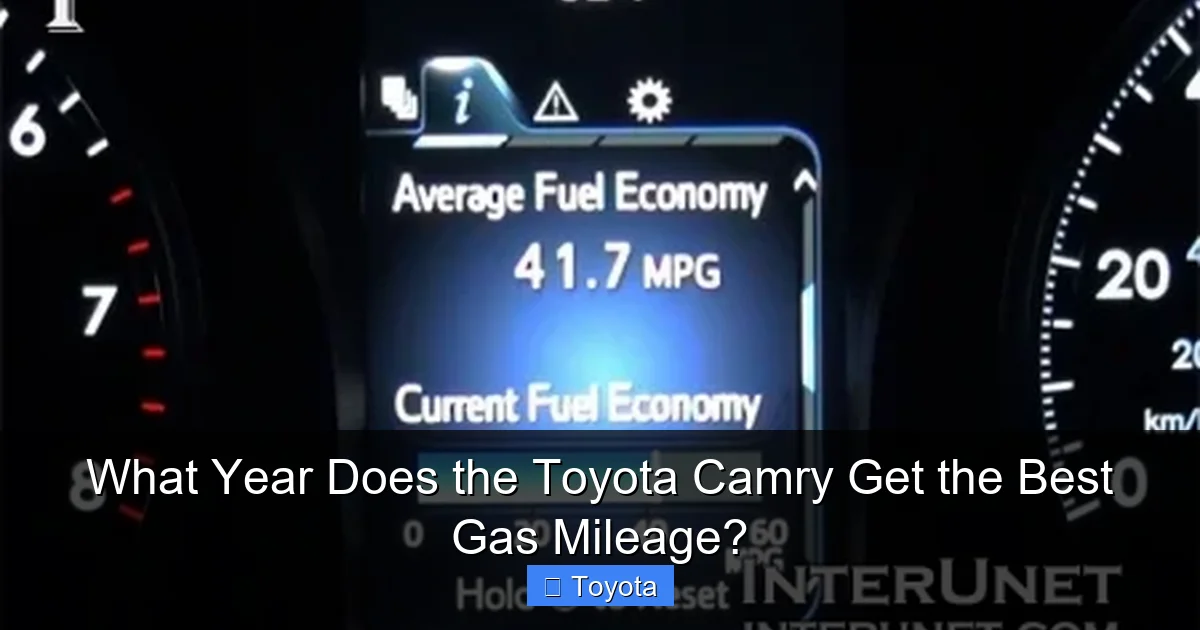
Here’s the most important truth: the model year is just a starting point. How you drive and maintain your Camry will have a larger impact on your actual MPG than the difference between a 2019 and a 2021 model. Let’s talk about what really moves the needle.
Visual guide about What Year Does the Toyota Camry Get the Best Gas Mileage?
Image source: interunet.com
Driving Habits: The #1 Influencer
You can have a brand-new 2024 Camry Hybrid, but if you drive it like you’re on a racetrack—hard acceleration, speeding, and riding the brakes—your MPG will plummet. Gentle, predictable acceleration, maintaining steady speeds (using cruise control on highways), and anticipating traffic flow are the single best things you can do for fuel economy. Hybrids especially thrive in stop-and-go city traffic, where they can use electric power more often. If your commute is 90% steady-state highway at 75 mph, you might only see 40-42 MPG in a hybrid rated for 52 MPG.
Maintenance is Non-Negotiable
A neglected Camry will not get good mileage. This means:
- Proper Tire Inflation: Under-inflated tires increase rolling resistance. Check monthly.
- Regular Oil Changes: Using the correct oil viscosity (like 0W-16 for newer hybrids) reduces engine friction. Using the best motor oil for your specific Camry year is a simple, cheap way to protect efficiency.
- Air Filter: A clogged air filter chokes the engine, forcing it to work harder and use more fuel.
- Spark Plugs: Worn spark plugs cause misfires and poor combustion. Knowing the best spark plug for your Camry and replacing them on schedule is crucial.
Climate & Accessories
Running the A/C compressor constantly can reduce MPG by 1-3, especially in city driving. Using the recirculate mode is more efficient. Roof racks and cargo carriers add significant aerodynamic drag, killing highway MPG. Remove them when not in use. Even your wheel and tire choice matters; larger, heavier wheels and low-profile performance tires increase unsprung weight and rolling resistance.
Buyer’s Guide: How to Choose Your Best Year
So, you’re ready to shop. Here’s a practical roadmap based on your priorities.
For Absolute Max MPG & Latest Tech: Buy New or Recent Used Hybrid
Target: 2023-2024 Camry Hybrid LE/SE. You get the 52 MPG rating, the latest safety tech (Toyota Safety Sense 3.0), a great warranty, and the most refined hybrid experience. If budget is a factor, look at 2020-2022 Camry Hybrids. You sacrifice a few MPG (down to 46-47 combined) but save thousands. Always get a pre-purchase inspection, focusing on the hybrid battery health and transmission operation.
For Best Gas-Only Value & Efficiency: Target 2018-2021
Target: 2018-2021 Camry 4-cylinder (LE, SE, or XLE trims). These offer the 32 MPG combined figure, a smooth 8-speed automatic, and are widely available on the used market. They are mechanically simple, reliable, and cheap to repair. Avoid the V6 if MPG is your goal—it gets about 22-25 MPG combined. When shopping, check the tire size; some larger alloy wheels on higher trims can slightly reduce MPG.
The Used Market Wild Card: Condition Over Year
A 2015 Camry with 150,000 miles that has been impeccably maintained with all service records can and will get better real-world MPG than a 2020 Camry that has been ignored and has never had its air filter changed. Always prioritize:
- A comprehensive vehicle history report (Carfax/AutoCheck).
- A pre-purchase inspection by an independent mechanic.
- Verification of all maintenance records, especially oil changes and timing belt/chain service (the 2.5L uses a timing chain, which is generally lifetime but still benefits from inspection).
Conclusion: The Real “Best Year” is the One You Maintain
So, what year does the Toyota Camry get the best gas mileage? The technical answer is clear: the 2023 and 2024 Camry Hybrid models hold the official MPG crown. For those sticking with gasoline, the 2018-2021 Camry with the 2.5L 4-cylinder engine is the efficiency leader. These are the benchmark years against which all others are measured.
But the practical, real-world answer is more nuanced. The “best year” for you is the one that fits your budget, has a clean maintenance history, and matches your driving style. A well-cared-for 2019 hybrid will happily outperform a poorly maintained 2024 model. Your own right foot has more influence on the fuel gauge than any single model year’s engineering tweaks. Focus on finding a Camry—hybrid or efficient 4-cylinder—that has been loved and serviced, and you’ll enjoy the famous Camry reliability and fantastic fuel economy for years to come. It’s a winning combination that makes the Camry a perennial smart choice for the fuel-conscious driver.
Frequently Asked Questions
Is the Camry Hybrid worth the extra cost over the 4-cylinder for gas mileage?
Yes, if you keep the car long-term and drive mostly in city or mixed conditions. The fuel savings over 5-7 years often offset the higher initial price. The hybrid also provides smoother, quieter operation and may have better resale value.
Do I need to use premium gas in any Camry model for best mileage?
No. All current and recent Camry models, including the hybrid, are designed to run on regular 87-octane unleaded gas. Using premium provides no benefit in power or mileage for standard engines. Only the old supercharged models or specific markets might have different requirements.
What is the realistic real-world MPG I can expect from a 2024 Camry Hybrid?
While rated at 52 MPG combined, real-world results vary. Most owners report 45-50 MPG in mixed driving. Aggressive highway driving (75+ mph) will drop it to the low-to-mid 40s. Gentle, hypermiling-style driving in ideal conditions can push it to 55+ MPG.
How does the Camry’s gas mileage compare to a competitor like the Nissan Rogue?
The Camry sedan generally has better highway aerodynamics than a compact SUV like the Nissan Rogue. A Rogue FWD gets about 26-27 MPG combined, while a Camry Hybrid gets nearly double that. For pure efficiency, a sedan like the Camry is hard to beat.
Can I improve my older Camry’s gas mileage with aftermarket parts?
Be wary of “mileage booster” gadgets. The most effective modifications are proper maintenance, low-rolling-resistance tires, and ensuring your engine’s computer has no fault codes. For significant gains, the only proven path is switching to a hybrid model.
Should I buy a used Camry Hybrid or a new gas model for the best long-term value?
Do the math based on your annual mileage. If you drive 15,000+ miles per year, especially in the city, the used hybrid will almost certainly save you more money in fuel costs over 5 years than the price difference. For low-mileage, mostly highway drivers, a new gas model might be simpler and cheaper upfront.