
What Is the Transmission Problem in the 2024 Toyota Tacoma?

The 2024 Toyota Tacoma’s transmission problem centers on its all-new 8-speed automatic transmission, which replaces the proven 6-speed unit. Owners and early reviewers report issues including harsh or jerky shifts, hesitation, and unintended downshifts, particularly at low speeds. While Toyota has not issued a recall, technical service bulletins (TSBs) may address specific software faults. Potential buyers should test drive extensively, check for applicable TSBs, and consider an extended warranty for peace of mind.
Key Takeaways
- The 2024 Tacoma uses an all-new 8-speed automatic transmission. This is a major change from the previous generation’s reliable 6-speed automatic and marks a significant engineering shift for the truck.
- Common owner-reported issues include harsh shifts, shuddering, and hesitation. These problems are most frequently noted during low-speed acceleration, from a stop, or during gear changes under light throttle.
- Toyota has not issued a safety recall for the transmission. However, the company is aware of complaints and may release software-based Technical Service Bulletins (TSBs) to recalibrate shift points and smoothness.
- The manual transmission option is no longer available for the 2024 Tacoma. All models are equipped with the new 8-speed automatic, leaving drivers with no alternative if they are dissatisfied with its behavior.
- Long-term reliability remains unproven. As a brand-new design, there is no historical data on the durability of this specific 8-speed unit in Tacoma applications over high mileage.
- Driving modes like ECT Power and features like Auto LSD influence shift behavior. Understanding these settings can help manage the transmission’s characteristics, and explanations for these features can be found in our guides to ECT Power on a Toyota Tacoma and Auto LSD on Toyota Tacoma.
- A thorough pre-purchase test drive is non-negotiable. Buyers must experience the transmission in their typical driving conditions—city traffic, hills, and highway merging—to assess if the shift quality is acceptable to them.
📑 Table of Contents
- Understanding the Heart of the Matter: The New 8-Speed Transmission
- What Are Owners Actually Experiencing? The Symptom Checklist
- Toyota’s Stance: Awareness, Response, and the Road Ahead
- How Does This Compare to Previous Generations?
- What Should a Potential 2024 Tacoma Buyer Do?
- Maintenance and Long-Term Care: Can You Mitigate Issues?
- The Bottom Line: A Problem or a Character Flaw?
Understanding the Heart of the Matter: The New 8-Speed Transmission
Let’s be real. When you think of a Toyota Tacoma, you think of a bulletproof, go-anywhere, workhorse truck. For decades, that reputation was built on a foundation of simple, robust engineering. One of the most celebrated parts of the previous-generation Tacoma (2014-2023) was its 6-speed automatic transmission. It was slow-shifting by modern standards, but it was famously durable and smooth enough for daily duties and serious off-roading. For the completely redesigned 2024 Tacoma, Toyota made a huge, some would say risky, change: they ditched the old 6-speed for an all-new 8-speed automatic transmission.
This isn’t just a minor update; it’s a fundamental redesign. The new transmission is designed to be more efficient, provide better acceleration, and improve fuel economy—all critical goals for a modern truck facing stricter emissions standards. It’s paired with either a turbocharged 2.4-liter four-cylinder engine (in most trims) or a hybrid powertrain. The goal was to make the Tacoma feel more responsive and sophisticated. But in the real world, a subset of new owners and reviewers are encountering what they describe as “transmission problems.” The core of the issue is that this new, complex transmission’s software calibrations and mechanical behavior aren’t meeting everyone’s expectations for smoothness, especially in low-speed, everyday driving situations.
The Big Switch: From 6-Speed to 8-Speed
Moving from 6 speeds to 8 gives the transmission more closely spaced gears. In theory, this means the engine can stay in its optimal power band more often. For towing or hard acceleration, this is a good thing. However, for daily commuting and stop-and-go traffic, it means more gear changes. If those shifts aren’t executed with surgical precision by the transmission control module (TCM), you feel it. You feel a jerk, a pause, or a shudder as the truck decides which of its eight gears to use next. This is the essence of the “problem” most people are talking about. It’s less about a catastrophic mechanical failure (though those are always possible in a brand-new design) and more about a persistent, frustrating lack of refinement.
What Are Owners Actually Experiencing? The Symptom Checklist
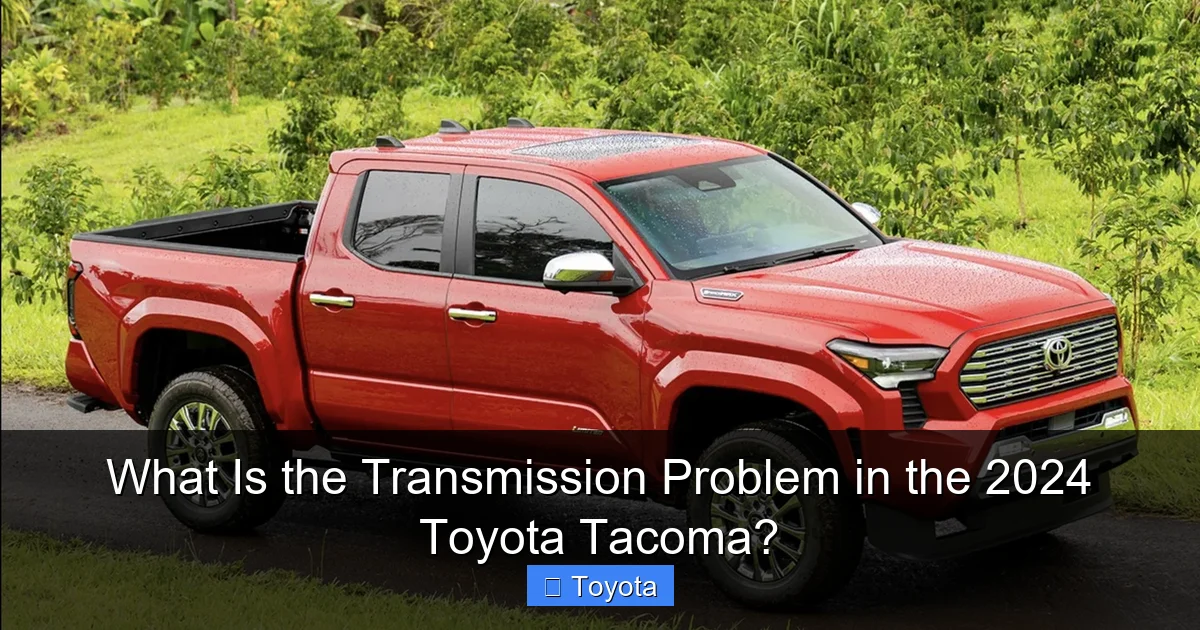
So, what does a “transmission problem” feel like in a 2024 Tacoma? It’s not usually a warning light or a complete failure to move (though those cases exist and are serious). Instead, it’s a collection of annoying, driveability-related symptoms that make the truck feel unpolished. Here’s a breakdown of the most frequently reported issues on owner forums, social media groups, and some professional reviews.
Visual guide about What Is the Transmission Problem in the 2024 Toyota Tacoma?
Image source: motorbiscuit.com
Harsh or Jerky Shifts, Especially at Low Speeds
This is the number-one complaint. Owners describe a noticeable “clunk,” “thud,” or “jerk” when the transmission shifts from 1st to 2nd gear, or from 2nd to 3rd, particularly when accelerating gently from a stop. It can feel like the truck is being kicked in the rear. Some call it a “shift shock.” This is often most pronounced in the Normal or Eco driving modes. The transmission seems to struggle to find the right torque converter lockup point smoothly.
Shuddering and Vibration
Related to the harsh shifts, many report a vibration or shudder that can be felt through the seat, steering wheel, and floorboards. This often occurs at specific, low speeds (around 20-30 mph) under light throttle, as the transmission is in a transition phase between gears or when the torque converter is partially locked. It can make the cabin feel less serene than expected from a new vehicle.
Hesitation and “Shift Lag”
Some drivers experience a momentary delay—a fraction of a second, but very noticeable—between pressing the accelerator and the truck actually surging forward. It’s as if the transmission is thinking, “What does the driver want?” before downshifting or engaging. This is particularly disconcerting when trying to merge onto a highway or make a quick pass. It breaks the connection between the driver’s right foot and the truck’s response.
Unexpected or Unwanted Downshifts
The truck’s computer is programmed to downshift aggressively for passing power. For some, this programming is too aggressive. The transmission might downshift unexpectedly while cruising, causing a sudden surge of power and engine noise that feels unnecessary and jolting. This can also happen when slightly lifting off the throttle, where the truck seems to “hunt” for a lower gear.
Noise from the Transmission
A few owners report unusual whining, whirring, or clattering noises from the transmission tunnel, especially when the truck is cold. While some noise is normal in any modern transmission, persistent or loud noises can indicate a problem with the planetary gearsets, bearings, or the torque converter.
Toyota’s Stance: Awareness, Response, and the Road Ahead
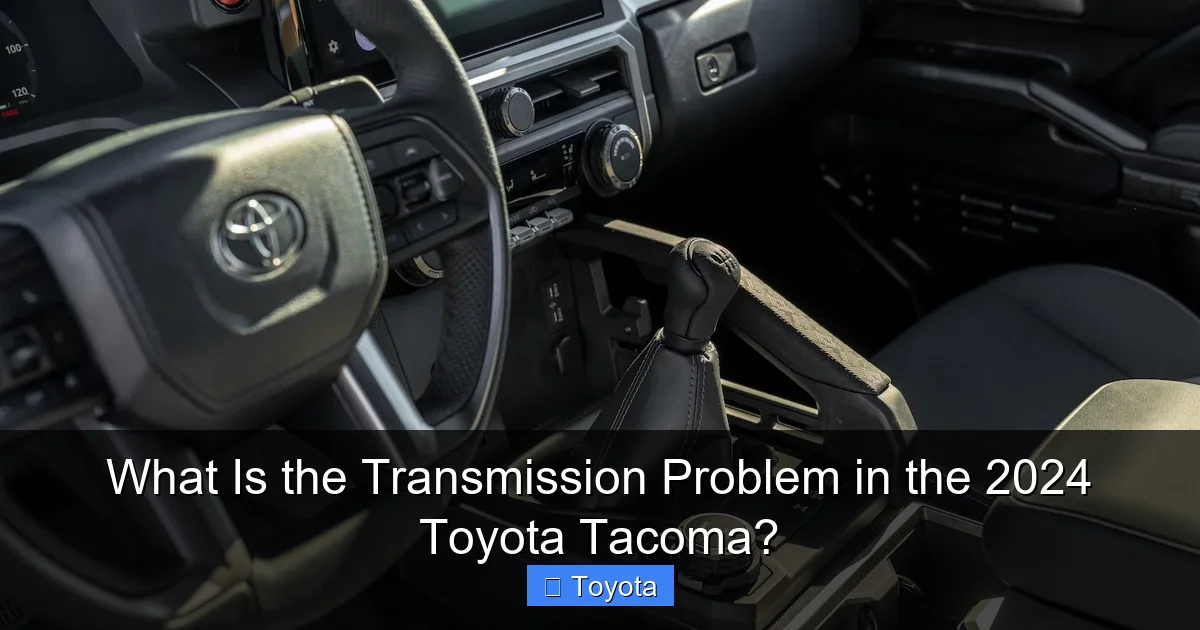
It’s crucial to understand Toyota’s official position. As of now, there is no safety recall from the National Highway Traffic Safety Administration (NHTSA) for the 2024 Tacoma’s transmission. This means the issue has not been deemed an immediate safety risk requiring a mandated fix for all vehicles. However, this doesn’t mean Toyota is ignoring it. The company is aware of customer and dealer feedback.
Visual guide about What Is the Transmission Problem in the 2024 Toyota Tacoma?
Image source: motorbiscuit.com
The Role of Technical Service Bulletins (TSBs)
Manufacturers like Toyota use Technical Service Bulletins to communicate known issues and repair procedures to their dealer network. A TSB is not a recall; it’s a “here’s how to fix this problem if a customer complains about it.” In the early life of a new vehicle model, especially one with a major new component like a transmission, TSBs are common. They often involve software updates (re-flashing the TCM) to alter shift schedules, torque converter lockup points, and shift solenoid timing. This is the most likely “fix” for the driveability complaints—a software patch from the dealer. Prospective buyers should ask a dealer if any TSBs are open for the transmission on the specific vehicle they’re looking at and ensure any available updates have been applied. For more general information on Toyota’s diagnostic and service procedures, resources like the Toyota Assessment Test provide insight into their systematic approach to problem-solving.
Warranty Coverage is Your Safety Net
All 2024 Tacomas come with Toyota’s standard New Vehicle Limited Warranty, which covers the powertrain (including the transmission) for 5 years or 60,000 miles, whichever comes first. This is your primary protection. If you experience a failure—like the transmission slipping out of gear, refusing to shift, or making catastrophic noises—this warranty should cover the repair. For the more subjective “driveability” issues (harsh shifts, shudder), a dealer may be less inclined to replace a transmission and more likely to perform the TSB software update. This is where an extended warranty (from Toyota or a third party) can provide additional peace of mind for the long haul, covering components beyond the standard warranty period.
How Does This Compare to Previous Generations?
To understand the current situation, we must look backward. The pre-2024 Tacoma’s 6-speed automatic was a known quantity. It was slow, but it was smooth and incredibly robust. Owners of 2014-2023 models almost universally praise its reliability. The trade-off was poor fuel economy and leisurely acceleration. The 2024 Tacoma’s 8-speed is the direct opposite in philosophy: it’s designed for efficiency and performance, but it’s introducing complexity that the old unit never had.
Visual guide about What Is the Transmission Problem in the 2024 Toyota Tacoma?
Image source: motorbiscuit.com
The older 6-speed had decades of use in various Toyota and Lexus vehicles. Its failure points were well-understood. The new 8-speed, likely part of a Toyota Global Architecture (TNGA) family of transmissions, is fresh. Its long-term durability in the high-stress environment of a mid-size truck—especially one that might be used for towing, off-roading, or fleet duty—is still a big question mark. Early adopters are essentially beta testers for this transmission in this specific application. While Toyota’s engineering is top-tier, the transition to more gears for better efficiency is an industry-wide trend that has sometimes been rocky. You can look at other manufacturers’ initial 8- or 10-speed launches to see similar early complaints about shift quality that were often resolved with software updates over time.
What Should a Potential 2024 Tacoma Buyer Do?
If you’re in the market for a new mid-size truck, the 2024 Tacoma is undoubtedly on your list. Its capability, off-road prowess (especially in TRD Pro or Trailhunter trims), and Toyota’s reputation for reliability are huge draws. But the transmission narrative is a significant asterisk. Here is your action plan.
1. The Test Drive is Your Most Important Tool
Do not buy a 2024 Tacoma without a comprehensive, deliberate test drive. This isn’t about a quick spin around the block. You need to replicate your real driving. Here’s a checklist:
- Cold Start: Drive it first thing in the morning. Cold transmission fluid is thicker, and this is when many shudder and harsh shift issues are most pronounced.
- Stop-and-Go Traffic: Find a busy parking lot or street. Accelerate gently from a complete stop multiple times. Listen and feel for clunks, jerks, or vibrations between 1st and 2nd, and 2nd and 3rd gear.
- Light Throttle Cruising: Drive at a steady 25-35 mph. Does the truck feel smooth, or is there a constant, subtle vibration (shudder)? Try it in both Normal and Eco modes.
- Moderate Acceleration: Find a safe place to merge. Press the accelerator firmly to about 50%. Does the truck downshift promptly and smoothly, or is there a lag? Does the downshift itself feel harsh?
- Hill Driving: If possible, drive up and down a hill. Does the transmission hunt for gears? Does it hold gears appropriately on the descent?
Bring a friend or family member to get a second opinion on comfort. Your perception might be skewed if you’re trying to justify the purchase. Be honest with yourself about what you feel.
2. Ask the Dealer Direct, Hard Questions
When you visit a dealership, be an informed consumer. Ask the salesperson and, more importantly, the service manager these questions:
- “Have there been any Technical Service Bulletins (TSBs) for the transmission on this 2024 Tacoma?”
- “Has the transmission control module (TCM) software been updated to the latest version?”
- “What is your experience with customers who have reported transmission shudder or harsh shifting?”
- “If I experience these issues after purchase, what is your process for diagnosis and repair under warranty?”
A dealership that is evasive, says “I’ve never heard of that,” or is unwilling to check for TSBs is a red flag. A good dealer will be transparent and proactive.
3. Consider Your Trim and Drivetrain
It’s possible that the transmission behavior varies slightly by engine and drivetrain. The turbocharged 2.4L gas engine is the most common. The hybrid i-FORCE MAX system pairs the same engine with an electric motor-generator. The hybrid’s power delivery is inherently different—electric torque fills in gaps—so its transmission behavior might feel distinct. Some early reports suggest the hybrid may mask some low-speed shift harshness due to the electric motor’s instant torque. It’s worth test driving both if you’re considering them. Also, 4WD models have a transfer case and potentially different programming; test the specific configuration you want.
Understanding the driving modes is also key. The RSCA (Rear Seat Cargo Alert) is an unrelated safety feature, but modes like ECT Power, Sport, and Eco directly alter the transmission’s shift mapping. ECT Power holds gears longer and shifts more aggressively. You might find you prefer the shift logic in one mode over another. Experiment with these during your test drive.
4. Weigh the Pros and Cons Objectively
The 2024 Tacoma has staggering amounts of new tech, capability, and refinement compared to the old model. The interior is vastly superior. The infotainment is modern. The off-road hardware (like the standard rear locker on TRD Pro and Trailhunter) is impressive. The new engines are powerful. You must balance these significant positives against the potential transmission irritation. For some buyers, the truck’s overall capability will outweigh a few rough shifts. For others, whose daily driving is 90% city commuting, a smooth, quiet ride is paramount, and the Tacoma’s transmission might be a deal-breaker. Only you can decide where your tolerance lies.
Maintenance and Long-Term Care: Can You Mitigate Issues?
If you do purchase a 2024 Tacoma, there are steps you can take to potentially promote transmission health and smooth operation.
- Follow the Break-In Period: Toyota recommends a break-in period for the first 500 miles. During this time, avoid full-throttle acceleration, hard braking, and towing. This allows the transmission’s clutch packs and other mating surfaces to wear in evenly, which can improve long-term smoothness.
- Use the Correct Fluid: Toyota specifies their WS (World Standard) automatic transmission fluid. Always use genuine Toyota fluid or a high-quality equivalent meeting the specification. Incorrect fluid can cause shuddering and poor shift quality.
- Regular Servicing: While the transmission is “sealed for life” per Toyota’s design (meaning no scheduled drain and fill), many independent mechanics and transmission specialists still recommend a fluid change every 60,000-80,000 miles for severe service (towing, hot climates, stop-and-go traffic). Fresh fluid can help maintain optimal performance as the truck ages.
- Stay Updated: When you bring your truck in for any warranty work or regular oil changes, ask the dealer to check for any new TSBs or software updates for the transmission and powertrain. These updates may be released periodically to address concerns.
Another feature to be aware of is the transmission’s “Creeping” function in 4WD Low range, which is essential for technical off-road maneuvers. If you plan to off-road, understanding how the truck behaves in 4L is part of the ownership experience. The behavior of the transmission in this mode is a separate calibration from normal driving.
The Bottom Line: A Problem or a Character Flaw?
So, is there a “transmission problem” in the 2024 Toyota Tacoma? The answer is nuanced. There is not a widespread, catastrophic, safety-related failure that warrants a recall. However, there is a clear and consistent pattern of owner complaints regarding driveability—harsh shifts, shuddering, and hesitation—that suggests the initial software calibrations for this new 8-speed unit may not be optimized for all driving styles and conditions. It’s a “character flaw” in the driving experience rather than a “problem” that will leave you stranded (though the latter is always a remote possibility with any new complex design).
For Toyota, a company built on a reputation for bulletproof reliability and refinement, this is an uncharacteristic stumble. The bar for smoothness in a new truck is incredibly high, and the Tacoma’s transmission, in its current state for some examples, falls short of that bar. The good news is that software is mutable. Many of these issues can likely be tuned out over time with TSB updates. The bad news is that you are buying a first-year model with a brand-new, unproven transmission. You are accepting some level of risk and uncertainty.
If you test drive a 2024 Tacoma and the transmission’s behavior doesn’t bother you—if you can live with the occasional nudge or shudder—then this might be the best mid-size truck you can buy, packed with capability and tech. If you are highly sensitive to shift quality and demand a silky-smooth daily driver, you should probably look at competitors like the Honda Ridgeline (with its smooth 9-speed) or even a used previous-generation Tacoma, which, while slower and less efficient, has a known-good transmission. The 2024 Tacoma is a phenomenal truck wrapped in a package with a significant, potentially fixable, but currently real annoyance. Go in with your eyes wide open, test drive relentlessly, and ask the hard questions. Your ownership experience will depend entirely on your personal tolerance for its transmission’s quirks.
Frequently Asked Questions
Is the 2024 Tacoma transmission defective?
Not in a safety-recalled, catastrophic sense. The issues are primarily related to driveability—harsh shifts, shuddering, and hesitation—which point to software calibration that may not be optimized for all conditions. These are irritants, not guaranteed failures.
Will Toyota fix the transmission issues for free?
If you experience a problem while under the 5-year/60,000-mile powertrain warranty, Toyota will diagnose and repair any verified malfunction. If the issue is a known software fault covered by a TSB, the dealer will perform the update at no cost. For purely subjective complaints about shift feel with no diagnostic codes, a dealer may be less inclined to perform major work.
How does the 2024 transmission compare to the old Tacoma’s?
The old 6-speed automatic was slower but famously smooth and durable. The new 8-speed is designed for better performance and fuel economy but introduces complexity that has resulted in reported roughness and hesitation, especially at low speeds. The old unit’s reliability is proven; the new one’s long-term durability is still unknown.
Should I avoid buying a 2024 Tacoma because of the transmission?
Only you can decide based on your tolerance. The truck’s overall capability and tech are outstanding. However, if a smooth, refined daily driving experience is your top priority, you should test drive extensively. If the transmission’s behavior bothers you during the test drive, it will likely bother you for years. Consider a test-driven, well-specced used 2023 model as a proven alternative.
Can a software update fix the shuddering and harsh shifts?
Yes, this is the most likely and common fix. Transmission behavior is controlled by software. Toyota can and does release TSBs with updated calibrations for the Transmission Control Module (TCM) to alter shift points, torque converter lockup, and shift solenoid timing to improve smoothness. Always ensure your truck has the latest software.
Does the hybrid Tacoma have the same transmission problems?
The hybrid uses a different, specialized version of the 8-speed automatic (a transaxle) that works with the electric motor. Some early reports suggest the electric motor’s instant torque may mask some low-speed shift harshness, but it is not immune to potential software-related drivability quirks. A test drive of the specific hybrid model you’re considering is essential.
