
How Many Miles Can a Toyota Tacoma Go on a Full Tank of Gas?

The distance a Toyota Tacoma can travel on a full tank isn’t a single number—it varies significantly based on model year, engine, drivetrain, and driving habits. Most modern Tacomas with a 21.1-gallon tank achieve a real-world range of 300 to 420 miles, but aggressive driving, heavy loads, or off-road use can drastically reduce that. Understanding your specific truck’s fuel capacity and MPG is key to planning trips and avoiding the stress of running low.
Key Takeaways
- Range Depends on Multiple Factors: Your Tacoma’s miles per tank are determined by its fuel tank size, engine type (4-cylinder or V6), drivetrain (2WD or 4WD), driving conditions, and vehicle load.
- Tank Size Varies by Generation: Current (2016-2023) Tacomas have a 21.1-gallon tank, while older models may have 18.5 or 21.2 gallons, directly impacting maximum range.
- Real-World MPG is Lower Than EPA Estimates: While EPA ratings provide a baseline, actual combined fuel economy often runs 1-3 MPG lower due to driving style, terrain, and climate.
- Towing and Payload Reduce Efficiency: Adding weight via a trailer or heavy cargo decreases fuel economy, shortening your range per tank. A fully loaded Tacoma towing at capacity may see MPG drop by 25-30%.
- Maintenance is Critical for Optimal Range: Proper tire inflation, regular oil changes with the correct oil type and quantity, and a clean air filter ensure your engine runs efficiently and conserves fuel.
- The Gas Light Gives You a Safety Reserve: When the fuel light illuminates, you typically have 30-50 miles remaining, but this is a warning, not a target. Relying on this regularly can damage your fuel pump.
- Driving Habits Have the Biggest Impact: Smooth acceleration, using cruise control on highways, and avoiding excessive idling can improve your Tacoma’s MPG by several miles per gallon, extending your range.
📑 Table of Contents
- Introduction: The Myth of a Single Number
- Understanding the Variables: Why Range Isn’t Set in Stone
- Tacoma Model Year & Configuration Breakdown: Tank Size & Estimated Range
- Real-World vs. EPA Estimates: The Honest Truth
- Maximizing Your Tacoma’s Range: Practical Tips
- Conclusion: Know Your Truck, Drive Smart
Introduction: The Myth of a Single Number
If you’re asking “how many miles can a Toyota Tacoma go on a full tank of gas?” you’re likely planning a road trip, a work haul, or just want to know your truck’s limits. It’s a smart question. But the honest answer is: it depends. There is no one-size-fits-all mileage number for every Tacoma on the road. Your friend’s 2021 Tacoma might go 400 miles on a tank, while your 2015 model with a lift kit and big tires might only make it 280. The variance comes from a mix of factory specifications, real-world conditions, and how you treat the gas pedal.
The Toyota Tacoma is a legendary midsize pickup built for adventure and reliability. Its fuel range is a practical piece of that puzzle. Knowing your truck’s potential range helps with trip planning, budget management for fuel, and prevents the nerve-wracking experience of hunting for a gas station in a remote area. This guide will break down every variable—from tank size to driving technique—to give you a clear, personalized estimate for your specific Tacoma.
Understanding the Variables: Why Range Isn’t Set in Stone
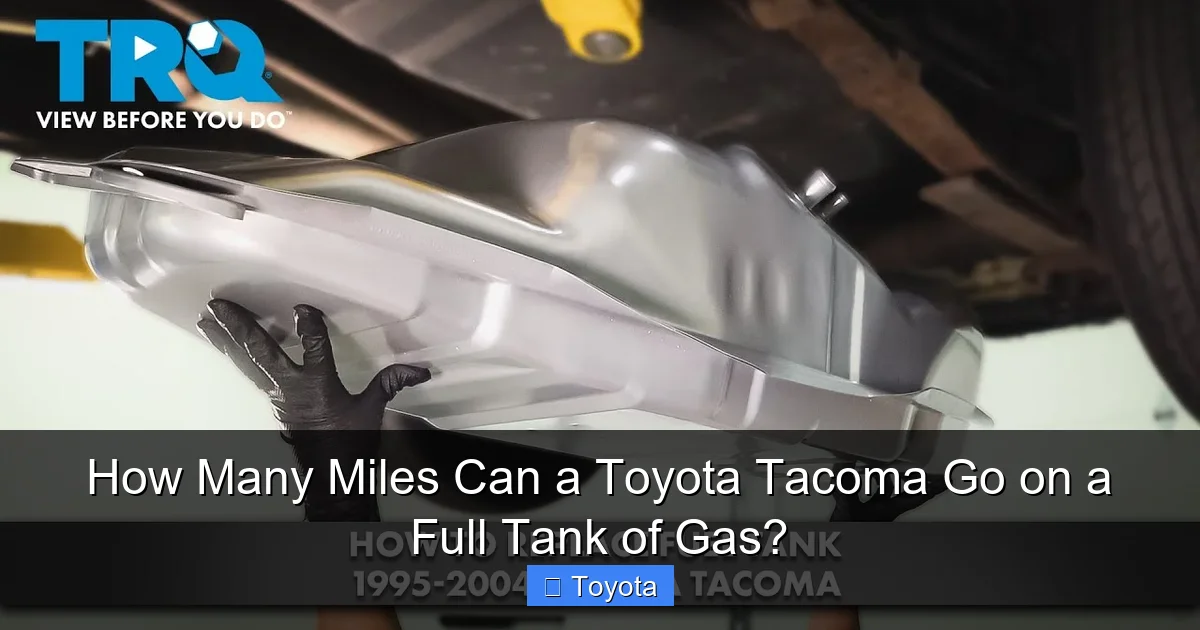
Before we dive into numbers, we must understand the core formula: Range = Fuel Tank Capacity x Miles Per Gallon (MPG). Both of those numbers are fluid. Your tank holds a fixed amount of gasoline, but the MPG you achieve is a chameleon, changing with every drive. Let’s dissect the key factors that turn your Tacoma into a fuel-sipping highway cruiser or a thirsty off-road beast.
Visual guide about How Many Miles Can a Toyota Tacoma Go on a Full Tank of Gas?
Image source: video-thumbnails-1a.s3.amazonaws.com
Engine and Drivetrain: The Heart of the Matter
The most significant factory variable is your powertrain. For the last two decades, Tacomas have primarily offered two engines:
- 4-Cylinder (2.7L): Found on base and some mid-tier trims. It’s significantly less powerful but more fuel-efficient. Expect EPA ratings around 20-22 MPG combined. With the standard 21.1-gallon tank, its theoretical range is roughly 420-460 miles.
- V6 (3.5L): The popular choice for towing and hauling. It provides robust power but consumes more fuel. EPA combined ratings typically sit at 18-20 MPG. On 21.1 gallons, that’s a range of 380-420 miles.
Drivetrain is the second piece. 2WD (Rear-Wheel Drive) models are lighter and have less drivetrain drag, yielding 1-2 MPG better than their 4WD or 4×4 counterparts. The transfer case and heavier front axle add mechanical resistance and weight, which the engine must overcome, burning more fuel. For maximum range, a 2WD 4-cylinder is the king. For capability, the V6 4WD is the workhorse, accepting a shorter range as a trade-off.
Driving Conditions: City vs. Highway vs. Off-Road
Your driving environment is the single biggest daily influence on MPG. The EPA tests use a specific cycle, but your reality differs.
- Highway Cruising (Steady 65-70 mph): This is where Tacomas shine. Aerodynamic drag is minimized, and the engine stays in a efficient RPM range. You can often achieve or even exceed the EPA highway estimate. This is the scenario for maximum range.
- City/Stop-and-Go Traffic: Constant acceleration and braking are fuel-intensive. The engine works hardest from a standstill, and city MPG can be 4-6 MPG lower than highway. A commute dominated by traffic lights will shrink your range substantially.
- Hilly or Mountainous Terrain: Climbing grades forces your engine to work overtime, dramatically increasing fuel consumption. The subsequent downhill decent may use little to no fuel (especially with modern fuel-injection cutoff), but the net effect is a lower average MPG for the trip.
- Off-Road Use: Low-range 4WD, rock crawling in first gear, and spinning tires in mud or sand are the most fuel-prohibitive activities. Your MPG can plummet to single digits. This is “adventure mode,” not “efficiency mode.”
Vehicle Load, Towing, and Aerodynamics
Every 100 pounds of extra weight in your Tacoma reduces fuel economy by approximately 1-2%. This includes passengers, cargo in the bed, and gear inside the cab. But the biggest range killer is towing. The aerodynamic drag and rolling resistance of a trailer create a massive load on the engine. Towing a 5,000-pound trailer can easily drop your Tacoma’s MPG by 30% or more. A truck that normally gets 20 MPG might dip to 14 MPG while towing, cutting its range in half. For specific towing capacities and their impact, refer to our detailed guide on how much a Toyota Tacoma can tow.
Aerodynamic add-ons also matter. A large roof rack, even when empty, creates “parasitic drag.” At highway speeds, it can reduce MPG by 1-3%. If you’re on a long, empty highway trip, removing it can give you a few extra precious miles.
Maintenance and Vehicle Health
A well-maintained Tacoma is an efficient Tacoma. Neglect is a silent range killer.
- Tire Pressure: Under-inflated tires increase rolling resistance. Check pressures monthly and inflate to the manufacturer’s spec on the driver’s door jamb sticker, not the tire sidewall. A 5 PSI drop can reduce MPG by 2-3%.
- Engine Air Filter: A clogged filter starves the engine of air, forcing it to work harder and burn more fuel. Replace it as scheduled, or more often in dusty conditions.
- Oil Viscosity: Using the correct oil weight (e.g., 0W-20 for newer models) ensures optimal lubrication. Thicker oil in cold weather or thinner oil in hot conditions increases internal engine friction. Always use the oil type and quantity specified in your owner’s manual.
- Spark Plugs and Fuel System: Worn spark plugs or dirty fuel injectors cause incomplete combustion, wasting fuel. Follow your maintenance schedule.
For precise maintenance specs, always consult your owner’s manual. You can also find general guidelines for Toyota maintenance on our site, including details on oil capacities for other Toyota models, which follow similar engineering principles.
Climate, Altitude, and Fuel Blends
Extreme temperatures and elevation play a role. Cold weather makes engines run richer (more fuel) until warmed up, and winter fuel blends are less energy-dense. You might see a 10-20% drop in MPG in winter versus summer. High altitude can be a mixed bag: thinner air reduces aerodynamic drag (good) but also reduces engine power, often causing you to use lower gears and higher RPMs (bad), netting a small MPG loss. The quality of gasoline also varies; some top-tier brands with better detergents can help maintain engine efficiency over time.
Tacoma Model Year & Configuration Breakdown: Tank Size & Estimated Range
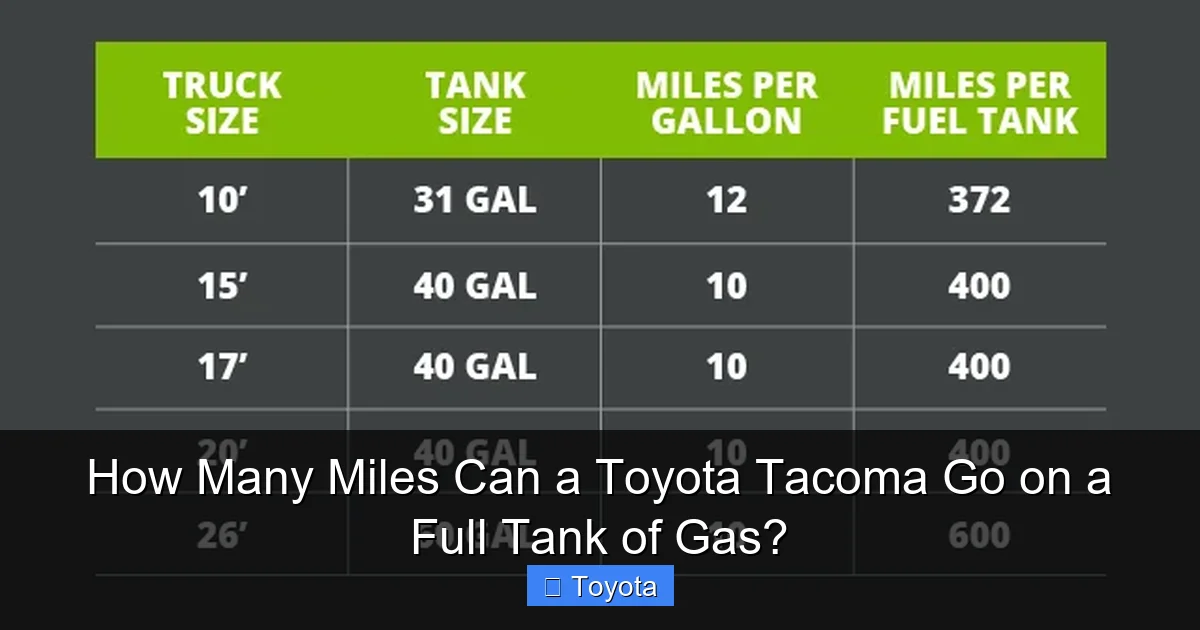
Now, let’s get specific. The fuel tank is your “fuel bucket.” A bigger bucket doesn’t guarantee more range if you’re pouring it out faster (low MPG), but it’s the starting point. Here’s how tank sizes have changed across generations and the resulting *theoretical maximum* ranges based on EPA combined MPG estimates. Remember, real-world results will almost always be lower.
Visual guide about How Many Miles Can a Toyota Tacoma Go on a Full Tank of Gas?
Image source: upack.com
Current Generation (2016-Present Model Year)
The modern Tacoma (N170 platform) standardized on a larger tank. For the vast majority of 2016-2023 models:
- Fuel Tank Capacity: 21.1 gallons (for most trims; some early 2016 models may vary slightly).
- 4-Cylinder (2.7L) 2WD: EPA Combined ~21 MPG. Theoretical Max Range: ~443 miles. Realistic highway-only range: 450-500 miles.
- 4-Cylinder (2.7L) 4WD: EPA Combined ~20 MPG. Theoretical Max Range: ~422 miles. Real-world mixed driving: 350-400 miles.
- V6 (3.5L) 2WD: EPA Combined ~20 MPG. Theoretical Max Range: ~422 miles. Real-world mixed driving: 360-400 miles.
- V6 (3.5L) 4WD: EPA Combined ~19 MPG. Theoretical Max Range: ~401 miles. Real-world mixed driving: 340-380 miles.
Important Note on TRD Pro and Trailhunter: These off-road-focused trims come with heavier off-road tires, suspension, and sometimes a front skid plate that can slightly reduce MPG (by 1-2 MPG). Their range will trend toward the lower end of the estimates above. For a deep dive into the specific gas tank capacity of your model year, see our dedicated article on how many gallons a Toyota Tacoma holds.
Previous Generation (2005-2015 Model Year)
The second-generation Tacoma (N210/N220 platform) had more variation:
- Fuel Tank Capacity: Primarily 18.5 gallons for most 4-cylinder and early V6 models. Later V6 models (2014-2015) and some PreRunner/4×4 trims upgraded to a 21.2-gallon tank.
- 4-Cylinder (2.7L): EPA Combined ~18-19 MPG. With an 18.5-gallon tank: Theoretical Range: ~333-352 miles.
- V6 (4.0L): EPA Combined ~16-17 MPG. With an 18.5-gallon tank: Theoretical Range: ~296-315 miles. With the larger 21.2-gallon tank (on some models): Theoretical Range: ~339-360 miles.
These older trucks, especially the 4.0L V6, are known for being thirsty. Their real-world range is often significantly less than a modern V6 Tacoma, despite having a similarly sized tank on some models. If you own a 2005-2013 Tacoma, expect 250-320 miles on a typical tank of gas.
First Generation (1995-2004 Model Year)
The original Tacoma came with a smaller tank:
- Fuel Tank Capacity: Typically 15.3 or 16.4 gallons depending on cab and bed configuration.
- 2.4L 4-Cylinder or 3.4L V6: EPA ratings were lower (15-17 MPG combined). Theoretical Range: ~230-280 miles. These classic trucks have a much shorter “legs” between fill-ups compared to modern standards.
Real-World vs. EPA Estimates: The Honest Truth
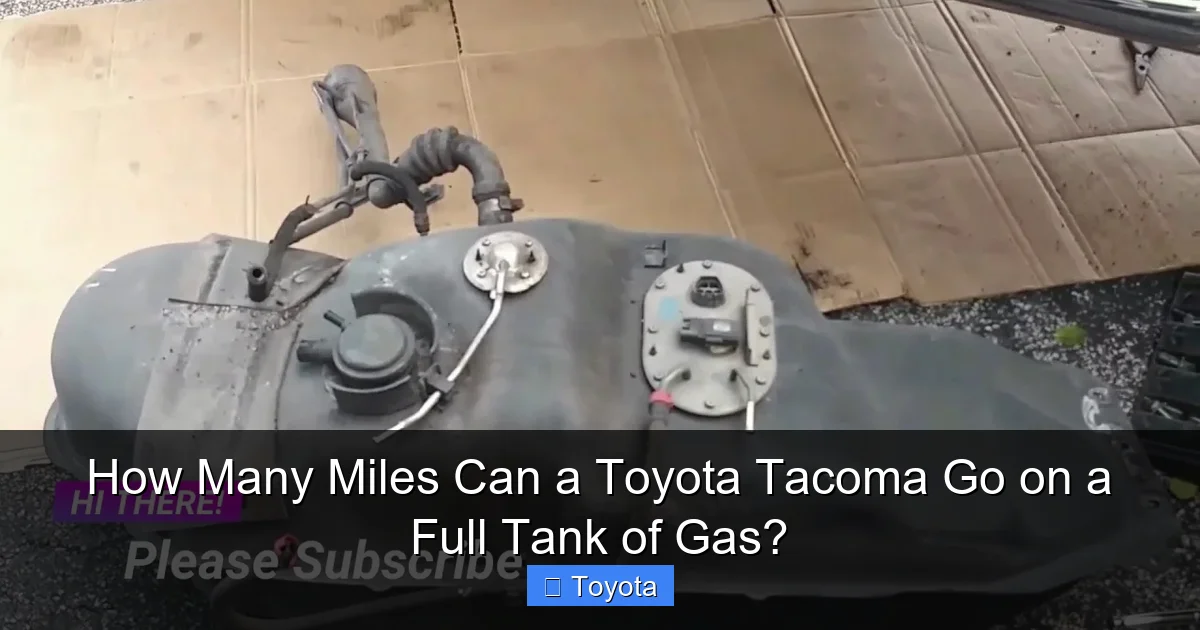
The EPA fuel economy numbers are a useful benchmark, but they are derived from controlled laboratory tests on a dynamometer. They do not account for your personal driving style, your local traffic patterns, or the mountain pass you cross every weekend. The gap between EPA and real-world MPG can be wide.
Visual guide about How Many Miles Can a Toyota Tacoma Go on a Full Tank of Gas?
Image source: i.ytimg.com
How Much Lower is Real-World MPG?
For the current-generation Tacoma, a realistic expectation for combined (city+highway) fuel economy is:
- 4-Cylinder 2WD: Expect 18-20 MPG real-world (vs. 21 EPA).
- 4-Cylinder 4WD: Expect 17-19 MPG real-world (vs. 20 EPA).
- V6 2WD: Expect 17-19 MPG real-world (vs. 20 EPA).
- V6 4WD: Expect 16-18 MPG real-world (vs. 19 EPA).
That 1-3 MPG difference translates directly to 20-60 fewer miles on a full tank. For the older 4.0L V6 (2005-2015), the real-world penalty can be even greater, with many owners reporting 14-15 MPG combined in daily driving, shaving 50+ miles off the theoretical range.
How to Calculate Your Personal Range
The best way to know your Tacoma’s true range is to do your own math after a few tanks.
- Fill Up Completely: Fill the tank until the pump clicks off. Note the odometer reading (Trip A).
- Drive Normally: Drive as you usually would until the fuel light comes on or you feel it’s time to refuel (ideally before it’s on empty).
- Refill and Record: Fill up again, note the gallons used, and reset Trip A. Look at the miles driven on Trip A. Your Range = Miles Driven on That Tank.
- Calculate Your MPG: MPG = Miles Driven / Gallons Used. Multiply your personal MPG by your tank’s capacity (e.g., 21.1 gallons) for your personal maximum range.
Do this 3-5 times to get a solid average. You’ll be shocked how much it varies from the window sticker.
Maximizing Your Tacoma’s Range: Practical Tips
You can’t change your tank size or engine, but you can control how you use them. Here’s how to squeeze every last mile from your fill-up.
Driving Techniques That Save Fuel
- Drive Smoothly: This is the #1 rule. Accelerate gently, anticipate stops to coast, and avoid hard braking. Rapid acceleration from a stop can use 3-5x more fuel than a smooth rollout.
- Use Cruise Control on Flat Highways: Maintaining a constant speed is far more efficient than fluctuating with your foot. It’s most effective on flat, straight roads.
- Observe Speed Limits: Aerodynamic drag increases exponentially with speed. Driving 75 mph vs. 65 mph can increase fuel consumption by 10-15%. Slowing down is the easiest way to save gas on long hauls.
- Turn Off the Engine When Stopped: If you’re idling for more than 60 seconds (e.g., waiting for a train or long load/unload), turn the engine off. Modern starters are efficient, and you’ll save fuel.
- Plan Trips to Avoid Traffic: Use navigation apps to find routes with fewer stop-and-go segments, even if they are slightly longer in distance.
Vehicle Preparation and Maintenance
- Maintain Proper Tire Pressure: Check monthly. Use the pressure on your door jamb sticker, not the max on the tire. This is a quick, free win.
- Reduce Weight: Clean out the bed and cab. Remove unnecessary tools, cargo, or aftermarket accessories. Every 100 lbs. counts.
- Service Regularly: Stick to your maintenance schedule. Fresh spark plugs, a clean air filter, and the right oil make a measurable difference. If you’re due for an oil change, using the correct oil type and capacity for your specific model year and engine is crucial.
- Consider Tire Choice: If you’re on stock or all-season tires, you’re likely optimized for efficiency. If you’ve upgraded to aggressive all-terrain or mud-terrain tires, accept that your MPG will drop 2-4 MPG due to increased rolling resistance and weight.
- Use the Recommended Fuel: For most Tacomas, regular 87-octane is specified. Using premium offers no benefit unless your manual specifically calls for it (some high-altitude or older models might). Save the money.
Smart Trip Planning
Don’t wait until the gas light comes on to start looking for a station. The light typically illuminates with 2.5-4 gallons remaining, giving you a 30-50 mile reserve. That’s your emergency buffer, not your driving strategy. Plan your refueling stops when you have about 1/4 tank left. This prevents stress and protects your fuel pump (which is cooled by gasoline).
On long road trips, use apps like GasBuddy to find the cheapest fuel along your route. Sometimes driving a few extra miles to a cheaper station can offset the cost of the extra gas you used to get there, especially if you’re already low.
Conclusion: Know Your Truck, Drive Smart
So, how many miles can a Toyota Tacoma go on a full tank of gas? For the most common current model—a 2020-2023 V6 4WD—a realistic, real-world expectation is 340 to 380 miles under mixed driving. A 4-cylinder 2WD can push toward 400-450 miles on the highway. Older models, especially V6s from 2005-2015, will be in the 280-330 mile range. Your personal number will land somewhere in these bands based on your unique combination of factors.
The key takeaway is this: your Tacoma’s range is a dynamic figure, not a static spec. By understanding the variables—tank size, MPG reality, load, and driving style—you can accurately predict your truck’s capabilities. More importantly, by adopting efficient driving habits and staying on top of maintenance, you can actively increase your miles per tank, saving money and time at the pump. The Tacoma’s legendary reliability is matched by its practicality; knowing its fuel range is just part of being a smart, prepared owner who can confidently hit the road or the job site without worry.
Frequently Asked Questions
How many miles can I drive after the gas light comes on in my Tacoma?
Most Tacomas have approximately 2.5 to 4 gallons of fuel remaining when the low fuel light illuminates. This typically translates to a reserve of 30 to 50 miles, depending on your exact MPG. However, this is an emergency reserve only. Driving on this reserve regularly can overheat and shorten the life of your in-tank fuel pump, which relies on gasoline for cooling and lubrication.
Does using 4WD all the time reduce my Tacoma’s range?
Yes, significantly. Full-time 4WD (or engaging 4WD on dry pavement) adds constant drivetrain drag and weight, which can reduce fuel economy by 1-3 MPG compared to 2WD. Part-time 4WD systems only engage when needed, so your range is not permanently impacted. For maximum range on dry, paved roads, use 2WD.
Will a lift kit and bigger tires affect my Tacoma’s gas mileage?
Absolutely. A lift kit raises the vehicle’s center of gravity and often requires larger, heavier tires. These tires have increased rolling resistance and the lift increases aerodynamic drag. Combined, you can expect a drop of 2-4 MPG, sometimes more with very aggressive mud-terrain tires. This directly reduces your miles per tank.
Is the fuel range different between the 4-cylinder and V6 Tacoma?
Yes. The 4-cylinder engine is more fuel-efficient, especially in city driving and when unloaded. The V6 provides more power for towing and hauling but consumes more fuel. In real-world mixed driving, the V6 will typically get 1-3 MPG less than the 4-cylinder. With the same 21.1-gallon tank, this means the V6’s range will be about 20-60 miles less than the 4-cylinder’s, depending on driving conditions.
How does towing a trailer impact my Tacoma’s fuel range?
Towing has the most dramatic negative effect on range. The aerodynamic drag and weight of a trailer can reduce your Tacoma’s MPG by 25-35% or more. A truck that normally gets 20 MPG might drop to 13 MPG while towing a heavy trailer. This can cut your range in half, requiring much more frequent fuel stops. Always calculate your towing range conservatively and plan fuel stops accordingly.
What is the actual fuel tank capacity of a Toyota Tacoma?
It varies by generation and configuration. For the current 2016-2023 models, the vast majority have a 21.1-gallon tank. Some early 2016 models and specific trims may differ slightly. Previous generations (2005-2015) commonly had an 18.5-gallon tank, though some later V6 models had a larger 21.2-gallon tank. The first generation (1995-2004) typically had 15.3 or 16.4-gallon tanks. For the exact capacity of your specific model year and trim, consult your owner’s manual or our detailed article on Toyota Tacoma gas tank size.
