How Many Gallons Does a Toyota Tacoma Hold?

Contents
- 1 Key Takeaways
- 2 📑 Table of Contents
- 3 Understanding the Toyota Tacoma’s Fuel Tank Capacity
- 4 Fuel Economy and Real-World Driving Range
- 5 Fuel Type and Octane Requirements
- 6 Comparing Tacoma Generations: Fuel Tank Evolution
- 7 Tips to Maximize Your Tacoma’s Fuel Range
- 8 Conclusion
- 9 Frequently Asked Questions



The Toyota Tacoma’s fuel tank capacity ranges from 20 to 21 gallons depending on the model year, cab configuration, and drivetrain. This size supports a driving range of 350–500+ miles per tank, making it ideal for daily commutes and off-road adventures alike.
If you’re thinking about buying a Toyota Tacoma—or you already own one—you’ve probably wondered: *How many gallons does a Toyota Tacoma hold?* It’s a smart question. Knowing your truck’s fuel tank capacity helps you plan long road trips, estimate fuel costs, and understand how far you can go between fill-ups. Whether you’re using your Tacoma for weekend camping, hauling gear, or just commuting to work, fuel efficiency and range are key factors in your overall experience.
The Toyota Tacoma has been one of America’s most popular midsize trucks for over two decades. Known for its rugged reliability, off-road capability, and strong resale value, the Tacoma appeals to everyone from weekend warriors to daily drivers. But beneath its tough exterior lies a practical design—including a fuel system built to keep you moving. Over the years, Toyota has refined the Tacoma’s engine and fuel delivery systems, but the fuel tank size has remained relatively consistent. Most models from 2016 to 2024 come with a 21-gallon tank, while earlier versions typically hold 20 to 21 gallons depending on configuration.
In this guide, we’ll dive deep into the fuel tank capacity of the Toyota Tacoma across different generations, trims, and drivetrains. We’ll also explore how factors like driving habits, terrain, and vehicle maintenance affect your real-world fuel economy and range. By the end, you’ll have a clear understanding of what to expect from your Tacoma at the pump—and how to get the most out of every gallon.
Key Takeaways
- Fuel tank size varies by model: Most modern Tacomas (2016–2024) hold 21 gallons, while older models (pre-2016) typically hold 20–21 gallons depending on cab and bed configuration.
- Cab and bed length impact capacity: Extended and crew cab models with longer wheelbases often have larger tanks than regular cab versions.
- 4WD vs. 2WD affects placement: Four-wheel-drive models may have slightly different tank designs due to underbody components, but capacity remains similar.
- Driving range is impressive: With 20–21 gallons and 18–23 MPG combined, you can expect 360–480+ miles per tank.
- Off-roading increases fuel use: Aggressive driving, terrain, and accessories like roof racks can reduce efficiency and shrink real-world range.
- Fuel type matters: All Tacomas require regular unleaded gasoline (87 octane), and using premium won’t improve performance or range.
- Maintenance boosts efficiency: Regular oil changes, tire pressure checks, and air filter replacements help maintain optimal fuel economy.
📑 Table of Contents
Understanding the Toyota Tacoma’s Fuel Tank Capacity
When it comes to fuel tank size, the Toyota Tacoma is designed with practicality in mind. Most modern Tacomas—especially those from 2016 onward—come equipped with a 21-gallon fuel tank. This capacity strikes a balance between long-range driving and manageable weight. A larger tank would add bulk and cost, while a smaller one might limit the truck’s versatility, especially for overlanding or rural driving where gas stations are few and far between.
But it’s not just about the number on the sticker. The actual usable capacity can vary slightly due to the fuel reserve and the way the tank is shaped. Most vehicles, including the Tacoma, have a small reserve—usually about 10–15% of the total capacity—that kicks in after the low-fuel light comes on. So, while the tank holds 21 gallons, you might only be able to safely use around 18–19 gallons before needing to refuel.
The 21-gallon tank is standard across most 2016–2024 models, including the SR, SR5, TRD Sport, TRD Off-Road, and Limited trims. However, earlier models—particularly those from 2005 to 2015—often came with a 20-gallon tank. The difference is small, but it can add up over long trips. For example, at 20 MPG, a 20-gallon tank gives you about 400 miles of range, while a 21-gallon tank pushes that to 420 miles. That extra 20 miles might not sound like much, but it could mean the difference between making it to your destination or needing an extra stop.
How Cab and Bed Configuration Affects Tank Size
One of the most common questions Tacoma owners ask is whether the truck’s cab and bed size impacts fuel tank capacity. The short answer? Yes—but only slightly. Toyota designs its fuel tanks to fit within the frame rails and under the cab, so the available space varies depending on the truck’s configuration.
Regular cab models, which are shorter and have less interior space, typically have slightly smaller fuel tanks—usually around 20 gallons in older models. These trucks are less common today, but they were popular in the early 2000s for work use. Because they have a shorter wheelbase and less room under the cab, there’s simply less space to fit a larger tank.
Extended cab (Access Cab) and crew cab (Double Cab) models, on the other hand, have more room. The longer wheelbase and additional cabin space allow Toyota to install a larger 21-gallon tank. This is true for most models from 2016 onward, regardless of whether it’s a 2WD or 4WD setup.
Bed length also plays a subtle role. Longer beds (6-foot) provide more cargo space but don’t directly affect the fuel tank size. However, they do influence the truck’s overall weight and aerodynamics, which can impact fuel economy. A heavier truck with a long bed may get slightly lower MPG, meaning you’ll burn through your 21 gallons a bit faster.
4WD vs. 2WD: Does Drivetrain Matter?
Another factor that often comes up is whether four-wheel drive (4WD) models have different fuel tank capacities than two-wheel drive (2WD) versions. The good news? In most cases, the answer is no. Toyota uses the same 21-gallon tank across both 2WD and 4WD Tacomas from 2016 to 2024.
That said, 4WD models do have additional components under the truck—like transfer cases, front axles, and skid plates—that can affect how the fuel tank is mounted. These parts take up space, so engineers have to design the tank to fit around them. While the shape might be slightly different, the total volume remains the same.
One exception is older models (pre-2016), where some 4WD configurations with larger differentials or different suspension setups might have had a 20-gallon tank instead of 21. But even then, the difference was minimal and not a major concern for most drivers.
The real impact of 4WD isn’t on tank size—it’s on fuel economy. Four-wheel-drive systems add weight and mechanical resistance, which can reduce MPG by 1–3 miles per gallon compared to 2WD models. So while both trucks hold the same amount of fuel, the 4WD version might not go quite as far on a tank.
Fuel Economy and Real-World Driving Range
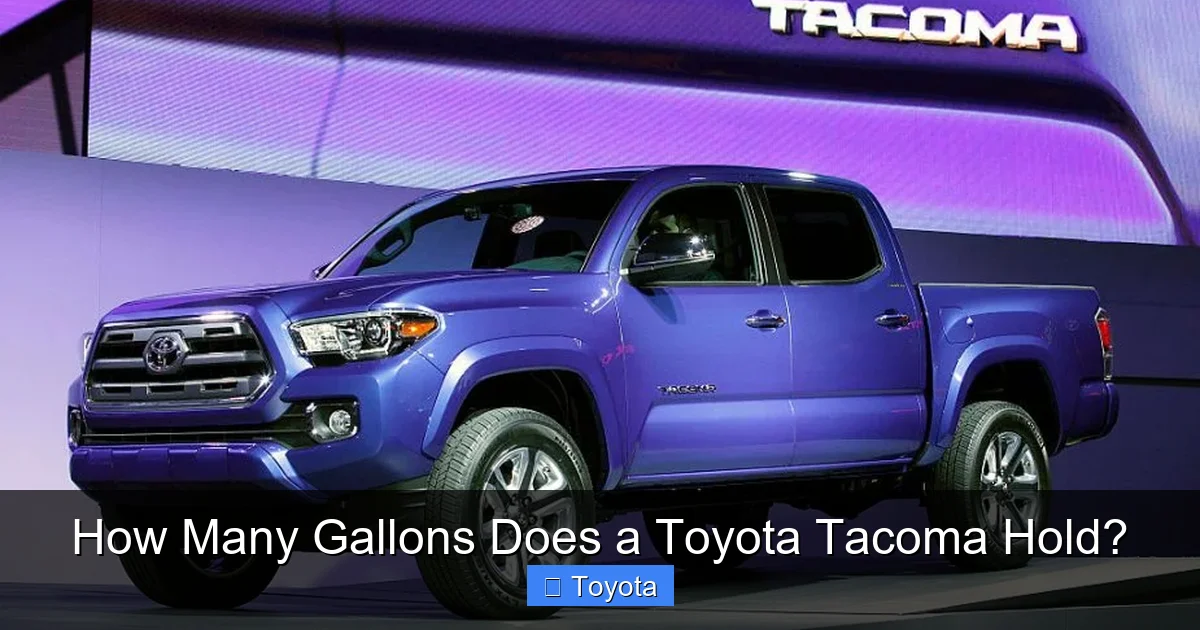
Visual guide about How Many Gallons Does a Toyota Tacoma Hold?
Image source: gearopen.com
Knowing how many gallons your Tacoma holds is only half the story. The other half is understanding how far those gallons will take you. Fuel economy varies based on engine type, driving conditions, and habits, but the Tacoma generally delivers solid mileage for a midsize truck.
Most modern Tacomas (2016–2024) with the 3.5L V6 engine get between 18 and 23 miles per gallon (MPG) combined, according to EPA estimates. The 2.7L four-cylinder engine, found in base models, is slightly more efficient, averaging around 20–22 MPG combined. These numbers are based on a mix of city and highway driving, but real-world results can differ.
For example, if your Tacoma gets 20 MPG and has a 21-gallon tank, your theoretical range is 420 miles (20 MPG × 21 gallons). If you’re getting 22 MPG, that jumps to 462 miles. That’s impressive for a truck that can also tow up to 6,800 pounds.
But let’s be real—most drivers don’t achieve perfect EPA numbers. Aggressive acceleration, frequent stops, and carrying heavy loads can all reduce efficiency. Off-roading, in particular, is a fuel guzzler. Driving on sand, mud, or rocky terrain requires more power and lower gears, which burns fuel faster. Add in accessories like roof racks, light bars, or oversized tires, and you could see your MPG drop by 2–4 points.
City vs. Highway Driving: What to Expect
City driving is where most trucks—including the Tacoma—struggle with fuel economy. Stop-and-go traffic, idling at lights, and frequent braking all contribute to lower MPG. In the city, a V6 Tacoma might average 16–18 MPG, while the four-cylinder could reach 18–20 MPG.
Highway driving is where the Tacoma shines. On the open road, with consistent speeds and minimal braking, you can expect 22–25 MPG from the V6 and up to 24–26 MPG from the four-cylinder. That means a highway-only trip could give you a range of 460–540 miles on a single tank—perfect for cross-country adventures.
One tip to maximize highway efficiency? Use cruise control. It helps maintain a steady speed, which reduces fuel spikes from acceleration and deceleration. Also, keep your speed around 65–70 mph. Going faster increases wind resistance, which can significantly cut into your MPG.
Off-Roading and Towing: How It Affects Range
If you use your Tacoma for off-roading or towing, you’ll notice a noticeable drop in fuel economy. Off-road driving often involves low-speed crawling, steep climbs, and uneven terrain—all of which demand more power and fuel. A weekend on the trails could cut your MPG in half compared to highway driving.
Towing is another major factor. The Tacoma can tow up to 6,800 pounds, but doing so reduces fuel economy dramatically. Towing a trailer or camper can drop your MPG to 10–14, depending on weight and aerodynamics. That means your 21-gallon tank might only get you 210–290 miles—less than half the normal range.
To minimize the impact, make sure your trailer is properly loaded and balanced. Use a weight-distributing hitch if needed, and avoid overloading. Also, consider upgrading to a more aerodynamic trailer or adding a tonneau cover to reduce drag.
Fuel Type and Octane Requirements
Visual guide about How Many Gallons Does a Toyota Tacoma Hold?
Image source: i.ytimg.com
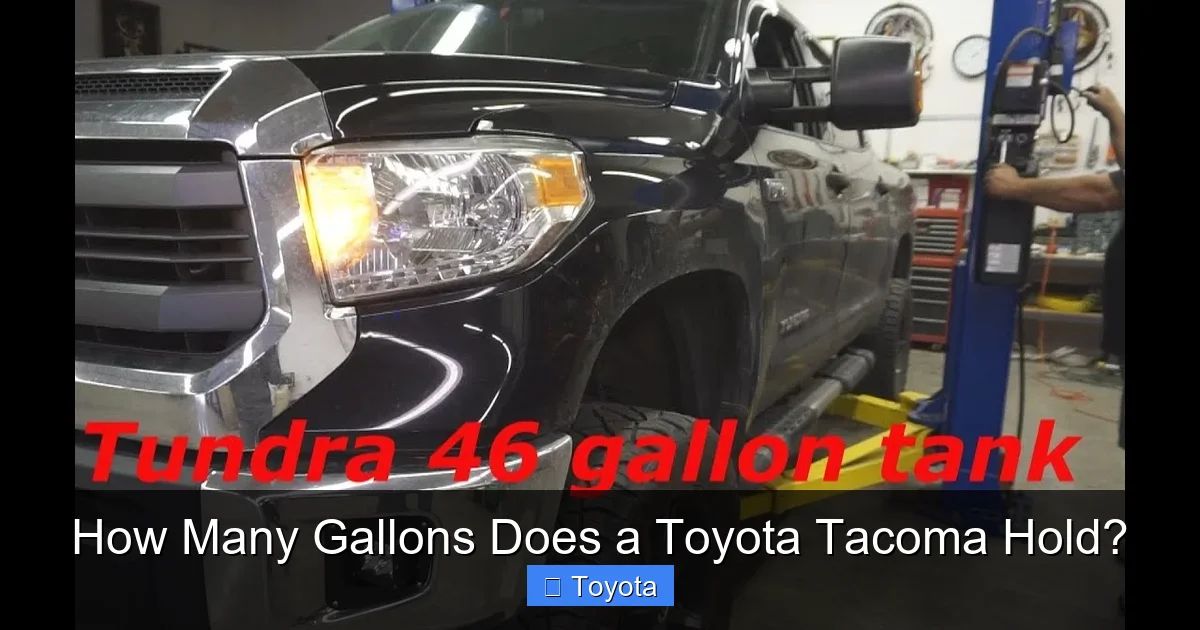
Another important aspect of fueling your Tacoma is understanding what kind of gasoline it needs. Unlike some performance vehicles, the Toyota Tacoma is designed to run on regular unleaded gasoline with an octane rating of 87. You don’t need to spend extra on premium fuel—it won’t improve performance, efficiency, or engine life.
Using 87 octane fuel is not only recommended by Toyota, but it’s also the most cost-effective option. Premium fuel (91–93 octane) is designed for high-compression engines or turbocharged systems, which the Tacoma doesn’t have. Putting premium in your Tacoma won’t hurt it, but it won’t help either—so save your money.
One thing to watch out for is ethanol content. Most gasoline sold in the U.S. contains up to 10% ethanol (E10), which is fine for the Tacoma. However, higher ethanol blends like E15 or E85 are not recommended unless your truck is specifically designed for flex-fuel (most Tacomas are not). Using E85 in a non-flex-fuel vehicle can damage fuel system components and void your warranty.
Fuel Additives and Maintenance Tips
To keep your Tacoma running efficiently, regular maintenance is key. One often-overlooked aspect is fuel system care. Over time, fuel injectors can get clogged with carbon deposits, which reduces fuel flow and efficiency.
Using a quality fuel injector cleaner every 10,000–15,000 miles can help keep things running smoothly. Look for products that contain polyetheramine (PEA), which is highly effective at breaking down deposits. You can also have your fuel system professionally cleaned during routine service.
Other maintenance tips include:
– Replacing the air filter every 15,000–30,000 miles (a dirty filter restricts airflow and reduces MPG)
– Keeping tires properly inflated (underinflated tires increase rolling resistance)
– Using the recommended motor oil (0W-20 full synthetic for most modern Tacomas)
– Getting regular tune-ups, including spark plug replacement every 60,000–100,000 miles
These small steps can add up to significant fuel savings over time.
Comparing Tacoma Generations: Fuel Tank Evolution
Visual guide about How Many Gallons Does a Toyota Tacoma Hold?
Image source: vehq.com
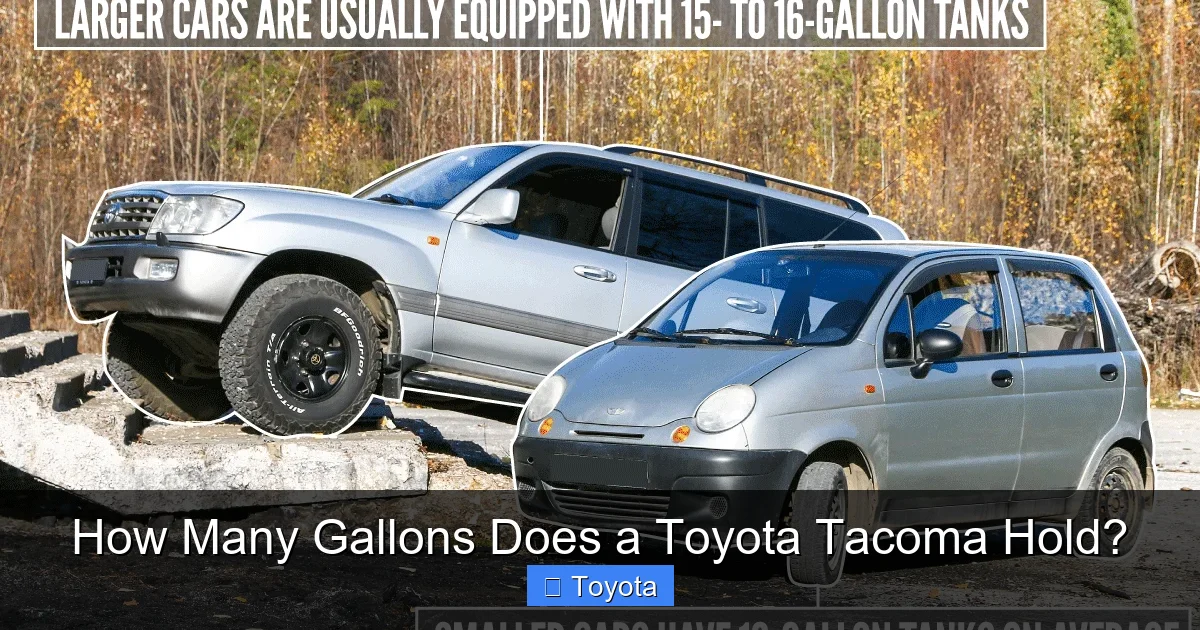
The Toyota Tacoma has gone through several generations since its introduction in 1995. While the overall design has evolved, the fuel tank capacity has remained relatively stable—with a few notable changes.
The first-generation Tacoma (1995–2004) typically came with a 20-gallon fuel tank, regardless of cab or drivetrain. These models were smaller and lighter, with less emphasis on long-range capability.
The second-generation Tacoma (2005–2015) saw a slight increase in size and capability. Most models still had a 20-gallon tank, though some crew cab and 4WD versions could be equipped with a 21-gallon tank, especially in later years.
The third-generation Tacoma (2016–present) standardized the 21-gallon tank across nearly all trims and configurations. This was part of Toyota’s effort to improve range and appeal to overlanders and long-distance drivers. The larger tank, combined with improved engine efficiency, made the Tacoma a top choice for adventure seekers.
One interesting note: the 2024 Tacoma introduces a new hybrid powertrain option. While the fuel tank size remains 21 gallons, the hybrid system improves overall efficiency, potentially boosting MPG into the mid-20s. This could push the range beyond 500 miles per tank—making it one of the most efficient Tacomas ever made.
Special Editions and Aftermarket Modifications
Some Tacoma owners modify their trucks with aftermarket fuel tanks for extended range. These larger tanks—often 25–30 gallons—are popular among overlanders who venture into remote areas with limited fuel access.
However, installing an aftermarket tank requires professional work and may affect your warranty. It also adds weight and can impact handling. For most drivers, the stock 21-gallon tank is more than sufficient.
Special edition models, like the TRD Pro or Trail Edition, don’t typically come with larger fuel tanks. But they often include features like skid plates and upgraded suspension, which can indirectly affect fuel economy by adding weight.
Tips to Maximize Your Tacoma’s Fuel Range
Getting the most out of your Tacoma’s fuel tank isn’t just about how many gallons it holds—it’s about how you use them. Here are some practical tips to stretch your range and save money at the pump:
– **Drive smoothly:** Avoid rapid acceleration and hard braking. Gradual speed changes improve fuel efficiency.
– **Reduce weight:** Remove unnecessary items from the bed or cab. Extra weight burns more fuel.
– **Use cruise control:** On highways, it helps maintain a steady speed and reduces fuel spikes.
– **Plan your route:** Use GPS apps that show real-time traffic and suggest fuel-efficient routes.
– **Combine trips:** Fewer cold starts mean better fuel economy. Group errands together when possible.
– **Keep up with maintenance:** A well-tuned engine runs more efficiently.
– **Check tire pressure monthly:** Properly inflated tires reduce rolling resistance.
By following these tips, you can easily add 10–20 miles to your range per tank—without spending a dime.
Conclusion
So, how many gallons does a Toyota Tacoma hold? For most modern models (2016–2024), the answer is 21 gallons. Older models typically hold 20–21 gallons, depending on cab size and drivetrain. This capacity, combined with decent fuel economy, gives the Tacoma a driving range of 360–500+ miles—making it a reliable companion for daily drives, road trips, and off-grid adventures.
While the fuel tank size is important, it’s just one piece of the puzzle. Your driving habits, terrain, and maintenance routine all play a role in how far your Tacoma can go on a tank. By understanding your truck’s capabilities and taking steps to improve efficiency, you can get the most out of every gallon.
Whether you’re a weekend warrior, a daily commuter, or an overlanding enthusiast, the Toyota Tacoma offers a practical balance of power, capability, and range. And with its proven reliability and strong resale value, it’s no wonder the Tacoma remains one of the most beloved trucks on the road.
Frequently Asked Questions
How many gallons does a 2023 Toyota Tacoma hold?
The 2023 Toyota Tacoma comes with a 21-gallon fuel tank across all trims, including SR, TRD Sport, TRD Off-Road, and Limited. This capacity applies to both 2WD and 4WD models.
Does the Tacoma’s fuel tank size change with the cab size?
Yes, but only slightly. Regular cab models (mostly older) may have a 20-gallon tank, while extended and crew cab models typically have a 21-gallon tank due to more under-cab space.
Can I put premium gas in my Toyota Tacoma?
You can, but it’s not necessary. The Tacoma is designed to run on regular 87 octane fuel. Premium gas won’t improve performance or fuel economy.
How far can a Toyota Tacoma go on a full tank?
With a 21-gallon tank and 18–23 MPG, the Tacoma can travel 378–483 miles on a full tank, depending on driving conditions and engine type.
Does towing reduce the Tacoma’s fuel range?
Yes, significantly. Towing can reduce MPG to 10–14, cutting the range to 210–290 miles on a 21-gallon tank. Proper trailer setup helps minimize the impact.
Are aftermarket fuel tanks available for the Tacoma?
Yes, larger 25–30 gallon tanks are available for overlanding, but they require professional installation and may affect warranty and handling.