What Size Torx Bit for Jeep Wrangler Doors?

Contents
- 1 Key Takeaways
- 2 📑 Table of Contents
- 3 Introduction: The Open-Air Freedom and Its One Catch
- 4 Why Torx? And Why Size is Everything
- 5 The Golden Answer: Torx Bit Sizes by Wrangler Generation
- 6 The Complete Tool List: More Than Just Torx Bits
- 7 Step-by-Step: Removing Your Wrangler Door
- 8 Common Pitfalls and How to Avoid Them
- 9 Reinstallation: Doing It Right the First Time
- 10 Beyond Door Removal: What’s Next?
- 11 Conclusion: Confidence Through Knowledge
- 12 Frequently Asked Questions


Removing your Jeep Wrangler’s doors requires the correct Torx bit to avoid stripping bolts and causing damage. For most JK (2007-2018) and JL/JT (2018+) models, you’ll primarily need a T50 Torx bit for the main door hinge bolts. However, smaller T40 and T45 bits are often needed for interior panels and latch components. Always confirm with your specific model year before starting, as using the wrong size can lead to costly repairs and frustration.
Key Takeaways
- Primary Bit is T50: The main bolts securing the Wrangler door to the hinge are almost universally a T50 Torx for JK, JL, and JT generations.
- Smaller Bits for Internals: Removing the interior door panel and accessing the latch mechanism typically requires T40 and sometimes T45 Torx bits.
- Model Year Matters: While T50 is standard, always double-check your specific year and model, as early TJ models and certain special editions may differ.
- Quality Bits are Non-Negotiable: Use high-quality, impact-rated Torx bits from brands like GearWrench, Craftsman, or Sunex to prevent rounding off the bolts.
- Anti-Seize is Your Friend: Applying a small amount of anti-seize compound to the bolt threads before installation makes future removal much easier and prevents corrosion.
- Don’t Force It: If the bolt doesn’t turn easily with proper torque, stop. Forcing it will strip the head, creating a major headache. Penetrating oil and patience are key.
- Bag and Tag: Immediately place bolts and brackets into labeled bags or containers. Wrangler door bolts are specific and easy to lose or misplace.
📑 Table of Contents
- Introduction: The Open-Air Freedom and Its One Catch
- Why Torx? And Why Size is Everything
- The Golden Answer: Torx Bit Sizes by Wrangler Generation
- The Complete Tool List: More Than Just Torx Bits
- Step-by-Step: Removing Your Wrangler Door
- Common Pitfalls and How to Avoid Them
- Reinstallation: Doing It Right the First Time
- Beyond Door Removal: What’s Next?
- Conclusion: Confidence Through Knowledge
Introduction: The Open-Air Freedom and Its One Catch
Few driving experiences compare to the wind-in-your-hair, sun-on-your-face exhilaration of driving a Jeep Wrangler with its doors off. It’s the ultimate expression of freedom, transforming your vehicle from an SUV into a rolling piece of adventure equipment. But before you can tear down the highway or tackle a backwoods trail in your shirt-sleeves, you have to conquer the first, and most critical, step: actually getting those heavy doors off the hinges. And that starts with one simple, yet profoundly important, question: what size Torx bit do you need?
Using the wrong tool is a classic Jeep owner rite of passage gone wrong. It leads to stripped bolt heads, rounded-off fasteners, and a door that’s now a permanent fixture. This guide is your definitive, no-nonsense manual to solving that puzzle. We’ll break down the exact Torx sizes for every modern Wrangler generation, walk you through the entire removal process, and share professional tips to ensure your door removal is a smooth, successful, and damage-free operation. Let’s get that door off.
Why Torx? And Why Size is Everything
Before we dive into sizes, let’s understand the “why.” Jeep engineers use Torx (the six-point star-shaped head) screws and bolts for a critical reason: torque transfer and cam-out resistance. The design allows for much higher torque to be applied without the driver slipping out of the fastener (cam-out), which is essential for securing heavy vehicle doors. For us, this means a more secure attachment, but also a greater need for a perfect-fit bit.

Visual guide about What Size Torx Bit for Jeep Wrangler Doors?
Image source: wheelingaway.com
The Dangers of the Wrong Bit
Using an undersized Torx bit is the fastest route to a stripped head. The bit will spin inside the fastener, chewing up the delicate aluminum or steel. An oversized bit won’t seat properly and will also slip. Once the head is rounded, your options become terrible: drill it out, use an extractor set, or in the worst case, cut it off. All are time-consuming, frustrating, and risk damaging the hinge or door. The correct bit, snugly seated, engages all six points of the Torx profile, allowing you to apply steady, controlled force.
Material Matters: Bits for Aluminum vs. Steel
Wrangler door hinge bolts are typically steel, but the door itself and many interior fasteners are aluminum. Aluminum is much softer and more prone to stripping. This is why investing in high-quality, hardened steel bits is crucial. Cheap, soft bits from a big-box store might work once or twice, but they will deform and wear quickly, especially on aluminum fasteners. Look for bits labeled “impact rated” or from reputable tool brands known for hardness and durability.
The Golden Answer: Torx Bit Sizes by Wrangler Generation
This is the core of your question. The answer has been remarkably consistent across the last three generations of Wranglers, which is great news for DIYers. The vast majority of bolt removal will be done with one primary bit size.

Visual guide about What Size Torx Bit for Jeep Wrangler Doors?
Image source: enginediary.com
JK Wrangler (2007-2018): The Workhorse Generation
For the immensely popular JK and JKU (Unlimited) models, the standard is clear:
- Main Hinge Bolts (2 per door): T50 Torx. These are the large, often black-painted bolts that connect the door to the door check arm and the main hinge. This is your #1, most-used bit.
- Door Check Arm Bolt: Also typically a T50.
- Interior Door Panel: A mix of sizes. You’ll encounter several T40 Torx screws holding the plastic door panel in place. Some models may also have one or two T25 or T30 for specific trim clips.
- Door Latch & Handle Mechanism: Once the panel is off, the internal latch and interior handle are usually secured with T40 and occasionally a T45 Torx.
Pro Tip: Before you even start, sit in the driver’s seat and look at the interior door panel. You’ll see the screw heads. Use a magnifying glass or good light to confirm the star pattern. It’s a quick visual check that saves time.
JL & JT Wrangler (2018-Present): Modern Refinement
The current JL (two-door) and JT (Gladiator) models, along with the 4-door JLU, follow a very similar pattern to the JK, with one notable change for some models:
- Main Hinge Bolts: Still predominantly T50 Torx.
- Door Check Arm: T50.
- Interior Door Panel: Primarily T40 Torx. JL/JT panels may use more plastic fasteners and clips, but the main screws are still T40.
- The “Maybe” T45: Some 2020+ JL models, particularly those with the optional power-folding mirrors, have been reported to use a T45 for the mirror bracket on the door frame. It’s not on every door, but if you have power-folding mirrors, check the base of the mirror where it attaches to the door skin.
Key Difference: The JL/JT uses more sophisticated plastic retainers and clips. Be gentle when prying the panel to avoid breaking the plastic tabs. A proper plastic trim removal tool is essential.
The Legacy TJ (1997-2006) and YJ (1987-1996)
If you’re rocking an older classic, the pattern changes slightly:
- Main Hinge Bolts: Often a T45 or T50. TJs are famous for using a T45 on the main hinge, but many owners report T50. The YJ can vary more. For these older models, physically checking is 100% mandatory.
- Other Fasteners: Expect a mix of T40, T45, and even some standard hex head bolts on the interior panels.
Bottom Line: For any Jeep from 2007 onward, buy a quality T50 and T40 Torx bit set. You will cover 95% of the job. Add a T45 if you have a newer JL with power folds or an older TJ. When in doubt, look at the bolt.
The Complete Tool List: More Than Just Torx Bits
Think of the Torx bit as your main key, but you need the whole keychain for the job. Having these tools ready before you start will make the process 10x smoother and prevent you from scrambling mid-job.
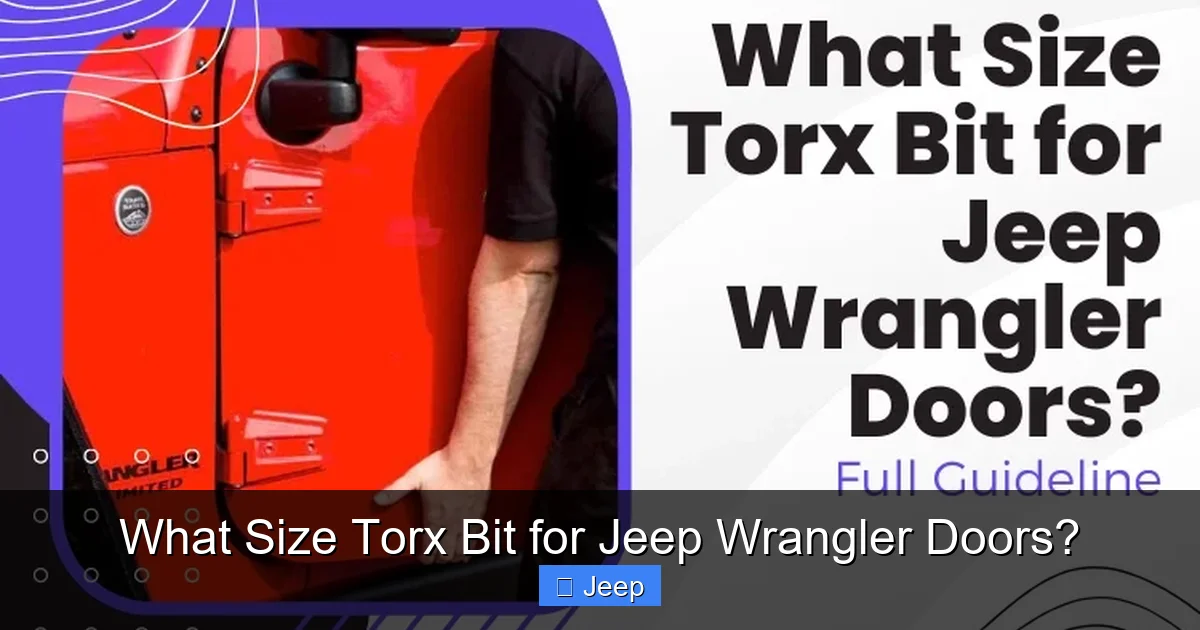
Visual guide about What Size Torx Bit for Jeep Wrangler Doors?
Image source: enginediary.com
- Torx Bit Set (T40, T45, T50): As discussed, get a good set. A 1/4″ drive set is perfect for most applications. Consider a set with a magnetic bit holder.
- Socket & Ratchet Set: A 3/8″ drive ratchet with a 10mm or 13mm socket is often needed for the nut on the backside of the main hinge bolt (especially on JKs). Some models have a nut, some are just a bolt threaded into the hinge. Have both sizes handy.
- Trim Removal Tools: Plastic pry tools are non-negotiable for the interior door panel. They prevent the costly mistake of cracking the plastic door card with a flathead screwdriver.
- Flathead Screwdriver: A small one can be used as a lever to pop the panel clips once you’ve gotten a corner started with the trim tool.
- Pliers: Needle-nose pliers are great for removing plastic retainers or clips that pop out.
- Magnetic Tray or Parts Organizer: You will have 10-15 bolts of different sizes. Keep them organized by door (driver, passenger) and location.
- Penetrating Oil (e.g., PB Blaster): If your Jeep lives in a salty area or hasn’t had its doors off in years, spray this on the hinge bolts 10-15 minutes before you start.
- Anti-Seize Compound: For reinstallation. A tiny dab on the bolt threads is a best practice.
- Gloves & Safety Glasses: Always.
- Helper: Doors are heavy (50-70 lbs). Have someone ready to support the door the moment the last bolt is removed. A dropped door can damage the hinge, the door skin, or your foot.
Step-by-Step: Removing Your Wrangler Door
With the right tools in hand, the process is straightforward. Go slow, be methodical, and don’t be afraid to consult your factory service manual for your specific year if you get stuck.
Phase 1: The Exterior – Freeing the Main Body
Step 1: Preparation. Park on level ground, set the parking brake, and lower the window. This is critical—you’ll need to reach inside to disconnect electrical connectors. Disconnect the negative battery terminal. This prevents any accidental short circuits when you unplug the door wiring harness.
Step 2: Locate and Remove the Main Hinge Bolts. With the door closed, look at the hinges. You’ll see two large Torx bolts on each hinge (four total per door). The upper bolt is often easier to access. Using your T50 bit, carefully loosen and remove each bolt. They may be very tight. Apply steady pressure. If they are stuck, a breaker bar on your ratchet can provide more leverage, but be cautious. If the bolt spins but doesn’t come out, you may have a nut on the backside. If so, you’ll need to access it with a socket.
Step 3: Support the Door. Before removing the final bolt, have your helper position themselves. They should place one hand under the door handle and the other on the bottom of the door frame. The door will drop slightly as the last bolt is removed and will be immediately heavy. Your helper must be ready.
Step 4: Disconnect Electrical. With the door slightly ajar, reach inside. You’ll find a large electrical connector near the front of the door (where the wiring loom enters the body). Press the tab and pull it apart. Some models have a secondary connector for the heated mirror or door lock actuator—disconnect that too. Gently route the wiring out of the way.
Step 5: Lift Off. With all bolts out and wiring disconnected, your helper can carefully lift the door straight up and off the hinge pins. Do not swing it out. The hinge pins are tapered; lifting straight up is the only way. Set the door down on a padded surface (a blanket or foam pad) to protect the paint.
Phase 2: The Interior – Removing the Panel (If Needed)
You don’t always need to remove the interior panel just to take the door off. But if you’re replacing speakers, installing a subwoofer, or fixing a latch, you will. Here’s how:
Step 1: Remove the Armrest Screws. Start by popping off the plastic caps on the armrest to reveal two Torx screws, usually T40.
Step 2: Pry the Panel. Starting at the bottom rear corner, insert your plastic trim tool and gently pry. Work your way around the perimeter. The panel is held by many plastic clips. They will pop with a firm, even pressure. Listen for the clicks.
Step 3: Disconnect Wiring & Handles. Once the panel is mostly free, you’ll see connectors for the door lock switch, window switch, and possibly an ambient light. Disconnect these. Also, there is a plastic rod that connects the interior door handle to the latch. Carefully unclip it from the back of the handle mechanism.
Step 4: Lift Off. The panel is now loose. Tilt the bottom outward slightly to clear the window seal, then lift it up and off the door. Be mindful of the wiring you already disconnected.
Common Pitfalls and How to Avoid Them
Even with the right bit, things can go wrong. Here’s how to sidestep the most common issues.
The “Stripped Bolt” Nightmare
Cause: Using a worn, undersized, or cheap bit. Applying too much angular force (prying with the ratchet).
Prevention: Use new, high-quality bits. Seat the bit fully into the bolt head. Apply pressure straight along the axis of the bolt. If it’s stuck, use penetrating oil and let it sit. Use a ratchet with a long handle for leverage, but push *down* on the handle, not out to the side, which creates angular force.
If it Happens: Stop immediately. Try a 6-point socket if the head is still somewhat intact. You can try a “bolt extractor” bit set, which bites into the damaged metal. As a last resort, you may need to drill the head off, but this risks damaging the hinge. For a stuck bolt on the hinge itself, heat (from a propane torch) can sometimes help, but be extremely careful around the door wires and plastic parts.
The “Dropped Door” Disaster
Cause: Underestimating the weight (50-70 lbs) or having an uncoordinated helper.
Prevention: Communicate clearly with your helper. Have a clear path and a soft landing spot (blankets, foam) ready. Do a practice lift with the last bolt finger-tight to gauge the weight. Consider using a small bottle jack or a helper stand under the door as a secondary support once it’s unbolted.
Broken Plastic Clips & Tabs
Cause: Using a metal tool (screwdriver) on the interior panel, or prying unevenly.
Prevention: Use only plastic trim tools. Start at a known weak point (usually bottom corner). Work slowly and evenly around the entire door. If a clip breaks, they are often available from the dealer or aftermarket suppliers, but it’s an avoidable expense.
Reinstallation: Doing It Right the First Time
Getting the door off is half the battle. Putting it back on correctly is just as important to ensure a proper seal and no rattles.
- Clean the Hinge Pins: Before reinstalling, wipe down the hinge pins and the holes in the door with a clean rag. Any dirt or old grease can prevent a perfect fit.
- Lubricate: Apply a thin film of white lithium grease or a dedicated hinge lubricant to the hinge pin and the bushing inside the door. This promotes smooth movement and prevents squeaks.
- Anti-Seize on Bolts: Apply a small amount of anti-seize compound to the threads of the T50 hinge bolts. This makes future removal easier and helps prevent galvanic corrosion between the steel bolt and the aluminum door.
- Hand-Tighten First: Place the door onto the hinge pins. It should settle into place. Start each hinge bolt by hand to avoid cross-threading. Turn it until it’s finger-tight.
- Torque to Spec: This is the most important step. Do not overtighten! Use a torque wrench. The factory specification for the main door hinge bolts on JK/JL models is typically 35-40 ft-lbs. Overtightening can crush the hinge bushings, strip the threads in the door, or warp the door skin. Tighten the bolts in a criss-cross pattern (top, then bottom) to seat the door evenly.
- Reconnect Electrical: Plug the main wiring harness back in until you hear the click. Reconnect any secondary connectors.
- Check the Fit: Before driving, close the door slowly. It should close with a solid, even thunk. Check the gaps along the front and rear of the door against the fender and rear quarter panel. They should be uniform. Open and close the door several times. It should move smoothly without binding. If the gap is uneven, you likely have a bolt that needs to be loosened and retorqued.
Beyond Door Removal: What’s Next?
With your doors safely off and stored, a world of Wrangler customization opens up. The exposed door sills are a perfect time to install new all-weather floor mats that will now be fully visible and functional. It’s also the ideal moment to clean and treat the door hinge pins and the inside of the door cavity, which is nearly impossible to access with the door on. Many owners take this opportunity to install a bikini top or half-top for a different style of open-air driving. If you’re planning a long off-road trip with the doors off, consider a robust phone mount for the now-exposed A-pillar. The possibilities are endless, but they all start with this fundamental task done correctly.
Conclusion: Confidence Through Knowledge
The question “What size Torx bit for Jeep Wrangler doors?” has a simple, elegant answer: for 2007 and newer models, a T50 for the hinges and a T40 for the interior panel will cover you in 99% of cases. But this article is about more than just a number. It’s about understanding the “why” behind the tool, respecting the engineering, and approaching the job with the right preparation, tools, and patience. A stripped bolt is not a badge of honor; it’s a preventable mistake. By investing in quality bits, using penetrating oil on stubborn fasteners, supporting that heavy door, and torqueing to specification, you transform a potentially frustrating chore into a routine, repeatable maintenance task. You gain the confidence to enjoy the full, open-air experience of your Wrangler, knowing you have the knowledge and skill to put it all back together perfectly. Now, grab your T50, find a helper, and go feel the wind. You’ve earned it.
Frequently Asked Questions
What if my main hinge bolt is rounded and I don’t have a T50?
If the T50 head is already partially stripped, stop immediately. Try a 6-point socket that fits over the bolt head. You can also use a specialized “Torx extractor” bit set designed to bite into damaged fasteners. In extreme cases, you may need to carefully drill the head off, but this is a last resort that risks damaging the hinge.
Can I use an impact driver with Torx bits to remove the door bolts?
You can, and many mechanics do, especially on rusty, seized bolts. However, use caution. An impact driver delivers sudden, rotational force that can easily round off an already compromised or soft aluminum fastener. If using impact, ensure your bits are specifically rated for impact use. For most DIYers, a manual ratchet with steady pressure is safer and provides more control.
My Jeep is a TJ (1997-2006). Is it still a T50?
Probably not. TJs are most commonly known for using a T45 for the main hinge bolts. Some later TJs may have used T50. The only way to be 100% sure is to visually inspect the bolt head yourself. Always verify before purchasing or attempting removal.
Do I need to disconnect the battery before removing the doors?
Yes, absolutely. Disconnecting the negative battery terminal is a critical safety step. It prevents any chance of a short circuit when you unplug the large door wiring harness, which could blow a fuse or damage the vehicle’s electrical system. It’s a simple step that takes two seconds and avoids major headaches.
How long should it take to remove both doors for the first time?
For a first-timer with all tools ready, budget 45 minutes to an hour per door. The process is straightforward, but finding the right bits, dealing with stubborn bolts, and carefully prying panels takes time. Once you’ve done it a few times, you can easily get both doors off in under an hour total.
My door has a power window and locks. Are there any special considerations?
Just be extra careful with the electrical connectors. They are larger and more complex. Note how they connect before unplugging. Some have locking tabs that need to be pressed. Also, when reinstalling the interior panel, ensure all the wiring for the switches is routed correctly behind it and not pinched. The process is the same, just with more connectors to manage.