
What Psi Should a Spare Tire Be

Knowing the correct psi for your spare tire is essential for safety and performance. Most spare tires require higher pressure than regular tires—often between 60 and 80 psi—to support your vehicle temporarily. Always check your owner’s manual or tire sidewall for the exact recommendation.
Key Takeaways
- Spare tires typically need higher psi than regular tires: Most full-size spares match your regular tire pressure (30–35 psi), but compact “donut” spares often require 60–80 psi due to their smaller size and temporary use design.
- Check your owner’s manual or tire sidewall: The manufacturer specifies the correct psi for your spare tire—never guess. This info is usually printed on the spare itself or in the vehicle manual.
- Underinflated spares are dangerous: Driving on a low-pressure spare can cause overheating, poor handling, and even tire failure, especially at highway speeds.
- Overinflation reduces traction and comfort: Too much air makes the spare bounce and lose grip, increasing stopping distance and wear.
- Inspect and inflate your spare regularly: Spares are often forgotten until needed—check pressure every 3–6 months and before long trips.
- Don’t exceed speed or distance limits: Most temporary spares are rated for 50 mph and 50–70 miles—driving beyond these limits risks damage or blowouts.
- Replace aging spares even if unused: Tires degrade over time due to UV exposure and temperature changes—replace spares older than 6–10 years, regardless of tread.
📑 Table of Contents
- Understanding Spare Tires: Why PSI Matters
- Types of Spare Tires and Their PSI Requirements
- How to Find the Correct PSI for Your Spare Tire
- Why Proper PSI Is Critical for Spare Tire Safety
- Maintaining Your Spare Tire: Tips and Best Practices
- Common Mistakes to Avoid with Spare Tires
- Conclusion: Be Prepared, Stay Safe
Understanding Spare Tires: Why PSI Matters
Imagine you’re driving down a quiet country road when suddenly—*thump, thump, thump*. You’ve got a flat tire. You pull over, grab your spare, and start changing it… only to realize the spare is completely flat. Or worse—it’s inflated, but not to the right pressure. Now what?
This is why knowing what psi your spare tire should be isn’t just helpful—it’s critical. A properly inflated spare can get you safely to a repair shop. An underinflated or overinflated one could leave you stranded, cause an accident, or damage your vehicle.
Spare tires come in different types—full-size, compact (often called “donuts”), and run-flat systems—and each has unique pressure requirements. While your regular tires might run at 32 psi, your spare could need 60, 70, or even 80 psi. That’s a huge difference, and ignoring it can have serious consequences.
In this guide, we’ll walk you through everything you need to know about spare tire psi: how to find the right number, why it matters, how to maintain it, and what to do when your spare finally gets used. Whether you drive a sedan, SUV, or pickup truck, this information could save you time, money, and stress down the road.
Types of Spare Tires and Their PSI Requirements
Visual guide about What Psi Should a Spare Tire Be
Image source: motorsnitch.com
Not all spare tires are created equal. The type of spare you have directly affects the psi it needs. Let’s break down the most common types and their typical pressure ranges.
Full-Size Spare Tires
A full-size spare is essentially a regular tire that matches your other four in size, tread, and load capacity. These are common in trucks, SUVs, and older vehicles. Because they’re identical to your standard tires, they usually require the same psi—typically between 30 and 35 psi, depending on your vehicle.
For example, if your Honda CR-V recommends 33 psi for all four tires, your full-size spare should also be inflated to 33 psi. It’s that simple. These spares can be used indefinitely and rotated into regular service, just like any other tire.
Compact Temporary Spares (“Donuts”)
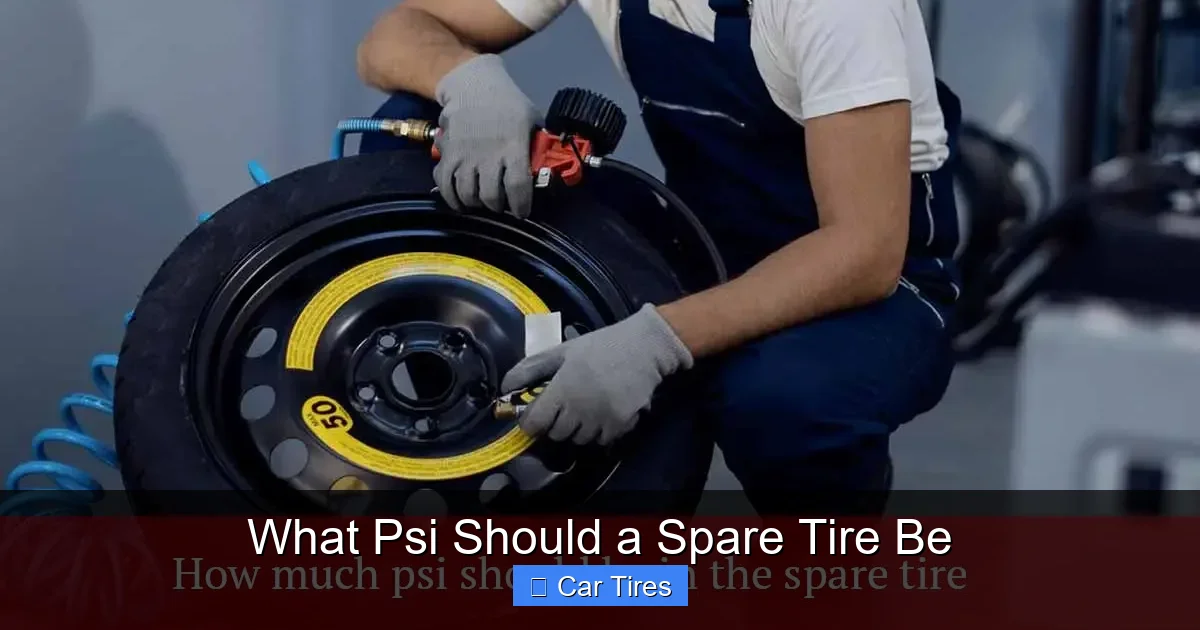
Compact spares, often called “donuts” due to their small, lightweight design, are the most common type of spare in modern cars. They’re smaller in diameter and width than regular tires and are meant for temporary use only.
Because of their reduced size, they need much higher psi to support the vehicle’s weight. Most compact spares require between 60 and 80 psi. For instance, a Toyota Camry with a donut spare might need 65 psi, while a Ford Focus could require 70 psi.
Why so high? The smaller contact patch and stiffer sidewalls mean the tire must be pressurized more to carry the load without overheating or deforming. Think of it like squeezing a balloon—too little air and it flops; too much and it bursts. The sweet spot is critical.
Run-Flat Tires (No Spare Needed)
Some newer vehicles come with run-flat tires, which allow you to drive for a limited distance (usually 50 miles or less) after a puncture, without needing a spare. These tires have reinforced sidewalls that support the car even when deflated.
If your car uses run-flats, you likely don’t have a spare tire at all—just a tire repair kit or sealant. In this case, psi maintenance focuses on the regular tires, not a spare. However, it’s still wise to carry a portable air compressor in case of slow leaks.
Mismatched or Aftermarket Spares
If you’ve replaced your spare with an aftermarket tire or one from another vehicle, the psi requirements might differ. Always check the sidewall of the tire for the maximum pressure rating and consult your owner’s manual. Never assume it matches your factory spare.
For example, a spare tire labeled “Max Load 600 lbs at 65 psi” means it should not exceed 65 psi, even if your manual suggests 70. Safety first—stick to the tire’s limit.
How to Find the Correct PSI for Your Spare Tire
Visual guide about What Psi Should a Spare Tire Be
Image source: ehcar.net
Now that you know the types, let’s talk about how to find the exact psi your spare needs. Guessing is dangerous—here’s how to get it right every time.
Check the Tire Sidewall
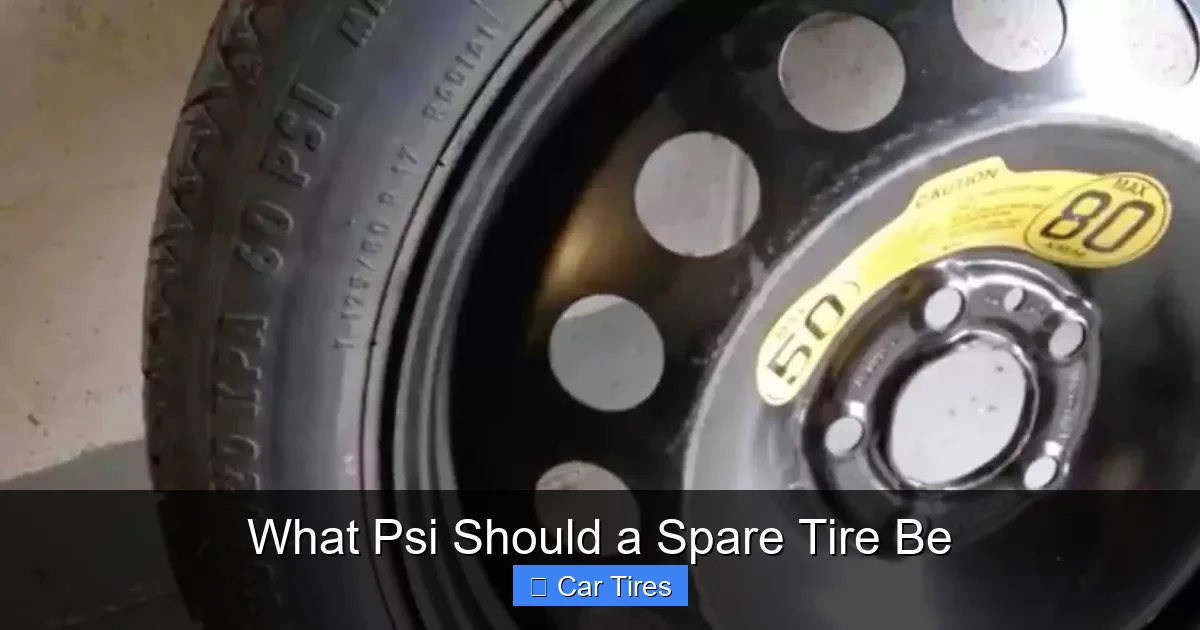
The easiest place to find the recommended psi is right on the spare tire itself. Look at the sidewall for a label that says something like “Max Pressure: 80 psi” or “Inflate to 65 psi.” This is the manufacturer’s specification for that specific tire.
Note: This number is the *maximum* safe pressure, not necessarily the ideal. Some manufacturers recommend inflating to max for compact spares to ensure stability. Others suggest a slightly lower pressure. When in doubt, follow the vehicle manual.
Consult Your Owner’s Manual
Your car’s owner’s manual is the most reliable source. It lists the correct psi for both regular tires and the spare. Look for a section titled “Tire Information,” “Spare Tire,” or “Tire Pressure.”
For example, a 2020 Subaru Outback manual states: “Temporary spare tire inflation pressure: 60 psi.” That’s your target. Even if the tire says “Max 80 psi,” the manual’s recommendation takes precedence because it’s tailored to your vehicle’s weight and balance.
Look for a Sticker in the Driver’s Door Jamb
Many vehicles have a tire pressure sticker on the driver’s side door jamb. This sticker shows the recommended psi for front and rear tires under normal load. While it usually doesn’t list the spare, it confirms the baseline for your regular tires—useful if you have a full-size spare.
If your regular tires are 32 psi, and you have a full-size spare, aim for 32 psi. If it’s a donut, expect 60+ psi.
Use a Reliable Tire Pressure Gauge
Once you know the target psi, use a quality tire pressure gauge to check and adjust. Digital gauges are accurate and easy to read, but a good analog (dial) gauge works too. Avoid the cheap ones at gas stations—they’re often inaccurate.
Pro tip: Check pressure when the tire is cold (not driven for at least 3 hours). Heat from driving increases pressure, giving a false reading.
Example: Finding PSI for a 2018 Honda Accord
Let’s say you drive a 2018 Honda Accord with a compact spare. Here’s how to find the correct psi:
1. Open the trunk and locate the spare tire.
2. Look at the sidewall: it says “T135/90D16 104M” and “Max Pressure: 65 psi.”
3. Check the owner’s manual: it confirms “Temporary spare tire: inflate to 65 psi.”
4. Use a gauge to check current pressure. If it’s 50 psi, add air until it reaches 65 psi.
Done. You’re ready for a flat.
Why Proper PSI Is Critical for Spare Tire Safety
Visual guide about What Psi Should a Spare Tire Be
Image source: ehcar.net
You might think, “It’s just a spare—how bad can it be?” The truth is, improper psi can turn a simple tire change into a dangerous situation.
Underinflation: The Silent Danger
An underinflated spare is unstable. The sidewalls flex too much, generating heat. At highway speeds, this heat can cause the tire to fail—suddenly and catastrophically.
Imagine driving 60 mph on a spare inflated to only 40 psi when it needs 65. The tire overheats, the tread separates, and you lose control. Worse, underinflation reduces traction, making braking and cornering unsafe.
Compact spares are especially vulnerable. Their small size means less air volume, so even a small drop in psi has a big impact.
Overinflation: Hard and Unforgiving
Too much air is also risky. An overinflated spare rides harshly, bouncing over bumps and reducing contact with the road. This leads to:
– Poor grip, especially in rain or snow
– Increased stopping distance
– Uneven wear on the center of the tread
– Higher risk of blowouts from impact (e.g., potholes)
Think of it like jumping on a trampoline with too much air—it’s stiff and unpredictable. Your car handles the same way.
Speed and Distance Limits
Most temporary spares are rated for 50 mph and 50–70 miles. This isn’t arbitrary—it’s based on the tire’s construction and psi. Driving faster or farther increases stress, especially if psi is wrong.
For example, a donut spare at 70 psi might handle 50 mph fine, but at 80 mph, the centrifugal force can tear the tread apart. Always obey the limits—your spare isn’t built for long hauls.
Real-World Example: The Blowout on I-95
A driver in Virginia had a flat and installed their compact spare. They checked the pressure—only 50 psi, but the tire needed 65. They drove 40 miles at 65 mph to reach a shop. Halfway there, the spare overheated and blew out, causing a minor crash.
The lesson? Even a small psi deficit can be dangerous at speed. Always inflate to the correct level.
Maintaining Your Spare Tire: Tips and Best Practices
A spare tire is only useful if it’s ready when you need it. Unfortunately, most people forget about it until it’s too late. Here’s how to keep your spare in top condition.
Check Pressure Every 3–6 Months
Spare tires lose air over time—about 1–2 psi per month, even when unused. Temperature changes accelerate this. A spare stored in a hot trunk can lose pressure faster.
Set a reminder on your phone: “Check spare tire pressure” every three months. It takes five minutes and could save your trip.
Inspect for Damage and Wear
While checking pressure, look for:
– Cracks in the sidewall (sign of aging)
– Bulges or blisters (internal damage)
– Dry rot (brittle, discolored rubber)
– Tread wear (even unused tires degrade)
If you see any of these, replace the spare—even if it looks fine otherwise.
Store It Properly
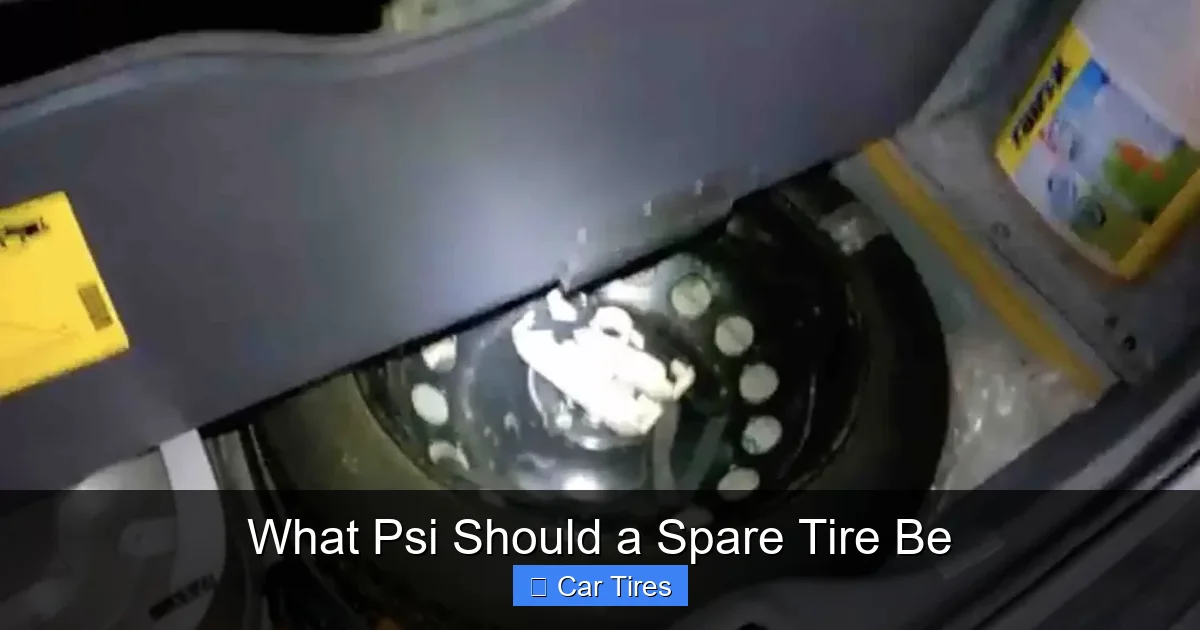
If your spare is stored under the car (common in trucks and SUVs), make sure the winch mechanism works. Test it once a year. If it’s in the trunk, keep it secured so it doesn’t roll around.
Avoid storing heavy items on top of the spare—it can damage the tire or rim.
Replace Old Spares
Tires have a lifespan, even if never used. Most manufacturers recommend replacing spares after 6–10 years. Check the DOT code on the sidewall (e.g., “DOT XXXXXXX 2323” means made in the 23rd week of 2023).
If your spare is from 2014 or earlier, it’s time for a new one.
Carry a Portable Air Compressor
A 12V air compressor plugs into your cigarette lighter and can inflate a flat spare in minutes. Keep one in your trunk—especially if you live in a cold climate where pressure drops in winter.
Bonus: Use it to top off your regular tires too.
Know How to Change a Tire
Even with the right psi, you need to know how to use the spare. Practice changing a tire in your driveway. Make sure you have:
– A working jack
– A lug wrench
– Wheel wedges (to prevent rolling)
– Gloves and a flashlight (for night changes)
Confidence comes from practice.
Common Mistakes to Avoid with Spare Tires
Even experienced drivers make spare tire mistakes. Here are the most common—and how to avoid them.
Assuming All Spares Use the Same PSI
Just because your friend’s car uses 65 psi doesn’t mean yours does. Every vehicle is different. Always check your manual.
Using a Spare Beyond Its Limits
Driving 100 miles on a donut spare or cruising at 70 mph is asking for trouble. Stick to the 50 mph, 50–70 mile rule.
Ignoring the Spare Until It’s Needed
“I’ll check it later” turns into “I wish I had checked it.” Make spare maintenance part of your routine.
Mixing Spare Types
Never put a compact spare on a different axle than recommended (usually the rear). It can affect handling and ABS systems.
Overlooking the Spare in Tire Rotations
If you have a full-size spare, include it in your tire rotation schedule. This ensures even wear and extends tire life.
Conclusion: Be Prepared, Stay Safe
Knowing what psi your spare tire should be is more than a technical detail—it’s a safety essential. Whether you drive a compact car with a donut spare or an SUV with a full-size backup, the right pressure ensures your spare can do its job when you need it most.
Remember: most compact spares need 60–80 psi, while full-size spares match your regular tires (30–35 psi). Always check the owner’s manual or tire sidewall for the exact number. Inspect your spare regularly, keep it inflated, and replace it when it ages.
A little maintenance now can prevent a big problem later. Don’t wait for a flat to think about your spare. Check it today—your future self will thank you.
Frequently Asked Questions
What psi should a spare tire be for most cars?
Most compact spare tires (donuts) require 60 to 80 psi, while full-size spares typically match your regular tire pressure, usually 30 to 35 psi. Always check your owner’s manual for the exact recommendation.
Can I drive long distances on a spare tire?
No. Temporary spares are designed for short-term use only—usually 50 to 70 miles and speeds under 50 mph. Driving beyond these limits can cause tire failure.
Is it safe to drive on an underinflated spare?
No. An underinflated spare can overheat, lose traction, and blow out, especially at highway speeds. Always inflate to the recommended psi before use.
How often should I check my spare tire pressure?
Check your spare tire pressure every 3 to 6 months, or before long trips. Spare tires lose air over time, even when not in use.
Can I use a spare tire with a different psi than recommended?
No. Using the wrong psi can compromise safety, handling, and tire integrity. Always follow the manufacturer’s specified pressure for your spare.
When should I replace my spare tire?
Replace your spare tire every 6 to 10 years, even if it’s never been used. Tires degrade over time due to exposure to heat, light, and air.