What Jeep Do I Have?

Contents
- 1 Key Takeaways
- 2 📑 Table of Contents
- 3 The VIN: Your Jeep’s Unchangeable Fingerprint
- 4 Visual Identification: Reading the Clues Your Jeep Gives You
- 5 Decoding the Door Jamb Sticker: The Insider’s Blueprint
- 6 Model Line Deep Dive: Common Confusions Explained
- 7 Online Resources and Communities: Crowdsourcing Your Answer
- 8 Common Pitfalls and “Almost” Identifications
- 9 Why This All Matters: Beyond Just a Name
- 10 Frequently Asked Questions

Jumper Cables
Foam Cannon

Liquid Car Polish

Dashboard Polish
Figuring out “What Jeep Do I Have?” is easier than you think. Your Vehicle Identification Number (VIN) is the ultimate source of truth, revealing your Jeep’s exact model, year, engine, and factory features. Don’t have the VIN? No problem. Distinctive design cues—like the iconic seven-slot grille, body style, and specific badging—provide strong clues. This guide walks you through every method, from decoding your door jamb sticker to avoiding common misidentification pitfalls, so you can know your Jeep inside and out.
You’re standing in your driveway, looking at your trusty rig. You know it’s a Jeep—that part is obvious. But when your friend asks, “So, what year is it? A Cherokee or a Wrangler?” you hesitate. Maybe you bought it used and the paperwork is long gone. Maybe it’s a hand-me-down with a faded badge. That moment of uncertainty is frustratingly common. “What Jeep do I have?” is a fundamental question every owner should be able to answer, not just for bragging rights, but for maintenance, repairs, insurance, and even when you decide it’s time to move on. The good news? With a few simple detective skills, you can become an instant expert on your own vehicle.
Jeep’s lineup has been both brilliantly iconic and confusingly overlapping over the decades. The same seven-slot grille has adorned everything from military-inspired rigs to luxury family haulers. Badges like “Sport,” “Sahara,” and “Limited” have different meanings across model lines. A 2024 Grand Cherokee L is a three-row family SUV, while a 2024 Wrangler is a bare-bones, door-ripping-off adventure machine. They share a brand, but little else. This guide will cut through the noise. We’ll start with the single most important tool in your arsenal: the VIN. Then, we’ll become visual identification experts, decoding body styles, grilles, and details. Finally, we’ll explore the treasure map on your door jamb and the common mistakes that trip everyone up. Let’s get to know your Jeep.
Key Takeaways
- Your VIN is the gold standard: The 17-digit VIN, found on the dashboard and door jamb, is the only way to get a 100% accurate, factory-level specification of your Jeep’s model, year, engine, and trim.
- Visual ID starts with the grille and body: A traditional, vertical seven-slot grille almost always means Wrangler or Gladiator. A more integrated, horizontal grille points to Grand Cherokee, Cherokee, or Compass.
- Doors and size matter: Two doors? Likely a Wrangler or classic Cherokee. Four doors? Could be a Grand Cherokee, Wrangler Unlimited, or modern Cherokee. A pickup bed? That’s a Gladiator.
- The door jamb sticker is your secret weapon: The manufacturer’s plate on the driver’s side door post lists the exact model year, body style, and often the trim level and engine code in a format only dealers and enthusiasts fully understand.
- Generation knowledge is key: Jeeps have distinct generational changes. A 2018 Wrangler (JL) looks very different from a 2010 (JK). Knowing approximate years helps narrow down models dramatically before you even check the VIN.
- Don’t trust badging alone: A “Limited” badge on a Grand Cherokee means something different than a “Limited” badge on a Wrangler. Always cross-reference visual clues with the VIN or door sticker for certainty.
- Once you know your Jeep, you can maintain and sell it properly: Accurate identification is crucial for buying the right parts, performing correct maintenance, and understanding the paperwork needed to sell your car in your state.
📑 Table of Contents
- The VIN: Your Jeep’s Unchangeable Fingerprint
- Visual Identification: Reading the Clues Your Jeep Gives You
- Decoding the Door Jamb Sticker: The Insider’s Blueprint
- Model Line Deep Dive: Common Confusions Explained
- Online Resources and Communities: Crowdsourcing Your Answer
- Common Pitfalls and “Almost” Identifications
- Why This All Matters: Beyond Just a Name
The VIN: Your Jeep’s Unchangeable Fingerprint
If you only take one thing from this article, let it be this: your Vehicle Identification Number (VIN) is the absolute, final authority on what your Jeep is. This 17-character alphanumeric code is assigned to your specific vehicle at the factory and never changes. It contains a wealth of encoded information that, when decoded, tells you everything from the plant it was built in to the exact transmission and axle ratios it left the factory with.
Where to Find Your Jeep’s VIN
Jeep, like all manufacturers, places the VIN in several standard locations. You’ll need to find it to use any official decoder or to provide it to a parts store or mechanic.
- Dashboard (Driver’s Side): The most common spot. Stand outside the driver’s door and look at the corner of the windshield where it meets the dash. The VIN is usually stamped on a small metal plate and should be visible from outside the vehicle.
- Driver’s Side Door Jamb: Open the driver’s door and look at the area where the door latches to the body (the “B-pillar”). There will be a sticker or plate with the VIN and often a copy of the tire pressure placard.
- Engine Block: On most Jeeps, the VIN is also stamped directly onto the engine block itself, usually on the top or side. This is a great way to verify an engine has never been swapped.
- Frame/Chassis: On older models (pre-2000s) and some Wranglers, you might find it stamped on the frame, often near the front of the driver’s side frame rail.
- Registration and Title: Your state-issued paperwork will list the VIN. This is a perfect backup if the physical plates are worn or damaged.
How to Decode Your VIN
You don’t need to be a cryptographer to crack the code. The VIN is broken into meaningful sections (World Manufacturer Identifier, Vehicle Descriptor Section, Vehicle Identifier Section). For a quick, free, and accurate readout of your Jeep’s basic specs, use a reputable online decoder.
- Official Mopar (FCA/Stellantis) VIN Lookup: The automaker’s own tool is the most accurate for factory build sheets. Search for “Mopar VIN decode” or “Stellantis VIN lookup.”
- NICB VINCheck: A free service from the National Insurance Crime Bureau that confirms basic vehicle data and checks for theft or salvage records.
- Commercial Decoders (e.g., Carfax, AutoCheck): These provide detailed vehicle history reports (which are great for used car purchases) and will decode the VIN to show model, year, engine, and trim.
What you’ll learn: A proper decoder will tell you the exact model year (e.g., 2018, not “around 2018”), the specific model (e.g., Wrangler Unlimited Rubicon, Grand Cherokee L Limited), the engine code (e.g., 3.6L Pentastar V6, 2.0L Turbo I4), and often the assembly plant and production sequence number. This is the definitive answer to “What Jeep do I have?”
Visual Identification: Reading the Clues Your Jeep Gives You
Before you run to get the VIN, you can learn a tremendous amount just by looking. Jeep’s design language is consistent within model families but distinct between them. Train your eye with these key identifiers.
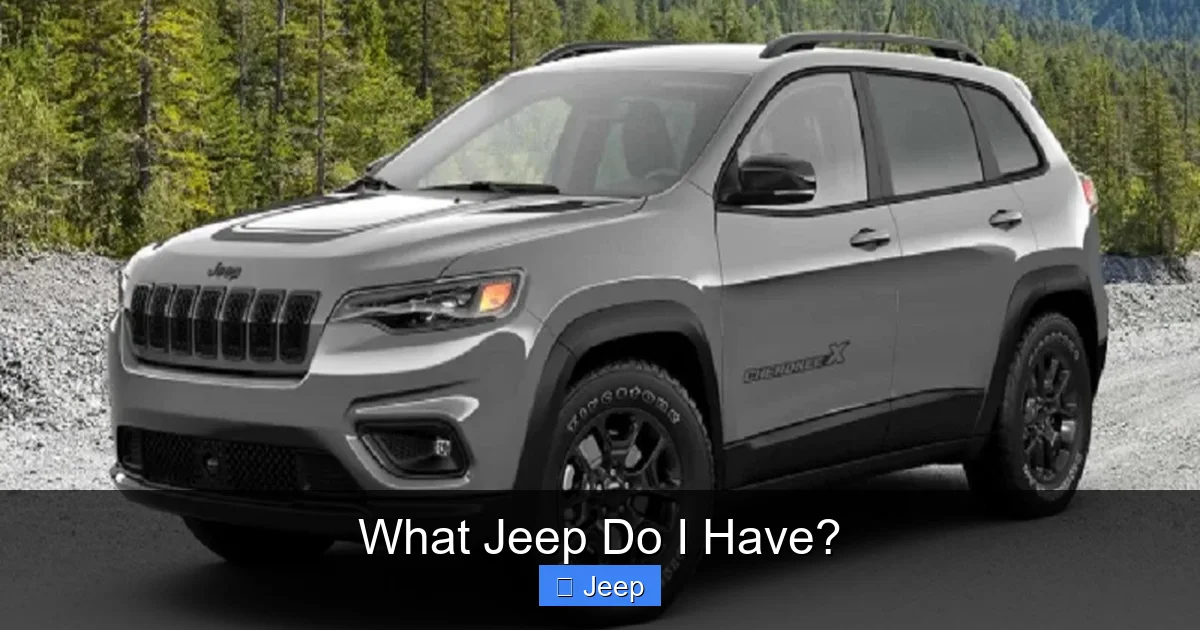
Visual guide about What Jeep Do I Have?
Image source: d1jougtdqdwy1v.cloudfront.net
The Grille: Your First and Most Important Clue
The iconic seven-slot grille is universal, but its shape and integration are model-specific.
- Vertical, Flat, and Protruding: This is the classic, military-Jeep look. If your grille stands proud of the hood/bumper and the slots are perfectly vertical, you are almost certainly looking at a Wrangler (any generation: YJ, TJ, JK, JL, JT Gladiator) or a Jeepster Commando (very rare vintage). This is the most unambiguous visual signature.
- Horizontal and Integrated: If the grille slots are more horizontal and the grille is flush or slightly recessed into the front fascia, you are in the realm of the Cherokee (XJ, KL), Grand Cherokee (ZJ, WJ, WK, WK2, WL), Compass (MP, ML, JL), Renegade (BU), and Patriot (MK). The exact shape varies by generation.
- Modern, Sculpted, and Large: The current Grand Cherokee (WL) and Grand Cherokee L have a massive, highly sculpted grille that dominates the front end, a world away from the simpler designs of the past.
Body Style & Doors: The Shape of Things
Count the doors and look at the overall silhouette.
- Two-Door, Removable Roof/Doors: This is the domain of the Wrangler (YJ, TJ, JK, JL) and the classic Cherokee XJ (1984-2001). If you can take the doors off and the roof comes off (soft or hard top), it’s a Wrangler. A fixed-roof, two-door SUV with a near-vertical rear window is likely an XJ Cherokee.
- Four-Door, Fixed Roof: This covers the vast majority of modern Jeeps. It could be a Wrangler Unlimited (JKU/JLU) (which still has removable doors/roof), a Grand Cherokee (all generations), a Cherokee (KL) (2014-2023), a Compass, Renegade, or Patriot. Size is a big differentiator here.
- Pickup Truck (Bed): Only one current model fits: the Gladiator (JT). It is, mechanically and visually, a Wrangler JL with a pickup bed. Its grille is vertical and protruding like a Wrangler’s.
- Size Comparison: The Grand Cherokee is a mid-to-full-size SUV. The Cherokee (KL) and Compass are compact. The Renegade is subcompact. A Wrangler Unlimited is shorter in wheelbase but taller and boxier than a Grand Cherokee.
Tailgate and Rear Hatch: The Backstory
The rear end provides final confirmation.
- Hinged Tailgate with Side-Opening Rear Window: Classic Wrangler (all gens) and Gladiator feature this. The tailgate drops down, and the rear window can swing out or (on newer models) roll down independently.
- Liftgate (Hatch): All other modern Jeeps—Grand Cherokee, Cherokee, Compass, Renegade, Patriot—use a conventional rear liftgate that swings upward, often with a separate rear window wiper.
- Side-Hinged Rear Doors: The two-door Cherokee XJ and the very early Wagoneer (SJ) had side-hinged rear doors like a minivan. This is a dead giveaway for those specific vintage models.
Decoding the Door Jamb Sticker: The Insider’s Blueprint
That sticker on your driver’s side door post is more than just tire pressure info. In the top section, often in a box or labeled “VEHICLE IDENTIFICATION,” is a goldmine of data. It’s written in a shorthand that can be cryptic but is decipherable.

Visual guide about What Jeep Do I Have?
Image source: motortrend.com
Reading the Code
Look for a line that might read something like: 4DR WK2 74R LUXURY GROUP 3.6V6 or 2DR JK SPORT 3.6V6. Here’s the breakdown:
- 4DR/2DR: Number of doors.
- WK2, JK, JL, WL, KL, etc.: This is the internal model/platform code. WK2 = Grand Cherokee (2011-2022), JK = Wrangler (2007-2018), JL = Wrangler/Gladiator (2018+), WL = Grand Cherokee (2022+), KL = Cherokee (2014-2023). Learning these codes is like getting a decoder ring.
- 74R, 77W, 80A, etc.: These are trim/package codes. “74R” is often a Laredo, “77W” a Limited, “80A” a Rubicon, but they change by model and year. A quick web search for “[Your Model Code] trim code [code]” will reveal it.
- 3.6V6, 2.0T, 5.7H8: The engine. 3.6L Pentastar V6 is the most common. 2.0T is the turbo 4-cylinder. 5.7H8 is the Hemi V8.
This sticker is factory-original and will never lie. It’s the single best piece of evidence you can have, short of the full VIN decode.
Model Line Deep Dive: Common Confusions Explained
Let’s tackle the specific models that get mixed up most often.
Visual guide about What Jeep Do I Have?
Image source: adventurejeep.com
Wrangler (YJ/TJ/JK/JL) vs. Grand Cherokee (ZJ/WJ/WK/WK2/WL)
The confusion is understandable—both are iconic. But the differences are stark:
- Wrangler: Body-on-frame, solid axles (front and rear on most), removable doors/roof, short overhangs, high approach/departure angles, minimal interior sound deadening. Purpose-built for off-roading. The grille is vertical and flat.
- Grand Cherokee: Historically unibody (except for the early ZJ had a unique unitized body, but not body-on-frame like a Wrangler), independent front suspension (IFS) on all modern models (except the 4xe hybrid which is IFS/IRS), fixed roof/doors, luxurious interior options. It’s a family SUV with serious off-road capability in higher trims. The grille is integrated and horizontal.
Cherokee XJ (1984-2001) vs. Cherokee KL (2014-2023)
These share a nameplate but are completely different vehicles separated by a 13-year gap with no Cherokee in the US.
- XJ (The “Classic” or “Sport” Cherokee): Two-door or four-door, unibody, iconic boxy shape with a nearly vertical rear window on the 4-door, side-hinged rear doors on 2-door, simple interior. A legend. The grille is more integrated than a Wrangler’s but still fairly upright.
- KL (The Modern Cherokee): Only four-door, modern aerodynamic styling, car-like unibody, far more refined. It’s a direct competitor to the Ford Escape and Honda CR-V. The grille is a slim, horizontal, three-slot design unique to this generation.
Compass (MP/ML/JL) vs. Patriot (MK)
These were sold side-by-side for years as “budget” compact crossovers. They are mechanically similar but styled differently.
- Patriot (2007-2016): Has a more traditional, boxy, utilitarian look reminiscent of the old Cherokee XJ. It has a very flat rear tailgate with a small, almost hidden rear window wiper.
- Compass (2007-Present): More rounded, modern crossover styling. The current JL generation (2017+) has a much larger, more aggressive grille and overall size increase. The rear tailgate is more contoured.
Online Resources and Communities: Crowdsourcing Your Answer
When in doubt, the global Jeep community is an incredible resource.
- Forums (JeepForum.com, WranglerForum.com, etc.): Post clear, well-lit photos of your Jeep’s front, rear, side, and door jamb sticker. Experts will identify it within minutes. Be sure to mention your country, as model availability varies.
- Social Media Groups: Facebook groups like “Jeep Wrangler Owners” or “Grand Cherokee Owners” are full of people who can spot a 2015 vs. 2016 Wrangler from a mile away.
- Image Search: Find a photo of your exact front grille and rear tailgate. Search Google Images with terms like “2012 Jeep Grand Cherokee front grille” or “2018 Jeep Wrangler JL rear tailgate.” Compare results.
- Building a VIN from Clues: If you have a partial VIN from a title or old part, online forums can sometimes help you fill in the blanks based on the known characters and your vehicle’s features.
Common Pitfalls and “Almost” Identifications
Even seasoned enthusiasts get tripped up. Beware these traps:
- The Liberty/Cherokee (KK) to Cherokee (KL) Transition: The Liberty (2002-2012) was replaced by the Cherokee (KL) in 2014. A 2013 Liberty looks nothing like a 2014 Cherokee. If you have a 2012-2013 compact Jeep with a fairly flat, upright grille, it’s a Liberty/KK, not a Cherokee.
- The “Wagoneer” Name’s History: The classic, full-size, boxy Wagoneer (SJ, 1963-1991) is a different beast from the modern, full-size Grand Wagoneer (WS, 2021+). The latter is based on the Grand Cherokee L platform but longer and more luxurious. Don’t confuse them.
- Renegade vs. Compass Size: The subcompact Renegade is significantly shorter and taller than the compact Compass. Park them side-by-side, and the difference is obvious.
- Grand Cherokee L vs. Grand Cherokee: The “L” means long wheelbase and three rows of seats. If your Grand Cherokee has a third row, it’s a Grand Cherokee L (WL). If it’s a two-row, it’s a standard Grand Cherokee (WL or WK2 depending on year).
- Trim Level Misnomers: “Sport” on a Wrangler is the base model. “Sport” on a Grand Cherokee is also a base model but has vastly different features and capability. The badge does not indicate a universal hierarchy of equipment.
Why This All Matters: Beyond Just a Name
Knowing your exact Jeep isn’t just trivia. It’s practical.
- Maintenance & Repairs: The correct oil filter, spark plug gap, brake pads, and coolant type are all model and engine-specific. Using the wrong part can cause damage. For example, the oil your Jeep needs depends entirely on its engine code, which you get from the VIN.
- Parts Sourcing: Whether you’re on RockAuto, a dealership parts counter, or a junkyard, you must provide the correct model year and trim. A 2020 Wrangler Rubicon’s front axle is different from a 2020 Wrangler Sport’s.
- Insurance & Valuation: Accurate model identification ensures you have the right coverage and that your vehicle is correctly valued.
- Selling Your Jeep: When it’s time to sell, you must accurately list the model, year, trim, and engine. Potential buyers will check this against the VIN. Being precise builds trust and streamlines the process. You’ll also need to know the specific paperwork required to sell a car in your state, which is uniform regardless of model but depends on having the correct title and documents.
- Modifications: Lifting kits, bumpers, and wheels are often model-generation specific. A lift for a 2007-2018 Wrangler JK won’t fit a 2019+ JL without specific adapters.
Frequently Asked Questions
My VIN is worn off the dashboard. What do I do?
Don’t panic. Check the driver’s side door jamb sticker and the engine block stamping. You can also find the VIN on your vehicle registration, title, and insurance card. If all physical markings are gone, a visit to a dealership with your registration can help them look up your vehicle in their system.
How can I tell the difference between a Wrangler and a Cherokee just by looking?
Focus on the grille and doors. A Wrangler has a vertical, flat grille that stands out from the hood and has removable doors and often a removable roof. A Cherokee (both XJ and KL) has a more integrated, horizontal grille and fixed, non-removable doors and roof. The Cherokee XJ is a classic boxy two- or four-door, while the modern Cherokee KL is a sleeker, four-door-only crossover.
My Jeep has a seven-slot grille but it’s a four-door SUV. Is it a Wrangler?
Almost certainly yes. The only four-door Jeep with a vertical, seven-slot grille and removable doors/roof is the Wrangler Unlimited (JKU/JLU). The Gladiator pickup also fits this description. All other four-door Jeeps (Grand Cherokee, Cherokee, Compass) have a more horizontally integrated grille.
What does the “L” mean on a Grand Cherokee?
The “L” stands for “Long wheelbase.” The Grand Cherokee L is a three-row, seven-passenger version of the two-row Grand Cherokee. It is longer behind the front wheels to accommodate the extra seating row. Externally, the most obvious difference is a longer rear overhang.
I have a two-door Jeep from the early 2000s with a boxy shape. Is it a Wrangler?
Probably not. The two-door Wrangler (TJ) from that era (1997-2006) had a very short wheelbase and a very upright, nearly vertical rear window. A longer, more traditional “station wagon” shape with a sloping rear window and side-hinged rear doors is the classic two-door Cherokee XJ (1984-2001), which is an incredibly common and beloved model.
Can I use the VIN to find out if my Jeep has a factory tow package?
Yes, but it’s not always straightforward from a basic free decoder. The full factory build sheet (available from some paid services or a dealer with your VIN) will list all optional packages, including towing packages, which typically include a heavy-duty radiator, transmission cooler, and specific wiring harness. You can also often see physical evidence like a trailer hitch and wiring connector under the rear bumper.