What Is the Recommended Tire Pressure for a 2011 Toyota Camry

Contents
- 1 Key Takeaways
- 2 📑 Table of Contents
- 3 Why Tire Pressure Isn’t Just a Number; It’s Your Car’s Health Metric
- 4 Finding the Gospel Truth: Your Camry’s Official Spec
- 5 Trim Level Differences: SE vs. LE vs. XLE
- 6 Seasonal and Temperature Effects: The Invisible Pressure Thief
- 7 The Tire Pressure Monitoring System (TPMS): Your Electronic Watchdog
- 8 How to Check and Adjust Your 2011 Camry’s Tire Pressure: A Step-by-Step Guide
- 9 Common Mistakes and FAQs: Avoiding the Pitfalls
- 10 Frequently Asked Questions

Car LED Headlight Bulb

Tire Pressure Monitoring System (TPMS)

Jack Stands

LED Emergency Road Flares
The recommended tire pressure for a 2011 Toyota Camry is typically 32 psi (pounds per square inch) for all four tires when they are cold. This standard pressure is listed on a sticker inside the driver’s door jamb and in the owner’s manual. However, the exact pressure can vary slightly based on your specific trim level (LE, SE, XLE) and load conditions. Maintaining this pressure is critical for optimal fuel economy, tire wear, handling, and safety.
Let’s talk about something that’s easy to forget but has a huge impact on your daily drive: your tire pressure. If you own a 2011 Toyota Camry, getting this one number right is a simple, free way to protect your investment, keep your family safe, and even save money at the pump. You might be thinking, “It’s just air, how big of a deal can it be?” Trust me, it’s a very big deal. Think of your tires as the only four things connecting your 3,000-plus-pound car to the road. The correct air pressure is what makes that connection firm, predictable, and efficient. So, what is the magic number? For the vast majority of 2011 Camry owners, the answer is 32 psi. But that’s just the starting point of the conversation. Let’s dive in together and make sure you know everything you need to keep your Camry riding right.
Key Takeaways
- Find the Sticker: The definitive, manufacturer-recommended pressure is on a yellow and white sticker located on the driver’s side door jamb when you open the door. Never rely solely on the number molded into the tire sidewall.
- Standard Cold Pressure: For most 2011 Camry models with standard all-season tires, the recommended pressure is 32 psi for both front and rear tires when cold (driven less than 1-2 miles).
- Trim & Load Matters: While 32 psi is common, SE models with larger sport tires or situations with a full passenger/cargo load may require a higher pressure, often up to 35 psi. Always check your door jamb sticker.
- Check When Cold: Tire pressure increases as tires heat up from driving. For an accurate reading, check pressure when tires are cold, ideally in the morning before driving or after sitting for 3+ hours.
- MPG & Safety Impact: Under-inflation by just 5 psi can reduce fuel economy by 2% and cause uneven, premature tire wear. Over-inflation reduces traction and leads to a harsh, noisy ride.
- TPMS is Your Helper: Your 2011 Camry has a Tire Pressure Monitoring System (TPMS) that will illuminate a warning light on the dashboard if pressure drops significantly (usually 25% below recommended). Don’t ignore it.
- Seasonal Adjustments: For every 10°F drop in outside temperature, tire pressure decreases by about 1-2 psi. Check and adjust pressure more frequently during fall and winter months.
📑 Table of Contents
- Why Tire Pressure Isn’t Just a Number; It’s Your Car’s Health Metric
- Finding the Gospel Truth: Your Camry’s Official Spec
- Trim Level Differences: SE vs. LE vs. XLE
- Seasonal and Temperature Effects: The Invisible Pressure Thief
- The Tire Pressure Monitoring System (TPMS): Your Electronic Watchdog
- How to Check and Adjust Your 2011 Camry’s Tire Pressure: A Step-by-Step Guide
- Common Mistakes and FAQs: Avoiding the Pitfalls
Why Tire Pressure Isn’t Just a Number; It’s Your Car’s Health Metric
Before we get to the exact psi, it helps to understand why Toyota engineers spent so much time deciding on that specific number. The recommended tire pressure for your 2011 Toyota Camry is a carefully calculated value that balances several critical factors. It’s not just about preventing a flat.
The Safety Triangle: Grip, Braking, and Stability
Proper inflation gives your tires the correct shape and contact patch—the part of the tire actually touching the road. When pressure is too low, the tire’s sidewalls flex excessively, and the tread doesn’t press down evenly. This makes the car feel vague and unresponsive, especially in emergency maneuvers. Your stopping distances increase, and the risk of a blowout from overheating rises. On the flip side, over-inflated tires become too rigid, shrinking the contact patch. This leads to a harsh ride, poor grip on wet surfaces (as the tire can’t channel water away effectively), and unpredictable handling. The 32 psi recommendation is the sweet spot for the Camry’s weight, suspension geometry, and intended use as a comfortable, safe family sedan.
The Money Saver: Fuel Economy and Tire Longevity
This is where you see direct, tangible results. Under-inflated tires have higher rolling resistance. Imagine trying to roll a partially deflated basketball versus a fully inflated one—the deflated one fights you every inch. Your engine has to work harder to overcome that drag. According to the U.S. Department of Energy, for every 1 psi drop in average tire pressure, fuel economy decreases by about 0.2%. That might not sound like much, but over thousands of miles, it adds up to significant extra fuel costs. Furthermore, incorrect pressure is the #1 cause of premature tire wear. Under-inflation wears the outer edges of the tread, while over-inflation wears the center. You could be replacing tires thousands of miles early, a cost that easily dwarfs the price of a good tire pressure gauge and some air.
Finding the Gospel Truth: Your Camry’s Official Spec
Okay, so we know 32 psi is the common answer. But where does that number come from, and how can you be 100% sure it’s right for your specific 2011 Camry? You must ignore the number on the tire itself. That’s a maximum pressure the tire can safely hold, not the vehicle’s recommended operating pressure. Your Camry’s true specs are found in two places.
Visual guide about What Is the Recommended Tire Pressure for a 2011 Toyota Camry
Image source: i.ytimg.com
The Driver’s Door Jamb Sticker: Your Primary Source
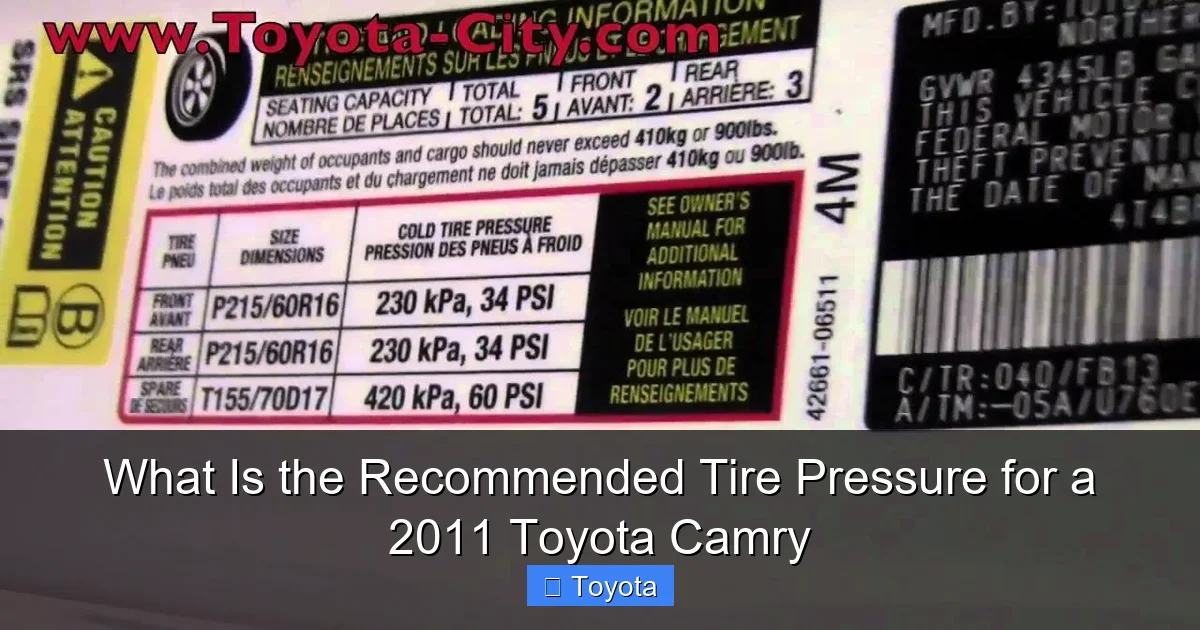
Open the driver’s side door and look at the door pillar (the B-pillar) or the edge of the door frame itself. You’ll find a permanent, factory-printed sticker, usually yellow and white. This is the single most important document for your Camry’s tire specs. It will list:
- Recommended Cold Inflation Pressure: For front and rear tires, usually the same for the Camry. It will say something like “32 PSI (220 kPa).”
- Vehicle Capacity Weight: The max weight the car can carry.
- Tire Size: The exact size for your trim, e.g., P215/70R16 or P225/50R17.
- Spare Tire Pressure: Often much higher, like 60 psi, for the temporary mini-spare.
Pro Tip: Take a photo of this sticker with your phone. That way, you’ll always have the spec with you at the gas station.
The Owner’s Manual: The Comprehensive Guide
Your glove compartment holds another goldmine of information. The “Tire and Loading Information” section in the owner’s manual will mirror the door jamb sticker but often provides more context. It will explain what to do if you’re carrying a heavy load or towing (which we’ll cover next). It’s a great reference to have on hand. If your manual is missing, you can often find a digital PDF on the Toyota owner’s portal website by entering your VIN.
When Pressure Changes: Load and Driving Conditions
The standard “32 psi” is for normal, everyday driving with a typical load (1-3 passengers, some cargo). The sticker and manual will also specify a “maximum load” pressure. If you’re taking a long road trip with the family and a packed trunk, or if you have a roof rack loaded with gear, you should increase the pressure to the maximum listed (often 35 psi for the Camry). This extra pressure supports the added weight and prevents excessive tire flexing and heat buildup. Conversely, if you’re driving on a smooth, empty highway with just yourself, you could theoretically drop 1-2 psi for a slightly softer ride, but the benefit is minimal and the risk of forgetting to re-inflate is high. It’s best practice to stick to the standard spec unless you have a specific, heavy-load scenario.
Trim Level Differences: SE vs. LE vs. XLE
Your 2011 Camry came in several trims, and the tire size—and sometimes the recommended pressure—can differ. The base LE model typically rode on 16-inch wheels with P215/70R16 tires. The sportier SE model often had 17-inch wheels with P225/50R17 tires. The range-topping XLE could have 17-inch or even 18-inch wheels. The good news? For the 2011 model year, Toyota generally kept the recommended cold inflation pressure at 32 psi across all trims and tire sizes. The engineering goal was consistent ride and handling characteristics regardless of wheel size. However, there is a crucial exception to know about.

Visual guide about What Is the Recommended Tire Pressure for a 2011 Toyota Camry
Image source: img.toyotask.com
The Sport-Tuned SE Model
Some SE models, particularly those with the optional “Sport Package” or certain market-specific configurations, might have a slightly higher recommended pressure. I’ve seen factory stickers on some 2011 SEs listing 33 psi. The difference is minor, but it underscores why you must check your own door jamb sticker. Don’t assume because your friend’s 2012 Camry is 32 psi, yours is too. The sticker on your car is the law for your car. Also, if you have installed aftermarket wheels and tires, the original pressure spec may no longer be optimal. In that case, consult with a professional tire shop for the best pressure for your new setup.
Seasonal and Temperature Effects: The Invisible Pressure Thief
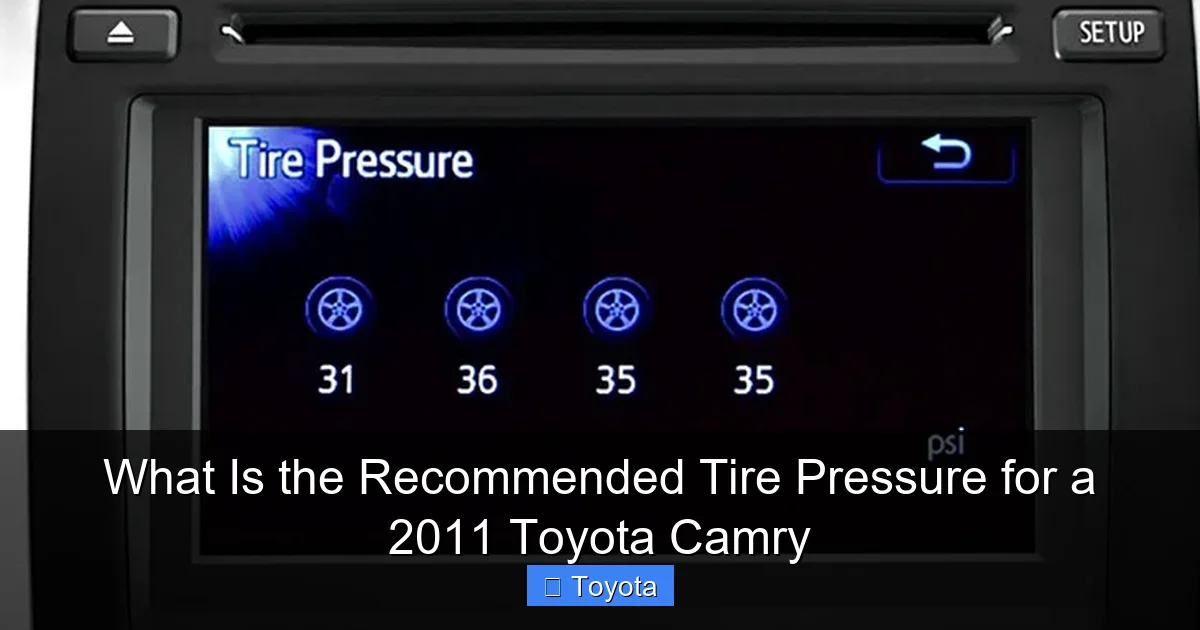
Here’s a fact that surprises many people: tire pressure changes with temperature. For every 10° Fahrenheit drop in ambient temperature, your tire’s air pressure decreases by about 1 to 2 psi. This is basic physics—cold air is denser and contracts. This means that crisp October morning when you check your tires? They might read 30 psi, even though they were 32 psi in the heat of August. Your TPMS light might flick on on a cold winter morning, only to turn off after driving for a few minutes (as the tires heat up and pressure rises). This is a classic sign of temperature-induced pressure drop, not necessarily a leak.
Visual guide about What Is the Recommended Tire Pressure for a 2011 Toyota Camry
Image source: dash-lights.com
Your Seasonal Checklist
To combat this, make it a habit to check and adjust your tire pressure at least once a month and every time there is a significant temperature swing (20°F or more). Do it in the morning before you drive. If it’s November and your cold pressure reads 30 psi, add air to bring it to the recommended 32 psi. In the summer, it’s normal for “hot” pressure (after driving) to be 3-5 psi higher than the cold spec. That’s okay—you never adjust pressure to a hot tire. Always adjust to the cold specification. If you live in an area with extreme temperature variations, consider keeping a high-quality digital tire pressure gauge in your car. They are more accurate and easier to read than old pencil gauges. For a related deep dive on how your car’s systems monitor this, you can read about where the TPMS reset button is on a Toyota Camry, which is useful if you need to manually reset the system after adjusting pressure.
The Tire Pressure Monitoring System (TPMS): Your Electronic Watchdog
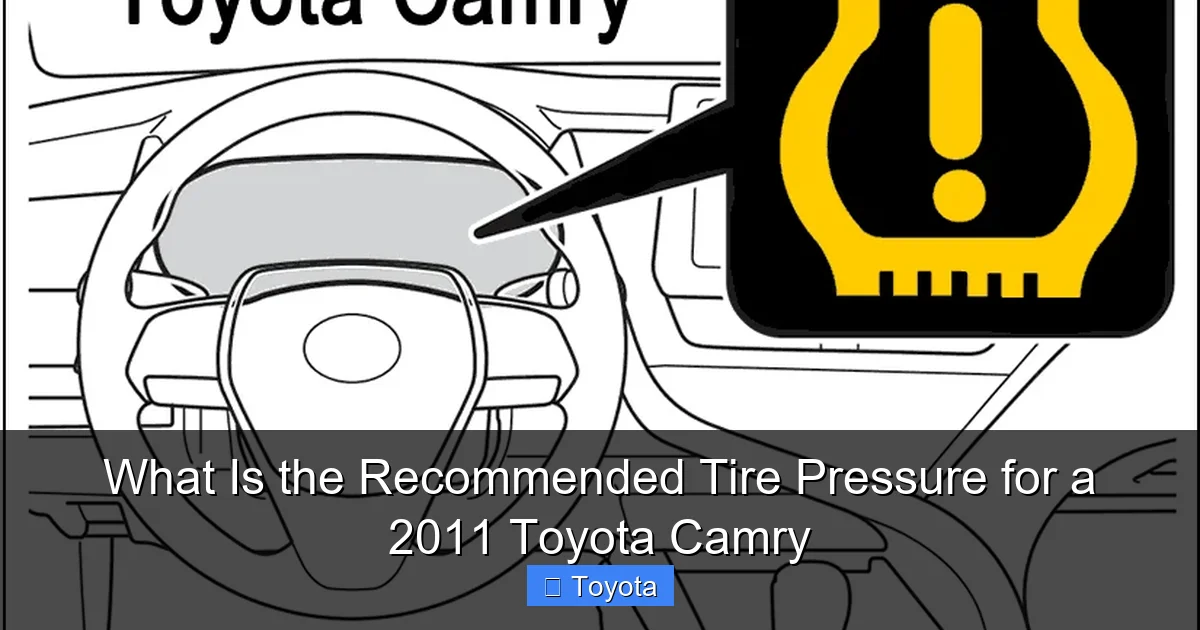
Since 2007, all vehicles, including your 2011 Camry, have been federally required to have a TPMS. This is a fantastic safety feature, but it’s important to understand its limitations. The system uses sensors mounted inside each wheel’s valve stem to radio the tire pressure to your car’s computer. When pressure in any tire drops 25% or more below the vehicle’s recommended cold pressure, the low tire pressure warning light—a yellow horseshoe with an exclamation point—will illuminate steadily on your dashboard.
What the TPMS Light Means (And What It Doesn’t)
A steady TPMS light means “check your tires NOW.” It is not a gentle reminder; it’s a warning that one or more tires are significantly under-inflated. You should stop as soon as it is safe, visually inspect the tires for a obvious nail or flat, and check the pressures with a gauge. A flashing TPMS light, which then stays on solid, usually indicates a fault in the TPMS system itself—like a dead battery in one of the wheel sensors or a communication error. This requires a diagnostic scan, often at a tire shop or dealership. Remember, TPMS is a backup system, not a replacement for manual checks. It typically won’t warn you for a slow leak that’s only 10-15% low, which is already hurting your fuel economy and tire wear.
How to Check and Adjust Your 2011 Camry’s Tire Pressure: A Step-by-Step Guide
This is the most important hands-on skill for any car owner. It’s incredibly simple and takes less than 5 minutes. Here’s how to do it right for your Camry.
Step 1: Get the Right Tools
You need two things: a reliable tire pressure gauge and an air source. Digital gauges are excellent and affordable. For air, you can use a home compressor, a portable 12V compressor that plugs into your cigarette lighter, or the pay-air machine at any gas station (usually costs $1-$2). Ensure you have the correct valve stem caps (they come with the car) to keep dirt and moisture out.
Step 2: Check When “Cold”
As emphasized, “cold” means the car has been parked for at least 3 hours or driven less than 1-2 miles. Driving heats the tires and air inside, giving a falsely high reading. First thing in the morning is perfect.
Step 3: Remove the Valve Cap and Check
Unscrew the small black or chrome cap from the valve stem on one tire. Press the gauge firmly onto the valve stem. You’ll hear a brief hiss of air. Hold it steady for 2-3 seconds until the reading stabilizes. Note the number. Do this for all four tires, and don’t forget the spare if it’s a full-size one (the mini-spare has its own, much higher spec on the door jamb sticker).
Step 4: Compare and Adjust
Compare your reading to the recommended 32 psi (or whatever your sticker says). If it’s low, add air. If it’s high, you’ll need to let some out by pressing the small metal pin in the center of the valve stem (use a tool or the back of the gauge). Add or release air in small increments, re-checking frequently. It’s easy to overfill. When you’re done, screw the valve caps back on tightly to prevent leaks.
Step 5: Reset the TPMS (If Needed)
After you’ve inflated all tires to the correct pressure, the TPMS light should turn off on its own after a few minutes of driving. If it doesn’t, you may need to manually reset the system. The reset process for a 2011 Camry is specific—you typically need to use the “SET” button located near the TPMS warning light on the dash, and the procedure involves turning the ignition on without starting the engine. The exact steps can vary. If the light persists after a day of driving with correct pressures, consult your owner’s manual or a professional. For more information on the Camry’s various buttons and systems, resources on what the Hold button does on a Toyota Camry can help you better understand your vehicle’s dashboard controls.
Common Mistakes and FAQs: Avoiding the Pitfalls
Even with the best intentions, it’s easy to slip up. Let’s clear up some confusion.
Mistake 1: Using the Tire Sidewall Number
The “MAX PRESSURE 44 PSI” on your tire is the absolute maximum the tire can hold. Inflating to that for daily driving will give you a bone-jarring ride, poor handling, and rapid center-tread wear. Always, always use the door jamb spec.
Mistake 2: Not Checking the Spare
That little donut spare in your trunk has its own, much higher pressure requirement (often 60 psi). It’s usually neglected and can be flat when you need it most. Check it annually.
Mistake 3: Ignoring Gradual Loss
Tires naturally lose about 1 psi per month. If you check your Camry and find it’s consistently 3-4 psi low every month, you likely have a slow leak from a nail, a faulty valve stem, or a poor bead seal. Get it inspected by a tire shop before it leads to a blowout or uneven wear that ruins the tire.
Mistake 4: Overcorrecting for Weather
Don’t add 5 psi in the summer because it’s hot, or drop 5 psi in the winter because it’s cold. The tire pressure will fluctuate on its own with temperature. Your job is to set it to the correct cold pressure when the tire is cold. The system is designed to handle normal temperature swings. Your only job is to compensate for long-term seasonal changes by checking monthly.
Frequently Asked Questions
What does the tire pressure light look like on a 2011 Toyota Camry?
It’s a yellow or amber icon that resembles a cross-section of a tire with an exclamation point inside, located on the instrument panel. It will illuminate steadily if one or more tires are 25% or more under-inflated.
Is 32 psi too high for my 2011 Camry?
No, 32 psi is the manufacturer’s recommended cold pressure for most 2011 Camry models. It is the optimal pressure for safety, comfort, fuel economy, and tire wear. The number on the tire sidewall (e.g., 44 psi) is the maximum, not the target.
Can I put 35 psi in my Camry tires?
You should only put 35 psi if that is the specific pressure listed on your driver’s door jamb sticker for your particular trim and load condition. Many 2011 Camrys call for 32 psi. Over-inflating to 35 psi when 32 is specified will cause a harsh ride, reduced traction, and premature center-tread wear.
Why does my tire pressure light keep coming on after I fill the tires?
First, ensure you filled them to the correct cold pressure as specified on your door jamb sticker (not the tire’s max pressure). If the light persists, the sensor may need a moment to communicate after driving. If it stays on, you may have a slow leak, a faulty TPMS sensor, or the system may need to be manually reset after adjusting pressure.
What happens if I drive with low tire pressure?
Driving with significantly low tire pressure is dangerous and costly. It causes excessive heat buildup, increasing the risk of a blowout. It leads to poor handling, longer stopping distances, and severely premature tire wear, typically on the outer edges of the tread. It also reduces your fuel efficiency.
Should I check tire pressure when tires are hot or cold?
Always check and adjust tire pressure when the tires are cold. This means the car has been parked for at least 3 hours or driven less than 1-2 miles. Driving heats the tires and air inside, giving a falsely high reading. The recommended pressure on your sticker is for cold tires.