
How Many Miles Can You Expect from a Toyota Sequoia?

The Toyota Sequoia is renowned for its durability, with many well-maintained examples reliably surpassing 300,000 miles. The groundbreaking 2023 model year redesign, featuring a hybrid powertrain, introduces a new era of efficiency and expected longevity. Ultimately, your Sequoia’s lifespan hinges less on the model year and more on consistent, thorough maintenance and mindful driving habits.
You’re eyeing a Toyota Sequoia. Maybe it’s a used model with 200,000 miles that looks pristine, or perhaps you’re considering the all-new 2023 hybrid version. The fundamental question burning in your mind is the same one every smart used car buyer asks: “How many miles can I *really* expect to get out of this thing?” It’s not just about a number; it’s about understanding the relationship between a vehicle’s engineering, its history, and your own role as a steward. The Toyota Sequoia has built a formidable reputation as a go-anywhere, tow-anything, last-forever family hauler. But separating the marketing legend from the mechanical reality requires a deep dive into its history, its engineering, and the cold, hard data from real-world owners. This article will give you that complete picture, breaking down mileage expectations by generation, highlighting the critical components that make or break longevity, and providing a practical framework to evaluate any Sequoia you’re considering.
Key Takeaways
- Proven Longevity: First-generation (2001-2007) Sequoias, particularly the 4.7L V8 models, are famous for routinely exceeding 300,000 miles with basic upkeep.
- Engine is Key: The 2008-2022 5.7L V8 is a robust, proven engine, while the all-new 2023+ i-FORCE MAX hybrid system promises exceptional efficiency and durability with new technology to monitor.
- Maintenance is Non-Negotiable: Strict adherence to oil changes, timing belt/chain service, and transmission fluid maintenance is the single biggest factor determining high-mileage survival.
- Ownership Costs Rise: As mileage climbs, expect significant investments in suspension, brakes, and major maintenance items like water pumps and radiators.
- Driving Habits Matter: Severe driving (towing, dusty conditions, short trips) accelerates wear; gentle use and warm-up periods extend the life of all components.
- Resale Value Holds: High-mileage, well-documented Sequoias retain strong value in the used market due to their reputation for reliability and capability.
- New vs. Used Trade-off: A high-mileage used Sequoia offers immense value, while a new 2023+ hybrid provides warranty peace of mind and drastically better fuel economy for long-term ownership.
📑 Table of Contents
- The Legend of the First Generation (2001-2007): The Million-Mile Foundation
- The Refined Workhorse: Second Generation (2008-2022) with the 5.7L V8
- The New Benchmark: 2023+ i-FORCE MAX Hybrid Powertrain
- The Unwavering Law: Maintenance Dictates Mileage
- Real-World Mileage Expectations by Model Year & Usage
- The High-Mileage Ownership Reality: Costs and Considerations
- Making Your Decision: New vs. Used, and How to Evaluate a High-Mileage Candidate
- The Final Verdict: A Mileage Number and a Mindset
The Legend of the First Generation (2001-2007): The Million-Mile Foundation
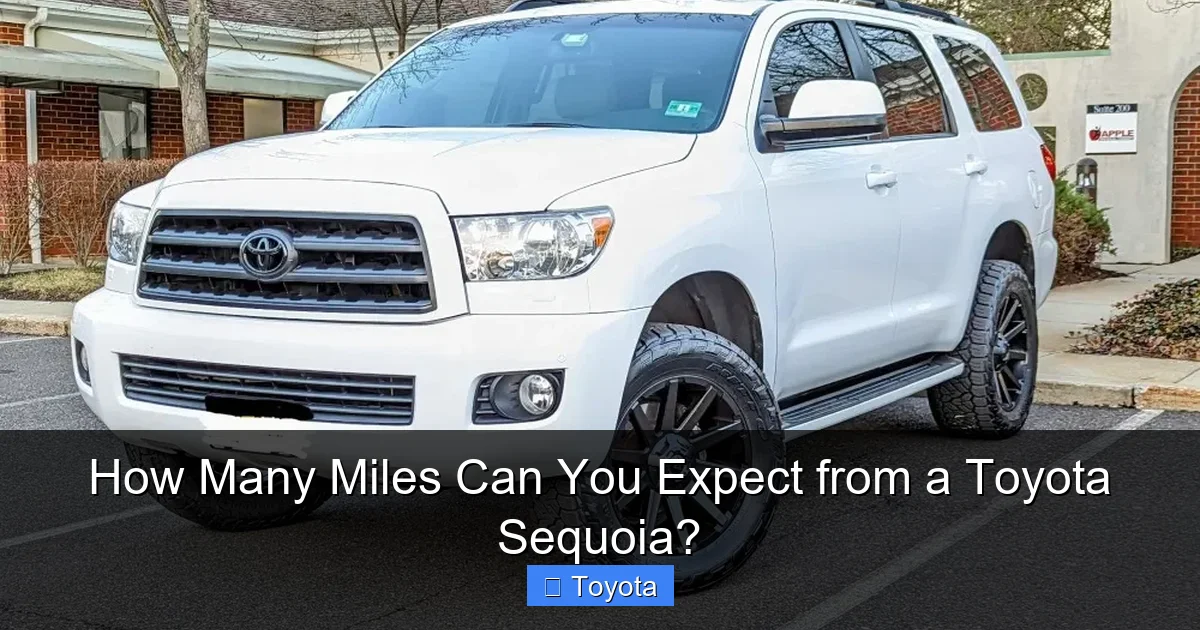
When discussing Toyota Sequoia longevity, you must start with the first generation. These are the trucks that built the myth. Produced from 2001 through 2007, they shared their platform and the legendary 4.7-liter V8 engine (2UZ-FE) with the Toyota Tundra pickup of the same era. This engine, paired with a robust 5-speed automatic transmission, is the stuff of lore. It was overbuilt, designed for truck duty, and responded exceptionally well to basic, scheduled maintenance.
Why the 4.7L V8 is a Mileage Monster
The 4.7L V8 (2UZ-FE) is an iron-block, overhead-cam engine known for its smooth power delivery and, more importantly, its resilience. It does not have a timing belt; it uses a timing chain, which is a massive advantage for longevity. Timing belts require a costly, scheduled replacement (often around 100,000 miles). If neglected, a broken belt means a destroyed engine. The Sequoia’s timing chain is designed to last the life of the engine under normal conditions, removing one of the most common high-mileage failure points. The engine’s design also features good oiling passages and durable components. The Achilles’ heel of this generation is not the engine itself, but the exhaust manifold bolts, which can crack and leak, and the rear main seal, which may eventually seep. Both are annoying and costly, but not catastrophic engine-killers.
Transmission-wise, the A750F 5-speed automatic is a workhorse. It’s the same family used in the 4Runner and Tundra. Its primary vulnerability at very high mileage is the internal solenoid pack, which can cause harsh shifts or get stuck in one gear. A rebuild or replacement of this solenoid pack is far less expensive than a full transmission rebuild. Many of these transmissions have been known to last 300,000+ miles with only fluid and filter changes.
So, what’s the realistic number? For a first-generation Sequoia with a complete service history—meaning oil changes every 5,000 miles, transmission fluid services every 60,000 miles, and coolant flushes—300,000 to 400,000 miles is an entirely reasonable expectation. There are documented examples of these trucks pushing past 500,000 miles, though at that point, wear items (suspension, pumps, seals) become a constant maintenance project rather than a daily driver. The key is finding one that has been cared for, not just one that has survived.
The Refined Workhorse: Second Generation (2008-2022) with the 5.7L V8
For the 2008 model year, Toyota gave the Sequoia a complete redesign. It grew in size, gained more sophisticated independent rear suspension, and, most importantly, swapped the 4.7L for the new 5.7-liter V8 (3UR-FE). This engine was a major upgrade in power and torque, but it also introduced a new maintenance consideration: a timing belt. Yes, the robust iron-block 5.7L V8 uses a timing belt that must be replaced every 90,000 miles (or 75,000 miles under severe service, as defined by Toyota). This is a non-negotiable, $1,000-$1,500 service. Skip it, and you risk catastrophic engine failure.

Visual guide about How Many Miles Can You Expect from a Toyota Sequoia?
Image source: off-road.com
Engine and Transmission Durability in the 5.7L Era
The 3UR-FE engine is also a proven unit. It’s powerful, generally reliable, and shares its architecture with the Tundra and the iconic Land Cruiser 200 Series. Common issues at high mileage include oil consumption (some models are worse than others), potential failure of the water pump (driven by the timing belt, so it’s replaced at the same time), and occasional VVT-i (variable valve timing) oil control valve failures. Again, these are manageable with a good mechanic and a healthy repair budget.
The transmission for this generation is the 6-speed automatic (AB60F). It’s a significant improvement in smoothness and efficiency over the old 5-speed. It’s generally very robust. The primary wear item is the internal clutch packs for the 2nd and 3rd gears, which can wear out around 200,000-250,000 miles if the truck has been used for heavy towing. A transmission rebuild at that point is a major expense ($3,000-$5,000), but it’s a known quantity. Regular fluid changes (every 60,000-80,000 miles) are critical to extending its life.
Realistic mileage for a 2008-2022 Sequoia? With impeccable maintenance—especially the timing belt/water pump service and transmission fluid changes—250,000 to 350,000 miles is a very achievable target. The bar is slightly higher for maintenance diligence than the first gen due to the timing belt. A neglected timing belt service will almost certainly end the engine’s life long before 200,000 miles. But a truck with a full stack of receipts for all major services can be a fantastically durable vehicle. The 2010-2012 model years had some reports of excessive oil consumption; a used vehicle check for this is wise.
The New Benchmark: 2023+ i-FORCE MAX Hybrid Powertrain
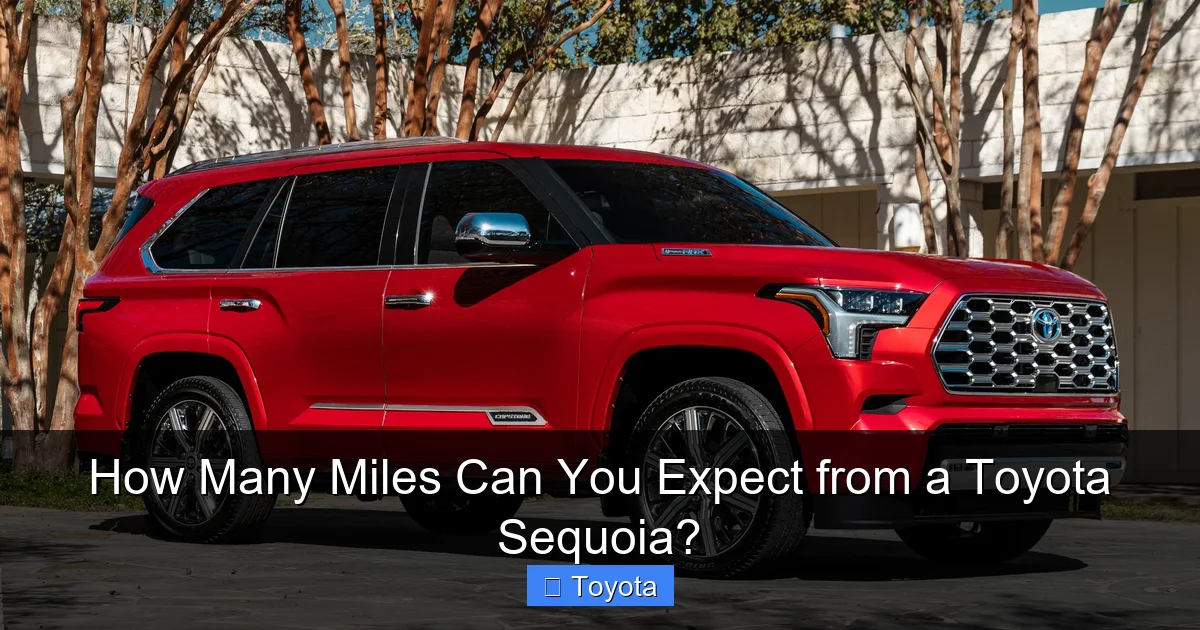
The 2023 model year represents the most significant change in the Sequoia’s history. Toyota retired the aging 5.7L V8 and introduced the i-FORCE MAX hybrid system, a twin-turbo 3.5L V6 paired with an electric motor-generator. This is not a “soft” hybrid; it’s a performance hybrid that delivers more horsepower and torque than the old V8 while dramatically improving fuel economy (from a dismal 13-15 MPG to a more reasonable 20-22 MPG). This changes the entire longevity equation.
Visual guide about How Many Miles Can You Expect from a Toyota Sequoia?
Image source: motortrend.com
Analyzing the New powertrain’s Long-Term Prospects
This powertrain is fundamentally new to the Sequoia, but its core components have extensive pedigree. The 3.5L V6 (V35A-FTS) is the same engine used in the Tacoma, Tundra, and Lexus vehicles. It has proven to be a strong, reliable engine in those applications. The hybrid system itself is similar to the one in the Toyota RAV4 Hybrid, which has an excellent reliability record over many years. The system uses a conventional automatic transmission (8-speed) with the hybrid motor integrated, not a CVT.
The major question mark is long-term hybrid battery durability. Toyota’s hybrid batteries have an exceptional track record, often lasting 150,000-200,000 miles or more with minimal degradation. The Sequoia’s battery is larger and more powerful for its class, but it’s built with the same proven technology. The warranty covers the hybrid components for 8 years/100,000 miles. Early indicators from the related Tundra Hybrid are positive.
What mileage can we expect? It’s too early for 300,000-mile data. However, based on Toyota’s hybrid history and the robustness of the underlying V6, a realistic expectation for the 2023+ Sequoia is 250,000-300,000 miles with proper maintenance, with the potential to go much further as the technology proves itself. The biggest risk factor for this generation is not the hybrid system, but the complexity of the twin-turbo system (intercoolers, turbochargers, high-pressure fuel pumps) which adds more components that could require attention at very high mileage. But the fuel savings alone mean the cost-per-mile of ownership could be far lower than any previous Sequoia.
The Unwavering Law: Maintenance Dictates Mileage
You can have the most overbuilt engine in the world, but without strict maintenance, it will fail. This is the universal truth for any high-mileage vehicle, and the Sequoia is no exception. Let’s break down the critical maintenance milestones that separate the 150,000-mile clunkers from the 300,000-mile legends.
Visual guide about How Many Miles Can You Expect from a Toyota Sequoia?
Image source: images.trailbuiltoffroad.com
The Non-Negotiable Service Schedule
Here is the bare minimum, based on the “Severe Service” schedule (which applies to most Sequoias used as family haulers with short trips, towing, or in dusty areas):
- Oil and Filter: Every 5,000 miles or 6 months. This is the single most important service. Use a high-quality full synthetic oil (Toyota 0W-20 for the 5.7L and newer, 5W-20 for the old 4.7L) and a premium filter. Don’t cheap out here.
- Transmission Fluid: Every 60,000 miles. This is critical for both the 5-speed and 6-speed automatics. Fluid degrades, and new fluid is cheap insurance against a $4,000 rebuild.
- Timing Belt/Chain: For 2008-2022 models, the timing belt/water pump service at 90,000 miles is an absolute must. Budget for it. For 2001-2007 and 2023+ models, the timing chain is “lifetime” but the tensioners and guides can wear; listen for rattles on cold start.
- Coolant: Every 30,000 miles or 2 years. Coolant loses its anti-corrosion properties. Old coolant leads to water pump failure, radiator leaks, and heater core issues.
- Differentials & Transfer Case: Every 60,000 miles. These are simple units but need fresh fluid. Neglect leads to noise, whining, and eventual failure.
- Brake Fluid: Every 2 years. Brake fluid is hygroscopic (absorbs water). Water in the system causes internal brake component corrosion and lowers boiling point, a safety hazard.
A vehicle with a complete, verifiable history of these services is worth a significant premium over one with gaps. Always ask for receipts.
Real-World Mileage Expectations by Model Year & Usage
Now let’s synthesize the information into practical expectations. Remember, these are for vehicles with complete maintenance records and no major accidents.
- 2001-2007 (4.7L V8): The gold standard. 300,000-400,000 miles. The engine and transmission are the stars. Expect to replace radiators, water pumps (not timing-belt driven), shocks, and various seals along the way. The body may rust in northern climates.
- 2008-2014 (Early 5.7L V8): Very solid. 250,000-350,000 miles. Be extra vigilant about the 90k timing belt/water pump service and oil consumption checks. The 8-10 speed transmission issues of the late Tundra are not present in the Sequoia’s 6-speed.
- 2015-2022 (Updated 5.7L V8): Incremental improvements. Similar expectation of 250,000-350,000 miles. These models received minor engine updates and the standard 8-speed transmission in some markets (though often the 6-speed persisted in the US). The core reliability remains high.
- 2023+ (i-FORCE MAX Hybrid): The new frontier. 250,000-300,000+ miles (projected). The hybrid system’s durability is the biggest unknown, but Toyota’s hybrid record is stellar. The fuel economy benefits are immediate and substantial. The complexity is higher, but the core components are shared with other successful hybrids.
Usage is everything. A Sequoia that spends its life on highways hauling a light load will last far longer than one used for daily stop-and-go city traffic, constant towing of a large boat, or plowing through deep snow and mud. “Severe service” accelerates every wear item. If you plan to use your Sequoia for heavy duty, budget for more frequent suspension and brake work.
The High-Mileage Ownership Reality: Costs and Considerations
Buying a Sequoia with 200,000+ miles is not about avoiding costs; it’s about managing them predictably. You are trading a large car payment for a predictable, albeit sometimes substantial, maintenance budget.
Common High-Mileage Wear and Replacement Items
Here is a checklist of what will likely need attention between 150,000 and 300,000 miles on a well-maintained Sequoia:
- Suspension: All four upper and lower control arm bushings, rear trailing arm bushings, struts/shocks, and sway bar links. This is a major job, often costing $2,000-$3,000+ for quality parts and labor. The independent rear suspension, while great for ride quality, has many bushings that wear out.
- Brakes: Multiple pad and rotor replacements are a certainty. Caliper rebuilds or replacements are common.
- Cooling System: Radiator, water pump, thermostat, and all hoses. The plastic tanks on radiators crack. This is a must-do item.
- Engine Seals: Rear main seal, camshaft seals, valve cover gaskets. They will eventually leak. Some are easy, some are expensive (rear main seal requires transmission removal).
- Exhaust: The factory exhaust is long and complex. Hangers break, pipes rust, and mufflers fail.
- Interior: Seat fabric wears, plastic trim cracks, and electronics (window regulators, HVAC blower motors) fail. These are annoyances but add up.
The strategy is to buy a Sequoia with a comprehensive, recent service history that addresses as many of these items as possible. If you buy one with original suspension at 220,000 miles, you are writing a $3,000 check immediately. If you buy one where the previous owner just spent $4,000 on a full suspension refresh, you’ve bought peace of mind.
Making Your Decision: New vs. Used, and How to Evaluate a High-Mileage Candidate
So, how do you translate this information into a decision? Here is your action plan.
For the Used Seeker (2001-2022)
Your goal is to find a truck that has been loved, not just used. Prioritize:
- History Over Anything: A clean Carfax/AutoCheck report with no accidents and a full service history from a dealer or reputable independent shop is worth its weight in gold. Gaps in service are red flags.
- Pre-Purchase Inspection (PPI): Never, ever buy a high-mileage Sequoia without a thorough PPI by a specialist (a Toyota dealer or a trusted independent mechanic who knows these trucks). They will put it on a lift, check for hidden leaks, scan for codes, and test drive it for transmission behavior. It’s the best $200-$300 you will ever spend.
- Look for “Just Serviced”: A seller who just spent money on a timing belt/water pump, transmission fluid, and a major service is often motivated to sell because the “big bills” are done for another 90k-100k miles.
- Check for Towing: Ask if it was used for towing. Heavy towing stresses the transmission and drivetrain. A non-towing truck is preferable.
For the New Buyer (2023+)
You are getting a vehicle with a full warranty (5 years/60,000 miles basic, 8 years/100,000 miles hybrid components). Your “mileage expectation” is now about long-term reliability after the warranty expires. The i-FORCE MAX system is the key. You are paying a premium for unparalleled fuel economy in this class and the latest tech/safety features. The gamble is on the long-term durability of the new hybrid system versus the known, bulletproof nature of the old V8s. Based on Toyota’s hybrid heritage, odds are excellent.
For a deep dive into the towing capabilities that put miles on these trucks, you can see our analysis of the Toyota Sequoia’s towing capacity across generations, which directly relates to drivetrain stress and longevity. Similarly, understanding how other full-size Toyotas perform over the long haul provides excellent context; for instance, the legendary reliability of the Toyota Avalon sedan speaks to Toyota’s engineering philosophy that also underpins the Sequoia.
The Final Verdict: A Mileage Number and a Mindset
So, what is the number? For a used Sequoia from 2001-2022, with a full service history, you can confidently plan for and expect 300,000 miles of reliable service. With exceptional care and a bit of luck, 400,000 is on the table. For the new 2023+ hybrid, the target is slightly lower at 250,000-300,000 miles for now, but its superior fuel economy means each mile costs less in fuel and produces fewer emissions.
But the number is secondary to the mindset. The Sequoia is not a disposable appliance. It is a machine built for durability. Its high-mileage potential is a direct reward for the owner who views maintenance as an investment, not an expense. You are not just buying a vehicle to get from A to B; you are buying a platform that, with respect and care, can become a multi-generational member of the family, carrying kids to soccer games, hauling camping gear, and pulling trailers for decades. That is the true mileage expectation of a Toyota Sequoia: not just a number on the odometer, but a story of partnership between a robust machine and a diligent owner.
Frequently Asked Questions
Is the Toyota Sequoia a good high-mileage buy?
Yes, absolutely. The Sequoia has a well-deserved reputation for durability. A well-maintained example from 2001-2022 with 200,000+ miles can be an excellent value, provided it has a complete service history and passes a thorough pre-purchase inspection. The key is avoiding neglected examples.
What is the biggest weakness of a high-mileage Sequoia?
The most common and costly issue at very high mileage (250,000+) is the suspension system, particularly the numerous bushings in the independent rear suspension. Replacing them all is a significant, but necessary, expense to restore ride and handling. The 2008-2022 models also require a mandatory timing belt/water pump service every 90,000 miles, which is a major cost if missed.
How does the new 2023 hybrid Sequoia affect long-term mileage expectations?
The new i-FORCE MAX hybrid system introduces more complexity but leverages Toyota’s proven hybrid technology. While long-term (300k+ mile) data doesn’t exist yet, Toyota’s hybrid systems are historically extremely durable. The immediate benefit is vastly better fuel economy, which reduces the cost-per-mile of ownership. The 3.5L V6 engine it’s paired with is also a newer, turbocharged design compared to the old naturally aspirated V8s, so its long-term ceiling is still being proven by the market.
Should I be worried about the timing belt in the 5.7L V8 Sequoias?
Yes, you should treat it with the utmost seriousness. The 5.7L V8 (2008-2022) uses a timing belt that must be replaced at 90,000 miles along with the water pump. This is a $1,200-$1,800 service. If the belt breaks, the engine is destroyed. Always verify this service has been done with receipts. For the 2023+ hybrid and the 2001-2007 4.7L models, the engines use timing chains, which are a “lifetime” part but still have tensioners that can wear.
What transmission problems should I look for?
For 2001-2007 models (5-speed), watch for harsh shifts or a transmission that gets stuck in one gear, often caused by a failed solenoid pack—a relatively inexpensive fix. For 2008-2022 models (6-speed), the main concern is clutch pack wear in 2nd and 3rd gears, especially if the truck has been used for heavy towing. This presents as slipping or harsh engagement. Regular fluid changes are the best prevention. The 2023+ uses an 8-speed automatic integrated with the hybrid system; early reports are positive, but it’s too new for high-mileage patterns.
Does towing significantly reduce the Sequoia’s lifespan?
Yes, frequent heavy towing (at or near maximum capacity) puts substantial stress on the transmission, engine cooling system, and rear axle. It accelerates wear on all these components. A Sequoia used primarily as a family hauler will last significantly longer than one used weekly to tow a large trailer or boat. If you plan to tow regularly, be prepared for earlier and more expensive transmission and cooling system maintenance.
