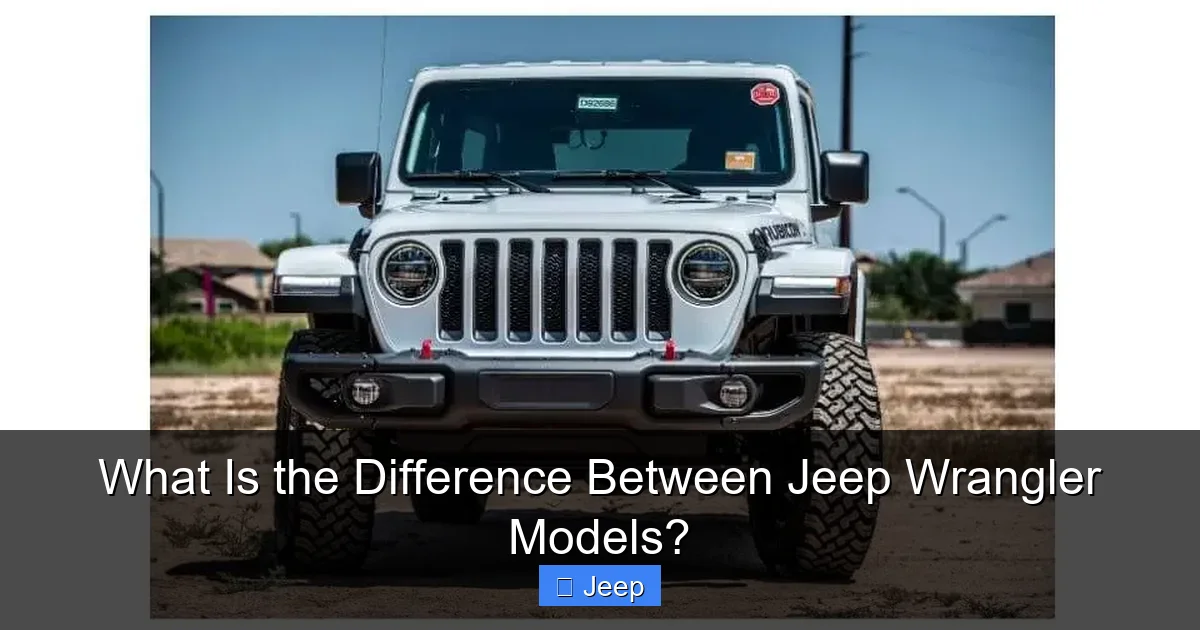
What Is the Difference Between Jeep Wrangler Models?

Contents
- 1 Key Takeaways
- 2 📑 Table of Contents
- 3 The Iconic Legacy: Why the Wrangler Stands Alone
- 4 The Core Wrangler Models: Sport, Sahara, Rubicon, and 4xe
- 5 Powertrain and Drivetrain: Mixing and Matching Your Heart’s Desire
- 6 Trim Level Deep Dive: Packages and Special Editions
- 7 Which Wrangler Model Is Right for You? A Practical Guide
- 8 Pricing, Value, and The Long-Term Picture
- 9 Conclusion: Your Adventure, Your Model
- 10 Frequently Asked Questions

Parking Sensor Kit

Brake Cleaner Spray

Microfiber Car Cleaning Cloth
Fuel Injector Cleaner
The Jeep Wrangler lineup is more than just one vehicle; it’s a family of rugged SUVs tailored for different drivers and adventures. The core models—Sport, Sahara, Rubicon, and the plug-in hybrid 4xe—vary dramatically in off-road capability, on-road comfort, technology, and price. Understanding these differences is the critical first step to finding the Wrangler that perfectly matches your budget and lifestyle, whether that’s daily commuting, weekend rock crawling, or efficient electric-assist exploring.
Key Takeaways
- The Sport is the basic, affordable, and highly modifiable foundation. It’s the entry point with minimal standard features but maximum potential for aftermarket customization.
- The Sahara is the refined, comfortable daily driver. It adds significant luxury, tech, and convenience features over the Sport, making it ideal for on-road use with occasional light off-roading.
- The Rubicon is the uncompromising off-road king. It comes standard with every hardcore off-road component, like locking differentials, a heavy-duty axle, and a disconnecting sway bar, for tackling extreme terrain.
- The Wrangler 4xe is the efficient, tech-forward hybrid. It combines a turbocharged engine with electric motors for impressive fuel economy and instant torque, while maintaining solid (though not Rubicon-level) off-road prowess.
- Powertrain choices (V6, Turbo I4, 4xe) and drivetrain (4×2 vs. 4×4) are independent of trim selection. You can mix and match engines and axles across most models, which dramatically changes the vehicle’s character and capability.
- Pricing and target audience are the clearest differentiators. The Sport targets budget-conscious buyers and modifiers, the Sahara targets comfort seekers, the Rubicon targets hardcore enthusiasts, and the 4xe targets eco-conscious adventurers and tech lovers.
📑 Table of Contents
- The Iconic Legacy: Why the Wrangler Stands Alone
- The Core Wrangler Models: Sport, Sahara, Rubicon, and 4xe
- Powertrain and Drivetrain: Mixing and Matching Your Heart’s Desire
- Trim Level Deep Dive: Packages and Special Editions
- Which Wrangler Model Is Right for You? A Practical Guide
- Pricing, Value, and The Long-Term Picture
- Conclusion: Your Adventure, Your Model
The Iconic Legacy: Why the Wrangler Stands Alone
Before we dive into the nitty-gritty of Jeep Wrangler models, let’s appreciate what makes this comparison so unique. The Wrangler isn’t just another SUV; it’s a living, breathing icon. Its lineage traces directly back to the WWII-era Willys MB, and that DNA—the solid axles, the removable doors and roof, the legendary command-view seating—is baked into every single model you can buy today. This means that whether you’re looking at a $35,000 Sport or a $70,000 Rubicon, you’re getting the same fundamental, go-anywhere mechanical soul. The differences aren’t about whether it’s a Wrangler; they’re about what kind of Wrangler it is.
Think of the Wrangler model lineup like a toolbox. The Sport is the basic, no-frills hammer. The Sahara is the comfortable, versatile multi-tool. The Rubicon is the industrial-grade impact wrench. And the 4xe is the innovative, battery-powered drill. They all do the core job of “fastening” (or in Jeep’s case, adventuring), but they do it with different tools, different levels of polish, and for very different users. The key is knowing which tool you need for your specific job. This guide will strip away the marketing and give you the straight facts on what sets each model apart, from the nuts and bolts to the final price tag.
The Core Wrangler Models: Sport, Sahara, Rubicon, and 4xe
For the current generation (the JL Wrangler, introduced in 2018), Jeep primarily sells four distinct model series. Within each, there are further sub-trims (like Sport S, Willys, Freedom, etc.) that add specific packages of features, but the fundamental character is set by the core model name. Let’s break down each one from the ground up.
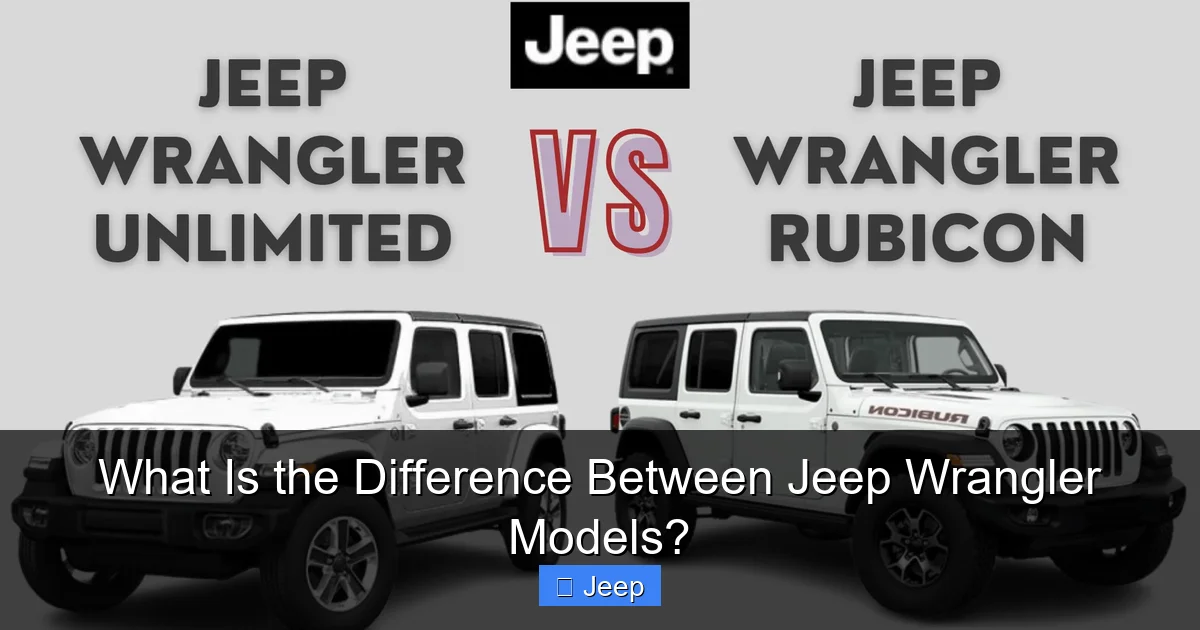
Visual guide about What Is the Difference Between Jeep Wrangler Models?
Image source: jeep.com.np
Jeep Wrangler Sport: The Blank Canvas
The Sport is the quintessential Wrangler—the one you see in the commercials with the doors off and the top down. It’s the most affordable, the most basic, and arguably the most pure for purists who want to build their own adventure rig. The philosophy here is minimal standard content to keep the starting price low, leaving room in your budget for the aftermarket parts you really want.
Key Features & Target Buyer: Expect manual roll-up windows, a basic AM/FM radio (often without a touchscreen), cloth seats, and 17-inch steel wheels. It comes standard with the part-time 4×4 system (Command-Trac) and the 3.6L V6 engine. The target is the first-time Wrangler buyer, the off-roader on a tight budget who plans to add lockers, winches, and lifts themselves, or someone who simply wants the iconic experience at the lowest possible entry cost. It’s the most capable base model off-road because it’s the lightest and has the same solid axles as every other Wrangler, but it lacks the electronic aids and heavy-duty components of the Rubicon.
Jeep Wrangler Sahara: The Refined Daily Driver
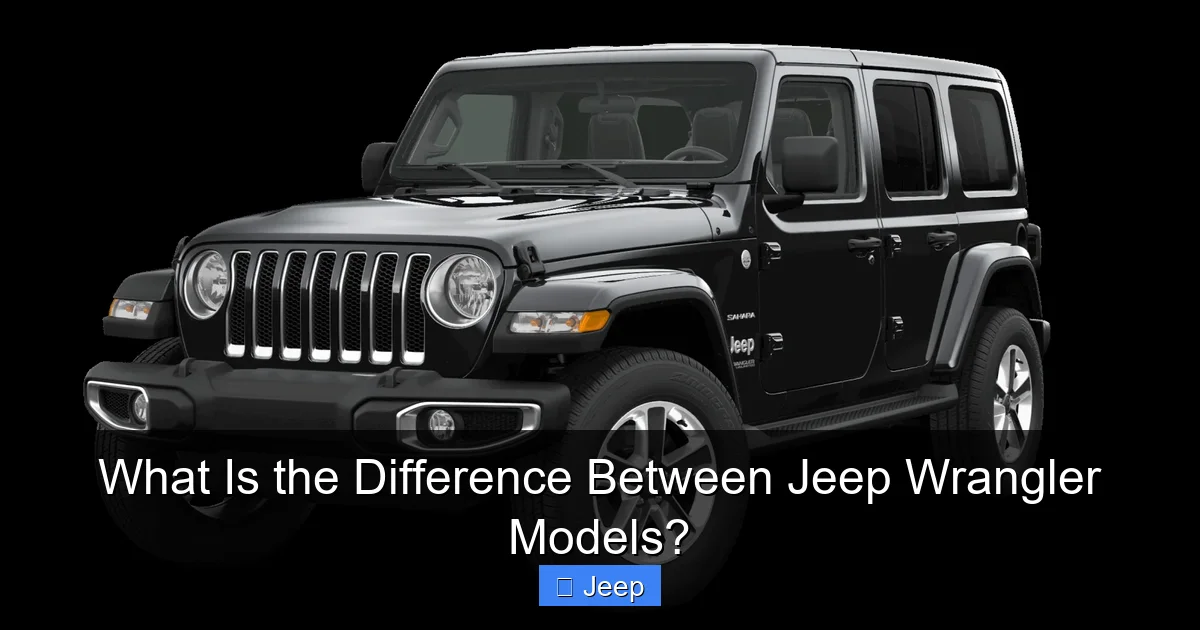
Step up to the Sahara, and the shift in focus is immediately apparent. This is the Wrangler for someone who wants the iconic look and capability but also demands a comfortable, convenient, and tech-friendly vehicle for daily driving and family duties. The Sahara is the best-selling Wrangler model for a reason: it hits the sweet spot.
Key Features & Target Buyer: The Sahara adds power windows and door locks, keyless entry, an 8.4-inch touchscreen with Apple CarPlay/Android Auto, premium cloth or available leather-trimmed seats, and 18-inch alloy wheels. It typically includes the improved Selec-Trac full-time 4×4 system (with a 2H mode for better pavement fuel economy) and often the optional V6 or the turbo I4. The target is the urban or suburban adventurer who takes weekend trips to the trailhead, values comfort and tech, and may only encounter mild dirt roads or snow. It’s the “do-it-all” Wrangler.
Jeep Wrangler Rubicon: The Off-Road Beast
Here’s the no-compromise, trail-conquering flagship. The Rubicon isn’t just a trim level; it’s a purpose-built machine. Every single component is upgraded for the sole purpose of surviving and thriving in the most demanding off-road conditions on the planet. You buy a Rubicon when you know you’ll be regularly tackling rocks, deep water, and steep inclines.
Key Features & Target Buyer: The Rubicon comes standard with front and rear electric locking differentials (Dana 44 axles with 4.10 gearing), an electronic front sway bar disconnect, 33-inch all-terrain tires, heavy-duty half-shafts, and a dedicated off-road rock rails. It also features a more robust 4×4 system (Rock-Trac with a 4:1 low-range transfer case). Inside, you get unique Rubicon branding, durable seats, and often a standard 12-inch touchscreen. The target is the serious off-roader, the overlander, and the enthusiast who views the trail as the primary destination. It’s overkill for the mall, but it’s the most capable Wrangler you can buy stock.
Jeep Wrangler 4xe: The Electrified Adventurer
The 4xe (pronounced “four-by-E”) represents the Wrangler’s future, blending its legendary capability with hybrid efficiency. It’s a completely different powertrain: a 2.0L turbocharged 4-cylinder paired with two electric motors (one integrated into the transmission, one on the front axle) and a 17 kWh battery pack.
Key Features & Target Buyer: The 4xe offers an estimated 49 MPGe and around 21 miles of pure electric range, plus a total system output of 375 horsepower—more than the V6. It’s available in Sahara and Rubicon trims (and the luxurious High Altitude), meaning you can get hybrid efficiency with either comfort or extreme off-road gear. The target is the environmentally conscious adventurer, the tech enthusiast, and anyone who wants to reduce fuel stops on long adventures. It’s the most expensive Wrangler to buy but can be the cheapest to run. Note: its electric motors and battery add weight, slightly impacting some extreme off-road metrics compared to a non-hybrid Rubicon, but for most, the trade-off is worth it.
Powertrain and Drivetrain: Mixing and Matching Your Heart’s Desire
Here’s where it gets interesting. Your choice of engine and 4×4 system is often separate from your choice of trim. This modularity is key to building your perfect Wrangler.

Visual guide about What Is the Difference Between Jeep Wrangler Models?
Image source: turbo.fr
Engine Options: V6, Turbo I4, and 4xe Hybrid
- 3.6L V6 (Pentastar): The classic. Proven, reliable, smooth, and powerful (285 hp, 260 lb-ft). It’s the default choice for many, especially Rubicon buyers who prioritize proven torque and simplicity. Fuel economy is the lowest of the gas options.
- 2.0L Turbo I4: The efficient alternative. Packs 270 hp and 295 lb-ft of torque (with a unique torque curve peaking lower). It gets significantly better highway fuel economy than the V6 and is standard on most Sahara and 4xe models. Some purists miss the V6’s sound and feel.
- 2.0L Turbo I4 + Hybrid (4xe): The unique powertrain. As described, it’s a performance and efficiency hybrid. The instant electric torque makes it feel incredibly responsive off the line. It’s the most complex but also the most technologically advanced.
Practical Tip: If your priority is ultimate low-speed, high-torque rock crawling control, the V6’s linear power delivery in a Rubicon is a classic pairing. If you want a great daily driver that still has power, the Turbo I4 in a Sahara is excellent. If you want to minimize gas station visits on adventure trips, the 4xe is a game-changer.
4×4 Systems: Command-Trac, Selec-Trac, and Rock-Trac
These are the transfer cases, and they define your on-pavement and off-pavement behavior.
- Command-Trac (Part-Time): Standard on Sport and some base models. It has a simple 2H, 4H, N, 4L layout. 4H and 4L are true, full-time 4WD (front and rear shafts locked). You must use 2H on dry pavement. It’s simple, robust, and fine for occasional off-road.
- Selec-Trac (Full-Time): Standard on Sahara and 4xe. It adds a true full-time 4WD mode (4F Auto) for all conditions, plus 4H part-time and 4L. The system can send power to the front axle only when needed, making it better for varying weather and light off-road without the need to constantly switch modes. It’s the most versatile for mixed driving.
- Rock-Trac (Part-Time with 4:1 Low Range): Standard on the Rubicon. This is the hardcore system. Its 4:1 low-range gearing multiplies engine torque for extreme slow-speed control over rocks and obstacles. It’s paired with the locking differentials. You only use this if you’re regularly in serious terrain.
Trim Level Deep Dive: Packages and Special Editions
Within each core model, Jeep layers on special packages and limited editions that can blur the lines. Understanding these helps you decode a window sticker.
Visual guide about What Is the Difference Between Jeep Wrangler Models?
Image source: countrychryslerdodgejeep.net
Sport & Sahara: The Willys and Freedom Editions
The Sport S and Sahara often have special editions like the Willys (adds classic-style wheels, special decals, and a slight lift) or the Freedom (adds unique badging, blacked-out accents, and often a portion of proceeds to veteran charities). These are mostly cosmetic and minor feature packages that don’t change the fundamental model character. A Willys Sport is still a Sport with a cool look; a Freedom Sahara is still a comfort-focused Sahara.
Rubicon: The Ultimate and Conquest
The top-tier Rubicon can be had in the standard form or as the Rubicon 392 (with the 470-hp 6.4L HEMI V8—a limited, high-performance model) or special editions like the Conquest (which adds unique wheels, bumpers, and interior trim). These push the price and performance even higher but sit on the same Rubicon foundation of axles, lockers, and transfer case.
The High Altitude: Luxury in Any Model
A relatively new addition, the High Altitude package (available on Sahara, 4xe, and sometimes Rubicon) is all about premium materials. It adds full leather interior, a premium audio system, special 20-inch wheels, and more chrome/gloss black accents. It’s the way to get a Wrangler that feels luxurious inside without stepping up to the Rubicon’s off-road focus. It’s essentially a luxury-focused Sahara.
Which Wrangler Model Is Right for You? A Practical Guide
Now, let’s match your needs to a model. Be honest with yourself about how you’ll use the vehicle 90% of the time.
- Choose the Sport if: Your budget is under $40,000, you plan to modify it extensively (lift, bumpers, wheels, lockers), you want the simplest mechanical setup, or you are a purist who values the bare-bones experience. It’s also the best choice if you only need a part-time 4WD vehicle for light snow and dirt.
- Choose the Sahara if: You want a comfortable, tech-filled daily driver that can also handle dirt roads, forest service roads, and light snow. You value keyless entry, a great stereo, and a smoother ride. It’s the “no regrets” choice for most people who love the Wrangler lifestyle but don’t need a rock crawler.
- Choose the Rubicon if: You know you will be driving on serious rocks, fording deep water, or tackling steep, technical trails. You want the most capable vehicle straight off the dealer lot with no modifications needed. You prioritize capability over comfort and fuel economy. Ask yourself: “Will I be intentionally seeking out the hardest trails?” If yes, the Rubicon is your answer.
- Choose the 4xe if: You want a Wrangler for its capability but are concerned about fuel costs or environmental impact. You have a short commute where you could drive mostly on electricity. You love cutting-edge tech and instant torque. It’s perfect for the adventurer who camps at trailheads with a power outlet or does a lot of driving in city-adjacent areas. Get it in Sahara for efficiency and comfort, or Rubicon 4xe for hybrid efficiency with hardcore off-road gear.
Remember: You can often add aftermarket parts to a Sport to make it nearly as capable as a Rubicon for less money, but it will never have the Rubicon’s warranty-covered heavy-duty axles, electronic lockers, or 4:1 transfer case. Similarly, you can’t add the 4xe’s hybrid system or the Sahara’s luxury features to a Sport later. The core model choice sets your unchangeable foundation.
Pricing, Value, and The Long-Term Picture
There’s a significant price jump between models. A base 2-door Sport might start around $37,000, while a similarly equipped Rubicon can easily exceed $55,000. The 4xe models start even higher, often north of $60,000. This gap represents the cost of the heavy-duty components, advanced electronics, and luxury features.
When considering value, think about use case. If you never go off-road, a Rubicon’s extra $15,000 is wasted. If you trailered your Wrangler to Moab every month, that same Rubicon is a bargain for the capability it delivers. Also, consider resale value. All Wranglers hold value exceptionally well, but Rubicons and 4xes often command a higher premium on the used market due to their desirability. You can research historical values for specific models, like a 2002 Jeep Wrangler, to see this long-term trend. Furthermore, if leasing is your preference, understanding the monthly Jeep Wrangler lease payments for each model will be crucial to your budgeting, as residual values and money factors vary by trim.
Conclusion: Your Adventure, Your Model
The difference between Jeep Wrangler models is a story of prioritization. It’s the classic compromise triangle: capability, comfort, and cost. You can’t max all three at once. The Sport sacrifices comfort for low cost and high modifiability. The Sahara sacrifices some ultimate capability for high comfort and value. The Rubicon sacrifices cost and some on-road refinement for maximum, no-compromise capability. The 4xe sacrifices some pure mechanical simplicity and adds cost for unmatched efficiency and tech.
Your job is to decide where your personal triangle points. Test drive them back-to-back. Feel the difference in the seats, hear the difference in the engine note, and imagine yourself in each one on your most common drives and your dream adventures. The beauty of the Wrangler is that no matter which model you choose, you’re joining a legendary community with a vehicle that can truly go anywhere. Choose the one that feels like it was built for your version of “anywhere.”
Frequently Asked Questions
What is the main difference between a Wrangler Sport and Sahara?
The Sahara adds significant comfort and technology features over the base Sport, including power windows/locks, an 8.4-inch touchscreen with smartphone integration, upgraded wheels, and often the more versatile Selec-Trac full-time 4×4 system. The Sport is a basic, modifiable platform, while the Sahara is a refined daily driver.
Is a Rubicon worth the extra money over a Sahara?
It’s worth the extra money only if you regularly engage in serious, challenging off-roading. The Rubicon’s locking differentials, electronic front sway bar disconnect, 4:1Rock-Trac transfer case, and heavy-duty axles are overkill for dirt roads but essential for rock crawling. For most drivers, the Sahara’s capability is more than sufficient.
How does the Wrangler 4xe compare to the gas models for off-roading?
The 4xe (available in Sahara and Rubicon trims) is very capable off-road, especially with its instant electric torque. A 4xe Rubicon has nearly all the hardcore hardware of a gas Rubicon. However, the added weight of the battery and electric motors can slightly reduce articulation and approach/breakover angles compared to a non-hybrid Rubicon. For extreme rock crawling, a non-hybrid Rubicon still has a slight edge.
Which Wrangler model is best for daily driving and commuting?
The Jeep Wrangler Sahara is unequivocally the best model for daily driving. It prioritizes on-road comfort, quietness, convenience features (power everything, great infotainment), and fuel economy (especially with the available Turbo I4 engine). The 4xe Sahara is even better for commutes if you have a place to plug in.
Can I get a Wrangler with the V6 engine and the Rubicon’s off-road parts?
Yes, absolutely. The V6 engine is a popular and available choice with the Rubicon trim. This is a classic combination for those who want the proven, torquey V6 paired with the Rubicon’s complete off-road package. The 4xe hybrid powertrain is also available in the Rubicon trim.
What is the cheapest way to get a Wrangler with locking differentials?
The only way to get locking differentials (front and rear) from the factory is to buy a Rubicon model. The Sport, Sahara, and other trims do not offer locking differentials as a factory option. They are a defining Rubicon feature. You could add aftermarket lockers to a non-Rubicon, but they won’t be integrated with the vehicle’s systems like the factory electronic lockers.