
What Is the Correct Tire Pressure for a Ford F150

Maintaining the correct tire pressure in your Ford F150 is absolutely critical for your safety, your truck’s handling, and its fuel efficiency. The factory-recommended pressure isn’t a one-size-fits-all number; it varies by model year, trim level, and tire size, typically falling between 30 and 40 PSI. Your definitive source is always the tire placard on your driver’s door jamb, and you must adjust for heavy loads and seasonal temperature swings to keep your F150 performing at its peak.
Key Takeaways
- Factory specs are king: The single correct pressure for your specific F150 is found on the Tire and Loading Information placard, usually on the driver’s door jamb. It is not a guess.
- Typical range is 30-40 PSI: Most modern F150s (2015+) with standard all-season tires recommend 35 PSI, but this can drop to 30 PSI for certain trims or rise to 40 PSI for high-performance or LT-rated tires.
- TPMS is a warning system, not a maintenance tool: Your Tire Pressure Monitoring System alerts you to severe drops (usually 25% below spec) but should not replace monthly manual checks with a reliable gauge.
- Seasonal changes matter: Tire pressure drops about 1 PSI for every 10°F decrease in temperature. You’ll need to add air in winter and may be slightly over-inflated in summer heat.
- Load and towing demand adjustments: Carrying a heavy bed load or towing a max-capacity trailer often requires increasing pressure by 3-5 PSI above the standard “normal load” specification. Consult your owner’s manual.
- Proper inflation saves money: Correct PSI maximizes tire tread life, optimizes fuel economy (up to 3% improvement), and ensures the intended ride quality and traction for your specific tire model.
📑 Table of Contents
- Why Tire Pressure is Non-Negotiable for Your Ford F150
- Decoding the Factory Recommendations: What Does My F150 Actually Need?
- How to Find and Check the Correct Pressure for Your Specific F150
- Your F150’s TPMS: Friend or Foe?
- Seasonal Adjustments and The Impact of Load
- Practical Tips, Common Mistakes, and Expert Advice
- Conclusion: Make It a Habit
Why Tire Pressure is Non-Negotiable for Your Ford F150
Let’s be real for a second. Your Ford F150 is a machine built for work and play—a versatile partner that hauls, tows, and conquers all kinds of terrain. But all that capability hinges on something you can’t see: the air inside your tires. Getting the correct tire pressure for a Ford F150 isn’t just a suggestion from the manual; it’s a fundamental pillar of safety, performance, and longevity. Think of it as the foundation your entire truck sits on. Too little air, and your tires overheat, wear unevenly, and your steering feels sloppy. Too much air, and you get a harsh ride, a smaller contact patch, and a higher risk of a blowout, especially when hitting potholes or off-road obstacles. For a truck as heavy and capable as an F150, hitting that sweet spot is crucial.
We’re going to break down everything you need to know, from decoding that mysterious door jamb sticker to understanding how your truck’s TPMS works and when to adjust for a heavy weekend at the lake. This isn’t just theory; it’s practical, hands-on knowledge that will save you money on tires and gas, and more importantly, keep you and your family safer on the road.
The Safety Triangle: Grip, Braking, and Stability
Your tires are the only point of contact between your F150 and the road. Proper pressure ensures the tire’s tread flexes exactly as designed, creating the optimal footprint for grip. Under-inflated tires have a tendency to wander, making steering corrections constant and fatiguing on long drives. They also suffer from “tread squirm,” which dramatically increases stopping distances—a terrifying prospect when you’re hauling a loaded trailer or navigating wet highways. Over-inflated tires reduce the contact patch, leading to a skittish, “bouncy” feel and poor traction, especially on loose surfaces. For a full-size truck, stable braking and predictable handling are everything.
Fuel Economy: The Hidden Money Saver
Rolling resistance is the force that opposes your tires’ motion. When a tire is under-inflated, it flexes excessively as it rolls, generating heat and creating more resistance. Your F150’s powerful engine has to work harder to overcome that resistance, burning more fuel. The U.S. Department of Energy estimates that for every 1 PSI drop in pressure below the recommended level, fuel efficiency decreases by about 0.2%. While that sounds small, for a truck that might see 15-20 MPG, it adds up quickly over thousands of miles. Keeping your tires at the correct Ford F150 tire pressure is one of the simplest, cheapest ways to maximize your miles per gallon.
Tire Longevity: Protecting Your Investment
F150 tires aren’t cheap, especially the larger all-terrain or LT-metric sizes. Incorrect pressure is the fastest way to destroy them. Under-inflation causes the outer edges of the tread to wear prematurely as they carry the brunt of the load. Over-inflation wears the center of the tread bald first. You might think you’re saving by not buying a gauge, but you’ll be buying new tires twice as often. Proper pressure ensures even wear across the entire tread face, giving you the full treadlife warranty you paid for.
Decoding the Factory Recommendations: What Does My F150 Actually Need?
This is the million-dollar question. The answer lives on a small, often yellow or white, sticker placed on the driver’s side door jamb when you open the door. It’s sometimes on the B-pillar or the glove box door, but the door jamb is most common. This placard is the bible for your specific truck’s tire pressure. It lists pressures for different driving conditions: “Normal Load” and sometimes “Maximum Load” or “Towing.”
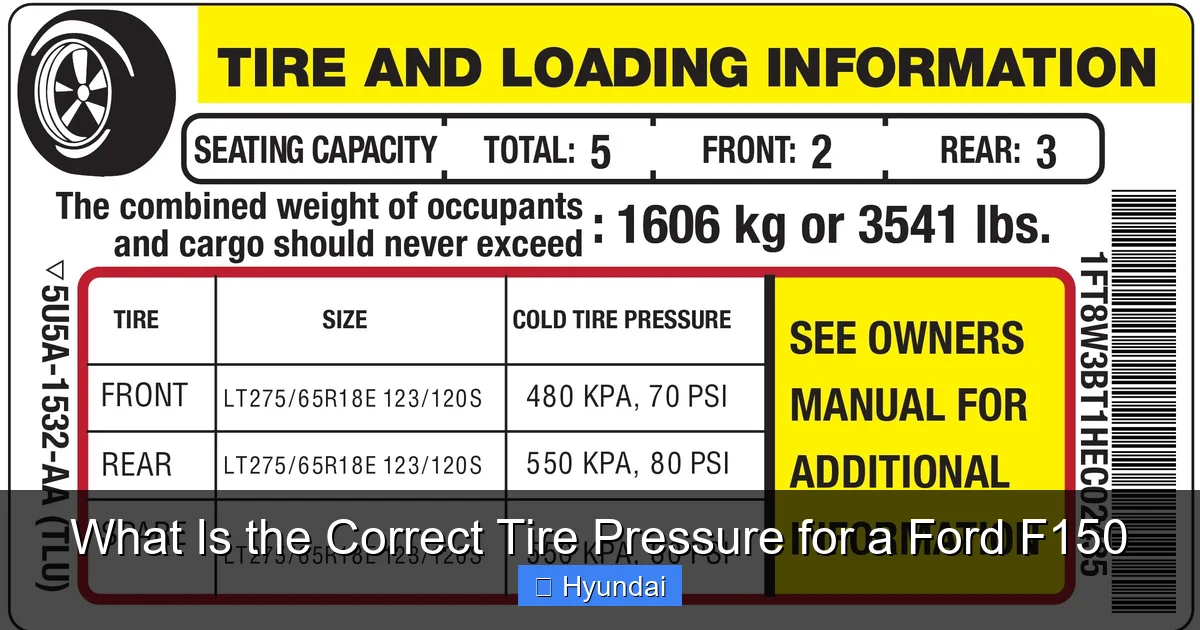
Visual guide about What Is the Correct Tire Pressure for a Ford F150
Image source: lesschwab.com
For example, a placard might read:
Front Tires: 35 PSI (Normal Load)
Rear Tires: 35 PSI (Normal Load)
Spare Tire: 60 PSI
Notice it doesn’t usually list pressures by trim (XL, XLT, Lariat, etc.) but by the *original equipment tire size*. That’s the key. Your recommended pressure is tied to the size and type of tire that came on your truck from the factory.
Pressure Variations by Model Year and Tire Size
While 35 PSI is a very common “normal load” figure for F150s from the 2015 redesign onward, it’s not universal. Here are some real-world examples to illustrate the point:
- 2018-2023 F150 (Most trims with 18″ or 20″ all-season tires): Typically 35 PSI front and rear for normal load.
- F150 with LT-metric or all-terrain tires (often on FX4, Lariat, or Platinum trims): The placard may specify 35 PSI, but the tire’s *maximum* pressure on its sidewall (e.g., 80 PSI) is not your target. Always follow the *lower* placard pressure for normal driving.
- Older F150s (2009-2014): Many used 30 PSI for the front and 35 PSI for the rear on Normal Load, especially with the standard 17″ or 18″ tires. Some heavier-duty models had different specs.
- F150 Raptor: The high-performance off-road Raptor often has a lower normal load pressure (like 30 PSI) on its special BFGoodrich KO2 tires to enhance off-crawl traction, despite its heavy weight.
Practical Tip: If your door jamb sticker is missing or illegible, your owner’s manual will have the same information. You can also often find the spec on the fuel filler door. Never rely on the number molded on the tire’s sidewall—that is the tire’s maximum cold inflation pressure, not the vehicle’s recommended pressure.
The “Normal Load” vs. “Maximum Load” Dilemma
Your placard almost always has a “Normal Load” pressure. This is for everyday driving with passengers and cargo up to a certain weight (usually the truck’s payload capacity minus a few hundred pounds). There is often a separate, higher pressure listed for “Maximum Load” or when the vehicle is “Curb Weight + Full Load.” This higher pressure (e.g., 40 or 45 PSI) is for when you are carrying or towing the absolute maximum your truck is rated for. The increased pressure supports the extra weight and prevents the tire from overheating and failing. If you’re heading to the dump with a bed full of gravel or hooking up a heavy fifth-wheel, you should inflate to this “Maximum Load” spec. When you unload, let the pressure back down to “Normal Load” for a comfortable ride and even wear.
How to Find and Check the Correct Pressure for Your Specific F150
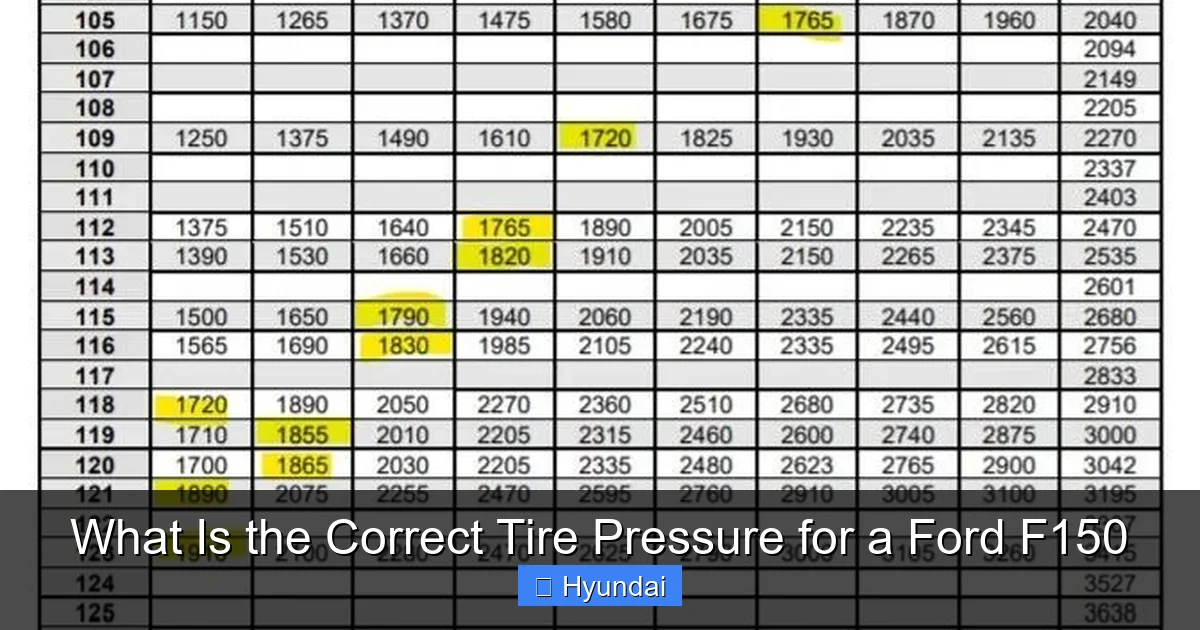
Finding the number is step one. Checking it correctly is step two, and most people get this wrong. The pressure on your gauge must be checked when the tires are “cold.” This doesn’t mean it’s cold outside; it means the tires haven’t been driven on for at least three hours or have been driven less than one mile. Driving even a short distance heats the air inside the tire, increasing the pressure reading and giving you a falsely high number. If you check hot tires and add air, you’ll actually be under-inflated when they cool down.
Visual guide about What Is the Correct Tire Pressure for a Ford F150
Image source: cimg7.ibsrv.net
Your Step-by-Step Check Routine
- Locate your spec: Open the driver’s door and read the Tire and Loading Information placard. Write down the recommended PSI for front and rear under “Normal Load.”
- Get a good gauge: Ditch the pencil-style gauges at gas stations. Invest $15-$30 in a digital or high-quality dial gauge from an auto parts store. Accuracy matters.
- Check when cold: First thing in the morning, or after the truck has sat for hours.
- Remove the valve cap: Screw it off and set it aside safely.
- Press the gauge on firmly: You’ll hear a slight hiss. Hold it straight and steady until the reading stabilizes.
- Compare and adjust: If it’s below spec, add air. If it’s above spec, press the small metal stem in the center of the valve to let air out (a quick press releases a burst).
- Don’t forget the spare: Check your full-size spare (if equipped) to the pressure listed on the placard, often much higher (like 60 PSI).
Pro Tip: Many F150 owners who use their trucks for towing or hauling keep a high-quality compressor and gauge in the truck bed. A portable 12V compressor is a lifesaver for adjusting pressures on the go, especially before a long highway trip with a loaded trailer.
Your F150’s TPMS: Friend or Foe?
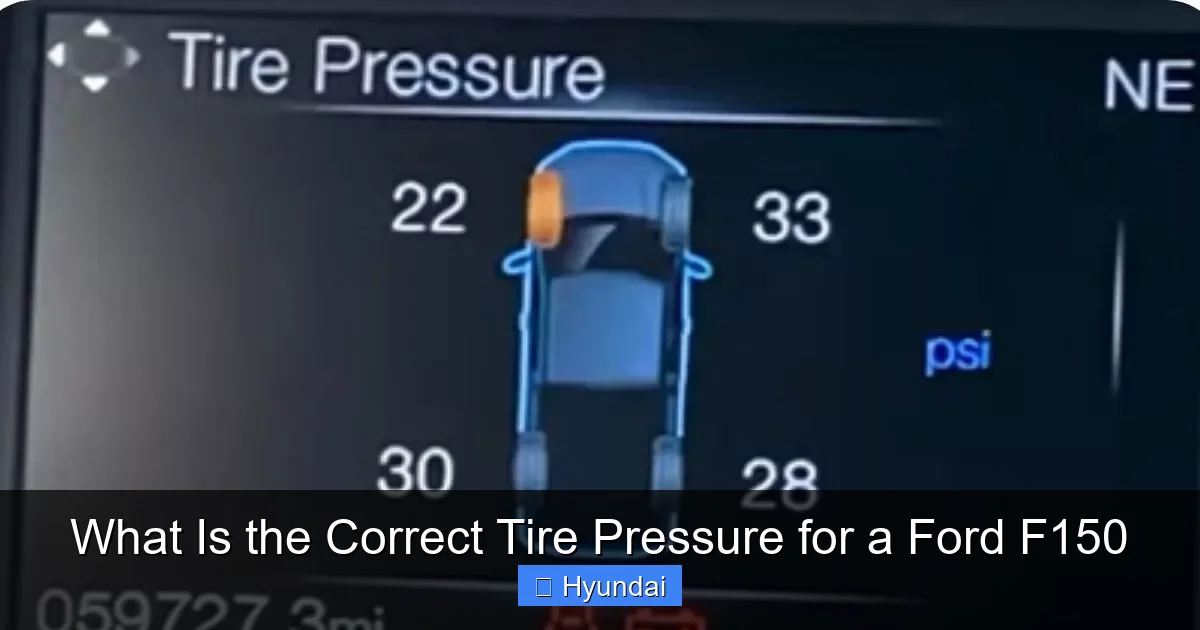
Since 2007, all F150s have had a mandatory Tire Pressure Monitoring System (TPMS). It’s that little light on your dash that looks like a cross-section of a tire with an exclamation point inside. Its job is to warn you when the pressure in one or more tires drops significantly below the vehicle’s recommended level. It’s a fantastic safety net, but it has critical limitations you must understand.
Visual guide about What Is the Correct Tire Pressure for a Ford F150
Image source: captaindon.org
How the F150’s TPMS Actually Works
Most F150s use a “direct” TPMS. This means there is a small sensor/transmitter inside each wheel (usually attached to the valve stem). It constantly monitors the pressure and temperature and sends a radio signal to your truck’s computer. When pressure falls 25% or more below the placard’s recommended level, the system triggers the warning light. Some newer models may also show which tire is low on the infotainment screen.
Why You Can’t Rely Solely on the TPMS Light
The TPMS is a catastrophic failure warning system, not a maintenance reminder. By the time the light comes on, you are already significantly under-inflated (e.g., 26 PSI in a 35 PSI tire). This means you’ve already been driving with poor handling, increased wear, and lower fuel economy for who knows how long. Furthermore, TPMS sensors can fail, lose battery power (the batteries last 7-10 years), or give false alerts after a tire service. You must check your pressures manually at least once a month and before any long trip.
If your TPMS light is on, it’s telling you to add air immediately. If it’s flashing when you start the truck, it usually indicates a system fault or a sensor battery failure, which requires diagnosis. For more on what that warning sign means, you can read a detailed explanation of the tire pressure warning sign and its variations across different automakers.
Resetting the TPMS After Service
After you inflate your tires to the correct pressure, the light should turn off after a few minutes of driving. If it doesn’t, you may need to perform a manual reset. The procedure varies by model year. Often, there’s a “TPMS” or “SET” button on the steering column or dash. You turn the ignition on (don’t start), press and hold the button until the light blinks three times, then drive. Always consult your owner’s manual for the exact procedure for your year. If the light persists after a proper reset and inflation, you likely have a faulty sensor that needs replacement.
Seasonal Adjustments and The Impact of Load
Your F150’s recommended “Normal Load” pressure is a starting point. Two major factors will require you to deviate from it: the weather and your cargo.
The Science of Temperature and PSI
Air is a gas. It expands when heated and contracts when cooled. This is not a theory; it’s physics. For every 10°F drop in ambient temperature, your tire pressure will decrease by about 1-2 PSI. Conversely, when summer heat soars, pressure can rise. This is why you often see TPMS lights come on during the first cold snap of fall—the air in your tires has contracted. The solution is to check and adjust your pressures in the morning during seasonal transitions. If your placard says 35 PSI and it’s 30°F colder than when you last set them, you’re likely down 3-4 PSI and need to top them off. Do not over-inflate to compensate for predicted heat; just set them to spec when the tires are cold.
Towing, Hauling, and Maximum Load Pressure
This is where many F150 owners go wrong. That “Normal Load” pressure is for the truck with a typical amount of passengers and cargo. When you are using your F150 for its intended work—towing a boat, horse trailer, or large camper, or filling the bed with heavy materials—you must increase the pressure. Your owner’s manual will have a chart or statement like: “When vehicle load is increased to maximum Gross Vehicle Weight Rating (GVWR), increase tire pressure to [X] PSI.” This is often 3-5 PSI higher than the normal spec, sometimes equal to the “Maximum Load” pressure on your door jamb sticker.
Why is this so important? The extra weight squashes the tire, causing it to flex more and heat up dangerously. The increased pressure stiffens the sidewall, reduces flex, and keeps the tire within its safe operating temperature range. Driving at maximum load with normal pressure is a direct path to a tire failure on the highway. Always consult your manual’s towing section for the precise guidance for your configuration.
Practical Tips, Common Mistakes, and Expert Advice
Let’s turn knowledge into action with some hard-earned wisdom from F150 owners and technicians.
Mistake #1: Using the Tire Sidewall Number
We said it before, but it bears repeating. The “Max. Press. 80 PSI” on your tire’s sidewall is the absolute maximum that specific tire can hold. Your F150’s suspension and ride quality are engineered for the much lower pressure on your door jamb sticker. Inflating to 80 PSI will give you a bone-jarring ride, destroy your suspension components over time, and actually reduce your tire’s contact patch, making you less stable. Always, always follow the vehicle manufacturer’s recommendation, not the tire manufacturer’s maximum.
Mistake #2: Ignoring the Spare Tire
That compact spare or full-size spare in the bed or under the truck has been sitting there for years, slowly losing air. It’s often forgotten until you get a flat. Check its pressure every six months and inflate it to the spec on your door jamb placard (for a full-size spare) or the spec on the spare itself (for a temporary “doughnut” spare). A flat spare is just a useless piece of rubber and steel.
Mistake #3: Not Checking After Tire Service
Any time you have tires rotated, balanced, repaired, or replaced, the technician should set them to your spec. But shop practices vary. Some air up tires to a generic 35 PSI regardless of vehicle. Always do your own check after any tire work. It takes two minutes and guarantees your safety.
Pro Tip: The Valve Stem is a Wear Item
On many F150s, the TPMS sensor is attached to the valve stem. When you replace a tire, the valve stem is usually replaced too. But if you have a older F150 without TPMS, the rubber valve stem itself degrades over 5-7 years and can crack, causing a slow leak. Consider replacing valve stems when you get new tires as a preventative measure.
Choosing Tires: Pressure is Part of the Equation
When it’s time for new tires, your choice affects the ideal pressure. If you switch from a standard all-season tire to a heavier-duty all-terrain or LT-metric tire, the load-carrying capacity changes. While you still start with the placard pressure, you may need to adjust slightly if the new tire has a significantly different load range. The best approach is to discuss your tire choice with a reputable dealer and confirm the pressure recommendation. For a comprehensive look at tire options tailored to the F150’s capabilities, exploring guides on the best tires for a Ford F150 is a great next step to understand how different tire types interact with your truck’s performance and pressure needs.
Conclusion: Make It a Habit
Knowing the correct tire pressure for your Ford F150 and committing to a simple monthly check routine is one of the highest-return, lowest-effort maintenance tasks you can perform. It directly protects your significant investment in your truck, safeguards your family, saves you money at the pump, and ensures that when you need to haul or tow, your F150 is ready and stable. The answer is always on your door jamb. The tool is a $20 gauge. The time commitment is five minutes. There is no excuse. Make it a habit, adjust for the seasons and your load, and enjoy the confidence that comes with knowing your truck is operating exactly as Ford engineered it to.
Frequently Asked Questions
What is the standard tire pressure for a Ford F150?
For most model year 2015 and newer F150s with standard all-season tires, the recommended “Normal Load” pressure is 35 PSI for both front and rear tires. However, this is a general range; your specific pressure is always listed on the Tire and Loading Information placard on your driver’s door jamb.
Where can I find the recommended pressure for my specific F150?
Look for a yellow or white sticker on the driver’s side door jamb when you open the door. It will list pressures for “Normal Load” and often “Maximum Load.” You can also find the information in your owner’s manual. Never use the pressure number printed on the tire’s sidewall.
How often should I check my F150’s tire pressure?
You should check all four tires and the spare with an accurate gauge at least once a month and before any long trip. Also, check them whenever there is a significant temperature change (10°F or more), as this affects pressure. Remember to check when tires are cold.
Does towing or carrying a heavy load affect the required tire pressure?
Yes, absolutely. When towing near your F150’s maximum capacity or carrying a very heavy payload, you typically need to increase tire pressure above the “Normal Load” spec. Consult your owner’s manual’s towing section for the exact “Maximum Load” or “Towing” pressure, which is usually 3-5 PSI higher than normal.
What does the tire pressure warning light mean on my F150 dash?
The light, which resembles a tire with an exclamation point, means your TPMS has detected that one or more tires is 25% or more below the recommended pressure. You should safely pull over and check/inflate your tires immediately. If the light is flashing when you start the truck, it indicates a TPMS system malfunction.
Can I use the same pressure for all four tires on my F150?
For most F150s under normal driving conditions, yes, the recommended pressure is the same for front and rear tires. However, some older models or specific configurations may have different front/rear specs. Always follow the numbers on your door jamb placard, which will specify if they differ. When towing a heavy trailer, some manufacturers recommend increasing rear pressure only.
