What Does Service Shifter Mean on a Jeep

Contents
- 1 Key Takeaways
- 2 📑 Table of Contents
- 3 Introduction: That Alarming Message on Your Dash
- 4 Decoding the Message: What “Service Shifter” Actually Means
- 5 Most Common Causes of a “Service Shifter” Warning in a Jeep
- 6 How the Electronic Shifter System Works (A Simplified Overview)
- 7 What to Do When the “Service Shifter” Light Comes On: A Step-by-Step Guide
- 8 Repair Options and Associated Costs
- 9 Prevention and Long-Term Care
- 10 Conclusion: A Warning You Must Heed
- 11 Frequently Asked Questions



Seeing the “Service Shifter” message on your Jeep’s dashboard is a serious warning from your vehicle’s computer that there’s a problem with the electronic shifter system or its communication with the transmission control module. It’s not a routine maintenance reminder; it indicates a fault that could prevent you from shifting gears or, in some cases, starting the vehicle. The issue can range from a simple software glitch to a failed mechanical position sensor or a wiring problem. Ignoring it can lead to being stranded or cause damage, so prompt diagnosis by a qualified technician is essential.
Key Takeaways
- It’s a Critical Fault Code: The “Service Shifter” message is an active diagnostic trouble code (DTC), not a maintenance reminder. It means the shifter’s position sensor or its communication network has failed.
- Common Triggers Include: A faulty shifter position sensor (often the most common cause), damaged wiring harnesses to the shifter, a failed transmission control module (TCM), or a software glitch requiring a reflash.
- Driving is Often Unsafe: You may lose the ability to shift out of Park, or the vehicle may not start. Even if it drives, the transmission could behave erratically, posing a safety risk.
- Diagnosis Requires Professional Tools: A simple visual check is rarely enough. Technicians need a scan tool to read the specific fault code from the Shifter or TCM module to pinpoint the failure.
- Repairs Vary in Cost: A simple sensor replacement might cost a few hundred dollars, while a failed TCM or extensive wiring repair can run into the thousands.
📑 Table of Contents
- Introduction: That Alarming Message on Your Dash
- Decoding the Message: What “Service Shifter” Actually Means
- Most Common Causes of a “Service Shifter” Warning in a Jeep
- How the Electronic Shifter System Works (A Simplified Overview)
- What to Do When the “Service Shifter” Light Comes On: A Step-by-Step Guide
- Repair Options and Associated Costs
- Prevention and Long-Term Care
- Conclusion: A Warning You Must Heed
Introduction: That Alarming Message on Your Dash
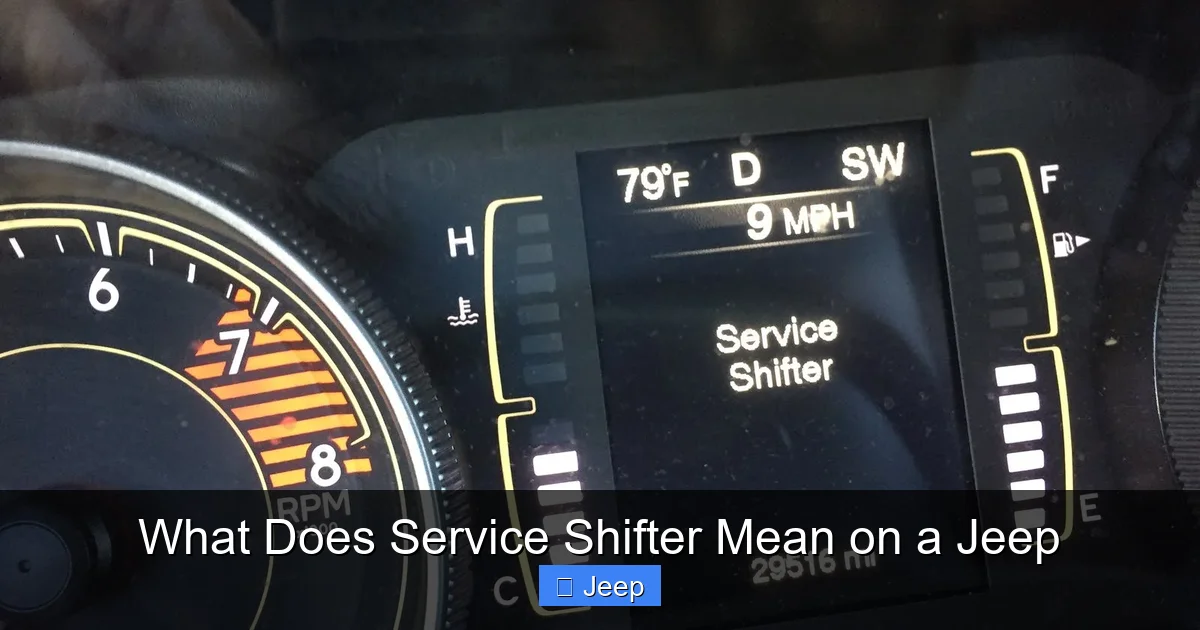
You’re starting your Jeep, or maybe you’re about to put it in Drive, and instead of the usual display, you see the words: SERVICE SHIFTER. It’s not a gentle reminder like “Oil Change Due.” It’s a stark, capitalized warning that feels urgent. And it is. This message is your Jeep’s way of screaming that its brain—the various computer modules—has lost reliable communication with the very component that tells the transmission what to do: the electronic shifter. In a modern Jeep, whether it’s a Grand Cherokee, Wrangler, Compass, or Cherokee, the simple mechanical link between your gear lever and the transmission has been replaced by a sophisticated electronic system. When that system fails, your vehicle’s mobility is compromised.
Understanding what “Service Shifter” means is the first step toward solving the problem and getting back on the road safely. This isn’t a DIY fix for a novice. It requires systematic diagnosis. In this comprehensive guide, we’ll break down exactly what this warning signifies, the most common culprits behind it, how the system works, what you can expect during diagnosis and repair, and crucial steps to take the moment that message appears. We’ll also touch on how this issue compares to similar warnings in other vehicles, like those seen in some Dodge Ram models, which share similar electronic architecture within the Stellantis family.
Decoding the Message: What “Service Shifter” Actually Means
To understand the warning, you need to know how your Jeep’s shifting system works. In older vehicles, moving the gear lever physically moved a cable or linkage connected directly to the transmission. Today, when you move the shifter in your Jeep, you’re moving an electronic sensor (often called a Shifter Position Sensor or a Hall Effect sensor) housed inside the shifter assembly itself. This sensor sends a digital signal to the Transmission Control Module (TCM), telling it exactly which gear position you’ve selected (Park, Reverse, Neutral, Drive, etc.). The TCM then commands solenoids inside the transmission to engage the correct gear.
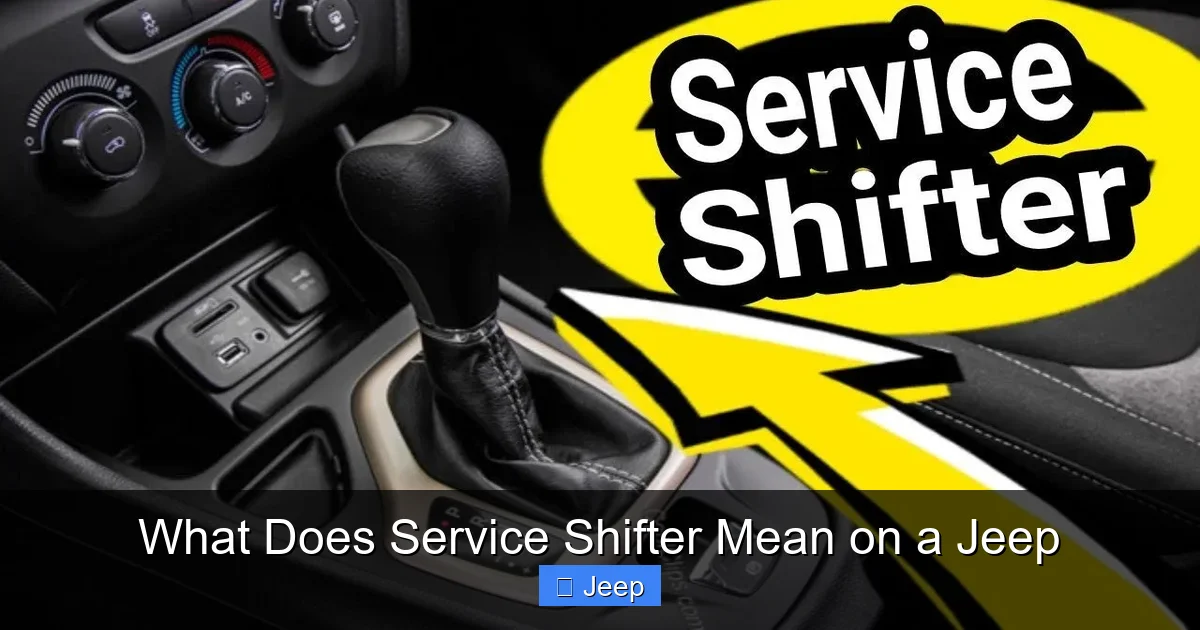
Visual guide about What Does Service Shifter Mean on a Jeep
Image source: jeepgenius.com
The Chain of Communication
The “Service Shifter” message is triggered when this communication chain breaks. The TCM or the Body Control Module (BCM) is constantly checking for a valid, consistent signal from the shifter sensor. If the signal is missing, out of range, or inconsistent (e.g., it says you’re in Park and Drive at the same time), the module logs a fault code and illuminates the warning. The system is designed this way as a critical safety feature. An incorrect gear signal could mean your vehicle might roll when you think it’s in Park, or it could refuse to start because it doesn’t detect it’s in Park/Neutral.
It’s important to distinguish this from other warnings. For instance, a “Service 4WD” message, which you might see on a Dodge Ram with 4×4, relates to the transfer case system, not the primary transmission shifter. While both are electronic, they are separate systems. The “Service Shifter” warning is solely about the gear selection interface and its primary electronic signal.
Most Common Causes of a “Service Shifter” Warning in a Jeep
While the ultimate result is the same—a broken communication path—the root causes can vary. Here are the most frequently diagnosed reasons for this fault, ordered from most to least common.
Visual guide about What Does Service Shifter Mean on a Jeep
Image source: carservicecosts.com
1. Failed Shifter Position Sensor (The Usual Suspect)
This is, by far, the most common failure point. The sensor inside the shifter assembly is an electromechanical component that can wear out, fail internally, or have its contacts corrode. Over thousands of gear changes, it can simply give up the ghost. Symptoms often include the warning appearing intermittently at first, then becoming constant. You might also notice the gear indicator on the dash flickering or showing the wrong gear (like showing “N” when you’re in Drive). Replacing the sensor is a common repair, but on many Jeeps, the sensor is part of the entire shifter assembly, requiring a full replacement.
2. Damaged or Corroded Wiring Harness
The wiring that runs from the shifter assembly up through the steering column and to the TCM is subject to constant movement, heat, and vibration. Over time, wires can fray, connectors can become loose or corroded, and insulation can crack. A short circuit or an open circuit in this harness will instantly kill the signal. This is particularly common in older Jeeps or those exposed to harsh conditions. A technician will perform a “wiggle test” on the wiring while monitoring the signal to see if the fault appears, which is a classic diagnostic for this issue.
3. Faulty Transmission Control Module (TCM)
Less common than a sensor or wire issue, but more serious, is a failure within the TCM itself. The TCM is the computer that processes the shifter signal. If its internal circuitry fails or it develops a software corruption, it can’t interpret the signal correctly. Diagnosing a bad TCM usually comes after the sensor and wiring have been ruled out. Sometimes, a TCM can be repaired or reflashed with updated software, but often it needs to be replaced and then programmed (or “paired”) to the vehicle, which adds to the cost and complexity.
4. Software Glitch or Need for Reflash
In some cases, especially after a battery disconnect or a voltage spike, the module’s software can become confused. A simple reflash—reprogramming the TCM or BCM with the latest factory software—can resolve the issue. Dealerships often have technical service bulletins (TSBs) that address known software bugs causing false “Service Shifter” warnings. This is the best-case scenario, as it’s relatively inexpensive and non-invasive.
5. Physical Obstruction or Mechanical Failure in the Shifter
While the signal is electronic, the shifter mechanism is still mechanical. If something physically jams the shifter assembly (like a foreign object) or a internal mechanical part breaks, the sensor may not move correctly, sending an invalid signal. You might feel resistance or grinding when moving the lever. This often requires disassembly and repair of the shifter assembly itself.
How the Electronic Shifter System Works (A Simplified Overview)
To truly diagnose the problem, it helps to visualize the system. Think of it as a three-part team:

Visual guide about What Does Service Shifter Mean on a Jeep
Image source: koala.sh
- Part 1: The Input Device (The Shifter). Your physical gear lever is connected to a shaft that rotates a magnet inside a housing. Surrounding that magnet is a Hall Effect sensor. As the magnet spins with the shifter movement, the sensor generates a precise voltage signal corresponding to each gear position (P, R, N, D, etc.).
- Part 2: The Brain (The Transmission Control Module – TCM). This is a dedicated computer, usually located near the transmission or under the hood. Its sole job is to receive the shifter’s signal, interpret it, and send commands to the transmission solenoids. It also communicates with other modules, like the Body Control Module (BCM) and the Engine Control Module (ECM).
- Part 3: The Output & Feedback (The Transmission & Dash Display). The TCM commands the transmission. Simultaneously, it tells the instrument cluster what gear to display. If there’s a mismatch between what the shifter sensor says and what the TCM expects, or if the signal is lost, the TCM flags a fault and commands the BCM to light up the “SERVICE SHIFTER” message on your dash.
This entire system is a closed-loop feedback mechanism. A failure anywhere—sensor, wiring, connector, or module—breaks the loop and triggers the warning. The complexity is why a scan tool is non-negotiable for diagnosis.
What to Do When the “Service Shifter” Light Comes On: A Step-by-Step Guide
Here is the practical action plan for a Jeep owner facing this warning.
Immediate Safety Steps
1. Do Not Panic, But Do Not Ignore. Safely pull over if you’re driving. The first question is: can you shift gears? Try moving the lever gently through all positions (P, R, N, D, etc.). Does it feel normal? Does the gear indicator on the dash change accurately?
2. Check for Starting Interlock. Many Jeeps will not start unless the shifter is firmly in Park (or Neutral). If your Jeep won’t start and displays “Service Shifter,” the system likely doesn’t “see” the shifter in Park. Try wiggling the shifter firmly in the Park position while pressing the brake. Sometimes a slightly misaligned sensor can be temporarily coaxed into registering Park.
3. Assess Drivability. If the vehicle is already running and in motion, and the message appears, shift to a lower gear (like 2nd or 3rd, if your vehicle has a “Sport” mode or manual option) to maintain slow, controlled speed. Do not attempt to shift into Reverse or Park while moving. Your priority is to get safely to a location where you can have the vehicle towed if necessary.
The Diagnostic Process (What a Technician Will Do)
This is not a home repair. You need a shop with the proper scan tool (like a wiTECH for FCA/Stellantis vehicles, or a high-end aftermarket tool). Here’s what happens:
- Step 1: Scan for Codes. The technician will plug in the scanner and read all modules. They are looking for a specific code related to the shifter, such as “P0841 – Shift Lever Position Sensor Circuit” or codes like “U” series (network communication) codes. The exact code is the roadmap for diagnosis.
- Step 2: Live Data Monitoring. Using the scan tool, they will watch the live data stream from the shifter position sensor. They’ll move the shifter and see if the percentage or voltage values change smoothly and correctly for each gear. If the signal is stuck, jumps erratically, or shows two gears at once, the sensor is bad.
- Step 3: Visual and Physical Inspection. They will inspect the wiring harness from the shifter to the TCM for damage, corrosion, or loose connectors. They will check the shifter assembly for physical damage or debris.
- Step 4: Component Isolation. If the sensor signal is bad but the wiring looks good, they may test resistance at the sensor connector or, in some cases, swap in a known-good sensor/assembly to confirm. If the wiring is bad, they repair it. If the sensor and wiring are good but the TCM still reports no signal, the TCM itself is suspect.
This methodical process eliminates guesswork. Throwing parts at the problem (e.g., just replacing the sensor) without diagnosis often leads to wasted money if the issue was actually a broken wire.
Repair Options and Associated Costs
The repair path is dictated entirely by the diagnosis. Here’s a breakdown of common fixes and their typical cost ranges (parts + labor). Remember, prices vary wildly by region, shop type (dealer vs. independent), and specific Jeep model/year.
- Shifter Position Sensor / Shifter Assembly Replacement: If the sensor itself is faulty and available separately, costs might be $150-$400 for the part and 1-2 hours of labor. However, on most modern Jeeps (especially from 2011 onward), the sensor is not serviceable separately; you must replace the entire shifter assembly. This part can cost $300-$800+ from the dealer. Labor is typically 1.5-3 hours as it involves disconnecting the battery, removing console trim, and unbolting the assembly. Total Estimate: $500 – $1,500.
- Wiring Harness Repair: This is the best-case scenario cost-wise. A technician will splice and repair damaged wires, replace a corroded connector, or secure a loose one. Total Estimate: $100 – $400.
- Transmission Control Module (TCM) Replacement & Programming: A new TCM from the dealer is expensive, often $800-$1,500+. Aftermarket units are available but must be precisely matched and programmed. The labor involves removal (location varies) and, most critically, the programming/adaptation process using proprietary software, which usually requires a dealer or a highly specialized mobile programmer. Total Estimate: $1,200 – $2,500+.
- Software Reflash/Update: If the issue is a software bug, the dealer will perform a TCM reflash. This is purely a labor/time charge, as there is no physical part. Total Estimate: $100 – $300.
Important: Always get a clear, written diagnosis and quote before authorizing any repair. Ask them to show you the fault code and explain how they arrived at the recommended fix.
Prevention and Long-Term Care
While you can’t prevent an electronic component from eventually failing, you can take steps to avoid premature failure and be prepared.
- Treat the Shifter with Respect. Avoid slamming the lever into Park or Reverse. Use the brake pedal firmly when shifting from Park. This reduces stress on the internal mechanisms and sensor.
- Be Mindful of the Ignition. On key-start Jeeps, always come to a full stop before shifting into Park or Reverse. For push-button start, ensure the vehicle is completely stopped before pressing the “Engine Start/Stop” button to shut off, as this sequence often requires the shifter to be in Park.
- Address Related Issues Promptly. A weak battery or charging system can cause voltage drops that may corrupt module software or cause communication errors. Keep your electrical system healthy.
- Stay Informed on TSBs. Check with your dealer or online Jeep forums (like JeepGarage or WJ/JL specific forums) for any Technical Service Bulletins related to “Service Shifter” for your specific model year. Sometimes a known issue has a factory-sponsored repair program or updated part that can save you money.
Ultimately, this system is robust but not infallible. When it fails, professional intervention is the only safe and reliable path forward.
Conclusion: A Warning You Must Heed
The “Service Shifter” message in your Jeep is a definitive red flag from your vehicle’s computer. It signals a loss of reliable communication between your gear selector and the transmission’s brain. This is not a minor inconvenience; it’s a critical systems failure that can strand you or create an unsafe driving condition. The causes range from a relatively simple sensor or wire issue to a major component failure like the TCM. The key takeaway is that diagnosis is everything. A proper scan, live data monitoring, and systematic testing are required to identify the true source of the problem and avoid costly, unnecessary part replacements.
When this warning appears, your immediate action should be to assess whether the vehicle is safe to drive or if it needs to be towed. Then, seek out a reputable repair shop—preferably a Jeep specialist or a dealer with the correct factory-level diagnostic tools. While the repair cost can vary dramatically, addressing the issue promptly is crucial for your safety and the long-term health of your Jeep’s transmission. Remember, similar electronic shifter warnings exist across the automotive landscape, including in many Dodge Charger models, highlighting the shared complexity of modern drivetrain electronics. Don’t gamble with your Jeep’s shifting system; get it serviced by professionals who understand these intricate networks.
Frequently Asked Questions
Can I drive my Jeep with the Service Shifter message on?
Generally, no. Driving is unsafe as you could lose the ability to shift gears, which could cause the vehicle to become stuck in one gear or fail to stop. If the vehicle is already moving and the light comes on, proceed with extreme caution to a safe location and have it towed.
What is the most common fix for a Service Shifter warning?
The most common fix is replacing the faulty shifter position sensor. However, on many Jeep models, the sensor is integrated into the shifter assembly, requiring a full shifter replacement rather than just a cheap sensor part.
Will disconnecting the battery reset the Service Shifter light?
Sometimes, if the issue is a minor software glitch, a battery disconnect might temporarily clear the code. However, the underlying problem will almost certainly cause the warning to return once the system rechecks and detects the fault again. It is not a permanent fix.
How much does it typically cost to fix a Service Shifter problem?
Costs vary widely based on the cause. A simple wiring repair might be under $400. A full shifter assembly replacement typically ranges from $500 to $1,500. A failed Transmission Control Module (TCM) replacement with programming can exceed $2,000.
Is the Service Shifter warning related to the transmission fluid?
No. The “Service Shifter” warning is specifically about the electronic shifter position sensor and its communication circuit. Low or dirty transmission fluid will typically trigger a different warning, such as “Transmission Over Temperature” or a generic “Check Engine” light with related codes.
Will a Service Shifter problem prevent my Jeep from starting?
Yes, very often. The vehicle’s safety interlock system requires a confirmed signal from the shifter that it is in Park (or Neutral) to allow the starter to engage. A failed shifter sensor means the computer never gets this confirmation, so the engine will not crank.