What Attention Level Means in Hyundai Vehicles

Contents
- 1 Key Takeaways
- 2 📑 Table of Contents
- 3 How the Attention Level System Works: The Tech Behind the Nudge
- 4 Which Hyundai Models Have Attention Level, and Where Is It Found?
- 5 The Real-World Benefits: Why This System Matters
- 6 Limitations and Things Every Driver Should Know
- 7 The Future of Driver Monitoring in Hyundai
- 8 Practical Tips for Owners: Getting the Most from Attention Level
- 9 Frequently Asked Questions
Interior Cleaner Spray

Car Floor Mats (Universal)

Microfiber Car Cleaning Cloth

Digital Tire Pressure Gauge
Hyundai’s Attention Level is an intelligent driver monitoring system that uses a camera to detect signs of fatigue or distraction. It provides visual and audible alerts to help you stay focused on the road, playing a key role in Hyundai’s safety suite. This technology is available across many recent Hyundai models, offering an extra layer of protection for you and your passengers.
Have you ever been driving and suddenly realized your mind was miles away? Maybe you were thinking about dinner, a work problem, or just feeling that afternoon slump. It happens to the best of us. But what if your car could gently nudge you back to the present moment before something goes wrong? That’s exactly the idea behind Hyundai’s Attention Level system. It’s a smart piece of technology that acts like a co-pilot, constantly watching for signs that you might be getting tired or losing focus. In this guide, we’ll break down everything you need to know about what Attention Level means in your Hyundai. We’ll talk about how it works, where you can find it, and why it’s such an important tool for modern driving safety.
Think of Attention Level as your car’s way of saying, “Hey, let’s both pay attention here.” It’s not about judging you; it’s about helping. Using a small, discreet camera mounted on the steering column, it monitors your face and eyes. When it detects patterns that suggest you’re blinking too much, your head is drooping, or you’re looking away from the road for too long, it will get your attention with a clear alert. It’s a proactive safety measure, designed to intervene before a moment of distraction turns into a serious incident. As cars get smarter, features like this are becoming standard, and understanding them is key to getting the most out of your Hyundai’s safety capabilities.
Key Takeaways
- Attention Level is a driver monitoring system: It uses an infrared camera to track eye movement and facial cues, identifying when a driver may be drowsy or not paying attention.
- It’s part of Hyundai SmartSense: This feature is included in Hyundai’s suite of advanced safety technologies, often bundled with systems like Forward Collision-Avoidance Assist.
- Available on many recent models: You’ll find Attention Level in popular vehicles like the Sonata, Tucson, Santa Fe, and Palisade, typically on higher trims.
- Alerts are designed to be unmistakable: The system issues a loud chime and a clear visual warning on the instrument cluster, urging the driver to take a break.
- It has limitations: The system may not function correctly if the camera view is obstructed, or in certain lighting conditions, and it is not a substitute for attentive driving.
- Maintenance is simple but crucial: Keeping the windshield clean in front of the camera and ensuring the camera lens is free of debris is essential for reliable operation.
- Future iterations will be more advanced: Hyundai is continuously improving the software to better recognize subtle signs of impairment and integrate with semi-autonomous driving features.
📑 Table of Contents
- How the Attention Level System Works: The Tech Behind the Nudge
- Which Hyundai Models Have Attention Level, and Where Is It Found?
- The Real-World Benefits: Why This System Matters
- Limitations and Things Every Driver Should Know
- The Future of Driver Monitoring in Hyundai
- Practical Tips for Owners: Getting the Most from Attention Level
How the Attention Level System Works: The Tech Behind the Nudge
To understand Attention Level, you need to know what it’s looking at. The magic happens through a combination of hardware and clever software. Let’s peel back the curtain.
The Infrared Camera: Your Car’s Watchful Eye
Tucked near the rearview mirror, usually on the steering column, is a small infrared camera. You might not even notice it. This isn’t a regular camera; it uses infrared light to see clearly in all conditions—bright sunlight, pitch darkness, or anything in between. It’s specifically designed to track your face. It doesn’t record a video or take pictures. It’s only analyzing data points like the position of your head, the openness of your eyes, and your gaze direction. This data is processed instantly and locally within the car; it’s not being sent to a cloud server. Your privacy is intact.
Algorithm Analysis: Decoding Your Facial Cues
The raw data from the camera is fed into a sophisticated algorithm. This software has been trained to recognize the subtle (and not-so-subtle) signs of driver fatigue and distraction. It’s looking for a few key things:
- Eye Closure Duration (PERCLOS): This is a scientific measure. The system calculates the percentage of time your eyes are closed over a specific period. A high percentage indicates drowsiness.
- Blink Frequency: Rapid, frequent blinking can be a sign of fatigue.
- Head Position: If your head starts to nod or tilt significantly downward, it’s a red flag.
- Gaze Direction: The system checks if you’re looking at the road ahead or if your attention has wandered to the infotainment screen, a passenger, or outside the window for too long.
When the algorithm determines that a combination of these factors crosses a certain threshold, it decides it’s time to alert you.
The Alert Sequence: Getting Your Attention
The system is designed to escalate gently but firmly. It won’t blast you with a noise the first time you glance away for three seconds. Instead, it typically follows a sequence:
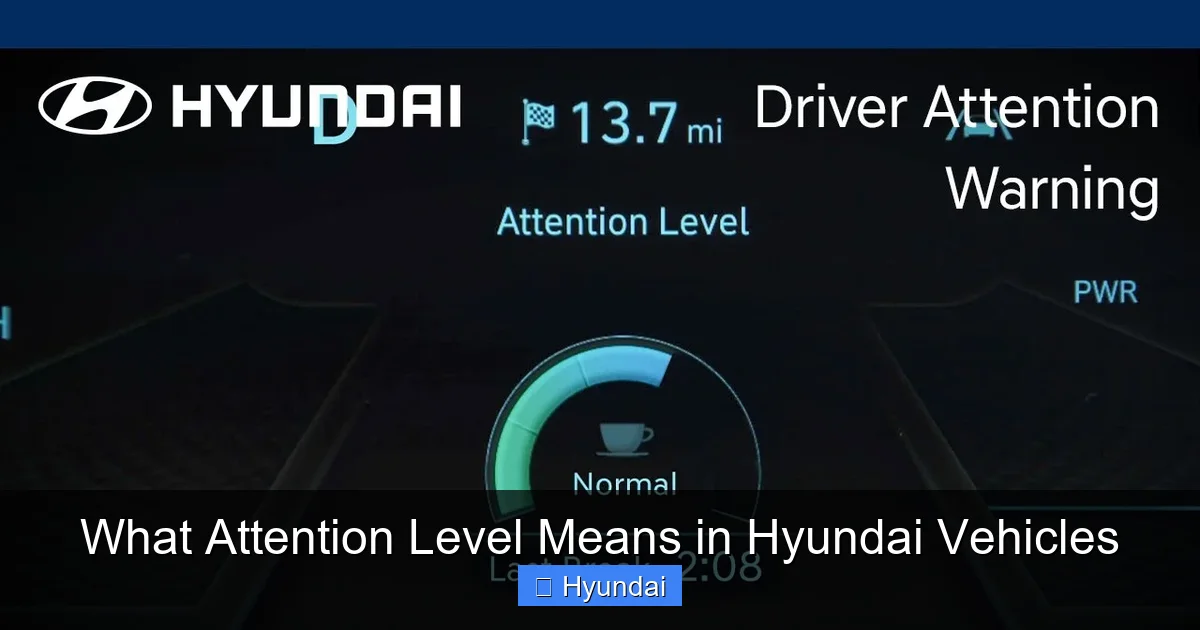
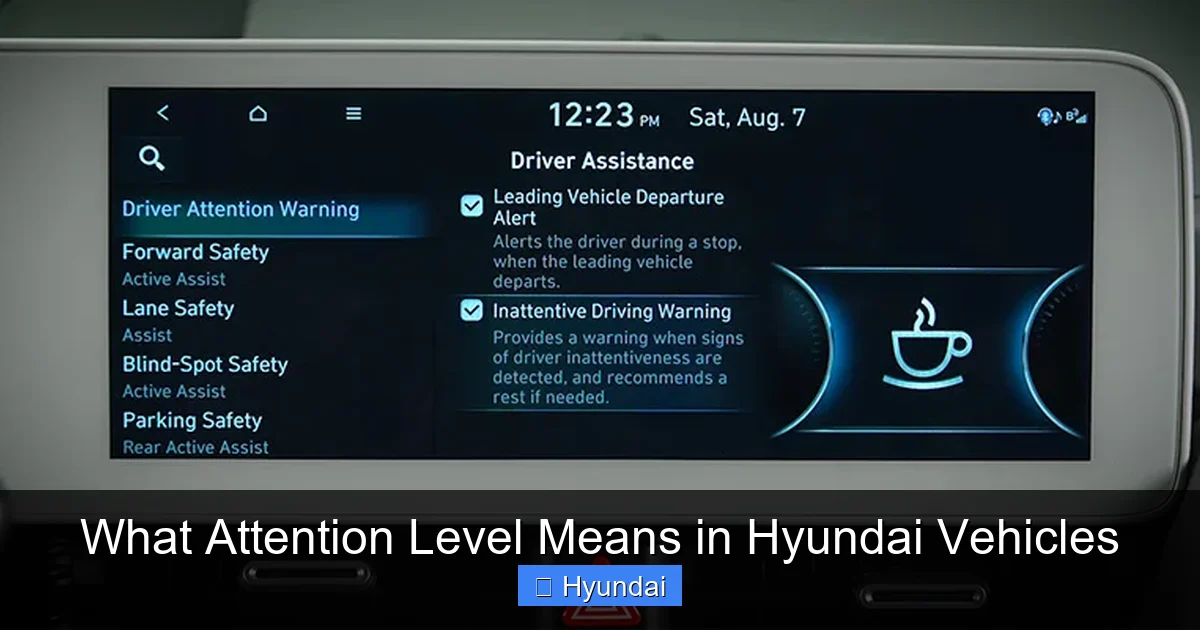
First, you might see a small icon—often a coffee cup or a stylized face—appear on your instrument cluster or head-up display (if equipped). This is the initial, subtle warning. If the concerning behavior continues, the system will emit a loud, distinctive chime. The visual icon will likely flash, and you may even see a message like “Attention, please!” or “Take a break.” The goal is to be impossible to ignore, jolting you back to full alertness. Once you acknowledge the alert by, for example, turning your head back to the road or pressing a button (depending on model), the system will reset and begin monitoring again.
It’s a closed-loop system: monitor, analyze, alert, reset. It runs quietly in the background every time you drive, without any need for you to turn it on. It’s always on duty, just like your Hyundai’s airbags or anti-lock brakes.
Which Hyundai Models Have Attention Level, and Where Is It Found?
Attention Level has been rolling out across Hyundai’s lineup for several years now, but it’s not available on every single trim of every model. It’s typically bundled within the highest tiers of Hyundai SmartSense, Hyundai’s umbrella name for its advanced driver-assistance systems (ADAS). Here’s a general guide to where you can expect to find it.

Visual guide about What Attention Level Means in Hyundai Vehicles
Image source: hyundaicanada.com
Sedans: Focus on the Family and Commuter
In the sedan range, the flagship Sonata has been a major beneficiary. For recent model years (2020 and newer), Attention Level is standard on the Sonata N Line and Limited trims, and often available on the SEL Plus. The smaller Elantra also offers it, but again, usually on the top Limited or N Line trims. The sporty Veloster N includes it as part of its comprehensive safety package. For the larger Genesis G80 (Hyundai’s luxury division), the system is sophisticated and widely available.
SUVs and Crossovers: Where Safety is a Top Priority
This is where you’ll find the broadest availability, as SUVs are family haulers where safety is paramount.
- Tucson: The compact SUV leader. Attention Level is standard on the Tucson Limited and N Line trims, and often on the SEL Premium.
- Santa Fe: The midsize workhorse. It’s a standard feature on the Santa Fe Calligraphy, Limited, and N Line trims.
- Palisade: The three-row flagship SUV. Here, it’s more commonly found, often standard on the Limited and Calligraphy trims.
- Kona: The subcompact crossover. Availability is more limited, typically reserved for the top Ultimate or N Line trims.
- Venue: The smallest SUV. It generally does not offer the Attention Level system, focusing on more basic safety features.
Important Note: Model year and market (country) can significantly affect availability. A 2022 Tucson in the US might have it standard on more trims than a 2022 Tucson in another region. The absolute best way to know for sure is to check the window sticker of the specific vehicle you’re looking at or consult your owner’s manual. You can also use Hyundai’s online build-and-price tool for your region to see which safety features come on which trim.
The Real-World Benefits: Why This System Matters
So, this camera watches you blink. So what? The benefit is profound and directly tied to crash prevention. Driver fatigue and distraction are leading causes of accidents. According to the National Highway Traffic Safety Administration (NHTSA), drowsy driving was responsible for an estimated 91,000 police-reported crashes in a recent year. The AAA Foundation for Traffic Safety has found that missing just 2-3 hours of sleep quadruples your crash risk, similar to driving drunk.
Visual guide about What Attention Level Means in Hyundai Vehicles
Image source: hondatheotherside.com
Proactive vs. Reactive Safety
Traditional safety features like seatbelts and airbags are reactive. They protect you after a crash has started. Systems like Automatic Emergency Braking (AEB) are active but still vehicle-focused; they react to obstacles outside the car. Attention Level is proactive and driver-focused. It aims to correct the problem before the vehicle even encounters an external hazard. By alerting a drowsy driver to pull over, it can prevent a lane departure or a failure to brake that would trigger the car’s other safety systems. It’s the first line of defense, addressing the human element, which is the most common factor in crashes.
A Constant, Unbiased Companion
We all like to think we’re good drivers, but self-assessment is notoriously poor. You might feel “fine” after a long day, but your micro-sleeps or prolonged eye closures tell a different story. Attention Level provides an objective, data-driven assessment. It doesn’t get tired, it doesn’t get annoyed, and it doesn’t assume you’re okay. For long highway road trips, monotonous commutes, or late-night drives, it serves as a vital, unbiased backseat driver (in the best way possible).
Complementing Other Hyundai SmartSense Features
Attention Level doesn’t work in isolation. It’s part of an integrated safety ecosystem. For example, if you’re distracted and start to drift out of your lane, you might get an Attention Level alert and a Lane Keeping Assist warning at the same time. This layered approach increases the chance that at least one message gets through. It works in harmony with Forward Collision-Avoidance Assist, Driver Attention Warning (a related but sometimes separate system), and even the navigation system, which might suggest a rest stop if you’ve been driving for hours and show signs of fatigue. This holistic approach is what makes modern Hyundai vehicles so safe.
Limitations and Things Every Driver Should Know
No technology is perfect, and Attention Level is no exception. Understanding its limitations is crucial for using it effectively and maintaining safe driving habits.

Visual guide about What Attention Level Means in Hyundai Vehicles
Image source: hondatheotherside.com
It’s an Aid, Not a Replacement
This is the golden rule. Attention Level is a driver-assistance feature, not an autonomous driving system. It cannot physically control the car. It cannot force you to pull over. It is a warning system, and you are still 100% responsible for the safe operation of your vehicle. Relying on it to wake you up from a dangerous micro-sleep is a terrible idea. The moment you feel drowsy, you should still plan to stop at a safe location, stretch, or switch drivers if possible. Think of Attention Level as a helpful reminder, not your primary safety net.
Environmental and Physical Limitations
The system’s camera needs a clear, unobstructed view of your face. Several things can interfere:
- Obstructions: A hat brim, sunglasses (especially polarized ones), or even a hand in front of your face can block the camera.
- Lighting: Extreme backlighting (like driving directly into a setting sun) or very dark conditions can challenge the infrared camera, though it’s designed for low light.
- Camera Cleanliness: A dirty windshield right in front of the camera or a smudged camera lens itself will degrade performance. This is why regular cleaning is important.
- Driver Appearance: Significant facial hair, extreme makeup, or certain medical conditions that affect eye movement might reduce accuracy.
The system will often show a message like “Driver Attention Warning not available” or display a camera icon with a line through it if it can’t see you properly.
False Alarms and Missed Events
You might get an alert when you’re perfectly alert—maybe you glanced at the GPS for a second. That’s a false alarm. Conversely, it might not alert you if you’re extremely tired but sitting perfectly still with your eyes open (a rare but possible state of “zone-out”). The system is tuned to balance sensitivity to avoid being too annoying, but this means it’s not 100% infallible. Never assume that a lack of an alert means you’re fully capable of driving safely. Your own judgment is always the final authority.
The Future of Driver Monitoring in Hyundai
Attention Level is already impressive, but it’s just the beginning. Hyundai, through its N sub-brand and its research divisions, is rapidly advancing driver monitoring technology. The future points toward systems that are even more personalized, integrated, and capable.
Beyond the Face: Multimodal Sensing
Next-generation systems will likely combine facial tracking with other data streams. This could include:
- Steering Wheel Input: Monitoring for subtle, corrective steering movements that indicate weaving or lack of control.
- Vehicle Dynamics: Using data from the car’s stability control and lane-keeping systems to infer driver state.
- Biometric Sensors: Integrating with seat sensors or wearable tech (like a connected smartwatch) to monitor heart rate variability, which can be an indicator of stress or fatigue.
This “sensor fusion” approach would create a much more robust and accurate picture of your physical and mental state behind the wheel.
Integration with Autonomous Driving
As Hyundai moves toward higher levels of semi-autonomous driving (like Highway Driving Assist 2), the driver monitoring system becomes absolutely critical. For a car to safely hand control back to a human driver, it must first be certain the human is alert and ready to take over. Future Attention Level systems will play a key role in this handoff process, providing more precise and timely alerts to ensure a smooth and safe transition. It’s a foundational technology for the autonomous future.
Personalization and Learning
Imagine a system that learns your individual baseline. It could recognize your normal driving patterns and become more sensitive to deviations that are unique to you. It might also offer personalized advice based on the time of day, your calendar (if connected), and historical data. “You usually feel tired after 3 hours of driving on Tuesdays. Would you like to set a reminder for a break?” This kind of adaptive, personalized safety is the logical next step.
Practical Tips for Owners: Getting the Most from Attention Level
Now that you know what it is and how it works, here’s how to make sure it works best for you.
Keep Your Windshield Spotless
This is the single most important maintenance task. The camera’s view is through a specific area of your windshield, usually marked by a small icon or symbol on the glass itself (check your manual). Use a proper automotive glass cleaner and a soft microfiber cloth to keep this area completely clear of dirt, bugs, frost, snow, and fog. A quick wipe during regular car washes is a great habit. If your wipers are old and streaking, consider upgrading. For Hyundai Santa Fe owners, our guide to the best wiper blades can help you maintain perfect visibility for all your camera-based systems, including Attention Level and Forward Collision-Avoidance Assist.
Know How to Turn It On and Off
The system is usually on by default, but you can control it via your vehicle’s settings menu, often under “Driver Assistance” or “Safety.” You might find options to adjust the alert sensitivity or turn the system off entirely. While you can turn it off, we strongly advise against it. There’s no downside to having it active, and it could provide a crucial warning when you least expect it. If you must turn it off (for a specific reason), remember to turn it back on for your next drive.
Heed the Alerts Immediately
When you get that chime and icon, don’t ignore it or get frustrated. Take it seriously. The system has determined there’s a real risk. The safest response is to find a safe, legal place to pull over—a rest stop, a parking lot, or a wide shoulder. Get some fresh air, stretch, have a caffeinated drink if you need to, or better yet, switch drivers if possible. A 15-20 minute break can work wonders. Treat the alert as a positive intervention, not a nuisance.
Understand the Difference from Driver Attention Warning
Hyundai sometimes uses slightly different names for similar systems. “Attention Level” and “Driver Attention Warning” (DAW) are often used interchangeably, but in some model lines, DAW might be a more basic system that only monitors steering input patterns (looking for lack of correction) rather than using a camera. Your owner’s manual will have the precise definition for your specific model and year. If you have a camera-based system, you’ll know because it requires a clear view of your face.
In conclusion, Hyundai’s Attention Level is a sophisticated and valuable ally on the road. It represents a shift in automotive safety—from protecting you in a crash to helping you avoid one altogether. By understanding its purpose, respecting its capabilities, and maintaining your vehicle properly, you can leverage this technology to become a safer, more aware driver. Remember, the best safety system is still an engaged, alert, and responsible human behind the wheel. Let Attention Level help you be that driver.
Frequently Asked Questions
Does Hyundai Attention Level work at night?
Yes, it is designed to work in all lighting conditions, including complete darkness, thanks to its infrared camera. However, extreme glare from oncoming headlights or very poor ambient light can sometimes affect its performance.
Can I turn off the Attention Level system?
Yes, you can usually disable it through your vehicle’s infotainment system settings menu, typically found under Driver Assistance or Safety. However, it is strongly recommended to keep it enabled as it provides an important safety net.
How accurate is the Attention Level system?
It is highly accurate under normal conditions with an unobstructed view of the driver’s face. However, it is not infallible and can occasionally produce false alerts or miss signs of extreme fatigue. It should always be used as a supplement to, not a replacement for, the driver’s own judgment.
What does the Attention Level alert look and sound like?
The alert typically consists of a loud, distinctive chime and a flashing visual icon (often a coffee cup or a face) on the instrument cluster or head-up display. A text message like “Attention, please!” or “Take a break” may also appear.
Does the Attention Level camera record me or store my data?
No. The camera only processes facial data in real-time to detect eye and head position. It does not record video, take photographs, or store personal data. The processing is done locally within the vehicle.
Is Attention Level standard on all Hyundai vehicles?
No. It is part of the Hyundai SmartSense safety suite and is typically available on higher trim levels of most newer models (like Sonata, Tucson, Santa Fe, Palisade). It is not standard on base trims or on smaller models like the Venue. Always check the specific vehicle’s specifications.