
What Spark Plugs Does Hyundai Use?

Hyundai uses a variety of spark plugs, primarily from OEM brands NGK and Denso, selected specifically for each engine type. The correct plug—including its heat range and gap—is critical for performance and fuel economy. Always consult your owner’s manual or a dealership for the exact specification for your specific Hyundai model and year. Using the wrong plug can cause poor performance, misfires, and engine damage.
Key Takeaways
- OEM Brands: Hyundai primarily uses NGK and Denso spark plugs as original equipment, with the specific part number varying by engine.
- Engine-Specific: There is no single “Hyundai spark plug.” The correct plug depends entirely on your vehicle’s exact engine code (e.g., 2.0L GDI, 1.6L Turbo).
- Heat Range is Key: The most important specification is the heat range, which must match the engine’s design to prevent pre-ignition or fouling.
- Replacement Interval: Follow Hyundai’s recommended service schedule, typically every 30,000 to 100,000 miles depending on the plug type and engine.
- Aftermarket Options: High-quality aftermarket equivalents from NGK, Denso, or Bosch are acceptable if they match the OEM part number and heat range exactly.
- Gap Matters: Even pre-gapped plugs should be verified with a gap tool before installation, as handling can alter the setting.
- Consult the Source: The definitive answer is found in your owner’s manual, a Hyundai dealership’s parts department, or a reputable online parts catalog using your VIN.
[FEATURED_IMAGE_PLACEHOLDER]
📑 Table of Contents
- Why the Right Spark Plug is Non-Negotiable for Your Hyundai
- The OEM Brands: NGK and Denso Dominate the Factory Floor
- Decoding the Specification: It’s All About the Engine Code
- Replacement Intervals: Following Hyundai’s Schedule
- Aftermarket vs. OEM: Your Smart Replacement Choices
- A Step-by-Step Guide to Finding *Your* Spark Plug
- Conclusion: Knowledge is Power (and Performance)
Why the Right Spark Plug is Non-Negotiable for Your Hyundai
Let’s talk about the tiny, mighty component under your Hyundai’s hood that makes everything else possible: the spark plug. It’s easy to overlook this small part, but its job is huge. With every revolution of your engine, each spark plug fires a precise electrical spark that ignites the compressed air-fuel mixture in the cylinder. This controlled explosion is what pushes the piston down, creating the power that moves your car. Think of it as the highly coordinated drummer in a band; if the timing is off or the beat is weak, the whole performance suffers.
For a Hyundai, known for its value, efficiency, and increasingly sophisticated engines—from basic MPI (Multi-Point Injection) to advanced GDI (Gasoline Direct Injection) and turbocharged units—the spark plug specification is not a one-size-fits-all scenario. Hyundai engineers spend countless hours matching the perfect plug—with the right ceramic composition, electrode design, metal shell, and most critically, the correct heat range—to each specific engine’s combustion characteristics. Using an incorrect plug disrupts this delicate balance. A plug that’s too “hot” can cause pre-ignition or engine knock, while one that’s too “cold” can lead to fouling, misfires, and poor fuel economy. So, understanding what spark plugs Hyundai uses isn’t just trivia; it’s essential maintenance knowledge for keeping your car running smoothly and efficiently.
The OEM Brands: NGK and Denso Dominate the Factory Floor
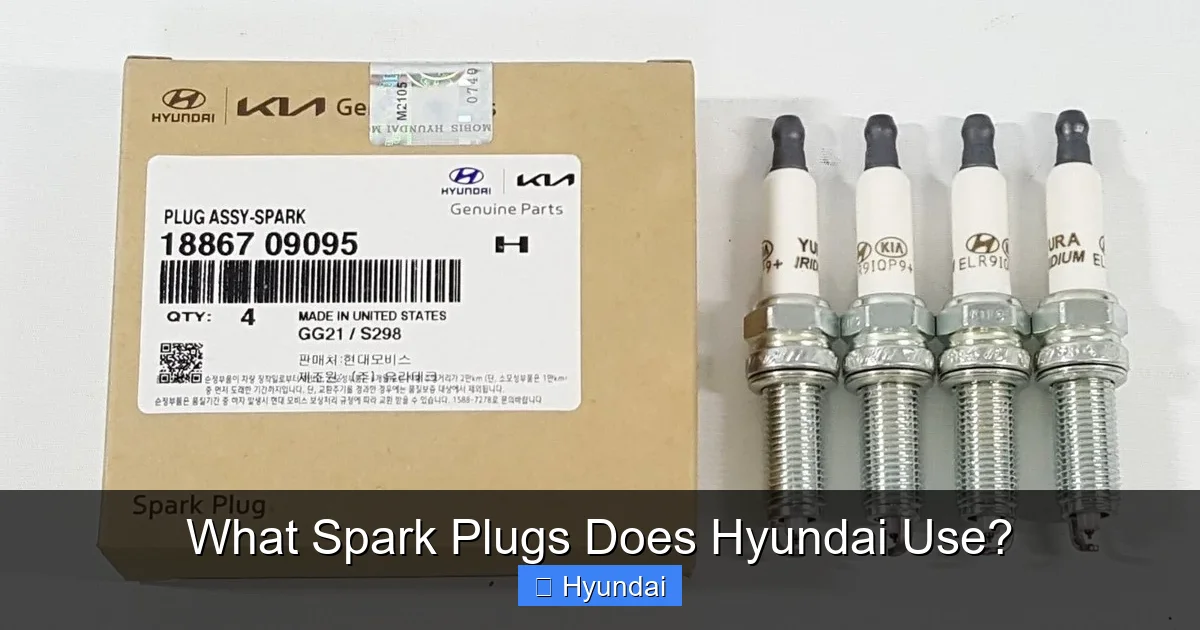
If you were to open the engine compartment of a brand-new Hyundai straight off the production line, you would almost certainly find a spark plug made by either NGK or Denso. These two Japanese manufacturers are the global leaders in ignition technology and are the preferred original equipment (OE) suppliers for Hyundai Motor Company. Their reputation for quality, consistency, and innovation aligns perfectly with Hyundai’s engineering standards.
Visual guide about What Spark Plugs Does Hyundai Use?
Image source: i.ebayimg.com
NGK Spark Plugs in Hyundai
NGK, which stands for Nippon Gaishi Kaisha, is a massive conglomerate with a storied history in ceramics and spark plug manufacturing. For Hyundai, you’ll commonly find NGK plugs with part numbers starting with “L*” or “CR*” for many of their standard and GDI engines. A classic example is the NGK LFR5AIX-11, which was a common OEM plug for many Hyundai 2.0L and 2.4L Theta II engines in the 2010s. These are often iridium or platinum plugs designed for long life. NGK’s Laser Iridium and Laser Platinum series are particularly prevalent in newer Hyundai models, featuring a fine-wire iridium center electrode for a focused spark and exceptional durability.
Denso Spark Plugs in Hyundai
Denso, another giant in automotive components, is also a primary OE provider for Hyundai. Denso plugs are known for their innovative designs, like the TT (Twin Tip) and IT (Iridium Tough) series. You’ll frequently see Denso part numbers like IT20 or IT22 on Hyundai engine specs. For instance, many Hyundai 1.6L Gamma GDI engines use a Denso IT22 as original equipment. Denso’s iridium plugs use a unique sintering process to create an extremely durable center electrode, while their platinum plugs often feature a dual platinum design for longevity on both electrodes.
It’s a common misconception that Hyundai uses a “house brand” plug. They don’t. They contract the world’s best specialists. This is actually great news for owners because it means the exact OE plug is readily available on the aftermarket at a fraction of the dealer price, as long as you know the correct part number. For specific popular models, you can find excellent guides on the best aftermarket equivalents, such as our detailed reviews for the Hyundai Elantra, Santa Fe, and Veloster.
Decoding the Specification: It’s All About the Engine Code
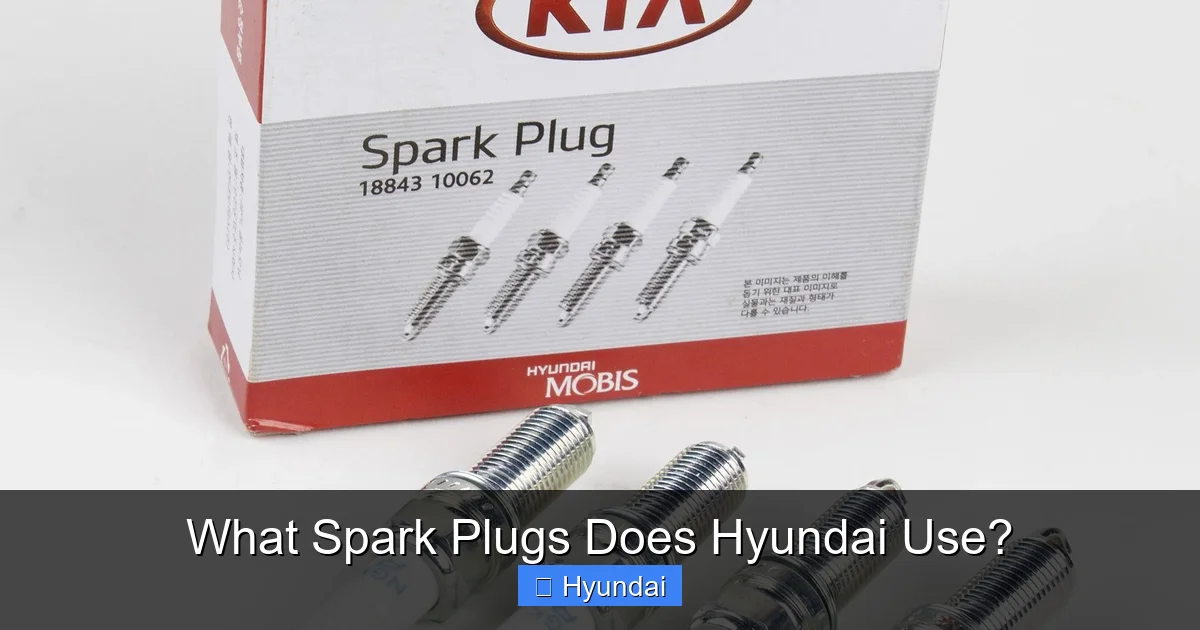
Here is the most crucial piece of information you need: Hyundai does not make a spark plug for “a Hyundai.” They make a spark plug for a specific engine code. Your 2020 Hyundai Sonata with a 2.5L MPI engine uses a completely different plug than a 2020 Sonata with the 1.6L Turbo GDI engine, even though they are the same model year and nameplate.
Visual guide about What Spark Plugs Does Hyundai Use?
Image source: m.media-amazon.com
The engine code is the alpha-numeric identifier stamped on the engine block itself (e.g., G4FA, G4LC, G4NH, G4MJ). This code is your golden ticket to finding the exact spark plug. You can find it in your owner’s manual, on a sticker under the hood, or by using your VIN (Vehicle Identification Number) on Hyundai’s official parts website or a reputable third-party catalog. The specification will list the required spark plug’s part number, heat range, and gap.
Real-World Examples Across Popular Hyundai Engines
Let’s look at some common Hyundai engine families and their typical OE spark plugs to illustrate this point:
- 1.6L Gamma GDI (G4FJ, G4LC): Found in the Elantra, Veloster, and Kona. OEM is typically a Denso IT22 or an NGK LFR5AIX-11. These are often iridium plugs with a 0.043″ (1.1mm) gap.
- 2.0L Theta II MPI/GDI (G4NA, G4NJ): Found in the Sonata, Tucson, and Santa Fe. OEM varies by year and sub-type (MPI vs. GDI). Common plugs include the NGK LFR5AIX-11 (MPI) and the Denso IT20 or ITV22 (GDI). The GDI versions often require a more robust, colder plug due to higher combustion pressures and temperatures.
- 2.4L Theta II MPI/GDI (G4KE, G4KJ): The workhorse engine in many older Sonatas and Santa Fes. A classic OEM plug is the NGK LFR5AIX-11. Later GDI versions might use a Denso IT20.
- 1.8L Nu MPI (G4MD): Used in the Elantra and Tucson. Often uses an NGK LFR5AIX-11 or a Denso IT20.
- 3.3L Lambda V6 (G6DB, G6DC): Found in older Santa Fes and Azera. These typically use a standard platinum plug like the NGK LZFR5AIX-11 or a Denso IT22.
- 2.0L Smartstream G2.0 (G4NM): Hyundai’s newest Atkinson-cycle engine in the Sonata and Tucson Hybrid. It uses a specialized iridium plug, often an NGK SILFR5A11, designed for the unique combustion cycle.
Notice the pattern? The displacement (2.0L) isn’t the deciding factor; the specific engine family and generation are. This is why a 2015 Hyundai Sonata 2.0L and a 2022 Hyundai Sonata 2.5L have entirely different recommended plugs, even though both are “2.0L-ish” engines. For the latest model-specific recommendations, our article on the 2015 Hyundai Sonata provides a deep dive into the options for that popular generation.
Replacement Intervals: Following Hyundai’s Schedule
So, you know what plug to buy. But when do you actually need to replace it? Hyundai’s factory maintenance schedule is your best guide, and it varies significantly based on the plug type and engine. Ignoring the interval leads to degraded performance, poor fuel economy, and eventually, misfires that can damage the catalytic converter.
Visual guide about What Spark Plugs Does Hyundai Use?
Image source: thecarhow.com
Standard Copper/Nickel Plugs (Rare in Modern Hyundais)
Older Hyundai models (pre-2010ish) might have come with standard copper or nickel-alloy plugs. These have the shortest lifespan, typically requiring replacement every 30,000 miles. They offer good conductivity but wear out faster due to electrode erosion. You’ll rarely find these as OEM in recent models.
Single & Double Platinum Plugs
Platinum plugs, with a small platinum disc welded to the center or both electrodes, resist wear much better. Hyundai often used these in the late 2000s and early 2010s. Their recommended replacement interval is usually 60,000 miles. They provide a good balance of cost and longevity.
Iridium Plugs (The Modern Standard)
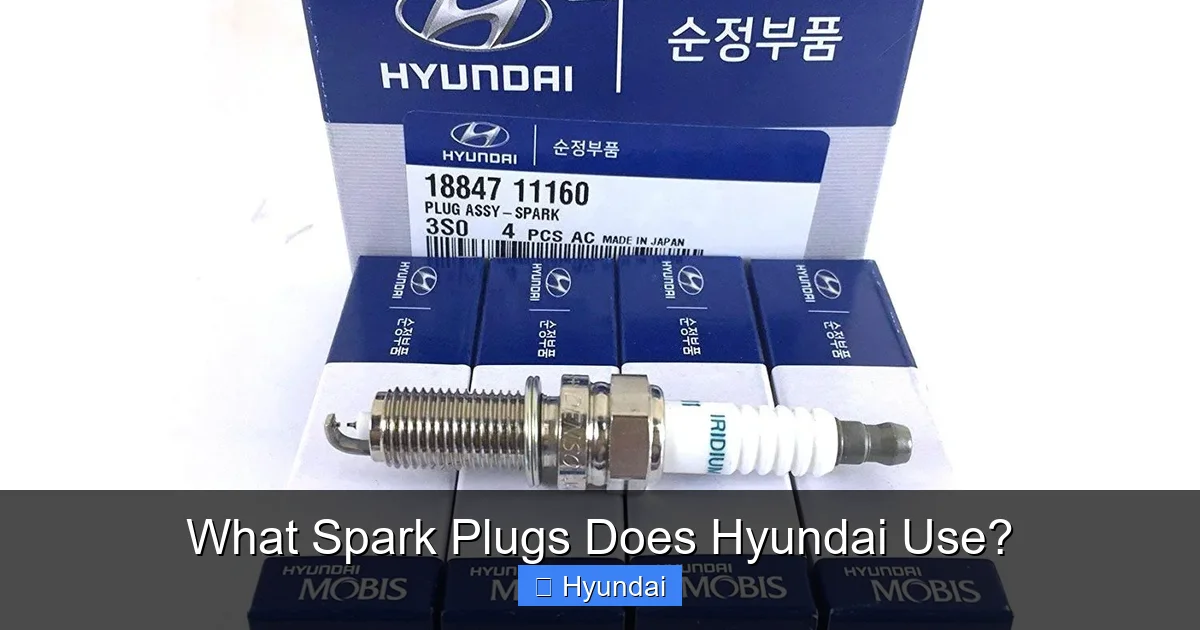
This is what you’ll find in the vast majority of Hyundai vehicles from the last decade. Iridium is one of the hardest and most durable metals used in spark plugs. The fine-wire iridium center electrode resists wear for an incredibly long time. Hyundai’s recommended service interval for OEM iridium plugs is typically 100,000 miles or more (often 120,000 miles). This is the “lifetime” plug for many owners, though many mechanics still recommend inspecting them around the 80,000-mile mark, especially in high-mileage or severe-service vehicles.
Critical Tip: Always follow the interval specified for your specific engine in your owner’s manual. A 2012 Elantra with a 2.0L MPI might call for 60,000-mile platinum plugs, while a 2022 Elantra with the 2.0L MPI Smartstream uses 100,000-mile iridium plugs. Don’t guess—look it up.
Aftermarket vs. OEM: Your Smart Replacement Choices
When it’s time for new plugs, you face a choice: buy the exact OEM part from the Hyundai dealer (often at a premium price) or opt for a high-quality aftermarket equivalent. For spark plugs, the aftermarket is usually the smarter, more economical choice, provided you choose wisely.
Sticking to the Exact Specification
The golden rule is this: your aftermarket spark plug must match the OEM part number’s heat range, thread size, reach, and gap. The easiest way to do this is to use the OEM part number (found in your manual or on your old plug) and cross-reference it with an aftermarket brand’s catalog. Brands like NGK, Denso, and Bosch all produce direct equivalents to their own OEM parts and to each other’s. For example, if your Hyundai calls for an NGK LFR5AIX-11, you can buy that exact same NGK plug from an auto parts store for much less than the dealer charges, or you can find the Denso equivalent (likely an IT20) which is built to the same specs.
Why Not Use a “Better” or “Performance” Plug?
You might see plugs advertised as “double platinum,” “iridium IX,” or with special electrode designs. While these are high-quality, the most important factor is the heat range. A “colder” or “hotter” plug than what Hyundai specified can cause serious problems. The OE-specified plug is the result of extensive dyno and real-world testing. Stick to the correct heat range. If you want an upgrade, simply choose the OEM-spec iridium plug over a platinum one for longer life, not a different heat range. For turbocharged Hyundai engines (like the 1.6T in the Veloster or Sonata), the heat range is even more precisely calibrated, so deviating is not recommended.
Where to Buy and What to Look For
Purchase from reputable retailers—major auto parts chains, authorized online distributors, or directly from the brand’s website. Avoid unknown brands on e-commerce sites. Ensure the plug is the correct gap. While many modern plugs come pre-gapped from the factory, it is a non-negotiable step to verify the gap with a feeler gauge before installation. The gap can easily be altered during shipping and handling. A gap that is too wide can cause a weak spark; too narrow can cause fouling. Your owner’s manual or a service manual will specify the exact gap (e.g., 0.043″ or 1.1mm).
A Step-by-Step Guide to Finding *Your* Spark Plug
Feeling overwhelmed? Let’s boil it down to a simple, actionable checklist you can follow right now.
- Find Your Engine Code. This is step zero. Look in your owner’s manual. Check for a sticker under the hood (often on the radiator support or strut tower). If all else fails, use your 17-digit VIN. Enter it into Hyundai’s official parts website (parts.hyundai.com) or a trusted site like AutoZone or O’Reilly‘s catalog lookup. It will return the exact parts for your vehicle.
- Locate the OEM Spark Plug Part Number. Using the engine code or VIN, search for “spark plug.” The system will give you the Hyundai part number (which starts with 27500- or 27300-) and, more importantly, the supplier’s number (e.g., NGK LFR5AIX-11). Write this down.
- Search for Equivalents. Take that NGK or Denso number to any auto parts store website or catalog. They will list their own brand’s equivalent (e.g., “Bosch F7LCR” might be equivalent to an NGK LFR5AIX-11). Buy the equivalent from NGK, Denso, or Bosch. These are the top three and are perfectly interchangeable if the numbers match.
- Verify the Gap. Before you install, use a feeler gauge to check the gap against the spec in your manual. Gently adjust the ground electrode if needed—never force the center electrode.
- Install Correctly. Use a torque wrench! Over-torquing can crack the ceramic insulator. Under-torquing can cause poor heat transfer and pre-ignition. The torque spec is usually in a repair manual, but a good rule is to hand-tighten, then give a 1/4 to 1/2 turn with a wrench if the plug has a gasket (most do). For non-gasket plugs, follow the manual exactly.
This process eliminates guesswork and ensures you get the exact plug Hyundai engineers intended for your engine. If you drive a specific Hyundai model and want plug recommendations curated for it, check out our model-specific guides like the one for the Hyundai Tiburon.
Conclusion: Knowledge is Power (and Performance)
So, what spark plugs does Hyundai use? The answer is a precise, engineered component from elite manufacturers like NGK and Denso, selected for each unique engine in their lineup. There is no generic “Hyundai plug.” The key to unlocking the answer lies in your engine code or VIN. By understanding that the specification is engine-specific, respecting the critical importance of the correct heat range, and following the factory replacement intervals, you perform one of the most fundamental yet impactful maintenance tasks on your vehicle.
Choosing the right plug isn’t about buying the most expensive or the shiniest option; it’s about matching the exact specification. When you do, you ensure your Hyundai’s engine fires on all cylinders—literally. You’ll enjoy smooth idling, strong acceleration, optimal fuel economy, and the peace of mind that comes from knowing you’ve preserved the engine’s design integrity. Don’t trust a generic list or a guess. Invest five minutes in finding your engine code, and you’ll have the definitive answer for your car, ensuring this small part delivers big results for miles and miles to come. Your Hyundai’s performance, reliability, and efficiency depend on it.
Frequently Asked Questions
Does Hyundai use NGK or Denso spark plugs as OEM?
Hyundai uses both NGK and Denso as original equipment manufacturers. The specific brand and part number depend entirely on the engine model and year. You will find either brand in your Hyundai from the factory.
What happens if I put the wrong heat range spark plug in my Hyundai?
A plug with the wrong heat range can cause serious damage. A “hotter” plug can cause pre-ignition, engine knock, and potentially piston or valve damage. A “colder” plug can cause fouling, misfires, poor fuel economy, and eventually, a plugged catalytic converter. Always use the specified heat range.
Can I use a more expensive iridium spark plug if my Hyundai originally came with platinum?
Yes, but only if the iridium plug has the exact same heat range and specifications as the OEM platinum plug. Upgrading to an iridium version of the same part number (e.g., from an NGK Laser Platinum to an NGK Laser Iridium) is generally safe and offers longer life. Never change the heat range.
How often should I check my Hyundai’s spark plugs?
If your Hyundai uses iridium plugs with a 100,000-mile interval, it’s still a good practice to have them inspected at the 60,000-80,000-mile mark, especially if you do a lot of short-trip driving or operate in severe conditions (extreme heat/cold, dusty environments). For platinum plugs with a 60,000-mile interval, inspect them at 30,000 miles.
Do I need to gap a new spark plug for my Hyundai?
Yes, always. Even if the plug is labeled “pre-gapped,” it may have been altered during shipping or handling. You must verify the gap with a feeler gauge and adjust it to the exact specification found in your owner’s manual before installation. This is a critical step for proper ignition.
Can I use any spark plug with the correct thread size?
No. Thread size (diameter and pitch) is just one specification. You must also match the reach (length of the threaded portion), the hex size, the heat range, and the resistor value (if required for your radio/ECU). Using a plug with the wrong thread or reach can cause catastrophic engine damage. Always use the exact OE-specified part number or a verified equivalent.
