
How to Waterproof a Car Cover Again: Step-by-Step Guide

Quick Answer
You can often waterproof a car cover again by cleaning it correctly, checking whether the fabric still sheds water, and applying a compatible water-repellent treatment if the manufacturer allows it. However, many outdoor covers are intentionally water-resistant and breathable rather than completely waterproof, as Covercraft explains in its car-cover guidance.
Quick Reproofing Steps
- Check the material: Find the care label and confirm whether aftermarket waterproofing is allowed.
- Clean the cover: Remove dirt, oils, bird residue, and detergent buildup before treating the fabric.
- Test water repellency: Spray clean fabric with water and watch whether it beads or immediately soaks in.
- Apply compatible treatment: Use a fabric reproofing product intended for your cover’s material and follow its directions.
- Let it cure: Allow the cover to dry completely before putting it back on your vehicle.
- Test it again: Use a gentle hose spray to confirm that water beads and runs off.
Important
- Do not coat an unknown car-cover fabric with silicone, wax, or another sealer without checking compatibility first.
If you’re wondering how to waterproof a car cover again, start by figuring out why it stopped shedding rain. A dirty cover can look like failed waterproofing even when its original treatment is still working.
The goal usually isn’t to make the fabric completely impermeable. It’s to restore useful water repellency without destroying the breathability your vehicle needs underneath the cover.
In This Guide
- Can You Waterproof a Car Cover Again?
- How Do You Know If Your Car Cover Needs Reproofing?
- What Should You Do Before Waterproofing a Car Cover?
- How Do You Waterproof a Car Cover Again Step by Step?
- Which Waterproofing Treatment Should You Use?
- When Should You Replace the Cover Instead?
- Frequently Asked Questions
Can You Waterproof a Car Cover Again?
Yes, many car covers can have their water repellency restored after it weakens. The correct process depends on the fabric, coating, construction, and manufacturer’s care instructions.
Water repellency means water tends to bead on the fabric and roll away instead of quickly soaking into its outer surface.
A water-resistant cover isn’t necessarily defective because some moisture gets through under extreme conditions. Breathable outdoor covers often balance rain protection with moisture-vapor escape.
- Water-repellent: Water beads readily on the outer surface.
- Water-resistant: The material resists water penetration but isn’t an impermeable barrier.
- Waterproof: The material is intended to prevent liquid water penetration under defined conditions.
- Breathable: Moisture vapor and heat can escape through the material or construction.
Those differences matter around a parked vehicle. A completely sealed layer can also hold moisture underneath when condensation develops or the vehicle was already damp.
Some premium covers don’t rely on a topical waterproofing spray at all. For example, Coverking describes its Stormproof material as an uncoated, densely woven polyester design.
That is why I wouldn’t automatically spray every aging cover. First identify what you’re working with.
Section Takeaway: Restoring a car cover usually means restoring water repellency, not converting breathable fabric into a completely sealed barrier.
How Do You Know If Your Car Cover Needs Reproofing?
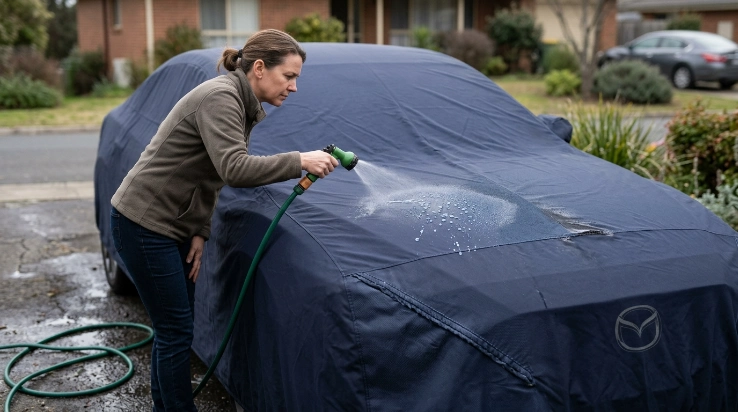
A clean cover that quickly wets out across broad areas may need reproofing. A dirty cover, damaged seam, hole, or condensation problem needs a different fix.
Start with a simple water test after cleaning and drying the material according to its care label.
- Lay the cover flat or install it on a clean vehicle.
- Spray a small section gently with clean water.
- Watch the surface for about one minute.
- Compare several areas, including the roof and hood sections.
If droplets bead and roll away, the water-repellent finish may still be functioning. You probably don’t need another coating.
If clean fabric darkens and absorbs water almost immediately, its surface repellency may have weakened. Reproofing may help when the manufacturer permits it.
| What You Notice | Likely Issue | Best First Action | Reproof? |
|---|---|---|---|
| Water no longer beads | Dirty fabric or worn repellency | Clean and retest | Possibly |
| One seam leaks | Seam or stitching problem | Inspect seam construction | Not necessarily |
| Drops appear underneath without rain | Condensation or trapped moisture | Dry car and cover | Usually no |
| Visible holes or tears | Physical damage | Repair or replace | No |
| Outer layer peels or flakes | Material or coating breakdown | Check warranty or replace | Usually no |
What Should You Do Before Waterproofing a Car Cover?
Clean it first. Reproofing dirty fabric can trap contamination and give you uneven results.
Look for the sewn care label, packaging, order history, or manufacturer’s online instructions. Washing recommendations can vary considerably between fabrics.
Inspect the Cover Before Washing
- Check seams for separated stitching.
- Look for holes around mirrors and antennas.
- Inspect elastic hems for deterioration.
- Check straps and buckles for damage.
- Look for peeling, cracking, or delamination.
- Check the vehicle-facing side for grit.
Reproofing won’t repair structural damage. Fixing a tear or replacing the cover makes more sense when the base material has failed.
Wash It According to Its Label
Avoid assuming that ordinary laundry settings are safe. Multi-layer covers, coated fabrics, canvas, and tightly woven synthetics can require different care.
Follow the manufacturer’s instructions for detergent, washer type, water temperature, and drying method. Avoid bleach or fabric softener unless the manufacturer specifically approves them.
After cleaning, perform the water-beading test again. Sometimes cleaning alone improves water behavior enough that no reproofing treatment is necessary.
How Do You Waterproof a Car Cover Again Step by Step?
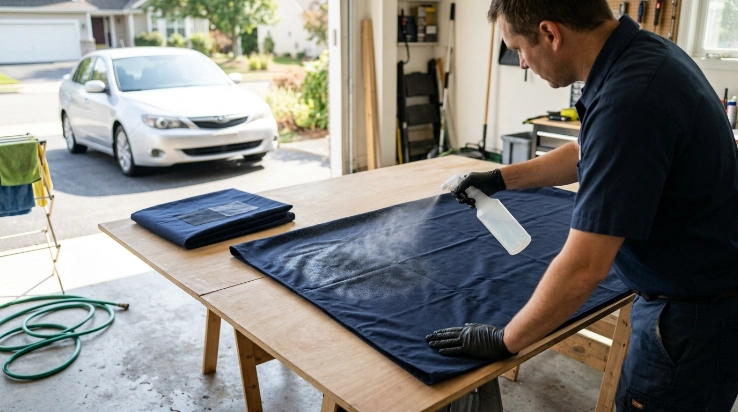
Once you’ve confirmed the fabric can accept a reproofing treatment, the process is straightforward. The product label should always override generic instructions.
1. Choose a Suitable Work Area
Work outdoors or in another well-ventilated location. Keep the cover away from dirt, grass clippings, dust, and anything that could stick to the treated surface.
Protect nearby paint, glass, flooring, and other surfaces from overspray. I prefer treating a cover in manageable sections rather than rushing the whole surface.
2. Clean the Cover Thoroughly
Remove loose debris before washing. Then clean the cover exactly as its manufacturer recommends.
Pay special attention to horizontal areas that face upward on the vehicle. Roof, hood, and trunk sections often receive the greatest exposure to sun, dirt, and rain.
3. Decide Whether the Treatment Requires Wet or Dry Fabric
Don’t guess here. Different reproofing products use different application methods.
Some treatments go onto damp material, while others require a dry surface. Follow the product’s stated preparation conditions.
4. Test a Hidden Area
Apply a small amount to an inconspicuous area first. Let it dry enough to check for color, texture, or finish changes.
This step matters more with older fabric. Weathered material doesn’t always react like new material.
5. Apply an Even Coat
Work section by section and maintain consistent coverage. Avoid soaking one area while barely treating another.
- Start at one end of the cover.
- Overlap sections slightly.
- Cover seams only when the treatment is suitable for them.
- Remove drips or excess treatment as directed.
- Keep the vehicle-facing lining free of unnecessary coating.
Outdoor-fabric products have their own directions. For example, Nikwax’s Tent & Gear SolarProof instructions call for even application to clean fabric, removal of excess product, and complete drying before storage or use.
6. Let the Cover Dry or Cure Completely
Don’t put a wet, freshly treated cover straight onto the vehicle. Allow it to reach the condition specified by the treatment manufacturer.
A cover that’s folded damp can develop odor or mildew problems. A wet cover can also keep the vehicle damp longer than necessary.
7. Perform a Final Water Test
Use a garden hose on a gentle setting once the treatment has fully cured. You’re checking whether droplets bead and run off rather than immediately wetting the fabric.
Don’t use a pressure washer for this test. High-pressure water creates conditions far beyond ordinary rainfall and can stress fabric, seams, and coatings.
Check several locations instead of judging the entire job from one spot. Pay attention to the roof, hood, seams, and other previously weak areas.
Section Takeaway: The safest reproofing sequence is identify, inspect, clean, test, treat, dry, and test again. Never skip material compatibility just because a spray is labeled for outdoor fabric.
Which Waterproofing Treatment Should You Use?
Choose the treatment according to the cover material, not the marketing phrase on the bottle. A product that’s suitable for one textile may be unsuitable for another.
| Cover Type | What to Check | Approach |
|---|---|---|
| Synthetic woven outdoor cover | Manufacturer permits topical treatment | Compatible breathable fabric reproofing treatment |
| Canvas or cotton blend | Fiber-specific care requirements | Product specifically designed for cotton or canvas |
| Factory-coated multilayer material | Compatibility with original coating | Follow cover manufacturer’s instructions first |
| Uncoated performance fabric | Whether treatment is recommended at all | Do not add a coating without approval |
| Unknown material | Missing label or specifications | Contact manufacturer before treating |
I would be cautious with generic silicone sprays, household water sealers, waxes, or coatings made for hard surfaces. They may alter flexibility, breathability, appearance, or how the material handles moisture.
Think about the cover itself before spending money on treatment. Independent testing from Car and Driver’s 2026 car-cover comparison also shows that outdoor covers differ considerably in construction, fit, and intended protection.
If you cannot identify the material or manufacturer, replacement can be the more predictable option. That is especially true for inexpensive covers with obvious deterioration.
When Should You Replace the Cover Instead?
Waterproofing spray cannot restore fabric that has physically broken down. Replace the cover when structural deterioration becomes the main problem.
As of 2026, I use condition rather than age alone to make that decision. Outdoor exposure varies too much for one replacement interval to fit every owner.
Signs Reproofing Probably Won’t Save It
- Multiple tears: The base fabric has lost useful strength.
- Peeling layers: Bonded or coated material is separating.
- Brittle fabric: UV and weather exposure have weakened the material.
- Failed seams: Several stitched areas are opening or leaking.
- Damaged lining: The vehicle-facing surface feels rough or contaminated.
- Persistent leaks: Clean, intact fabric still allows significant water penetration after approved treatment.
- Poor fit: Stretched elastic or distorted fabric lets the cover flap against the paint.
A replacement also makes sense if the manufacturer specifically warns against recoating the fabric. Don’t sacrifice breathability or paint safety just to squeeze another season from a worn cover.
If the cover is still structurally sound, cleaning and reproofing can be worth trying. If the material itself is deteriorating, a new cover is the safer long-term answer.
Frequently Asked Questions
Can I spray waterproofing directly on a car cover?
Yes, but only when the waterproofing treatment is compatible with the cover’s material and its manufacturer allows recoating. Clean the fabric first, test a hidden area, and follow the treatment’s application and curing instructions rather than applying a generic spray blindly.
Why is my car cover suddenly letting water through?
Dirt buildup, weakened surface repellency, worn seams, physical damage, or coating deterioration can reduce weather resistance. Moisture beneath a cover can also come from condensation, so confirm where the water originates before assuming rain is penetrating the fabric.
Should a car cover be completely waterproof?
Not necessarily. Many outdoor car covers intentionally combine water resistance with breathability so moisture vapor can escape. A completely impermeable cover can create its own moisture-management problems when water or humid air becomes trapped beneath it.
Can washing restore a car cover’s water resistance?
Sometimes. Dirt and contamination can stop water from beading normally, so cleaning the cover according to its care instructions should come before reproofing. Once clean, perform another water test before deciding whether the fabric needs treatment.
Can I use silicone waterproofing spray on a car cover?
Don’t use silicone merely because it repels water. First confirm that the cover manufacturer approves that specific treatment type, because an incompatible coating may affect breathability, flexibility, appearance, or the cover’s original finish.
How often should I waterproof my car cover?
There isn’t one correct schedule for every cover. Reproof only when clean fabric shows declining water repellency and the manufacturer allows retreatment, rather than automatically applying another coating every few months.
How do I know if reproofing worked?
Let the treated cover dry or cure completely, then spray several areas gently with clean water. Successful treatment should improve beading and runoff without leaving the fabric sticky, stiff, discolored, or otherwise noticeably damaged.
The simplest rule is to clean before you coat. A dirty car cover may only need proper maintenance, while damaged material usually needs repair or replacement rather than another layer of waterproofing.
When reproofing is appropriate, use a treatment matched to the actual fabric and follow both manufacturers’ instructions. That gives you the best chance of restoring rain protection without creating a new moisture problem underneath your car.
