Utah Window Tint Law Explained

Contents
- 1 Key Takeaways
- 2 📑 Table of Contents
- 3 Understanding the Core of Utah Tint Law: VLT Explained
- 4 Beyond Darkness: Utah’s Reflectivity and Other Restrictions
- 5 Medical Exemptions: How to Get Darker Front Tint Legally
- 6 Penalties for Non-Compliance: What Happens if You Get Pulled Over
- 7 How to Ensure Your Tint is Legal: A Buyer’s and Owner’s Checklist
- 8 Special Considerations for BMW Owners in Utah
- 9 Conclusion: A Clear Path to Legal and Effective Tint
- 10 Frequently Asked Questions


Utah window tint law allows fairly dark rear windows but strictly limits front side windows to 35% VLT. SUVs and vans have different rules than cars. Understanding these specifics is crucial to avoid costly tickets and ensure your vehicle passes inspection. The law also includes important exemptions for medical conditions and specific vehicle types. Always verify your tint’s exact VLT percentage with a meter before hitting the road.
So, you’re thinking about getting your car windows tinted in Utah. Maybe you want that sleek, custom look for your BMW 3 Series, or you’re just trying to beat the intense summer sun and keep the cabin cooler. That’s a great plan! Utah’s sunny climate makes window tint a smart upgrade for comfort and UV protection. But before you hand over your keys, there’s one critical step you absolutely cannot skip: understanding the Utah window tint law. It’s not just about style; it’s about staying legal, safe, and avoiding a nasty surprise from law enforcement.
Let’s be clear: window tint laws are not a suggestion. They are enforceable regulations with real penalties. The rules can be tricky because they differ for front vs. rear windows, and for different vehicle types like sedans versus SUVs. One misunderstood rule can lead to a ticket, a court appearance, and the immediate, costly requirement to remove your new tint. This guide will walk you through every detail of Utah’s window tint statutes in plain language. We’ll break down the Visible Light Transmission (VLT) percentages, explain the reflectivity rules, cover medical exemptions, and talk about what happens if you’re pulled over. Consider this your official playbook for navigating tinting in the Beehive State.
Key Takeaways
- Front Side Windows Must Allow Over 35% Light: For sedans, coupes, and the front driver/passenger windows of SUVs/vans, the tint must let in more than 35% of outside light (VLT > 35%).
- Rear Windows Can Be Much Darker: The back side windows and rear window of any vehicle can be tinted to any darkness, including limousine tint, with no VLT limit.
- Windshield Tint is Highly Restricted: Only a non-reflective strip at the very top (above the AS-1 line) is permitted. No other windshield tint is legal.
- Reflectivity Limits Apply: Both front and rear side windows cannot be more than 10% reflective. This prevents mirror-like or metallic finishes.
- Medical Exemptions Are Available: Individuals with a qualifying medical condition can apply for an exemption to allow darker front-side window tint, but it requires state certification.
- Penalties for Violations are Steep: A first-time tint violation is typically a class C misdemeanor, resulting in a fine that can exceed $200, plus you must remove the illegal tint.
- Professional Installation & Certification is Key: Reputable shops will know the law, provide a compliance certificate, and use film with verified VLT ratings to protect you from future issues.
📑 Table of Contents
- Understanding the Core of Utah Tint Law: VLT Explained
- Beyond Darkness: Utah’s Reflectivity and Other Restrictions
- Medical Exemptions: How to Get Darker Front Tint Legally
- Penalties for Non-Compliance: What Happens if You Get Pulled Over
- How to Ensure Your Tint is Legal: A Buyer’s and Owner’s Checklist
- Special Considerations for BMW Owners in Utah
- Conclusion: A Clear Path to Legal and Effective Tint
Understanding the Core of Utah Tint Law: VLT Explained
At the heart of every state’s window tint law is a measurement called VLT, or Visible Light Transmission. This is the percentage of visible light that is allowed to pass through your car’s window glass and the tint film combined. A lower VLT number means darker tint (less light gets through). A higher VLT number means lighter tint (more light gets through). For example, a 35% VLT tint allows 35% of outside light to enter the car, blocking 65%. A 5% limousine tint only allows 5% of light in.
Utah’s law is built on these VLT thresholds, but it applies them differently to various windows on your vehicle. The most critical distinction is between the front side windows (the driver and front passenger windows) and the rear side and back windows. Furthermore, the law makes a key distinction between passenger cars (sedans, couches, hatchbacks) and multipurpose passenger vehicles (SUVs, vans, and trucks). This is where many people get confused. Let’s clarify the specific VLT requirements for each window location.
VLT Rules for Passenger Cars (Sedans, Coupes, etc.)
If you drive a traditional car like a Toyota Camry, Honda Civic, or a BMW 3 Series sedan, here are your Utah VLT limits:
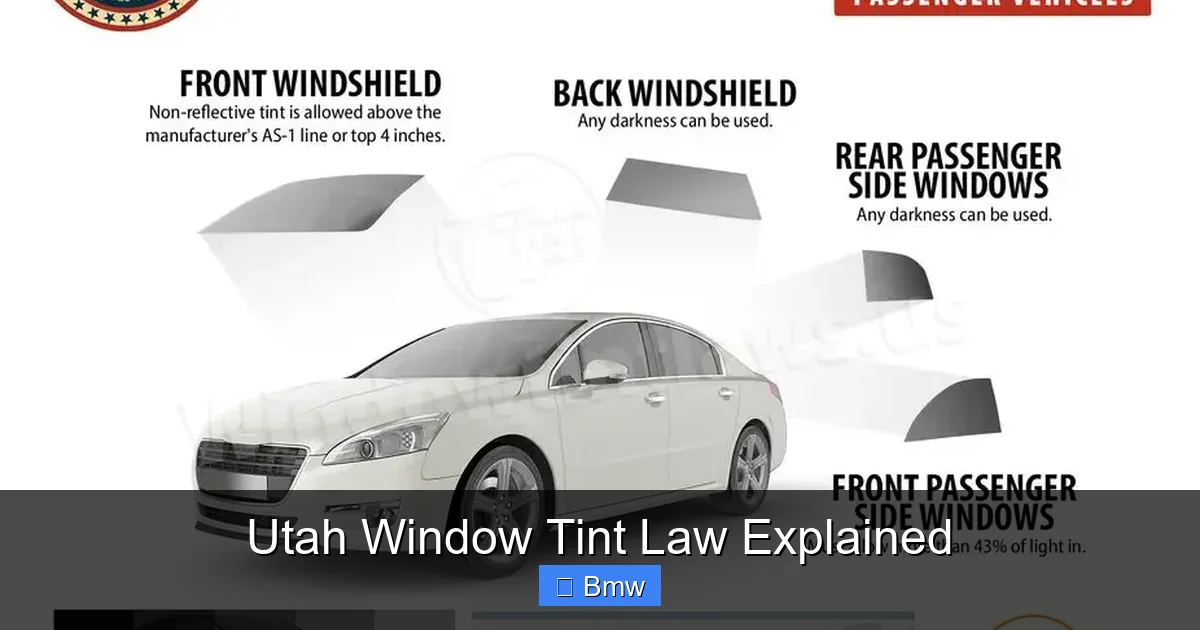
- Windshield: Tinting is prohibited except for a non-reflective strip at the very top. This strip must be above the manufacturer’s AS-1 line (usually marked on the glass). The strip’s darkness is not specified, but it cannot be reflective.
- Front Side Windows: Must allow more than 35% of light to pass through. In practical terms, your combined glass and tint VLT must be 35% or higher. This means the darkest legal tint you can put on the front doors of your sedan is 35% VLT film, assuming your factory glass is clear (which it typically is). If your car already has a slight factory tint (common on some models), you must factor that in. The final VLT after adding aftermarket film must still be >35%.
- Rear Side Windows: There is no specific VLT limit. You can legally install any darkness of tint on the rear driver and passenger windows of a sedan.
- Rear Window: There is no specific VLT limit. The back glass can be tinted to any darkness.
This creates a common look for sedans in Utah: lighter front windows (often 35% or 40%) paired with much darker rear windows (like 5% or 15%). This provides privacy for rear passengers and cargo while maintaining the driver’s forward visibility requirements mandated by law.
VLT Rules for SUVs, Vans, and Trucks (MPVs)
Utah law treats multipurpose passenger vehicles (MPVs) differently, generally offering more flexibility for rear window tint. The key rule for an SUV, van, or pickup is that the front side windows follow the same strict rule as cars: they must allow more than 35% of light (VLT > 35%). However, the treatment of the rear windows is where it changes.
- Windshield: Same as cars—only a non-reflective top strip is allowed.
- Front Side Windows: Must have a VLT of >35%. This applies to the driver and front passenger doors.
- Rear Side Windows: There is no specific VLT limit. You can tint these to any darkness.
- Rear Window: There is no specific VLT limit. You can tint the back glass to any darkness.
So, for your BMW X5 SUV, you would need to keep the front doors at 35% VLT or lighter, but the rear cargo and passenger area windows can be as dark as you prefer. This is a major point of confusion, as some people mistakenly believe all windows on an SUV can be dark. They cannot; the front two doors are always held to the 35% standard.
Beyond Darkness: Utah’s Reflectivity and Other Restrictions
VLT isn’t the only number that matters. Utah law also strictly regulates how reflective your window tint can be. This rule applies to both the front and rear side windows of all vehicle types. The law states that the window film must not be “more than 10% reflective.” This means the mirrored or metallic appearance of the tint is capped. You cannot use a highly reflective, chrome, or mirror-finish film on any side window. The purpose is to prevent excessive glare that could blind other drivers. Most standard dyed or carbon-based films from reputable manufacturers easily meet this 10% reflectivity standard. Always ask your installer for the film’s reflectivity rating to be sure.

Visual guide about Utah Window Tint Law Explained
Image source: windowtintlaws.us
Another important rule is about color. Utah statute does not explicitly prohibit certain tint colors (like red, blue, or yellow). However, using a color that significantly alters the natural color of the glass could potentially be interpreted by an officer as a violation of the “no material that is red, blue, or yellow” clause found in some other states’ laws. While Utah’s law is silent on specific hues, it’s a safe practice to stick with neutral tones like black, gray, or bronze to avoid any subjective interpretation issues. The primary legal focus is on VLT and reflectivity, not color, but err on the side of caution.
Finally, there’s the matter of factory tint. Many modern vehicles, especially SUVs and trucks, come from the manufacturer with a light tint on the rear windows (often around 20-25% VLT). This factory tint is legal because it was installed before the vehicle was sold and is considered part of the glazing. When adding aftermarket tint, you must calculate the combined VLT. If your factory rear glass is 25% VLT and you add a 20% VLT film, the resulting darkness is darker than 20%. You can use online VLT calculators to find the final percentage. For front windows, if your car has factory tint (less common), the aftermarket film you add must still result in a final VLT >35%. A professional installer should verify this for you.
Medical Exemptions: How to Get Darker Front Tint Legally
Utah recognizes that certain medical conditions can make sunlight exposure dangerous. Conditions like lupus, xeroderma pigmentosum, severe photosensitivity from medication, or a history of skin cancer may qualify an individual for a medical exemption. This exemption allows the holder to have a VLT lower than 35% on the front side windows of their vehicle.
Visual guide about Utah Window Tint Law Explained
Image source: windowtintlaws.us
To obtain this exemption, you must follow a specific process:
- Consult Your Physician: You need a signed statement from a licensed physician (MD or DO) or an optometrist. This statement must detail your medical condition and explicitly state that darker window tint is medically necessary to protect you from sunlight exposure.
- Apply to the Utah State Tax Commission: You must submit the physician’s statement, along with a completed application (form TC-578, “Application for Window Tint Medical Exemption”) and a fee, to the Utah State Tax Commission, Motor Vehicle Division.
- Receive Your Exemption Certificate: If approved, you will receive a certificate that must be displayed on your vehicle’s rear window. This certificate is your legal permission to have darker front-side tint.
It is crucial to understand that this exemption is tied to the vehicle and the individual. It is not transferable. If you sell the car, the exemption does not go with it. The new owner must comply with standard tint laws. Also, the exemption only applies to the front side windows; all other window tint rules (reflectivity, windshield strip) still apply. For BMW owners with medical needs, this process is the same as for any other vehicle operator in Utah.
Penalties for Non-Compliance: What Happens if You Get Pulled Over
Getting caught with illegal window tint in Utah is not a simple “fix-it” ticket. It is classified as a class C misdemeanor. This is a criminal offense, not just a civil infraction. The consequences are serious:

Visual guide about Utah Window Tint Law Explained
Image source: windowtintlaws.us
Fines: The base fine for a window tint violation can be substantial, often exceeding $200. This does not include court costs, fees, or potential surcharges, which can push the total financial penalty even higher. If you contest the ticket and lose, you will be responsible for these costs.
Removal Order: The primary remedy ordered by the court will be the immediate removal of the non-compliant tint. You will be given a deadline (often 30 days) to have the tint stripped from the offending windows and provide proof of removal to the court. This means paying for the removal and then potentially paying again to re-tint legally if you still want tint.
Impact on Registration and Insurance: While a single tint ticket typically doesn’t directly affect your car insurance premiums, repeated offenses or a pattern of non-compliance could be viewed negatively. More immediately, if your vehicle requires a safety or VIN inspection (common for out-of-state registrations or certain modifications), illegal tint will cause it to fail. You cannot legally register or renew the registration of a vehicle that does not comply with equipment standards.
Traffic Stop Complications: An officer who cannot see into your vehicle due to excessively dark front-side tint may have reasonable suspicion to prolong a traffic stop or conduct a more cautious approach. While tint alone isn’t probable cause for a search, it creates a less safe environment for the officer and can lead to increased scrutiny. For a luxury car like a BMW, which might already attract attention, ensuring full compliance is simply the smartest move.
How to Ensure Your Tint is Legal: A Buyer’s and Owner’s Checklist
So how do you make sure your new tint is 100% compliant and won’t land you in trouble? It starts with choosing the right professional and being an informed consumer.
1. Hire a Reputable, Local Installer Who Knows the Law
This is the single most important step. A good shop in Utah will:
- Know the exact VLT percentages for front vs. rear on your specific vehicle type (car vs. SUV).
- Use a calibrated VLT meter to measure your factory glass before recommending a film percentage. They should explain the “combined VLT” concept.
- Offer films that are certified to meet Utah’s VLT and reflectivity standards. Reputable brands provide technical data sheets.
- Provide you with a compliance certificate after installation, stating the VLT percentage of the film installed on each window. This is your documentation if you are ever questioned.
- Warrant their work and the film. A good warranty covers defects like bubbling, fading, or peeling.
Never use an out-of-state installer or a “fly-by-night” mobile tinter who isn’t intimately familiar with Utah’s specific regulations. Ask them directly: “Are you aware of the different rules for the front doors of an SUV versus a sedan in Utah?” Their answer will tell you everything you need to know.
2. Understand the Film Percentage You’re Buying
When a shop says “35% tint,” they are referring to the VLT of the film itself. The final darkness on your car depends on your factory glass. If your factory glass is clear, 35% film on the front will result in ~35% final VLT (legal). If your factory glass is already 20% (rare on fronts), adding 35% film would make it much darker, likely illegal. A pro will calculate this for you. For the rear windows of a sedan or any window of an SUV (except front sides), you can generally choose any film percentage you like, as there is no legal limit.
3. Get it Measured and Certified
After the tint is installed, ask the installer to measure each window with their VLT meter in your presence and write down the results. They should provide a certificate or invoice that lists the exact VLT reading for each window location. Keep this document in your glove compartment. If you are ever pulled over and an officer questions your tint, you can present this professional certification as evidence of your good-faith effort to comply. It may prevent a ticket altogether or be invaluable in court.
4. Beware of “Magic” Tint or “Limo Tint” on Front Doors
If an installer tells you they can put 20% or 5% film on the front doors of your BMW X5 and it will be legal, they are wrong. It does not matter if the film is “high-performance” or “ceramic.” The law is based on the final VLT measurement, not the film’s marketing name. Any shop promising “legal limo tint all around” in Utah is being dishonest. For front side windows on any vehicle, your target is a final VLT of 35% or higher. A common legal choice is 35% or 40% film on clear glass.
Special Considerations for BMW Owners in Utah
If you own a BMW, there are a few extra things to consider when tinting:
Factory Tint: Some BMW models, particularly certain SUV lines like the X5 or X3, may come from the factory with a light tint on the rear windows. It’s typically around 20-25% VLT. You must account for this if you want to go darker in the rear. Your installer should measure it. For the front, BMWs almost never come with factory tint, so you have a clean slate to install a compliant 35% or lighter film.
Advanced Driver Assistance Systems (ADAS): Modern BMWs are loaded with cameras and sensors behind the windshield, front bumper, and sometimes rear windows. While window tint itself does not interfere with these systems, the installation process can. The tools and heat guns used during installation can generate static electricity or heat that potentially damages sensitive electronics. Always choose an installer with specific experience tinting BMWs and other luxury brands with complex ADAS. They will know how to protect the sensors and may use different techniques (like lower heat) around those areas. Ask about their experience with your specific model year.
Resale Value: Professionally installed, high-quality tint that is legal can actually be a selling point. It suggests the owner cared for the car. However, illegal tint is a red flag for savvy buyers and will likely need to be removed, reducing the car’s appeal. Sticking to the law protects your investment. For a premium brand like BMW, maintaining a factory-like, compliant appearance is often preferred by future buyers.
Heat Rejection Technology: Utah’s intense sun makes heat rejection a top priority. You don’t need super dark tint to get great heat rejection. Modern ceramic and carbon films are excellent at blocking infrared (IR) heat while maintaining a higher VLT (like 35% or 40%). This means you can stay within the legal front-window limit and still enjoy a significant temperature drop inside your BMW. When getting quotes, ask specifically about the film’s Total Solar Energy Rejected (TSER) or IR rejection percentage, not just its VLT.
Conclusion: A Clear Path to Legal and Effective Tint
Navigating the Utah window tint law doesn’t have to be daunting. The core principle is simple: front side windows on all vehicles must stay above 35% VLT and under 10% reflective. Everything else—rear windows on sedans, all windows on SUVs except the fronts—is wide open. By understanding this dichotomy, you can have an intelligent conversation with any installer and make a choice that gives you the privacy, UV protection, and style you want without the risk of a misdemeanor ticket.
Remember, the law exists for safety—ensuring officers can see into vehicles and drivers have adequate visibility. Compliance isn’t about limiting your choices; it’s about making informed ones. For BMW owners, prioritize finding a specialist who understands your car’s electronics. Get that compliance certificate in writing. And if you have a legitimate medical need, pursue the exemption properly. A little knowledge and due diligence upfront will save you from significant headache, expense, and legal trouble down the road. Your beautiful, legally-tinted Utah BMW will then provide years of cool, comfortable, and worry-free driving.
Frequently Asked Questions
What is the darkest legal tint I can put on the front windows of my car in Utah?
The front driver and passenger windows on any vehicle in Utah must allow more than 35% of visible light to pass through (VLT > 35%). This means the darkest legal film you can install on clear factory glass is 35% VLT.
Can I put limousine tint (5% VLT) on the back windows of my sedan?
Yes, absolutely. Utah has no VLT limit for the rear side windows or rear window of a passenger car (sedan). You can legally install any darkness, including 5% limousine tint, on these rear windows.
Do the tint laws differ for my BMW X5 SUV compared to a sedan?
The key difference is that for an SUV like the X5, the rear side and rear windows also have no VLT limit, just like a sedan. However, the front side windows on the X5 are still held to the same strict >35% VLT rule as the front windows of a sedan. The law treats the front doors identically for all vehicle types.
What happens if I get a window tint ticket in Utah?
A window tint violation is a class C misdemeanor in Utah. You will face a fine (often over $200 plus court costs) and a court order to remove the illegal tint from your vehicle within a set timeframe, usually 30 days. You must provide proof of removal to the court.
How can I get a medical exemption for darker front window tint?
You must obtain a signed statement from your physician or optometrist stating your medical condition requires darker tint. Then, submit this statement with form TC-578 and a fee to the Utah State Tax Commission. If approved, you’ll receive an exemption certificate to display on your rear window.
My car came with a light factory tint on the rear windows. Can I make it darker?
Yes, you can add aftermarket tint to darken the factory glass. However, you must understand that the final VLT is a combination of the factory glass and the new film. A professional installer should measure your current VLT and recommend a film percentage that achieves your desired final darkness, as there is no legal limit for these rear windows on a sedan or SUV.