
Trailer Tire Load Ranges Chart

Understanding the trailer tire load ranges chart is crucial for safe and efficient towing. This guide breaks down load ratings, ply ratings, and how to match tires to your trailer’s weight—so you can hit the road with confidence.
Key Takeaways
- Load range indicates a tire’s maximum load capacity and inflation pressure. Higher load ranges (like E or F) support heavier weights and require higher air pressure.
- Load range is not the same as load index. Load range uses letters (B, C, D, etc.), while load index uses numbers (e.g., 110) found on the tire sidewall.
- Always match your tire’s load range to your trailer’s gross vehicle weight rating (GVWR). Overloading tires can cause blowouts, especially when towing at highway speeds.
- Proper inflation is critical for load-carrying ability. A tire rated for Load Range D must be inflated to its specified PSI to safely carry its maximum load.
- Trailer tires wear differently than passenger car tires. They’re built for load, not speed or comfort, so inspect them regularly for cracks, bulges, or uneven wear.
- Using the wrong load range can void warranties and insurance claims. Always follow manufacturer recommendations for tire specifications.
- Upgrading to a higher load range can improve safety margins. If you frequently tow near max capacity, consider stepping up one load range for added peace of mind.
📑 Table of Contents
What Is a Trailer Tire Load Ranges Chart?
When you’re hitching up your boat, camper, or utility trailer, one of the most overlooked—but critically important—components is the tire. And not just any tire will do. Trailer tires are specifically engineered to handle heavy loads, constant stress, and long-distance towing. That’s where the trailer tire load ranges chart comes in. This chart helps you understand how much weight each tire can safely carry based on its construction and air pressure.
The load range system uses letters—like B, C, D, E, and F—to indicate a tire’s strength and load-carrying capacity. These letters aren’t random; they correspond to the tire’s internal ply rating and maximum inflation pressure. For example, a Load Range C tire can handle more weight than a Load Range B, but only if it’s inflated to the correct PSI. The chart simplifies this information so you can quickly match your trailer’s weight to the right tire.
Why does this matter? Because underinflated or overloaded tires are a leading cause of trailer blowouts. These failures often happen at high speeds and can result in loss of control, accidents, or damage to your cargo. By using the trailer tire load ranges chart, you ensure your tires are up to the task—literally. Whether you’re hauling a small popup camper or a heavy-duty equipment trailer, knowing your tire’s load range is the first step toward safer, more reliable towing.
Understanding Load Range vs. Load Index
One of the most common points of confusion among trailer owners is the difference between load range and load index. While both relate to how much weight a tire can carry, they’re not the same thing—and mixing them up can lead to dangerous mistakes.
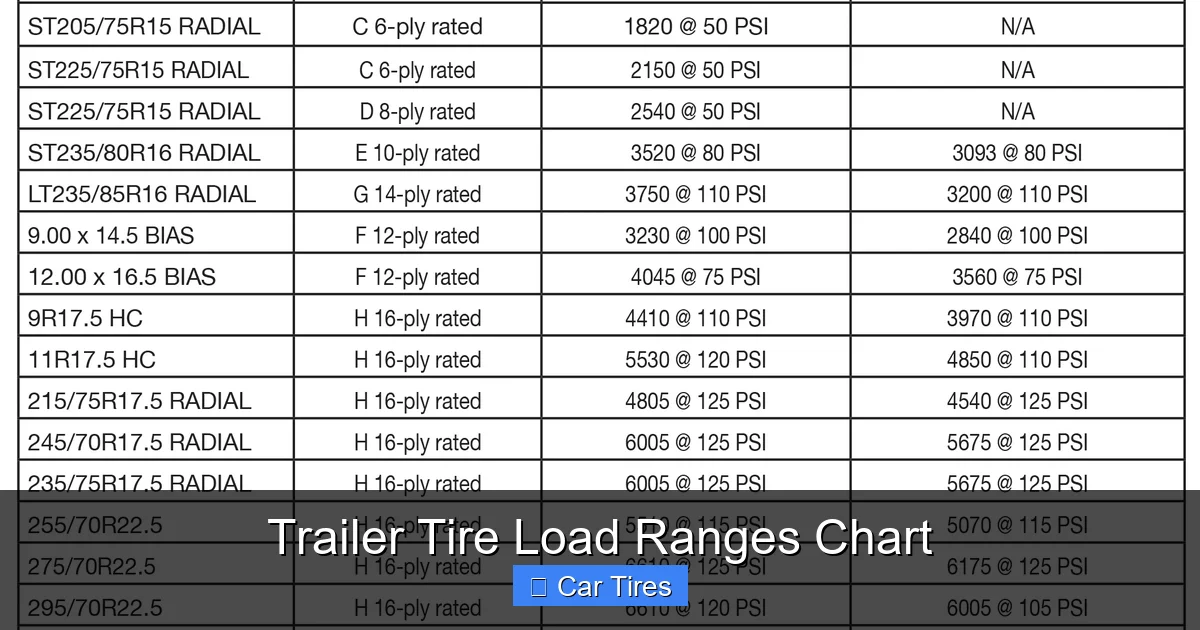
Visual guide about Trailer Tire Load Ranges Chart
Image source: felling.com
What Is Load Range?
Load range is a letter-based system (B, C, D, E, F) that tells you about the tire’s construction and maximum load capacity at a specific inflation pressure. It’s primarily used for light truck and trailer tires. The higher the letter in the alphabet, the stronger the tire and the more weight it can handle. For instance, a Load Range E tire is built with more plies (or equivalent strength) than a Load Range C, allowing it to carry heavier loads when properly inflated.
What Is Load Index?
Load index, on the other hand, is a numerical code (like 110 or 121) stamped on the tire sidewall. It corresponds to a specific weight in pounds or kilograms that the tire can carry at maximum pressure. You’ll find load index values in a separate chart provided by tire manufacturers. For example, a load index of 110 means the tire can carry 1,069 pounds per tire.
How They Work Together
Here’s the key: load range gives you the tire’s structural strength, while load index gives you the exact weight capacity. You need both pieces of information to make an informed decision. Let’s say you have a dual-axle trailer with a GVWR of 7,000 pounds. That means each tire needs to carry about 1,750 pounds (7,000 ÷ 4). A Load Range D tire with a load index of 115 (which supports 2,679 lbs per tire) would be more than sufficient. But if you only looked at the load index and ignored the load range, you might miss whether the tire is built to handle that pressure safely over long distances.
Practical Example
Imagine you’re buying tires for your 5th-wheel RV trailer. The manufacturer recommends Load Range E tires. You find a tire with a load index of 121—great! But if it’s only a Load Range C, it may not be built to sustain the required inflation pressure (usually 80 PSI for Load Range E) without risking failure. Always cross-reference both the load range and load index to ensure compatibility.
How to Read a Trailer Tire Load Ranges Chart
Now that you understand the basics, let’s dive into how to actually use a trailer tire load ranges chart. These charts are typically provided by tire manufacturers or found in trailer owner’s manuals. They list load ranges alongside maximum load capacities at specific inflation pressures.
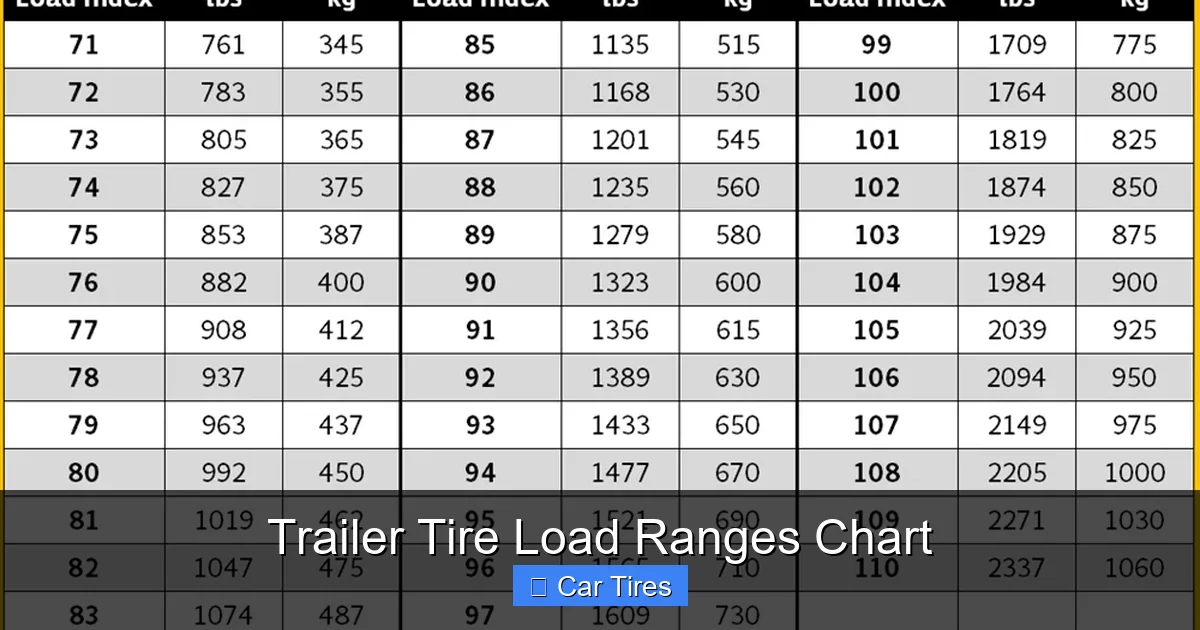
Visual guide about Trailer Tire Load Ranges Chart
Image source: prioritytire.com
Typical Load Range Values
Here’s a breakdown of common load ranges and what they mean:
- Load Range B: 4-ply rated, max load ~1,520 lbs at 35 PSI
- Load Range C: 6-ply rated, max load ~1,820 lbs at 50 PSI
- Load Range D: 8-ply rated, max load ~2,270 lbs at 65 PSI
- Load Range E: 10-ply rated, max load ~2,830 lbs at 80 PSI
- Load Range F: 12-ply rated, max load ~3,450 lbs at 95 PSI
Note: These values are approximate and can vary slightly by manufacturer. Always check the sidewall of the tire or the manufacturer’s specs for exact numbers.
Reading the Chart Step-by-Step
Let’s walk through an example. Suppose you have a single-axle trailer with a GVWR of 3,500 pounds. That means each tire must support 1,750 pounds. Looking at the chart:
- Load Range B: 1,520 lbs — too low
- Load Range C: 1,820 lbs — acceptable
- Load Range D: 2,270 lbs — more than enough
In this case, Load Range C is the minimum you’d want. But if you often carry heavy loads or travel long distances, upgrading to Load Range D gives you a safety buffer.
Why Inflation Pressure Matters
One critical detail often missed: the load capacity is only valid at the specified inflation pressure. A Load Range C tire inflated to 35 PSI won’t carry 1,820 pounds—it needs 50 PSI. Underinflation causes excessive heat buildup, tread separation, and blowouts. Always use a quality tire pressure gauge and check pressure when tires are cold (before driving).
Where to Find the Chart
You can find load range charts in several places:
- Tire manufacturer websites (e.g., Goodyear, Carlisle, Maxxis)
- Trailer owner’s manuals
- Tire retailers or service centers
- Online resources like the Tire and Rim Association (TRA) handbook
Some charts also include temperature ratings and speed limitations, which are especially important for long-haul towing.
Matching Load Range to Your Trailer’s Weight
Choosing the right load range isn’t just about picking the strongest tire—it’s about matching the tire’s capacity to your trailer’s actual needs. Overkill can be costly and unnecessary, while underestimating can be dangerous.

Visual guide about Trailer Tire Load Ranges Chart
Image source: ladiesoffroadnetwork.com
Step 1: Know Your Trailer’s GVWR
The first step is to find your trailer’s Gross Vehicle Weight Rating (GVWR). This is the maximum weight your trailer is designed to carry, including cargo, fluids, and accessories. You’ll usually find this on a sticker near the trailer tongue or in the owner’s manual. Never exceed this weight.
Step 2: Calculate Per-Tire Load
Divide the GVWR by the number of tires. For example:
- Single-axle trailer (2 tires): 5,000 lbs GVWR ÷ 2 = 2,500 lbs per tire
- Dual-axle trailer (4 tires): 8,000 lbs GVWR ÷ 4 = 2,000 lbs per tire
- Tri-axle trailer (6 tires): 12,000 lbs GVWR ÷ 6 = 2,000 lbs per tire
This gives you the minimum load capacity each tire must support.
Step 3: Choose the Right Load Range
Now, refer to the trailer tire load ranges chart. Find the smallest load range that meets or exceeds your per-tire requirement. Using the examples above:
- 2,500 lbs per tire → Requires at least Load Range D (2,270 lbs) or E (2,830 lbs)
- 2,000 lbs per tire → Load Range D is sufficient
It’s wise to add a 10–15% safety margin. So if your calculation is 2,000 lbs, aim for a tire rated at 2,200–2,300 lbs.
Real-World Example: Boat Trailer
Let’s say you have a 6,000-pound boat trailer with dual axles (4 tires). Each tire needs to carry 1,500 pounds. A Load Range C tire (1,820 lbs) works, but if you frequently launch in rough conditions or carry extra gear, stepping up to Load Range D gives you extra durability and peace of mind.
When to Upgrade
Consider upgrading your load range if:
- You often tow near your GVWR
- You travel long distances or at high speeds
- Your trailer carries heavy or uneven loads
- You’ve experienced tire failures in the past
Higher load range tires are typically more durable and resistant to heat, making them ideal for demanding conditions.
Common Mistakes to Avoid
Even experienced trailer owners make mistakes when it comes to tire load ranges. Avoid these common pitfalls to keep your towing safe and trouble-free.
Using Passenger Tires on Trailers
One of the biggest errors is using passenger car tires (P-metric) on trailers. These tires are designed for comfort and speed, not heavy loads. They lack the reinforced sidewalls and heat resistance of trailer-specific tires (LT or ST). Always use ST (Special Trailer) or LT (Light Truck) rated tires for trailers.
Ignoring Inflation Pressure
As mentioned earlier, load capacity depends on correct inflation. A Load Range E tire must be inflated to 80 PSI to carry its full load. Many people inflate to the vehicle’s recommended pressure (like 35 PSI for a truck), which is dangerously low for trailer tires. Always inflate to the PSI listed on the tire sidewall—not the vehicle door jamb.
Mixing Load Ranges
Never mix different load ranges on the same axle. For example, don’t put a Load Range C tire on one side and a Load Range D on the other. This creates uneven load distribution, increasing the risk of blowouts and handling issues. Always replace tires in pairs (or all four) and match load ranges exactly.
Overlooking Tire Age
Trailer tires degrade over time, even if they look fine. Rubber dries out, sidewalls crack, and internal belts can weaken. Most manufacturers recommend replacing trailer tires every 5–7 years, regardless of tread depth. Check the DOT date code on the sidewall (the last four digits indicate the week and year of manufacture).
Neglecting Regular Inspections
Before every trip, inspect your tires for:
- Cracks or dry rot on sidewalls
- Bulges or blisters (signs of internal damage)
- Uneven tread wear (could indicate alignment or inflation issues)
- Foreign objects like nails or stones
Catching problems early can prevent roadside emergencies.
Maintenance Tips for Long-Lasting Trailer Tires
Proper maintenance extends tire life and ensures consistent performance. Here’s how to keep your trailer tires in top shape.
Check Pressure Weekly
Tire pressure drops naturally over time—about 1–2 PSI per month. Check pressure weekly, especially before long trips. Use a digital gauge for accuracy. Remember: check when tires are cold (not after driving).
Store Tires Properly
If you store your trailer for long periods, protect the tires from UV rays, ozone, and moisture. Cover them with tire shields or store the trailer in a shaded area. Avoid parking on concrete, which can accelerate rubber degradation.
Rotate Tires (If Possible)
While trailer tires don’t rotate like car tires, you can swap front and rear tires annually to promote even wear—especially on dual-axle trailers.
Balance and Align
Unbalanced tires cause vibration and uneven wear. Have your tires balanced when installing new ones. Also, check axle alignment periodically; misaligned axles cause one side of the tire to wear faster.
Use Tire Covers
When parked for extended periods, use vinyl tire covers to block sunlight. UV rays break down rubber compounds, leading to premature aging.
Keep a Spare
Always carry a matching spare tire and know how to change it. A flat tire on the highway can ruin your trip—and a mismatched spare won’t help.
Conclusion
The trailer tire load ranges chart is more than just a reference—it’s a vital tool for safe, reliable towing. By understanding load ranges, matching them to your trailer’s weight, and maintaining your tires properly, you reduce the risk of blowouts, improve handling, and protect your investment. Whether you’re hauling a small utility trailer or a massive RV, the right tires make all the difference.
Don’t guess when it comes to tire capacity. Use the chart, check your GVWR, inflate to the correct PSI, and inspect your tires regularly. A little attention now can prevent a lot of trouble down the road. Remember: your safety—and the safety of others—depends on the tires beneath your trailer. Choose wisely, maintain diligently, and tow with confidence.
Frequently Asked Questions
What does Load Range E mean on a trailer tire?
Load Range E indicates a 10-ply rated tire capable of carrying up to 2,830 pounds per tire when inflated to 80 PSI. It’s commonly used on heavy-duty trailers like RVs, boat trailers, and equipment haulers.
Can I use a higher load range tire than recommended?
Yes, you can safely use a higher load range tire (e.g., upgrading from D to E) as long as the size and load index are compatible. It provides a greater safety margin and improved durability under heavy loads.
How often should I check my trailer tire pressure?
Check tire pressure at least once a month and always before long trips. Tires lose air over time, and underinflation is a leading cause of trailer tire failure.
Is Load Range the same as ply rating?
Not exactly. Load range is a modern equivalent of the older ply rating system. For example, Load Range D corresponds to an 8-ply rating, but modern tires use stronger materials, so the actual number of plies may be less.
Can I mix different load range tires on my trailer?
No, you should never mix different load ranges on the same axle. This can cause uneven weight distribution, poor handling, and increased risk of tire failure.
How do I find the load capacity of my current trailer tires?
Check the tire sidewall for the load range letter and load index number. Then refer to a trailer tire load ranges chart or the manufacturer’s specifications to determine the maximum load capacity at the recommended PSI.