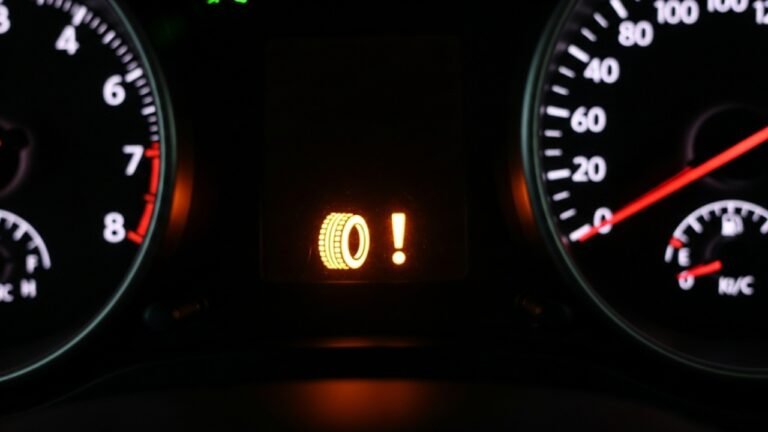
Tire Pressure Sensor Reading Wrong

If your tire pressure sensor reading wrong, it could be due to sensor malfunctions, temperature changes, or battery issues. This guide explains why it happens, how to fix it, and how to prevent future inaccuracies for safer, smoother rides.
In This Article
- 1 Key Takeaways
- 2 📑 Table of Contents
- 3 Why Your Tire Pressure Sensor Might Be Reading Wrong
- 4 How Tire Pressure Monitoring Systems Work
- 5 Common Causes of Incorrect Tire Pressure Sensor Readings
- 6 How to Diagnose a Faulty Tire Pressure Sensor
- 7 How to Fix a Tire Pressure Sensor Reading Wrong
- 8 Preventing Future TPMS Issues
- 9 When to See a Professional
- 10 Conclusion
- 11 Frequently Asked Questions
- 11.1 Why does my tire pressure sensor keep saying low when the tires are fine?
- 11.2 Can I drive with a faulty tire pressure sensor?
- 11.3 How much does it cost to replace a TPMS sensor?
- 11.4 Do I need to reset the TPMS after rotating tires?
- 11.5 Can a bad tire cause a false TPMS reading?
- 11.6 Will disconnecting the battery reset the TPMS?
Key Takeaways
- Sensor Battery Failure: Most TPMS sensors run on batteries that last 5-10 years. When they die, readings become unreliable or stop entirely.
- Temperature Fluctuations: Cold weather can cause pressure drops, leading to false low-pressure warnings even when tires are properly inflated.
- Damaged or Corroded Sensors: Road salt, moisture, and physical damage can corrode sensors or break internal components, causing incorrect readings.
- Improper Tire Installation: If tires are mounted incorrectly or sensors aren’t reset after rotation, the system may display wrong data.
- System Calibration Issues: After tire changes or rotations, the TPMS may need to be recalibrated to match the new sensor positions.
- Interference from Electronics: Strong electromagnetic fields or aftermarket devices can disrupt sensor signals, leading to false alerts.
- Use a Reliable Gauge: Always double-check sensor readings with a manual tire pressure gauge to confirm accuracy.
📑 Table of Contents
- Why Your Tire Pressure Sensor Might Be Reading Wrong
- How Tire Pressure Monitoring Systems Work
- Common Causes of Incorrect Tire Pressure Sensor Readings
- How to Diagnose a Faulty Tire Pressure Sensor
- How to Fix a Tire Pressure Sensor Reading Wrong
- Preventing Future TPMS Issues
- When to See a Professional
- Conclusion
Why Your Tire Pressure Sensor Might Be Reading Wrong
You’re driving down the highway, enjoying the ride, when suddenly—*ding*—a warning light flashes on your dashboard. It’s the tire pressure monitoring system (TPMS), telling you one or more tires are low. You pull over, check the tires, and they look fine. You use a handheld gauge, and the pressure is actually perfect. So why is the sensor saying otherwise?
This frustrating scenario happens more often than you’d think. A tire pressure sensor reading wrong can stem from a variety of causes, ranging from simple environmental factors to complex electronic failures. The TPMS is designed to keep you safe by alerting you to underinflated tires, which can lead to poor fuel economy, uneven tire wear, and even blowouts. But when the system itself isn’t working correctly, it can cause unnecessary stress, wasted trips to the mechanic, and even unsafe driving conditions if you ignore real warnings.
Understanding why your tire pressure sensor might be giving false readings is the first step toward fixing the problem. In this guide, we’ll walk you through the most common reasons behind inaccurate TPMS readings, how to diagnose them, and what you can do to restore reliable monitoring. Whether you’re a daily commuter or a weekend road-tripper, keeping your TPMS in good working order is essential for safety and peace of mind.
How Tire Pressure Monitoring Systems Work

Visual guide about Tire Pressure Sensor Reading Wrong
Image source: wonder007.com.tw
Before we dive into why your sensor might be reading wrong, it helps to understand how the system actually works. There are two main types of TPMS: direct and indirect.
Direct TPMS
Direct systems use physical sensors mounted inside each tire, usually attached to the valve stem or wheel rim. These sensors measure the actual air pressure and sometimes temperature, then transmit that data wirelessly to your vehicle’s onboard computer. Most modern cars use direct TPMS because it’s more accurate and provides real-time readings for each tire individually.
Each sensor has a unique ID, so the car knows which tire is which. When you rotate your tires or replace a sensor, the system may need to be reprogrammed to recognize the new positions. This is a common step often overlooked during tire service, which can lead to confusion—like the system thinking the front left tire is actually the rear right.
Indirect TPMS
Indirect systems don’t use physical pressure sensors. Instead, they rely on the car’s anti-lock braking system (ABS) wheel speed sensors. When a tire is underinflated, it has a slightly smaller diameter and rotates faster than the others. The ABS system detects this difference and triggers a warning light.
While indirect TPMS is cheaper and requires less maintenance, it’s also less precise. It can’t tell you the exact pressure in each tire, and it often only activates after a significant pressure drop—sometimes as much as 25%. It also can’t detect if all four tires lose pressure at the same rate, like during a cold snap.
Why Accuracy Matters
Whether your car uses direct or indirect TPMS, accuracy is crucial. The recommended tire pressure for most passenger vehicles ranges between 30 and 35 PSI (pounds per square inch). Even a small deviation—say, 5 PSI below optimal—can reduce fuel efficiency by up to 3%, increase stopping distance, and accelerate tire wear.
That’s why a tire pressure sensor reading wrong isn’t just an annoyance—it’s a safety risk. If the system fails to warn you about a real problem, you could be driving on underinflated tires without knowing it. On the flip side, constant false alarms can lead to “warning fatigue,” where you start ignoring the light altogether—even when it’s trying to tell you something important.
Common Causes of Incorrect Tire Pressure Sensor Readings

Visual guide about Tire Pressure Sensor Reading Wrong
Image source: i.ytimg.com
Now that you know how TPMS works, let’s explore the most common reasons your sensor might be giving you the wrong information.
1. Dead or Dying Sensor Battery
This is the number one cause of TPMS failure. Most direct TPMS sensors are powered by a small lithium battery sealed inside the unit. These batteries typically last between 5 and 10 years, depending on usage and environmental conditions.
Once the battery dies, the sensor can no longer transmit data. In some cases, it may send sporadic or incorrect readings before going completely silent. If your car is over 7 years old and you’ve never replaced the sensors, battery failure is a strong possibility.
Unfortunately, these batteries aren’t replaceable—you’ll need to install a new sensor. The good news? Many modern sensors are designed to last longer, and some newer vehicles use energy-harvesting technology that extends battery life.
2. Extreme Temperature Changes
Tire pressure is directly affected by temperature. For every 10°F drop in temperature, tire pressure decreases by about 1 PSI. This is why you often see TPMS warnings in the winter, even if your tires were properly inflated in the fall.
For example, let’s say you inflated your tires to 32 PSI on a warm autumn day (70°F). When winter hits and temperatures drop to 20°F, your tire pressure could drop to around 29 PSI—below the recommended level. The sensor detects this and triggers a warning, even though the tires haven’t lost air; the pressure just decreased due to the cold.
Conversely, in hot weather, pressure can rise. If you drive on a hot highway, tire temperatures can increase significantly, causing pressure to spike. Some sensors may interpret this as overinflation, though most systems are designed to account for normal operating heat.
3. Physical Damage or Corrosion
TPMS sensors are tough, but they’re not indestructible. They’re exposed to road debris, water, salt, and extreme temperatures. Over time, the metal parts—especially the valve stem—can corrode, especially in snowy or coastal areas where salt and moisture are common.
Corrosion can block the sensor’s ability to read pressure accurately or prevent it from transmitting data. In severe cases, the sensor may crack or break, especially during tire mounting or dismounting. Mechanics sometimes accidentally damage sensors when removing tires, so it’s important to let them know your car has TPMS.
4. Improper Tire Installation or Rotation
When tires are rotated or replaced, the TPMS sensors need to be handled carefully. If a tire is mounted incorrectly—say, the sensor is twisted or not seated properly—it can give false readings.
Even more common is forgetting to reset the system after a tire rotation. Most cars require a TPMS reset procedure to relearn which sensor is in which position. If you don’t do this, the system might show the wrong tire as low, or it might not recognize a new sensor at all.
Some vehicles have an automatic relearn feature that detects sensor positions after a few miles of driving. Others require a manual reset using a scan tool or a specific sequence of button presses. Check your owner’s manual for instructions.
5. Sensor Signal Interference
TPMS sensors communicate with your car using radio frequency (RF) signals, usually around 315 MHz or 433 MHz. These signals can be disrupted by strong electromagnetic interference (EMI) from nearby power lines, radio towers, or even certain aftermarket electronics.
For example, installing a high-powered CB radio or a custom alarm system near the wheels could interfere with sensor signals. Some drivers have reported TPMS issues after installing LED light bars or performance tuners that emit RF noise.
Additionally, if you’re driving near a cell tower or in a tunnel with strong signal activity, it could temporarily disrupt communication between the sensors and the car.
6. Software or System Glitches
Like any electronic system in your car, the TPMS can experience software bugs or glitches. Sometimes, the onboard computer misinterprets sensor data or fails to update properly after a reset.
In rare cases, a firmware update from the manufacturer may be needed to fix known issues. This is more common in newer vehicles with advanced infotainment and safety systems that are constantly being updated.
How to Diagnose a Faulty Tire Pressure Sensor

Visual guide about Tire Pressure Sensor Reading Wrong
Image source: m.media-amazon.com
If your tire pressure sensor reading wrong, the first step is to confirm whether the issue is real or perceived. Here’s how to diagnose the problem.
Step 1: Use a Manual Tire Pressure Gauge
Don’t rely solely on the dashboard warning light. Grab a reliable handheld tire pressure gauge—digital ones are more accurate than analog—and check each tire’s pressure when they’re cold (before driving or after the car has sat for a few hours).
Compare your readings to the recommended PSI listed on the driver’s side door jamb sticker (not the max pressure on the tire sidewall). If the manual gauge shows correct pressure but the sensor says otherwise, the sensor is likely faulty.
Step 2: Check for Consistent Warnings
Does the warning light come on only in cold weather? Does it go away after driving for a while? If so, it might just be a temperature-related pressure drop, not a sensor issue.
But if the light stays on consistently, or if it flashes and then stays solid (a sign of a system malfunction), you likely have a real problem.
Step 3: Use an OBD2 Scanner or TPMS Tool
Many auto parts stores offer free TPMS diagnostics. You can also buy an OBD2 scanner with TPMS functionality for around $50–$100. These tools can read error codes, check sensor battery levels, and verify signal strength.
For example, a scanner might show that the front left sensor has a weak signal or a dead battery. This helps pinpoint exactly which sensor is failing.
Step 4: Inspect the Sensors Visually
If you’re comfortable removing the wheels, inspect the sensors for visible damage—cracks, corrosion, or loose fittings. Pay special attention to the valve stem, which is a common failure point.
You can also use a soapy water solution to check for air leaks around the sensor. Bubbles indicate a leak, which could explain low pressure readings.
Step 5: Test After a Reset
Try resetting the TPMS system according to your vehicle’s instructions. On many cars, this involves pressing a reset button under the steering wheel or using the infotainment menu. Drive for 10–15 minutes to allow the system to recalibrate.
If the warning light goes away and stays off, the issue may have been a temporary glitch. If it returns, the sensor likely needs replacement.
How to Fix a Tire Pressure Sensor Reading Wrong
Once you’ve diagnosed the problem, it’s time to fix it. Here are the most effective solutions.
Replace the Faulty Sensor
If the sensor battery is dead or the unit is damaged, replacement is the only option. Sensors typically cost $50–$150 each, and labor adds another $20–$50 per tire if done at a shop.
Some sensors are integrated into the valve stem and must be replaced as a unit. Others have a separate sensor body that can be detached. Make sure to get the correct frequency and protocol for your vehicle (e.g., 315 MHz for most GM, Ford, and Toyota models).
Relearn the Sensor Positions
After replacing a sensor or rotating tires, you’ll need to perform a TPMS relearn procedure. This tells the car which sensor is in which wheel.
Some cars do this automatically. Others require a scan tool or a specific sequence—like turning the ignition on and off, honking the horn, or pressing the brake pedal. Your owner’s manual or a quick online search for your make and model will have the steps.
Protect Sensors from Corrosion
To extend sensor life, ask your tire technician to use nickel-plated valve caps and anti-seize compound on the valve threads. Avoid over-tightening the valve core, which can crack the sensor.
If you live in a snowy area, consider using rubber valve caps instead of metal ones, which are more prone to corrosion.
Recalibrate After Tire Changes
Whenever you install new tires or wheels, make sure the TPMS is recalibrated. Some aftermarket wheels don’t have sensor mounting provisions, so you may need to transfer the old sensors or buy new ones.
Also, if you switch to winter tires with separate sensors, ensure the system is set to the correct tire set.
Address Environmental Factors
If cold weather is causing false warnings, consider inflating your tires to the higher end of the recommended range in winter. For example, if your car calls for 32 PSI, inflate to 34 PSI in colder months to account for pressure drops.
Just don’t overinflate—this can reduce traction and cause uneven wear.
Preventing Future TPMS Issues
An ounce of prevention is worth a pound of cure—especially when it comes to tire safety.
Regular Maintenance Checks
Make it a habit to check your tire pressure monthly with a manual gauge. This helps you catch real issues early and confirms whether your TPMS is working correctly.
Also, inspect your tires for damage, wear, and embedded objects during each check.
Schedule Professional Inspections
During routine oil changes or tire rotations, ask your mechanic to inspect the TPMS sensors. They can check for corrosion, test signal strength, and ensure proper installation.
Use Quality Sensors and Parts
When replacing sensors, choose OEM (original equipment manufacturer) or high-quality aftermarket units. Cheap sensors may fail prematurely or give inaccurate readings.
Keep Software Updated
If your car has a connected TPMS system, check for software updates through your dealer or manufacturer’s website. Updates can fix bugs and improve sensor performance.
Be Mindful of Modifications
If you’re installing aftermarket electronics, choose low-interference components and keep them away from the wheels. Shielded wiring can help reduce RF noise.
When to See a Professional
While some TPMS issues can be resolved at home, others require expert help.
Seek professional assistance if:
– The warning light flashes and stays on (indicating a system malfunction).
– You’ve replaced the sensor but the problem persists.
– You’re unsure how to perform a TPMS reset or relearn procedure.
– Multiple sensors are failing at once (could indicate a deeper electrical issue).
A qualified technician can run a full diagnostic, replace sensors correctly, and ensure your system is functioning safely.
Conclusion
A tire pressure sensor reading wrong can be confusing and concerning, but it’s rarely a sign of a major problem. Most issues stem from dead batteries, temperature changes, or simple installation errors. By understanding how your TPMS works and knowing how to diagnose and fix common problems, you can keep your system accurate and reliable.
Regular maintenance, proper tire care, and using a manual gauge to double-check readings are simple habits that go a long way. And when in doubt, don’t hesitate to consult a professional.
Your tires are the only part of your car that touches the road. Keeping them properly inflated isn’t just about comfort or fuel economy—it’s about safety. So the next time your TPMS light comes on, take a deep breath, check the pressure, and drive with confidence.
Frequently Asked Questions
Why does my tire pressure sensor keep saying low when the tires are fine?
This is often due to cold weather causing a natural pressure drop, or a dying sensor battery. Use a manual gauge to confirm the actual pressure and check if the warning appears only in cold conditions.
Can I drive with a faulty tire pressure sensor?
Yes, but it’s not recommended. You won’t get accurate pressure alerts, which could lead to driving on underinflated tires. Replace the sensor as soon as possible for safety.
How much does it cost to replace a TPMS sensor?
Sensors typically cost $50–$150 each, plus $20–$50 per tire in labor. Some shops offer package deals for all four sensors.
Do I need to reset the TPMS after rotating tires?
Yes, most vehicles require a TPMS reset or relearn procedure after tire rotation to ensure the system knows which sensor is in which position.
Can a bad tire cause a false TPMS reading?
Yes, a slow leak, damaged valve stem, or improperly seated tire can cause low pressure readings, even if the sensor itself is working fine.
Will disconnecting the battery reset the TPMS?
Not usually. While it may clear temporary glitches, most TPMS systems require a specific reset procedure using a tool or dashboard menu.