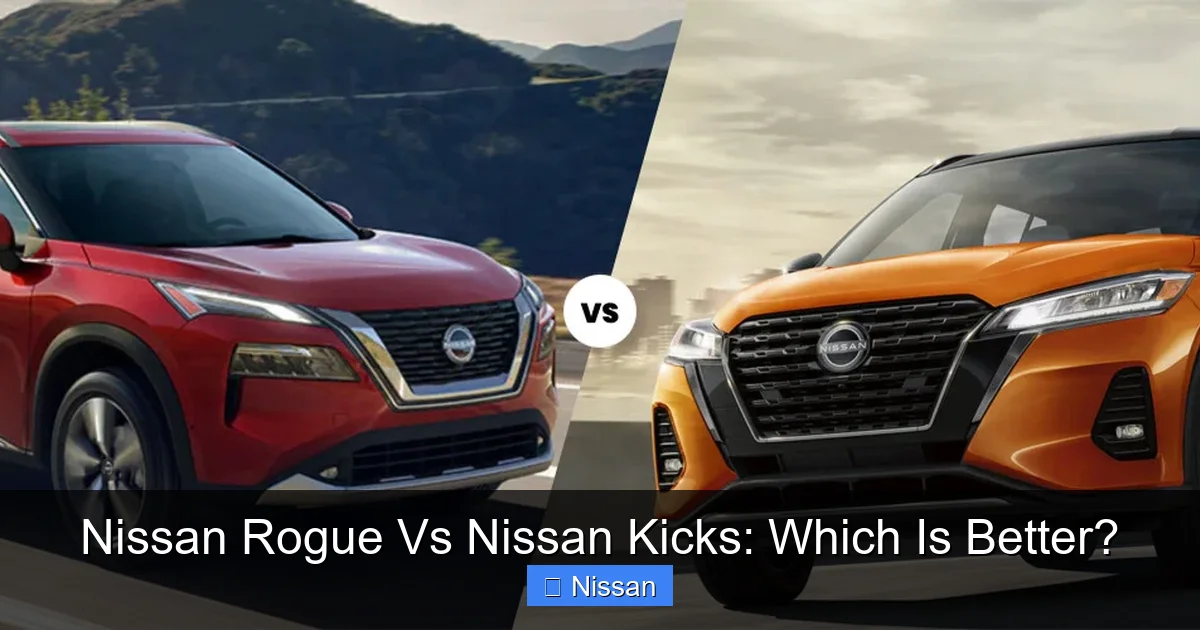
Nissan Rogue Vs Nissan Kicks: Which Is Better?

Contents
- 1 Key Takeaways
- 2 📑 Table of Contents
- 3 Nissan Rogue vs Nissan Kicks: Which Is Better?
- 4 Size and Interior Space: Room to Grow or Just Right?
- 5 Performance and Driving Experience: Power vs. Efficiency
- 6 Technology and Safety Features: Smart and Secure
- 7 Price and Value: What You Get for Your Money
- 8 Real-World Use Cases: Who Should Buy Which?
- 9 Final Verdict: Which One Should You Choose?
- 10 Frequently Asked Questions


Choosing between the Nissan Rogue and Nissan Kicks depends on your needs. The Rogue offers more space, power, and family-friendly features, while the Kicks is a compact, fuel-efficient urban warrior with a lower price tag.
Key Takeaways
- Size and Space: The Rogue is a midsize SUV with three rows (optional), ideal for families, while the Kicks is a subcompact SUV with two rows, better suited for city driving and smaller households.
- Performance and Power: The Rogue comes with a stronger 1.5L turbocharged engine and available all-wheel drive, whereas the Kicks has a modest 1.6L engine and front-wheel drive only.
- Fuel Efficiency: The Kicks wins in fuel economy, averaging up to 33 mpg combined, compared to the Rogue’s 28–30 mpg depending on drivetrain.
- Technology and Safety: Both offer Nissan Safety Shield 360, but the Rogue includes more advanced tech like a larger touchscreen, wireless Apple CarPlay, and available ProPILOT Assist 2.0.
- Cargo and Practicality: The Rogue provides significantly more cargo space (up to 74.1 cubic feet) and higher towing capacity (1,500 lbs), making it better for road trips and hauling.
- Price and Value: The Kicks starts around $21,000, making it a budget-friendly entry point, while the Rogue begins near $28,000 but offers more features and capability.
- Target Audience: The Kicks suits singles, couples, or city dwellers; the Rogue is better for growing families, frequent travelers, or those needing more versatility.
📑 Table of Contents
- Nissan Rogue vs Nissan Kicks: Which Is Better?
- Size and Interior Space: Room to Grow or Just Right?
- Performance and Driving Experience: Power vs. Efficiency
- Technology and Safety Features: Smart and Secure
- Price and Value: What You Get for Your Money
- Real-World Use Cases: Who Should Buy Which?
- Final Verdict: Which One Should You Choose?
Nissan Rogue vs Nissan Kicks: Which Is Better?
When it comes to choosing a Nissan SUV, two models often rise to the top of the conversation: the Nissan Rogue and the Nissan Kicks. Both are stylish, reliable, and packed with modern features, but they serve very different lifestyles. Whether you’re a busy parent shuttling kids to soccer practice or a young professional navigating city streets, one of these SUVs is likely a better fit for you.
The Rogue is Nissan’s flagship midsize SUV, known for its spacious interior, smooth ride, and advanced safety tech. It’s designed for families and long-distance travelers who need room, comfort, and capability. On the other hand, the Kicks is a compact, nimble subcompact SUV that shines in urban environments. It’s affordable, fuel-efficient, and easy to park—perfect for city dwellers or first-time car buyers.
So, which one is better? The answer isn’t one-size-fits-all. It depends on your priorities: space, performance, budget, and how you plan to use your vehicle. In this detailed comparison, we’ll break down every key aspect—from engine specs and interior comfort to tech features and real-world usability—so you can make an informed decision. Let’s dive in and see how the Rogue and Kicks stack up head-to-head.
Size and Interior Space: Room to Grow or Just Right?
Exterior Dimensions and Curb Appeal
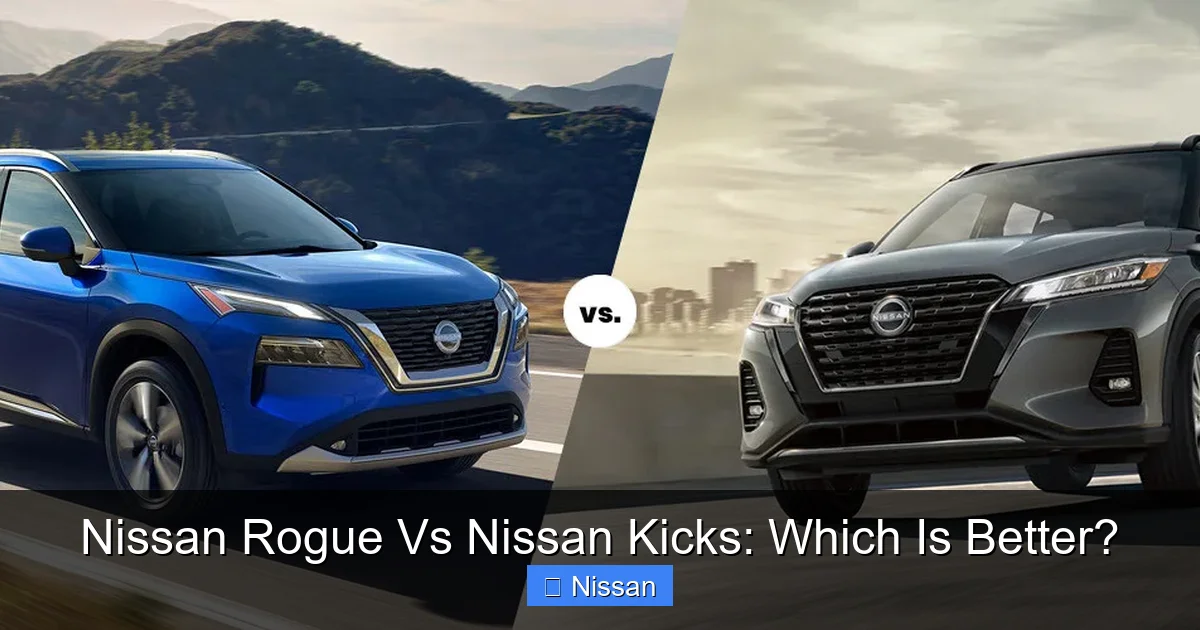
At first glance, the difference in size between the Rogue and Kicks is obvious. The Rogue measures about 183 inches in length, 73 inches wide, and 67 inches tall, giving it a commanding presence on the road. It looks and feels like a traditional SUV—bold, confident, and ready for adventure. The Kicks, by contrast, is much smaller: just 169 inches long, 69 inches wide, and 63 inches tall. It’s more of a crossover hatchback with SUV styling, designed to slip into tight parking spots with ease.
Visual guide about Nissan Rogue Vs Nissan Kicks: Which Is Better?
Image source: dealerinspire-image-library-prod.s3.us-east-1.amazonaws.com
The Rogue’s larger footprint translates to a longer wheelbase (106.5 inches vs. Kicks’ 103.1 inches), which contributes to a smoother, more stable ride—especially on highways or uneven roads. The Kicks, while agile, can feel a bit bouncy on rough pavement due to its shorter wheelbase and stiffer suspension tuned for city driving.
Passenger Comfort and Seating
Inside, the Rogue offers seating for up to five passengers, with an optional third row in some trims (though it’s quite tight—best for kids or short trips). The front seats are wide and supportive, with plenty of legroom and headroom even for taller drivers. Rear passengers also enjoy generous space, making long drives more comfortable for everyone.
The Kicks, on the other hand, is strictly a two-row, five-passenger vehicle. While the front seats are comfortable, rear legroom is tighter—about 33.4 inches compared to the Rogue’s 38.5 inches. Taller passengers might find the back seat a bit cramped on longer journeys. However, the Kicks makes clever use of its compact space with fold-flat rear seats and under-floor storage, maximizing utility without sacrificing style.
Cargo Capacity and Practicality
When it comes to hauling gear, the Rogue dominates. With the rear seats up, it offers 36.5 cubic feet of cargo space—more than enough for groceries, luggage, or sports equipment. Fold the rear seats down, and that number jumps to an impressive 74.1 cubic feet. That’s enough room for a week’s worth of camping gear, a large dog crate, or even a small piece of furniture.
The Kicks provides 25.3 cubic feet behind the rear seats and 50.5 cubic feet with the seats folded. While that’s respectable for a subcompact SUV, it’s still significantly less than the Rogue. For example, if you’re planning a weekend getaway with a partner and two large suitcases, the Kicks might force you to pack light. The Rogue, however, gives you room to spare.
Another practical advantage of the Rogue is its available hands-free power liftgate and higher load floor, making it easier to load heavy items. The Kicks has a manual liftgate and a higher load height, which can be a bit awkward when lifting bulky items.
Performance and Driving Experience: Power vs. Efficiency
Engine and Powertrain Options
Under the hood, the Rogue and Kicks take very different approaches. The Rogue comes standard with a 1.5-liter three-cylinder turbocharged engine that delivers 201 horsepower and 225 lb-ft of torque. That’s a significant upgrade from previous models and gives the Rogue plenty of pep for highway merging, passing, and climbing hills. It’s paired with a continuously variable transmission (CVT) that’s smooth and responsive.

Visual guide about Nissan Rogue Vs Nissan Kicks: Which Is Better?
Image source: dealerinspire-image-library-prod.s3.us-east-1.amazonaws.com
The Kicks, meanwhile, uses a naturally aspirated 1.6-liter four-cylinder engine producing 122 horsepower and 114 lb-ft of torque. While it’s not a powerhouse, it’s adequate for city driving and light highway use. The CVT in the Kicks is tuned for efficiency, so it prioritizes fuel economy over performance. You won’t win any drag races, but you’ll get where you’re going without breaking a sweat—or the bank.
All-Wheel Drive and Towing
One major advantage the Rogue has over the Kicks is available all-wheel drive (AWD). On most trims, you can opt for AWD, which improves traction in rain, snow, or light off-road conditions. This makes the Rogue a better choice for drivers in colder climates or those who enjoy weekend adventures in the mountains or countryside.
The Kicks, unfortunately, is front-wheel drive only. While FWD is fine for most city and suburban driving, it can struggle in heavy snow or on slippery roads. If you live in an area with harsh winters, the Rogue’s AWD capability could be a deciding factor.
When it comes to towing, the Rogue can handle up to 1,500 pounds when properly equipped—enough for a small trailer, jet ski, or pop-up camper. The Kicks isn’t rated for towing at all, so if you plan on hauling anything behind your vehicle, the Rogue is the only option.
Fuel Economy: Kicks Wins the Efficiency Race
If saving money at the pump is a top priority, the Kicks is the clear winner. It achieves an EPA-estimated 31 mpg in the city, 36 mpg on the highway, and 33 mpg combined. That’s excellent for a non-hybrid SUV and makes it one of the most fuel-efficient vehicles in its class.
The Rogue, while not a gas guzzler, is less efficient. With front-wheel drive, it gets 27 mpg city, 35 mpg highway, and 30 mpg combined. Opt for AWD, and those numbers drop slightly to 26/33/29 mpg. Still respectable for a midsize SUV, but not quite on par with the Kicks.
For example, if you drive 15,000 miles per year and gas costs $3.50 per gallon, the Kicks would cost about $1,590 annually in fuel, while the Rogue (FWD) would cost around $1,750. That’s a $160 difference per year—not huge, but over five years, it adds up to nearly $800. For budget-conscious buyers, that’s a meaningful savings.
Technology and Safety Features: Smart and Secure
Infotainment and Connectivity
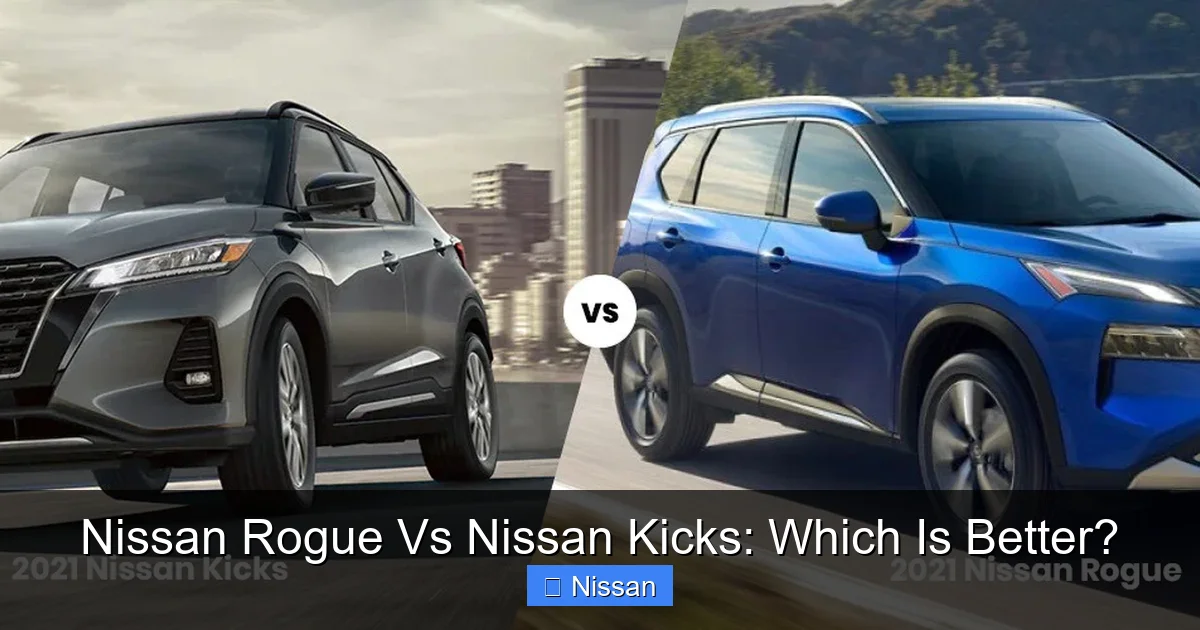
Both the Rogue and Kicks come with Nissan’s user-friendly infotainment system, but the Rogue offers more advanced tech. The base Kicks S trim includes a 7-inch touchscreen with Apple CarPlay and Android Auto, Bluetooth, and a four-speaker audio system. It’s simple and functional, perfect for drivers who just need the basics.
Visual guide about Nissan Rogue Vs Nissan Kicks: Which Is Better?
Image source: dealerinspire-image-library-prod.s3.us-east-1.amazonaws.com
The Rogue starts with an 8-inch touchscreen on most trims, with higher-end models offering a 9-inch display. Wireless Apple CarPlay is available (a big plus for iPhone users), and you can upgrade to a Bose premium audio system with 10 speakers. The Rogue also supports over-the-air software updates, keeping your system current without a trip to the dealership.
Another nice touch on the Rogue is the available 12.3-inch digital instrument cluster, which replaces traditional gauges with a customizable display. You can view navigation maps, media info, and driver assistance alerts right in front of you. The Kicks sticks with a traditional analog cluster, which feels dated in comparison.
Safety and Driver Assistance
Safety is a strong suit for both models. Every Rogue and Kicks comes standard with Nissan Safety Shield 360, a suite of six advanced driver assistance features:
- Automatic Emergency Braking with Pedestrian Detection
- Blind Spot Warning
- Rear Cross Traffic Alert
- Lane Departure Warning
- High Beam Assist
- Rear Automatic Braking
These features help prevent accidents and give drivers peace of mind, especially in heavy traffic or when reversing out of parking spots.
The Rogue goes a step further with available ProPILOT Assist 2.0, a semi-autonomous driving system that combines adaptive cruise control, lane centering, and hands-free driving on compatible highways (in certain trims and conditions). It’s one of the most advanced driver aids in the segment and makes long road trips less tiring.
The Kicks doesn’t offer ProPILOT Assist, but it does include standard Intelligent Driver Alertness Monitoring, which watches for signs of drowsiness or distraction and alerts the driver if needed. It’s a thoughtful addition for city drivers who spend a lot of time in stop-and-go traffic.
Interior Materials and Build Quality
Inside, the Rogue feels more upscale. Higher trims feature soft-touch materials, leather-wrapped steering wheels, and available leather or premium cloth seats. The dashboard layout is clean and modern, with intuitive controls and minimal clutter.
The Kicks has a more basic interior, with more hard plastics and a simpler design. That’s not necessarily a bad thing—it keeps costs down and appeals to buyers who prefer a no-frills approach. But if you’re looking for a more premium feel, the Rogue delivers.
Both vehicles offer available heated front seats, dual-zone automatic climate control, and a panoramic moonroof (on select trims). The Rogue also offers a heated steering wheel and rear seat climate vents—nice touches for families or cold-weather drivers.
Price and Value: What You Get for Your Money
Starting Prices and Trim Levels
The Kicks is the more affordable option, with a starting MSRP of around $21,000 for the base S trim. The SV trim adds more features like a larger touchscreen, upgraded audio, and additional safety tech for about $23,500. The top-tier SR trim, with sporty styling and premium features, tops out around $25,500.
The Rogue starts at approximately $28,000 for the base S FWD model. The SV trim, which is the most popular, costs around $30,500 and includes more standard features like an 8-inch touchscreen, dual-zone climate control, and additional USB ports. The SL and Platinum trims can push the price past $37,000, especially with AWD and optional packages.
So, there’s a clear price gap—about $7,000 to $10,000 depending on trim. But remember: you’re also getting a larger, more powerful, and more capable vehicle with the Rogue.
Resale Value and Ownership Costs
Both vehicles have strong resale values, but the Rogue tends to hold its value slightly better due to its popularity and broader appeal. According to industry reports, the Rogue retains about 50–55% of its value after three years, compared to 45–50% for the Kicks.
Maintenance and repair costs are similar, though the Kicks’ simpler engine and lack of AWD may lead to slightly lower long-term expenses. Insurance costs are also typically lower for the Kicks, thanks to its smaller size and lower price tag.
Warranty coverage is identical: a 3-year/36,000-mile basic warranty and a 5-year/60,000-mile powertrain warranty. Both also come with 24/7 roadside assistance for the duration of the basic warranty.
Which Offers Better Value?
If you’re on a tight budget and primarily drive in the city, the Kicks offers excellent value. You get modern safety features, decent tech, and great fuel economy for under $25,000.
If you need more space, power, and versatility—and can afford the higher price—the Rogue is the better long-term investment. It’s more comfortable, capable, and future-proof for growing families or changing needs.
Real-World Use Cases: Who Should Buy Which?
The Kicks: Ideal for Urban Lifestyles
The Kicks shines in city environments. Its compact size makes it easy to park in tight spots, and its fuel efficiency saves money on daily commutes. It’s perfect for:
- Young professionals living in apartments
- College students needing reliable transportation
- Empty nesters downsizing from a larger vehicle
- City dwellers who rarely take long road trips
For example, imagine a graphic designer in downtown Chicago who drives 20 miles round-trip to work, runs errands on weekends, and occasionally visits family in the suburbs. The Kicks fits their lifestyle perfectly—affordable, efficient, and easy to maneuver through traffic and parking garages.
The Rogue: Built for Families and Adventures
The Rogue is designed for those who need more from their vehicle. It’s ideal for:
- Growing families with kids and car seats
- Frequent road trippers or weekend campers
- People who live in rural or snowy areas
- Anyone who values comfort and space on long drives
Picture a family of four planning a summer vacation to the mountains. They need room for luggage, coolers, and camping gear. They’ll be driving on highways and possibly unpaved roads. The Rogue’s AWD, cargo space, and comfortable ride make it the obvious choice.
When to Consider the Other Option
That said, there are exceptions. A single person who loves outdoor adventures might prefer the Rogue for its AWD and cargo space, even if they don’t need the extra seating. Conversely, a couple with no kids might find the Kicks more than adequate—and appreciate the savings.
The key is to assess your current and future needs. If you plan to start a family, get a dog, or take more road trips in the next few years, the Rogue’s versatility could save you from needing to upgrade later.
Final Verdict: Which One Should You Choose?
After comparing every aspect—size, performance, tech, price, and real-world use—the answer comes down to your lifestyle and priorities.
If you value affordability, fuel efficiency, and city-friendly size, the Nissan Kicks is the better choice. It’s a smart, practical SUV that delivers excellent value for urban drivers and budget-conscious buyers.
If you need more space, power, and capability—especially for family life, long drives, or adverse weather—the Nissan Rogue is the clear winner. It’s a more versatile, comfortable, and future-ready vehicle that justifies its higher price tag.
Ultimately, both are excellent SUVs in their respective categories. The Kicks proves that small doesn’t have to mean compromised, while the Rogue shows that midsize SUVs can be both refined and rugged. Take a test drive of both, consider your daily routine, and choose the one that fits your life—not just your driveway.
Frequently Asked Questions
Is the Nissan Rogue bigger than the Nissan Kicks?
Yes, the Rogue is significantly larger. It’s a midsize SUV with more passenger and cargo space, while the Kicks is a subcompact SUV designed for city driving and smaller households.
Which Nissan SUV has better fuel economy: Rogue or Kicks?
The Kicks is more fuel-efficient, averaging up to 33 mpg combined. The Rogue gets 28–30 mpg, depending on whether it has front-wheel or all-wheel drive.
Does the Nissan Kicks have all-wheel drive?
No, the Kicks is front-wheel drive only. The Rogue offers available all-wheel drive, making it better for snowy or slippery conditions.
Can the Nissan Rogue tow a trailer?
Yes, the Rogue can tow up to 1,500 pounds when properly equipped. The Kicks is not rated for towing.
Which has more advanced technology: Rogue or Kicks?
The Rogue offers more advanced tech, including a larger touchscreen, wireless Apple CarPlay, and available ProPILOT Assist 2.0. The Kicks has solid basics but fewer high-end features.
Is the Nissan Kicks a good car for a family?
The Kicks can work for small families or couples, but its limited rear seat and cargo space make it less ideal than the Rogue for larger families or frequent travel.