Is the Tesla Model 3 Rear-wheel Drive Good in Snow?

Contents
- 1 Key Takeaways
- 2 📑 Table of Contents
- 3 Understanding the Fundamental Challenge: RWD vs. AWD in Snow
- 4 The Tesla Model 3 RWD’s Secret Weapons: Tech and Weight
- 5 The Unbeatable Variable: Tires, Tires, Tires
- 6 Real-World Driving: Techniques and Strategies
- 7 Where the Model 3 RWD Hits Its Limits in Snow
- 8 Who is the Model 3 RWD For in Winter?
- 9 The Verdict: A Capable, But Conditional, Winter Car
- 10 Frequently Asked Questions



The Tesla Model 3 Rear-Wheel Drive can be surprisingly capable in snow with the right preparation, primarily through winter tires. Its instant torque control and low center of gravity are major assets. However, it fundamentally lacks the mechanical traction of an AWD system, making cautious driving and proper equipment essential for serious winter conditions. It’s a good winter car for moderate snow regions with dedicated winter tires, but not an invincible snow machine.
So, you’re eyeing the Tesla Model 3 Rear-Wheel Drive. Maybe you love the efficiency, the minimalist interior, or that iconic instant torque. But then winter hits, or you’re moving to a snowy state, and a big question bubbles up: Is the Tesla Model 3 Rear-Wheel Drive good in snow? It’s a smart and critical question. After all, you’re investing in an electric future, but you still need to get to work, the grocery store, and grandma’s house when the white stuff falls. The short answer is: it can be, but with some very important conditions. Let’s dive deep, beyond the marketing, into the real-world physics, technology, and practical steps that determine whether this RWD electric sedan becomes a winter warrior or a driveway ornament.
Key Takeaways
- Winter Tires Are Non-Negotiable: The single most important upgrade for Model 3 RWD in snow is a high-quality set of dedicated winter tires. They dramatically improve traction, braking, and handling on ice and packed snow, far outweighing the benefits of AWD on all-seasons.
- Instant Torque Control is a Secret Weapon: Tesla’s precise, software-controlled power delivery allows you to modulate acceleration smoothly, preventing the wheel spin that often plagues traditional RWD cars. This is a significant advantage in slick conditions.
- Low Center of Gravity Enhances Stability: The heavy battery pack mounted in the floor gives the Model 3 an exceptionally low center of gravity. This reduces body roll and improves stability during cornering on slippery surfaces, making it feel planted.
- Regenerative Braking Requires Adjustment: One-pedal driving, while efficient, can feel unpredictable on ice. You must learn to modulate the accelerator gently for smooth stops or switch to a low regen setting in winter to avoid sudden rear-wheel lock-up tendencies.
- Weight Distribution is Excellent, but Traction is Limited: The near 50/50 weight distribution is ideal for balance. However, with only two driven wheels, the Model 3 RWD will struggle for initial traction on steep, unplowed hills or deep snow compared to an AWD Tesla.
- Pre-Trip Planning is Crucial: Always check weather and road reports. Use the Tesla mobile app to pre-heat the cabin and battery while plugged in, which improves range and performance. Keep your charge above 20% and know Supercharger locations along your route.
- It’s About Managing Expectations: The Model 3 RWD is not a substitute for a true winter truck or AWD vehicle in heavy snow regions. It excels as a daily driver in areas with occasional snow, ice, and treated roads when equipped properly and driven skillfully.
📑 Table of Contents
- Understanding the Fundamental Challenge: RWD vs. AWD in Snow
- The Tesla Model 3 RWD’s Secret Weapons: Tech and Weight
- The Unbeatable Variable: Tires, Tires, Tires
- Real-World Driving: Techniques and Strategies
- Where the Model 3 RWD Hits Its Limits in Snow
- Who is the Model 3 RWD For in Winter?
- The Verdict: A Capable, But Conditional, Winter Car
Understanding the Fundamental Challenge: RWD vs. AWD in Snow
First, we need to ground ourselves in basic vehicle dynamics. Rear-wheel drive (RWD) sends engine power to the back two wheels. All-wheel drive (AWD) distributes power to all four wheels, usually with a bias to the front or rear depending on the system. In snow and ice, the primary enemy is a lack of traction—the tires’ ability to grip the road surface.
The Traction Equation
Think of traction like a budget. On a slippery surface, your tire’s “grip budget” is very small. When you accelerate, you spend some of that budget. When you brake or turn, you spend more. With AWD, you have four tires sharing the acceleration budget. With RWD, only the two rear tires bear the entire load. This means, all else being equal (same tires, same driver), an AWD car will accelerate from a stop or up a hill more effectively because it has twice the number of wheels trying to grab the road.
This is the classic, inarguable advantage of AWD for winter driving: superior initial traction and hill-climbing ability. However, “all else being equal” is the key phrase we must unpack, because with the Tesla Model 3, “all else” is not equal at all. The electric powertrain introduces game-changing variables.
The Tesla Model 3 RWD’s Secret Weapons: Tech and Weight
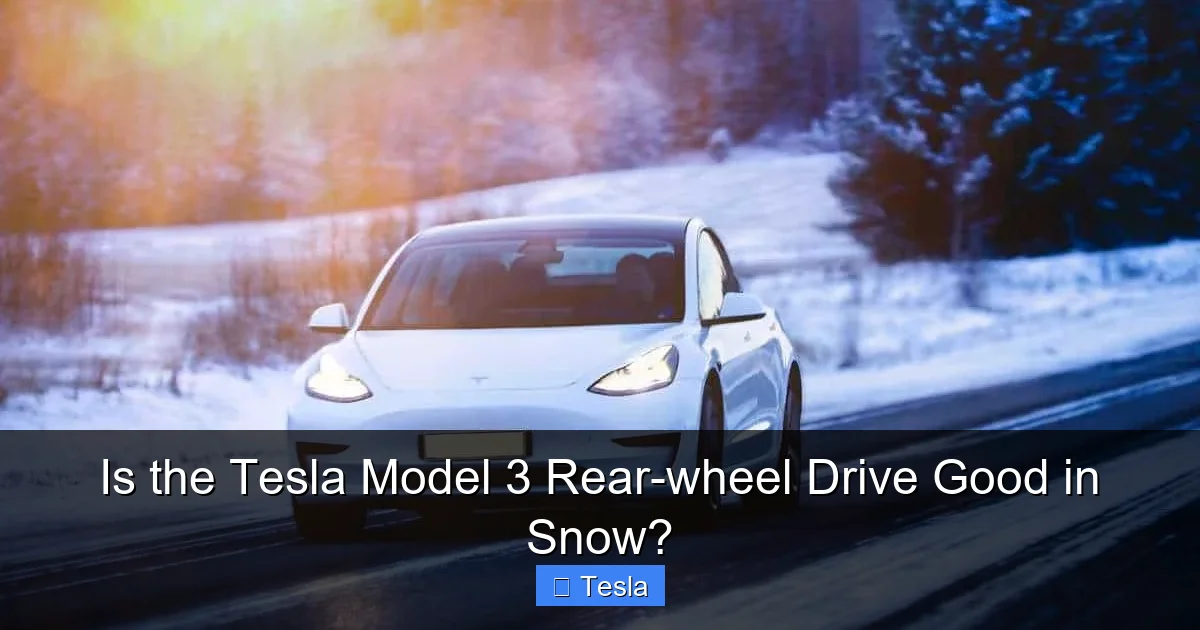
So, if RWD is at a mechanical disadvantage, what gives the Model 3 RWD a fighting chance? Two massive factors: its revolutionary powertrain and its physical architecture.
Visual guide about Is the Tesla Model 3 Rear-wheel Drive Good in Snow?
Image source: zevfacts.com
Instant, Software-Controlled Torque
In a traditional gasoline RWD car, you press the gas pedal, a throttle body opens, the engine revs up, and through a transmission, power eventually reaches the rear wheels. This process is laggy and blunt. You either give it too much gas and spin the tires, or you’re too timid and stall. The Tesla Model 3 RWD has no engine, no transmission, no lag. Its single electric motor on the rear axle delivers maximum torque the instant you touch the pedal. But the real magic is in the software.
Tesla’s traction control system is incredibly fast and intelligent. It can micro-manage power to the millisecond. If it detects the rear wheels starting to spin, it can instantly and seamlessly reduce motor output. This allows for a level of smooth, progressive acceleration that is almost impossible to match in a conventional RWD car. You can actually modulate the “go” pedal with finesse on ice, which is a huge safety and confidence booster. You’re not fighting a laggy engine; you’re having a precise conversation with the road through the accelerator. This is arguably the Model 3 RWD’s greatest asset in slippery conditions.
The Low, Heavy Battery Pack
Now, picture the heaviest part of the car—the 50+ kWh battery pack. In the Model 3, it’s mounted in a sealed, armored slab in the floor of the vehicle. This does two profound things for winter driving:
- Center of Gravity: It plummets the car’s center of gravity to an exceptionally low point, lower than almost any production car on the market. This makes the car resist rolling in corners. On a snowy, winding road, this feeling of stability and plantedness is noticeable and confidence-inspiring. The car doesn’t feel tippy or floaty.
- Weight Distribution: The battery’s central placement gives the Model 3 a near-perfect 50/50 front-to-rear weight distribution. This balanced weight means the rear wheels, which are the driven wheels, always have a healthy amount of weight pressing down on them. More weight on the drive wheels equals more potential traction. In a traditional RWD sedan, the engine is up front, so the rear axle is often relatively light, exacerbating traction issues. The Model 3 RWD solves this fundamental RWD problem through brilliant packaging.
The Unbeatable Variable: Tires, Tires, Tires
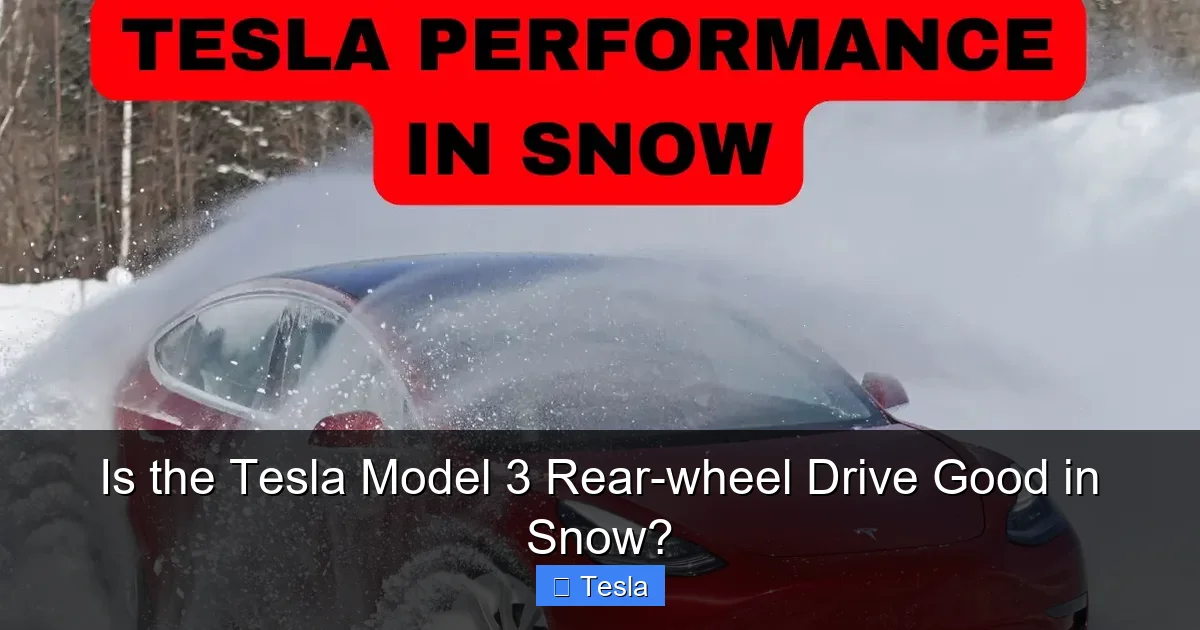
I cannot stress this enough. The discussion about whether the Tesla Model 3 RWD is good in snow is 80% a discussion about tires. The factory tires on most Model 3 RWDs are performance all-season tires. They are designed for dry and wet pavement, with some light snow capability. They are not winter tires.
Visual guide about Is the Tesla Model 3 Rear-wheel Drive Good in Snow?
Image source: evehiclelab.com
The Science of Winter Rubber
Winter tires are not just “snow tires.” They are a completely different compound of rubber that stays flexible in cold temperatures (below 45°F / 7°C). All-season and summer tires turn hard as plastic in the cold, losing virtually all grip. Winter tires also have vastly more aggressive tread patterns with deep, wide grooves and “siping” (small slits in the tread blocks) that are specifically engineered to:
- Cut through slush and packed snow.
- Evacuate water and snow from the contact patch.
- Flex and bite into ice and packed snow.
Putting a set of quality winter tires (like Bridgestone Blizzaks, Michelin X-Ice, or Continental WinterContact) on your Model 3 RWD is the single most transformative thing you can do. The difference is night and day. It will stop shorter, corner more confidently, and accelerate with less wheel spin on snowy roads than an AWD Model 3 on stock all-seasons. This is not an opinion; it’s a well-established fact in automotive testing. For those considering the cost, you might want to research how much it costs to wrap a Tesla Model 3—but for winter, spend that budget on tires instead. They are a safety-critical performance upgrade.
All-Wheel Drive Still Needs Winter Tires
Let’s be clear: putting winter tires on an AWD Model 3 will make it even more capable. But the point stands: without winter tires, any Tesla—RWD or AWD—is severely handicapped in cold, snowy conditions. The RWD’s disadvantage is magnified with bad tires, but with good tires, its inherent tech advantages help close the gap significantly.
Real-World Driving: Techniques and Strategies
You’ve got your Model 3 RWD with a set of Blizzaks bolted on. Now what? Driving technique becomes paramount.

Visual guide about Is the Tesla Model 3 Rear-wheel Drive Good in Snow?
Image source: teslarati.com
Mastering One-Pedal Driving in Winter
One-pedal driving is a hallmark of Tesla ownership. You use the accelerator to go and to slow down, as regenerative braking recaptures energy. In winter, this requires finesse. On ice, a sudden lift-off of the accelerator can cause the rear wheels to lock up slightly due to the abrupt regen torque, feeling like a skid. The solution is twofold:
- Smoothness: Your inputs must be smoother than a baby’s bottom. Plan your stops early and gently ease off the pedal.
- Adjust Settings: Tesla allows you to set the regenerative braking level. In the settings, switch it to “Low.” This mimics a traditional automatic transmission’s coasting behavior and gives you more predictable, linear braking with the brake pedal, which many find more confidence-inspiring on ice. You can always switch back in the spring.
Driving Modes and Traction Control
Keep your Tesla’s traction control system ON. It’s incredibly effective. The only time you might consider turning it off is if you’re stuck in deep snow and need a little wheel spin to “rock” the car free, but that’s a very specific scenario. For normal winter driving, let the computers work their magic.
There is no dedicated “snow mode” like you might find in a Toyota Highlander. Instead, your “snow mode” is your right foot and your winter tires. The car’s standard stability and traction control systems are already optimized for low-traction conditions.
Route Planning and Pre-Conditioning
This is where Tesla’s connected tech shines. Use the mobile app to:
- Pre-heat the cabin: While the car is still plugged in, turn on the climate control to warm the interior. This saves precious battery range for driving.
- Pre-heat the battery: This is more important. Driving a cold battery reduces performance and regen efficiency. Pre-heating warms the battery to its optimal operating temperature. You can schedule this or do it manually before you leave. A warm battery also charges faster at Superchargers.
Always check your route for Supercharger availability along the way. Cold weather reduces range (by roughly 10-20%), so factor that in and keep your charge buffer larger than in summer. Aim to arrive at destinations with at least 20% charge.
Where the Model 3 RWD Hits Its Limits in Snow
For all its clever tech and low center of gravity, the Model 3 RWD is not magic. There are hard limits imposed by its two-wheel-drive architecture.
Steep, Unplowed Hills and Deep Snow
This is the RWD’s kryptonite. If you encounter a steep, snow-covered hill that hasn’t been plowed or packed down, the rear wheels will likely spin before you get much momentum. The weight distribution helps, but gravity is a powerful force. An AWD system, by sending power to the front wheels, can often claw its way up inclines that leave a RWD car spinning its tires. For deep, unpacked snow (more than a few inches), the lack of a front drivetrain also means the front wheels have no propulsion, which can affect directional control when plowing through.
Ice-Covered Hills and Stop-and-Go Traffic
Starting from a stop on a glazed, icy hill is a nightmare for any vehicle, but especially RWD. The moment you apply power, the rear wheels want to slide sideways. This requires impeccable pedal control and often a bit of a rolling start to build momentum. In stop-and-go traffic on an icy incline, this can be a stressful, white-knuckle experience. An AWD system, particularly one with a good rear-biased torque vectoring, can manage these starts more gracefully.
The “Slushy Soup” Problem
Heavy, wet slush can act as a lubricant between the tire and the hard-packed road underneath. It reduces traction for all vehicles. However, with only two drive wheels, the Model 3 RWD can find itself with very little purchase when trying to accelerate out of a slushy rut. The front tires are just along for the ride, not contributing to propulsion.
Who is the Model 3 RWD For in Winter?
Given all this, who should buy the Model 3 RWD if they see snow?
- The Moderate Climate Resident: If you live in an area like the Pacific Northwest, the mid-Atlantic, or parts of the South that gets occasional snowstorms (6-12 inches) followed by plowing and salting of main roads, the Model 3 RWD with winter tires is a fantastic choice. You’ll handle 90% of winter days with ease and confidence.
- The Urban/Suburban Commuter: If your daily drive is on maintained, treated roads and highways, the RWD’s stability and efficiency are perfect. The winter tire requirement remains, but the lack of extreme hill climbs or deep snow makes it very manageable.
- The Cost-Conscious Buyer: The RWD Model 3 is the most affordable entry into the Tesla ecosystem. If your winter needs are moderate, you can put the money you saved on the AWD premium into a fantastic set of winter tires and maybe even a Tesla Model 3 tint for privacy and solar heat rejection. It’s a smarter performance investment for mild winters.
Who should strongly consider AWD instead? Anyone in the “Snow Belt” regions like Upstate New York, Minnesota, Michigan’s UP, the Colorado Rockies, or the mountains of Utah and Vermont. If you regularly encounter unplowed roads, steep hills, or heavy, persistent snowpack, the AWD model’s mechanical advantage, combined with winter tires, is worth the extra cost for peace of mind and capability. It’s not that the RWD is “bad,” it’s that the AWD is *better* in those extreme, consistent conditions.
The Verdict: A Capable, But Conditional, Winter Car
So, is the Tesla Model 3 Rear-Wheel Drive good in snow? The final answer is a qualified yes, with critical prerequisites.
It is not good in snow on its stock all-season tires. It is not good in deep, unplowed snow or on steep, icy hills when compared to its AWD sibling. Its limitations are real and physics-based.
However, with a set of proper winter tires, it transforms into a surprisingly confident and stable winter daily driver. Its instantaneous, controllable torque and ultra-low center of gravity give it driving dynamics that many traditional RWD cars can only dream of. It rewards a smooth, attentive driver and punishes a heavy foot. For the vast majority of people who face plowed, treated roads during occasional snow events, the Model 3 RWD equipped for winter is more than adequate. It’s efficient, stable, and safe when you respect its limits and prepare it correctly. Your winter readiness checklist is simple: Winter Tires + Smooth Driving + Pre-Conditioning = Success. Fail on the first item, and no amount of Tesla software wizardry will save you.
Frequently Asked Questions
Can I drive a Tesla Model 3 RWD in snow without winter tires?
You can, but it is strongly not recommended. The stock all-season tires will offer very poor traction on snow and ice, severely compromising acceleration, braking, and cornering, making the car unsafe. Winter tires are the single most important safety and performance upgrade for any car in cold climates.
Does the Tesla Model 3 RWD have a snow or winter driving mode?
No, the Model 3 does not have a specific “snow mode” button like some conventional cars. Its standard traction and stability control systems are always active and highly effective. Your primary adjustments for winter are installing winter tires and optionally setting regenerative braking to “Low” for more predictable slowing on ice.
How does the Tesla Model 3 RWD compare to a conventional RWD car like a BMW 3 Series in snow?
The Tesla is significantly better. Its instant, software-controlled torque allows for much smoother acceleration without wheel spin. Its 50/50 weight distribution and extremely low center of gravity (from the floor-mounted battery) provide superior stability and balance compared to a front-engine RWD car, which typically has a weight-biased front end and higher center of gravity.
Is the Tesla Model 3 RWD good for a ski trip to the mountains?
It depends entirely on the road conditions. If you’re driving on maintained, plowed highways to a ski resort, it will be fine with winter tires. However, if your route includes steep, unplaved access roads or heavy snow accumulation, the RWD model will struggle significantly. For frequent mountain trips, the AWD version is a much safer and more capable choice.
What is the biggest mistake Model 3 RWD owners make in winter?
The biggest mistake is underestimating the importance of winter tires. The second biggest mistake is failing to adjust driving style. The car’s instant torque can be a double-edged sword; a jerky, aggressive input on the accelerator can still break traction. Smooth, deliberate inputs are key to maintaining control.
Does regenerative braking work the same in winter on the Model 3 RWD?
It works, but it can feel more abrupt and less predictable on ice. The cold can slightly affect battery regen acceptance, but the main issue is driver feel. Many drivers switch regenerative braking to the “Low” setting in winter to have more traditional braking feel with the brake pedal, which can be easier to modulate on very slippery surfaces.