
Is the Nissan 5.6l V8 a Good Engine?

The Nissan 5.6L V8 is a robust, naturally aspirated engine known for strong towing power and smooth operation in trucks and SUVs. While not the most fuel-efficient, it offers solid reliability and proven longevity with proper maintenance.
If you’re in the market for a full-size truck or SUV and have your eye on a Nissan—like the Titan or Armada—you’ve probably come across the 5.6L V8 engine. It’s a big, bold powerplant that’s been around for over a decade, and it’s earned a reputation for being tough, dependable, and capable. But is the Nissan 5.6L V8 a good engine? That’s the million-dollar question, especially when you’re weighing it against competitors like the Ford 5.0L V8, Chevrolet’s 5.3L V8, or Toyota’s 5.7L V8.
The short answer? Yes—mostly. The Nissan 5.6L V8 is a solid engine, particularly if you value raw power, towing strength, and simplicity over cutting-edge efficiency. It’s not the most fuel-sipping motor on the block, and it doesn’t have the high-tech turbocharging or hybrid assist of some newer engines. But what it lacks in modern frills, it makes up for in durability and straightforward engineering. Whether you’re hauling a camper up a mountain pass or cruising down the highway with the family, this V8 has proven time and again that it can handle the job.
In this deep dive, we’ll explore everything you need to know about the Nissan 5.6L V8—from its origins and design to real-world performance, reliability, and common issues. We’ll also compare it to rival engines and help you decide if it’s the right choice for your next vehicle. So grab a coffee, sit back, and let’s get under the hood of one of Nissan’s most iconic powerplants.
Key Takeaways
- Strong Towing and Hauling Capability: The 5.6L V8 delivers impressive torque and horsepower, making it ideal for towing trailers, boats, and heavy loads—especially in the Nissan Titan and Armada.
- Proven Reliability with Maintenance: When properly maintained, this engine can last well over 200,000 miles, with many owners reporting trouble-free operation beyond that mark.
- Naturally Aspirated Simplicity: Unlike turbocharged engines, the 5.6L V8 uses a traditional design, reducing complexity and potential failure points related to forced induction systems.
- Fuel Economy Trade-Off: Expect lower fuel efficiency compared to smaller or turbocharged engines—typically 13–17 mpg combined, depending on driving conditions and vehicle weight.
- Used in Multiple Nissan Models: This engine powers the Nissan Titan pickup, Armada SUV, and earlier Frontier models, offering consistent performance across platforms.
- Timing Chain vs. Belt: Most versions use a timing chain, which requires less frequent replacement than a timing belt, reducing long-term maintenance costs.
- Aftermarket Support and Tuning Potential: Enthusiasts can enhance performance with cold air intakes, exhaust upgrades, and ECU tuning for increased horsepower and responsiveness.
📑 Table of Contents
Overview of the Nissan 5.6L V8 Engine
The Nissan 5.6L V8, officially known as the VK56VD (and earlier as the VK56DE), is a 32-valve, dual overhead cam (DOHC) V8 engine that has been in production since the early 2000s. It first appeared in the 2004 Nissan Titan and has since powered a range of Nissan’s largest vehicles, including the Armada SUV and the third-generation Frontier pickup. Over the years, Nissan has made several updates to improve performance, emissions, and efficiency, but the core design has remained remarkably consistent.
This engine displaces 5.6 liters (5,552 cc) and features an aluminum block and heads, which helps keep weight down compared to older iron-block V8s. It uses direct fuel injection in later versions (starting around 2010), which improves fuel atomization and combustion efficiency. The VK56VD variant, introduced in 2008, also includes variable valve timing on both the intake and exhaust camshafts (Nissan’s VVEL system), allowing for better throttle response and power delivery across the RPM range.
In its most common tuning, the 5.6L V8 produces around 390 horsepower and 395 lb-ft of torque—numbers that are competitive with other naturally aspirated V8s in its class. For example, the Ford 5.0L V8 in the F-150 makes about 400 horsepower, while the Toyota 5.7L V8 in the Tundra delivers 381 horsepower. So while the Nissan isn’t the most powerful in absolute terms, it holds its own, especially when it comes to low-end torque, which is crucial for towing and off-the-line acceleration.
One of the engine’s standout features is its naturally aspirated design. Unlike many modern engines that rely on turbochargers or superchargers to boost power, the 5.6L V8 breathes on its own. This means fewer components that can fail, simpler maintenance, and a more linear power delivery that many drivers prefer. There’s no turbo lag to worry about—just smooth, immediate response when you press the accelerator.
Performance and Power Output
Visual guide about Is the Nissan 5.6l V8 a Good Engine?
Image source: storage.googleapis.com
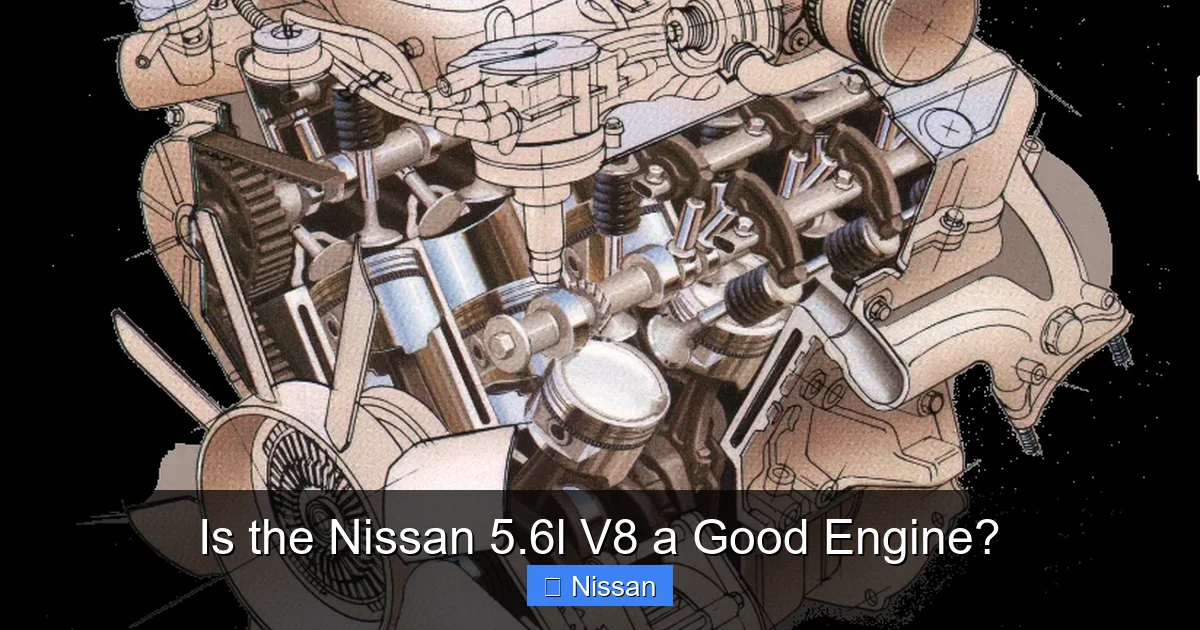
When it comes to performance, the Nissan 5.6L V8 doesn’t disappoint—especially if you’re using it for what it was designed for: heavy-duty work and long-distance driving. In the Nissan Titan, this engine enables a maximum towing capacity of up to 9,300 pounds when properly equipped, which is on par with many competitors. The Armada, being a full-size SUV, can tow up to 8,500 pounds, making it a great choice for families who need to haul trailers, boats, or RVs.
The engine’s torque curve is particularly impressive. With peak torque arriving around 4,000 RPM, it provides strong pulling power right off the line and through the mid-range. This is ideal for merging onto highways, climbing hills, or accelerating with a heavy load. Drivers often praise the engine’s responsiveness and the way it “pulls” rather than “pushes” the vehicle forward—a trait that’s especially noticeable when towing.
In real-world driving, the 5.6L V8 feels smooth and refined. The engine note is deep and muscular, but not overly loud or harsh. Nissan has done a good job of balancing performance with comfort, so you get that satisfying V8 rumble without the cabin noise that can come with some truck engines. The 7-speed automatic transmission (used in most applications) shifts smoothly and holds gears well under load, though some drivers note that it can be a bit slow to downshift during sudden acceleration.
One area where the engine shines is in high-altitude performance. Because it’s naturally aspirated, it doesn’t suffer from the power loss that turbocharged engines experience at elevation. If you live in the mountains or frequently drive through them, this can be a big advantage. You won’t notice the engine struggling to breathe like you might in a turbocharged vehicle.
That said, the 5.6L V8 isn’t the quickest truck or SUV in a straight line. The Titan, for example, takes around 6.5 to 7 seconds to reach 60 mph—respectable, but not class-leading. The Ford F-150 with the 5.0L V8 or the Ram 1500 with the Hemi V8 can be quicker, especially when equipped with performance packages. But for most drivers, the Nissan’s acceleration is more than adequate, especially when you consider its towing and hauling strengths.
Reliability and Longevity
Visual guide about Is the Nissan 5.6l V8 a Good Engine?
Image source: hongliyangzhi.com
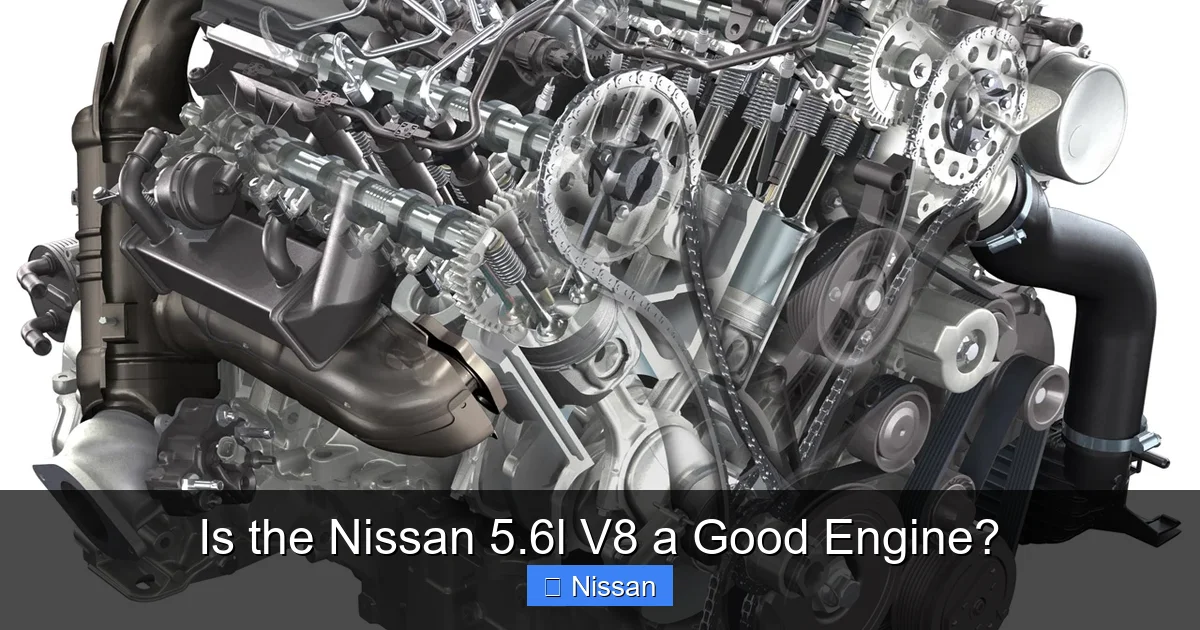
One of the biggest questions people ask about any engine is: “Will it last?” When it comes to the Nissan 5.6L V8, the answer is generally yes—especially if you follow the recommended maintenance schedule. This engine has a reputation for durability, and many owners report driving well over 200,000 miles without major issues.
A key factor in its longevity is the use of a timing chain instead of a timing belt. Timing chains are more durable and typically last the life of the engine, whereas timing belts need to be replaced every 60,000 to 100,000 miles. This reduces long-term maintenance costs and the risk of catastrophic engine failure if the belt breaks.
Oil consumption can be an issue in some earlier models (particularly pre-2010), but Nissan addressed this in later versions with improved piston ring design and better oil control. If you’re buying a used vehicle with this engine, it’s wise to check for excessive oil consumption—look for blue smoke on startup or frequent top-offs between changes.
Another strength is the engine’s simplicity. With no turbos, superchargers, or complex hybrid systems, there are fewer components that can fail. The direct injection system, while efficient, can lead to carbon buildup on intake valves over time (a common issue with GDI engines), but this is manageable with periodic cleaning or using fuel additives.
Regular maintenance is key. Stick to the factory-recommended oil change intervals (usually every 5,000 to 7,500 miles), use high-quality synthetic oil, and don’t skip coolant or transmission fluid changes. The 5.6L V8 is tough, but like any engine, it rewards good care with long life.
Fuel Economy and Efficiency
Visual guide about Is the Nissan 5.6l V8 a Good Engine?
Image source: enginelandinc.com
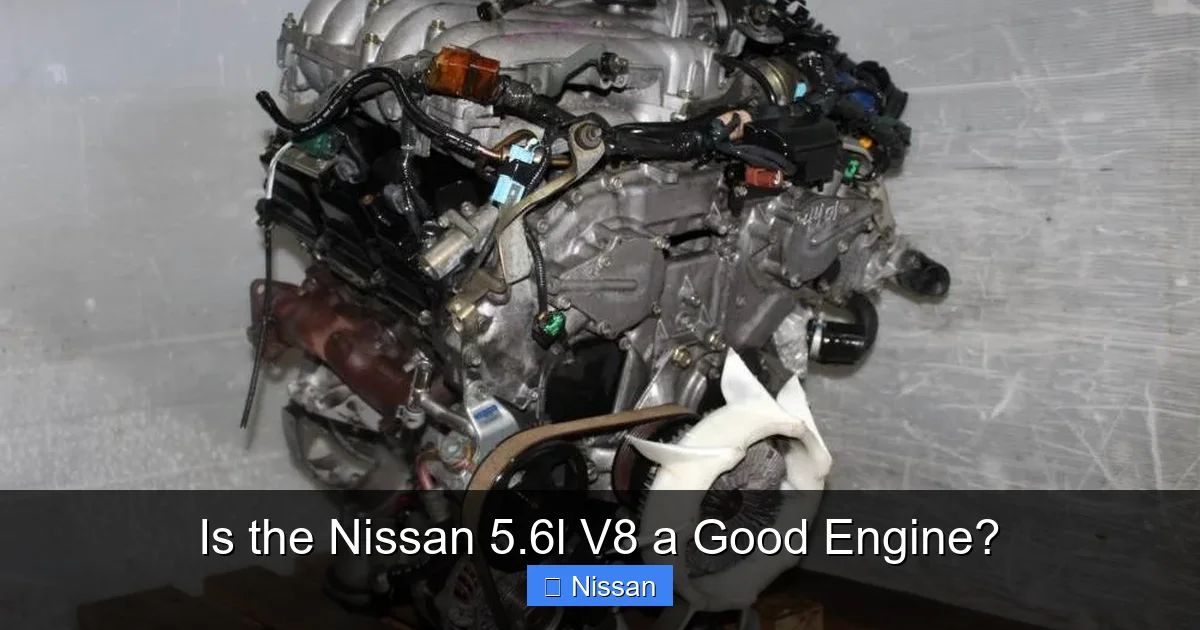
Let’s be honest—fuel economy isn’t the 5.6L V8’s strong suit. As a large, naturally aspirated V8, it consumes more fuel than smaller or turbocharged engines. In the Nissan Titan, you can expect around 13–15 mpg in the city and 18–20 mpg on the highway, depending on driving habits and load. Combined, that’s roughly 15–17 mpg—decent for a full-size truck, but not impressive compared to modern turbocharged V6s or hybrid powertrains.
For example, the Ford F-150 with the 2.7L EcoBoost V6 can achieve over 20 mpg combined, and the Ram 1500 with the eTorque mild-hybrid system can reach similar numbers. The Toyota Tundra, with its 5.7L V8, gets slightly better mileage than the Nissan, but still lags behind smaller engines.
That said, if you need the towing power and don’t mind the fuel cost, the 5.6L V8 is a reasonable trade-off. It’s also worth noting that Nissan has made efforts to improve efficiency over the years, such as adding cylinder deactivation in some models (though this feature is not available on all 5.6L applications).
If fuel economy is a top priority, this engine might not be the best choice. But if you’re using the vehicle for work, towing, or frequent highway driving, the power and reliability often outweigh the fuel costs.
Common Issues and Maintenance Tips
No engine is perfect, and the Nissan 5.6L V8 has a few known quirks. Here are some common issues and how to prevent or address them:
Carbon Buildup on Intake Valves
Because the engine uses direct injection, fuel doesn’t wash over the intake valves like in port-injected engines. This can lead to carbon deposits over time, causing rough idle, hesitation, or reduced performance. Solution: Use high-quality fuel, add a fuel system cleaner every 5,000 miles, or have the valves professionally cleaned every 60,000–80,000 miles.
Oil Consumption (Older Models)
Some early VK56DE engines (pre-2010) were known to burn oil. If you’re buying a used vehicle, check the oil level regularly and look for signs of leaks or smoke. Later models have improved, but it’s still wise to monitor oil levels.
Transmission Shifting
The 7-speed automatic can sometimes feel hesitant or slow to downshift. Regular transmission fluid changes (every 60,000 miles) can help maintain smooth operation.
Exhaust Manifold Bolts
On some models, exhaust manifold bolts can loosen or break due to heat cycling. Listen for ticking noises at idle—this could indicate a loose bolt. Have it inspected if you notice unusual sounds.
Cooling System
The 5.6L V8 runs hot under load, so ensure the radiator, coolant, and thermostat are in good condition. Overheating can lead to warped heads or blown gaskets.
Comparison to Competing V8 Engines
So how does the Nissan 5.6L V8 stack up against the competition? Let’s compare it to three key rivals:
– Ford 5.0L V8: More horsepower, better fuel economy with EcoBoost variants, but more complex with direct injection and turbocharging. The Nissan offers simpler, more predictable performance.
– Chevrolet 5.3L V8: Smaller displacement but similar power thanks to active fuel management and cylinder deactivation. Better fuel economy, but some reports of lifter issues in earlier models.
– Toyota 5.7L V8: Similar power and torque, excellent reliability, but older design with port injection. Toyota’s engine is known for bulletproof durability, but lacks some of the refinement of the Nissan.
Overall, the Nissan 5.6L V8 holds its own—especially if you value simplicity, towing power, and a smooth driving experience.
Conclusion: Is the Nissan 5.6L V8 a Good Engine?
So, is the Nissan 5.6L V8 a good engine? The answer is a resounding yes—for the right buyer. It’s not the most fuel-efficient, nor the most powerful, but it strikes an excellent balance between performance, reliability, and simplicity. If you need a truck or SUV that can tow heavy loads, handle long highway miles, and last for decades with proper care, this engine is a strong contender.
It’s particularly well-suited for buyers who prioritize durability over cutting-edge technology, and who appreciate the linear power delivery of a naturally aspirated V8. While it may not win any awards for innovation, it earns respect for doing what it’s designed to do—very well.
Whether you’re driving a Titan, Armada, or Frontier, the 5.6L V8 delivers a confident, capable experience that’s hard to beat in its class. Just remember to keep up with maintenance, and this engine will likely serve you faithfully for many years to come.
Frequently Asked Questions
How long does the Nissan 5.6L V8 engine last?
With proper maintenance, the Nissan 5.6L V8 can last well over 200,000 miles. Many owners report trouble-free operation beyond 250,000 miles, especially in later models with improved components.
What vehicles use the Nissan 5.6L V8?
The 5.6L V8 is used in the Nissan Titan pickup, Nissan Armada SUV, and earlier generations of the Nissan Frontier. It has also appeared in some Infiniti models like the QX80.
Is the Nissan 5.6L V8 fuel efficient?
No, it’s not the most fuel-efficient engine. Expect 13–17 mpg combined, depending on the vehicle and driving conditions. It’s best suited for those who prioritize power over fuel economy.
Does the 5.6L V8 have a timing belt or chain?
Most versions use a timing chain, which typically lasts the life of the engine and doesn’t require regular replacement like a timing belt.
Can the Nissan 5.6L V8 be tuned for more power?
Yes, the engine responds well to aftermarket upgrades like cold air intakes, performance exhausts, and ECU tuning, which can add 20–50 horsepower depending on the setup.
What are common problems with the Nissan 5.6L V8?
Common issues include carbon buildup on intake valves, oil consumption in older models, and occasional exhaust manifold bolt loosening. Regular maintenance helps prevent most of these problems.