
How to Wash a Car Cover: Step-by-Step Cleaning Guide
Quick Answer
To wash a car cover, remove loose debris, clean it with a manufacturer-approved mild detergent, rinse thoroughly, and let it dry completely before reuse. Hand washing is the safest default when machine-washing instructions are unknown. Some covers can be machine washed, but the correct settings depend on the material. Check the car cover cleaning instructions before starting.
Six quick cleaning steps
- Check the label: Identify permitted cleaning methods and drying restrictions.
- Remove loose dirt: Shake off dust, leaves, pollen, and grit.
- Prepare mild cleaner: Use the recommended cleaning product and water temperature.
- Wash gently: Use a soft sponge or an approved gentle machine cycle.
- Rinse completely: Remove soap residue, including around seams and folds.
- Dry thoroughly: Air dry unless the manufacturer expressly permits machine drying.
Important precautions
- Avoid harsh products: Never use bleach or fabric softener unless specific manufacturer instructions explicitly allow a product.
- Protect your paint: Keep the dirty cover and cleaning tools from rubbing against the vehicle.
A dirty car cover can transfer dust, grit, and stains onto the vehicle it was meant to protect. Washing it correctly helps keep the paint-contact surface clean without unnecessarily stressing the cover’s fabric.
I prefer a gentle approach, especially with multi-layer outdoor covers. This 2026 guide explains hand washing, machine washing, drying, stubborn stains, and storage.
In This Guide
What Should You Do Before Washing a Car Cover?
Before washing a car cover, identify its fabric, read the care label, and remove surface debris. These steps prevent avoidable damage and help you choose the correct washing method.
A car cover is a protective fabric or layered barrier designed to shield a parked vehicle from dust, sunlight, moisture, and environmental debris. Indoor and outdoor covers often use different materials and protective treatments.
Check the manufacturer’s cleaning instructions
Start with the label or the manufacturer’s product-care page. Water temperature, detergent selection, washing-machine compatibility, and drying requirements can differ significantly.
For example, some Covercraft fabrics permit machine washing, while others require a large washer without an agitator. Their instructions also distinguish fabrics that can use a dryer from those that must air dry.
- Fabric type: Identify polyester, polypropylene, cotton blends, flannel, or coated material.
- Wash method: Confirm whether hand washing or machine washing is approved.
- Water temperature: Follow the specified cold or warm setting.
- Cleaning agent: Check for required or prohibited detergents.
- Drying method: Confirm whether air drying is mandatory.
Remove dust and loose debris first
Shake the cover carefully in an open area away from the vehicle. Remove leaves, sand, twigs, and loose dirt without dragging the fabric across painted surfaces.
For stubborn dry particles, use a clean, soft brush. Avoid aggressive scrubbing, particularly on a soft inner lining.
Gather your cleaning supplies
- Manufacturer-approved mild detergent or cleaner
- Clean bucket or large wash basin
- Soft sponge or microfiber cloth
- Garden hose with a gentle spray setting
- Clean drying line or suitable drying surface
- Optional large-capacity washer if permitted
Keep separate cleaning tools for the cover and the vehicle’s paint. A sponge containing sand or grit can damage both surfaces.
Section Takeaway: Identify the material before choosing a cleaning method. A gentle process cannot compensate for ignoring a fabric-specific restriction.
How Do You Hand Wash a Car Cover?
Hand washing involves cleaning a cover with a diluted, approved cleaner, a soft sponge, and a thorough water rinse. It’s a practical method for oversized covers or fabrics without confirmed machine-washing approval.
You can clean a cover on a large clean surface or, when the manufacturer permits, while it is fitted over a vehicle. Avoid placing the dirty inner surface against clean paint.
Step 1: Choose a safe washing location
Use a spacious, clean area where the cover will not drag across gravel or rough concrete. A large clean tarp can provide a temporary washing surface.
Some manufacturers allow washing a cover while it remains on the vehicle. Only use this method when the vehicle and its paint-contact surface are already clean.
Step 2: Prepare the cleaning solution
Fill a bucket with the recommended amount of water and cleaner. Follow the detergent dilution and temperature specified by your cover manufacturer.
Coverstore provides a hand-washing example using one ounce of mild dish soap or gentle laundry detergent per gallon of warm water. Treat that as product-specific guidance, not a universal formula.
Step 3: Wet the cover gently
Use a low-pressure hose spray to wet the exposed fabric. Work gradually across large panels instead of blasting water into seams or coated areas.
Avoid pressure washers unless the manufacturer expressly approves them. Concentrated water pressure may stress delicate fabric, seams, or protective treatments.
Step 4: Clean the surface
Dip a soft sponge into the cleaning solution and move it gently across the cover. Use light pressure rather than forcing dirt into the fabric.
- Start with relatively clean upper sections.
- Work toward the dirtier lower edges.
- Give bird droppings and mud time to soften.
- Use gentle strokes around mirror pockets and seams.
- Inspect the inner surface separately for grit.
Pay close attention to hems where dirt collects. Don’t scrub aggressively across stitching or waterproof coatings.
Step 5: Rinse until the water runs clear
Rinse every section thoroughly with clean water. Residual detergent can leave marks and may affect fabric performance.
Lift folds and check around straps and reinforced seams. Repeat the rinse when needed until visible suds disappear.
Step 6: Let the cover dry completely
Move the cover to a clean drying location with good airflow. Spread the material so folded sections do not remain damp.
Wait until both surfaces and all seams are dry before folding. Never store the cover wet.
Section Takeaway: Hand washing gives you direct control over scrubbing pressure and cleaning concentration. It also works well when a machine is too small or the care label prohibits machine washing.
Can You Machine Wash a Car Cover?
Yes, some car covers can be machine washed, but only when the manufacturer approves it. Use the specified cycle, water temperature, detergent, and machine capacity.
Machine washing is particularly convenient for lightweight covers designed for repeated cleaning. However, coated, waterproof, and multi-layer models need careful attention to their care instructions.
Use a sufficiently large washing machine
A bulky car cover needs space to move and rinse properly. For larger SUV and truck covers, a commercial front-loading washer may be necessary.
When permitted, choose a washer without a central agitator. Agitators can twist large fabric panels and place additional strain on seams.
Follow this machine-washing checklist
- Verify compatibility: Confirm that machine washing is specifically permitted.
- Check capacity: Ensure the cover fits loosely without overloading the drum.
- Choose settings: Select the approved water temperature and gentle cycle.
- Add cleaner: Use the fabric-specific product and quantity.
- Skip additives: Avoid bleach and fabric softener.
- Rinse again: Use an additional rinse when the instructions recommend it.
- Dry correctly: Air dry unless the care label allows a dryer.
Covercraft’s general cleaning guidance recommends rinsing twice and prohibits fabric softener. Its drying guidance varies by fabric, so one setting does not suit every model.
When should you avoid machine washing?
Do not machine wash a cover labeled for hand cleaning only. Avoid machine washing when the fabric is deteriorating or its coating is already peeling.
Stop if the washer cannot accommodate the cover without tight packing. A larger machine or approved hand-cleaning method is the safer option.
- The care label prohibits machine washing.
- The manufacturer requires a cleaning method your washer cannot provide.
- The cover exceeds the washer’s capacity.
- The lining is separating or damaged.
- Stitching, straps, or elastic sections are failing.
Don’t assume waterproof means machine-washable. Water resistance describes protective performance, not how well a cover tolerates mechanical agitation.
How Do Cleaning Methods Differ by Car Cover Material?
Cleaning methods differ because car cover materials vary in weight, lining construction, coatings, and moisture resistance. The material name alone cannot replace the manufacturer’s care label.
The comparison below summarizes practical considerations rather than prescribing a universal washing setting.
| Cover material | Cleaning approach | Main precaution |
|---|---|---|
| Polyester or nylon blends | Gentle hand wash; machine wash if approved | Avoid excessive heat and agitation |
| Soft indoor or flannel-lined | Use manufacturer-approved gentle cleaning | Protect soft inner fibers from grit |
| Multi-layer outdoor | Follow the specific model’s washing instructions | Avoid stressing bonded layers and seams |
| Water-resistant coated | Use approved mild cleaners and settings | Protect the water-resistant treatment |
| Unknown material | Confirm care instructions before washing | Do not guess about machine or dryer compatibility |
Waterproof versus water-resistant covers
A waterproof cover is designed to block water penetration under specified conditions. A water-resistant cover is designed to repel or resist moisture but may permit some water through.
Either type may include a treatment, membrane, or protective layer. An unsuitable cleaner or washing method can compromise those features.
Use the manufacturer-recommended cleaning product rather than applying household waterproofing sprays automatically. A treatment designed for clothing or tents may not suit your particular cover.
Why brand-specific guidance matters
Covercraft’s Ultra’tect and three-layer moderate-climate covers both allow machine washing in suitable machines, but their instructions remain model-specific. WeatherShield HP also permits machine drying, unlike many other covers.
You can check the Covercraft Ultra’tect care instructions as an example. Always identify your actual product before applying any guidance.
How Do You Remove Stubborn Stains From a Car Cover?
Stubborn stains usually respond best to gentle pre-treatment rather than hard scrubbing. Remove loose material, soften the residue with an approved cleaner, and rinse thoroughly.
Bird droppings, mud, pollen, tree sap, and greasy road film behave differently. Treat each contaminant without damaging the surrounding fabric.
Bird droppings and dried mud
Moisten the affected area with water and an approved mild cleaning solution. Give hardened residue time to soften before removing it gently.
Don’t scrape dried deposits with a hard plastic tool or abrasive pad. Sharp pressure can damage fibers and coatings.
Tree sap and sticky residue
Sticky sap can be difficult to remove because it adheres firmly to fabric. Start with a mild cleaner and test any approved spot treatment in an inconspicuous area.
Avoid applying alcohol, gasoline, acetone, or aggressive adhesive removers without manufacturer approval. These products may affect dyes, coatings, or bonded layers.
Grease and road grime
Road film can build up along the lower edges of outdoor covers. Gently pre-treat affected areas with the manufacturer’s recommended cleaning solution.
Rinse well after cleaning to remove residual dirt and detergent. Repeat a gentle treatment if necessary instead of increasing scrubbing pressure.
Mold, mildew, and musty odors
A musty smell may develop when a cover remains damp for an extended period. Wash it according to the care label and dry it completely in a well-ventilated space.
- Light odor: Clean and dry the entire cover thoroughly.
- Visible spotting: Use only a treatment approved for the material.
- Persistent growth: Consider replacing the cover if cleaning cannot restore it safely.
- Recurring dampness: Correct the storage or drying conditions.
If you see widespread mold, avoid shaking or brushing the cover near people. Anyone sensitive to mold should avoid handling contaminated fabric directly.
For broader cleaning guidance, see AutoZone’s car cover guide.
How Do You Dry and Store a Car Cover After Washing?
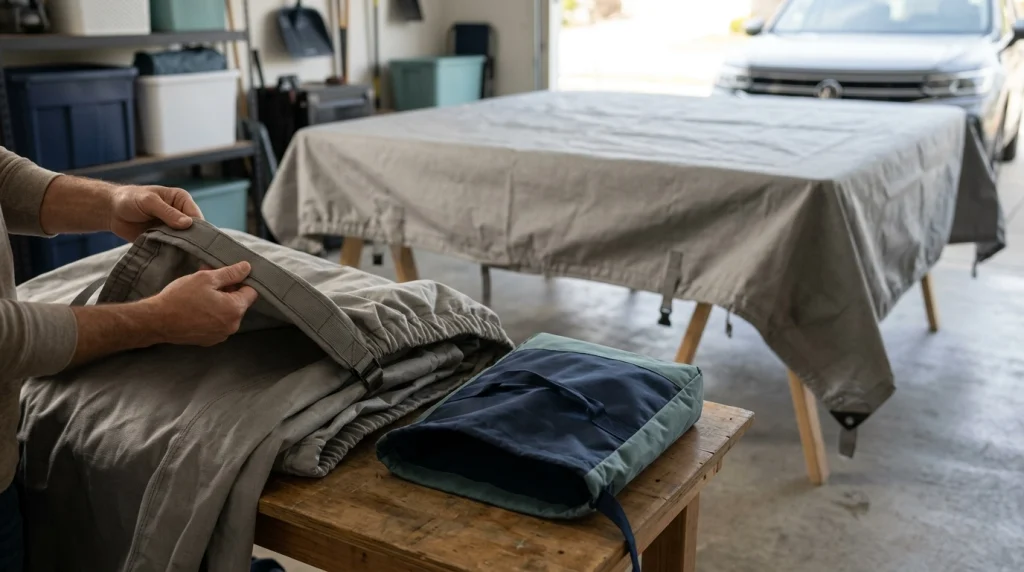
Dry the car cover completely before storage, including its seams, straps, hems, and inner surface. Unless the care label allows machine drying, choose air drying.
This step is just as important as washing. Trapped moisture can cause odors and create conditions favorable to mildew growth.
Air drying without damaging the fabric
Choose a clean, ventilated location where the cover can spread without touching dirty ground. Use broad, smooth support points to avoid stretching wet fabric.
If hanging is permitted, arrange the cover so water can drain naturally. Avoid sharp hooks that concentrate weight on a small section.
- Keep the fabric off dirty pavement.
- Open folded areas to improve airflow.
- Check moisture around reinforced stitching.
- Avoid placing the cover near heaters or open flames.
- Turn or reposition it when needed for even drying.
Can you put a car cover in the dryer?
Only when the manufacturer explicitly allows it. Some Covercraft materials support specified dryer temperatures, while others require air drying.
Do not assume a low-heat setting is always safe. Follow the exact care instructions for your cover.
Fold and store the cover properly
After drying, spread the cover across a clean surface and remove remaining loose debris. Fold or roll it while keeping the vehicle-facing side protected.
Place it in a clean storage bag and choose a cool, dry location. Avoid storage areas exposed to standing water or excessive heat.
Before the next installation, inspect the fabric for dampness, grit, or contamination. Also check the vehicle’s surface before covering it.
Section Takeaway: A properly washed cover must also be thoroughly dried and stored cleanly. Never trap moisture or dirt against the surface that will eventually touch your paint.
How Often Should You Wash a Car Cover?
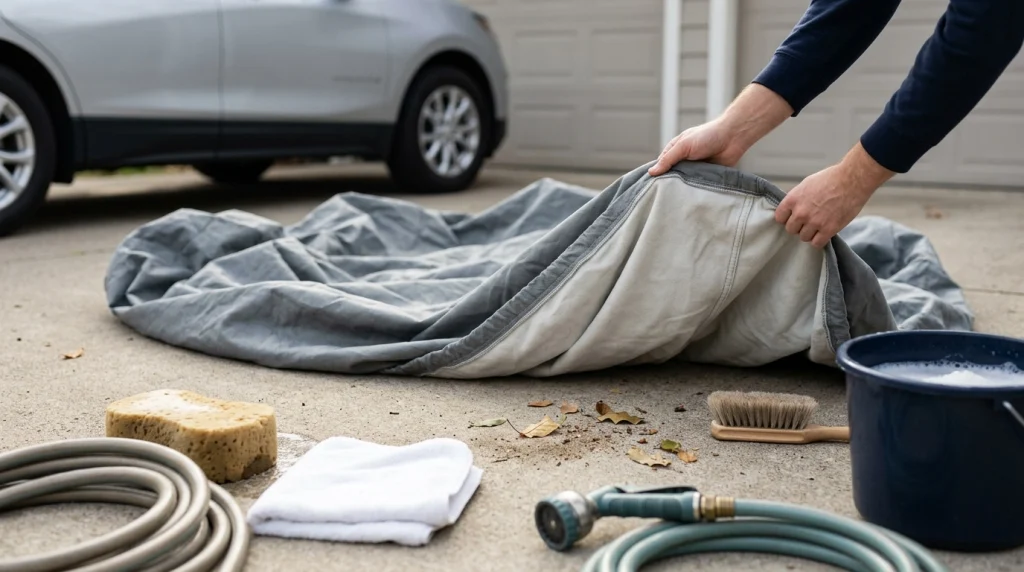
Wash a car cover when accumulated dirt, stains, salt, or contamination cannot be removed by light cleaning. There is no universal washing interval that suits every cover.
Indoor covers often need less frequent washing than covers exposed to rain, pollen, dust, and road grime. Regular inspection is more useful than following a fixed schedule.
Signs your car cover needs cleaning
- Visible dust or dirt remains after shaking.
- Bird droppings or organic residue are present.
- Road salt or muddy deposits have accumulated.
- The inner surface contains particles that could contact paint.
- The cover develops a persistent unpleasant odor.
- Water-resistant performance appears reduced and cleaning is recommended by the manufacturer.
Cleaning after heavy rain or snow
Rain alone does not mean the cover requires washing. A clean wet cover generally needs proper drying rather than another wash.
However, rain mixed with mud, salt, or heavy contamination can justify cleaning. Check the fabric and remove deposits before storing it.
Common washing mistakes to avoid
- Using bleach: It may harm fabric, dyes, or coatings.
- Adding softener: Manufacturers commonly prohibit it.
- Using hot water: Excess heat may damage sensitive fabrics.
- Overloading a washer: Poor movement prevents proper cleaning and rinsing.
- Scrubbing aggressively: Excess friction can stress delicate fibers.
- Leaving soap behind: Residue may affect appearance or performance.
- Storing while damp: This encourages odors and mildew.
The goal isn’t to wash a cover as frequently as possible. It’s to remove contamination while preserving the fabric’s useful life.
Frequently Asked Questions About Washing Car Covers
Can I wash my car cover in a washing machine?
Yes, if the manufacturer’s care instructions permit machine washing. Use the approved settings and a washer large enough for the cover. Many manufacturers recommend a gentle cycle and a machine without an agitator. Hand wash when machine cleaning is prohibited.
What detergent is safe for washing car covers?
Use the specific cleaner recommended by the manufacturer. Some covers accept mild laundry detergent, while others have different requirements. Avoid bleach and fabric softener. Follow the product’s dilution instructions and rinse completely to remove cleaning residue.
Can I wash a waterproof car cover?
Yes, many waterproof or water-resistant car covers can be cleaned. However, their coatings and seams may require special care. Check the manufacturer’s cleaning instructions before washing and avoid unapproved chemicals or abrasive scrubbing that could affect protective performance.
Can I clean a car cover while it is on my car?
Some manufacturers permit on-vehicle cleaning. Make sure the car and the cover’s inner surface are clean before doing so. Use gentle cleaning tools and avoid trapping grit between the fabric and paint. If the manufacturer prohibits this method, wash the cover separately.
Can I put a car cover in the dryer?
Only when the specific cover’s instructions allow it. Some fabrics are suitable for machine drying at approved settings, while many require air drying. If the label is missing or unclear, do not experiment with dryer heat.
How do I remove a musty smell from a car cover?
Wash the cover according to its care label, then dry both sides completely. Inspect seams and thick areas for hidden moisture. If visible mold or a persistent odor remains after proper cleaning, replacing the cover may be the safest option.
Should I wash my car cover before storing it?
Wash it if it contains mud, salt, stains, or other significant contamination. A lightly dusty cover may only need gentle debris removal. Regardless of washing, the cover must be completely dry before folding and storage.
Final Takeaway: Keep Your Car Cover Clean Without Damaging It
Washing a car cover doesn’t require specialized detailing equipment. It requires the right cleaner, the correct washing method, gentle handling, and complete drying.
My preferred rule is simple: check the care instructions first and use the least aggressive method that removes the dirt. Clean the paint-facing surface carefully, rinse thoroughly, and never store the cover damp.
Before your next wash, check the care label and inspect the cover for loose grit, damaged stitching, and worn coatings. A clean, intact cover is better prepared to protect your vehicle.
